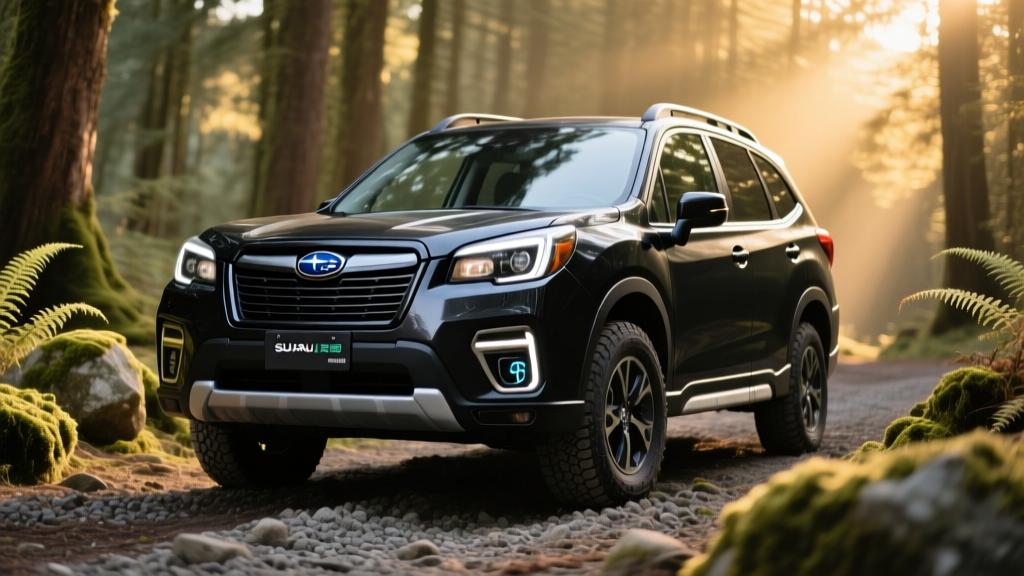
The Subaru Forester Wilderness has earned a loyal following among outdoor enthusiasts who need genuine ground clearance and all-wheel-drive capability without sacrificing daily-driver comfort. For 2026, Subaru has answered one of the most persistent requests from that community: a hybrid powertrain. The 2026 Subaru Forester Wilderness Hybrid pairs Subaru's proven 2.5-liter boxer engine with an electric motor integrated into the Lineartronic CVT, delivering improved fuel economy while retaining the 9.2 inches of ground clearance and rugged cladding that define the Wilderness trim.
This guide breaks down everything buyers need to know — from EPA fuel economy figures and real-world MPG expectations to hybrid battery longevity, warranty coverage, and how the Forester Wilderness Hybrid stacks up against full EVs and plug-in alternatives for adventure-oriented drivers.
What Is the Forester Wilderness Hybrid? HEV vs. PHEV Explained
Before diving into specs, it's critical to understand what the Forester Wilderness Hybrid is — and what it isn't. The 2026 Forester Wilderness Hybrid is a conventional hybrid electric vehicle (HEV), not a plug-in hybrid (PHEV). This distinction matters enormously for ownership expectations.
HEV vs. PHEV: Key Differences
| Feature | HEV (Forester Wilderness Hybrid) | PHEV (e.g., Toyota RAV4 Prime) |
|---|---|---|
| Plug-in charging required? | No — self-charging via regen and engine | Yes — for electric-only range |
| Electric-only driving | Very limited (low-speed creep only) | 25–42 miles typical |
| Battery size | ~1.1 kWh (small, self-managed) | 13–18 kWh usable |
| Federal tax credit (§30D) | Not eligible | Up to $7,500 if eligible |
| Home charging needed? | No — gas station only | Recommended for full benefit |
As an HEV, the Forester Wilderness Hybrid never needs to be plugged in. The small lithium-ion battery charges through regenerative braking and the gasoline engine. You fuel it exactly like a conventional car — at any gas station — while the hybrid system works invisibly in the background to reduce fuel consumption, particularly in stop-and-go city driving.
Fuel Economy: EPA MPG and Real-World Expectations
The headline improvement for the 2026 Forester Wilderness Hybrid is fuel efficiency. Subaru's hybrid system, shared in architecture with the Toyota-sourced series-parallel hybrid setup used in the Crosstrek Hybrid, delivers meaningful gains over the gas-only Wilderness model.
| Model | City MPG | Highway MPG | Combined MPG |
|---|---|---|---|
| 2026 Forester Wilderness Hybrid | 35 | 30 | 33 |
| 2026 Forester Wilderness (gas-only) | 25 | 28 | 26 |
| 2026 Toyota RAV4 Hybrid (Woodland Edition) | 38 | 35 | 37 |
Source: fueleconomy.gov (EPA estimates). Actual mileage will vary based on driving conditions, terrain, and climate.
Real-World MPG: What Owners Actually See
Hybrids consistently outperform their EPA city ratings in real-world stop-and-go traffic, where regenerative braking recaptures the most energy. Expect 36–38 MPG in suburban and city driving during mild weather. Highway cruising at 70+ mph yields closer to 28–30 MPG, where the electric motor provides less benefit and aerodynamic drag dominates.
In cold weather (below 30°F), expect a 5–10% reduction in fuel economy as the engine runs more frequently to maintain cabin heat and battery temperature. Off-road trail driving in low-range conditions will return significantly lower figures — typically 18–22 MPG — due to constant low-speed, high-load operation.
The hybrid system's biggest advantage over the gas-only Wilderness is the 7 MPG combined improvement, which translates to roughly 80–100 additional miles per tank. With the Forester's 16.9-gallon fuel tank, total range stretches to approximately 555 miles combined under EPA conditions — a meaningful gain for overlanding and remote trail access where fuel stations are sparse.
Powertrain Specs: Engine, Motor, and Combined Output
The 2026 Forester Wilderness Hybrid uses Subaru's updated series-parallel hybrid architecture. Unlike mild-hybrid systems that merely assist during acceleration, this setup can propel the vehicle on electric power alone at very low speeds (parking lots, traffic creep) before seamlessly blending in the gasoline engine.
| Specification | Value |
|---|---|
| Engine | 2.5L DOHC 4-cylinder Boxer |
| Engine horsepower | 180 hp @ 5,800 rpm |
| Electric motor output | 88 kW (118 hp) |
| Combined net horsepower | 215 hp |
| Transmission | Lineartronic CVT w/ electric motor integrated |
| Drivetrain | Symmetrical AWD w/ X-MODE |
| Hybrid battery | ~1.1 kWh lithium-ion (sealed, self-charging) |
| Ground clearance | 9.2 inches |
| Towing capacity | 1,500 lbs (est.) |
| 0–60 mph | ~7.8 seconds (est.) |
| Fuel tank | 16.9 gallons |
The combined 215 hp represents a modest bump over the gas-only Wilderness (180 hp), and the electric motor's instant torque fills in the low-end response that Subaru's naturally aspirated 2.5L has historically lacked. The result is noticeably quicker off-the-line acceleration and more confident highway merging — particularly useful when loaded with gear.
Subaru's X-MODE dual-function system (Snow/Dirt and Deep Snow/Mud modes) carries over to the hybrid, and the hybrid's regenerative braking adds a useful layer of speed modulation on steep trail descents, reducing brake fade on long downhill sections.
Battery Warranty, Lifespan, and Replacement Cost
Hybrid battery longevity remains one of the most common concerns for first-time hybrid buyers. Subaru's track record with hybrid systems — and the shared Toyota engineering heritage — provides strong confidence here.
Hybrid Battery Warranty Coverage
- Hybrid battery warranty: 10 years / 150,000 miles (in states adopting California emissions standards, including CA, NY, MA, WA, OR, CO, and others)
- Federal emissions standard: 8 years / 100,000 miles (all other states)
- Hybrid system components: 8 years / 100,000 miles nationwide (includes inverter, electric motor, control modules)
- Capacity threshold: Subaru warrants against abnormal loss of battery capacity — typically defined as falling below ~70% of original capacity
Verify your state's emissions classification at EPA.gov, as CARB-state adoption has expanded through 2025–2026.
In practice, modern hybrid batteries from Subaru and Toyota routinely last 150,000–200,000+ miles before significant degradation. The small 1.1 kWh battery in the Forester Wilderness Hybrid operates within a narrow state-of-charge window (roughly 40–80%), which dramatically reduces stress on the cells compared to a full EV battery that cycles through wider charge ranges.
Replacement cost if out of warranty: Based on current Subaru hybrid battery pricing and comparable Toyota hybrid replacements, expect $2,500–$4,000 for a new OEM hybrid battery pack including labor. Third-party refurbished options may reduce this to $1,500–$2,500. This is a fraction of full EV battery replacement costs ($8,000–$20,000+), reflecting the much smaller battery capacity.
Pricing, Trims, and Tax Credit Eligibility
The 2026 Forester Wilderness Hybrid slots in as the most expensive Forester trim, reflecting both the Wilderness equipment package (all-terrain tires, skid plates, enhanced suspension, LED fog lights) and the hybrid powertrain premium.
| Trim | MSRP (incl. destination) |
|---|---|
| 2026 Forester Wilderness Hybrid | $38,495 |
| 2026 Forester Wilderness (gas-only) | $35,495 |
| Hybrid premium over gas | +$3,000 |
Pricing based on Subaru's announced 2026 MSRP. Final dealer pricing may vary.
Federal Tax Credit: Not Eligible
The Forester Wilderness Hybrid does not qualify for the IRS §30D Clean Vehicle Credit (up to $7,500). That credit applies exclusively to plug-in electric vehicles — battery EVs and plug-in hybrids with battery capacities of at least 7 kWh. Conventional hybrids (HEVs) are excluded under current IRS rules.
Some states and utilities offer smaller incentives for hybrid purchases (typically $500–$1,500), and certain states provide HOV lane access for hybrids. Check your state's energy office or AFDC incentive database for local programs.
Break-even analysis: The $3,000 hybrid premium over the gas-only Wilderness recoups through fuel savings in approximately 4.5 years at 15,000 miles/year and $3.50/gallon fuel, saving roughly $670 annually in fuel costs. For owners who plan to keep the vehicle 7–10 years (typical Subaru ownership pattern), the hybrid pays for itself well within the ownership period — and the higher MPG provides insurance against future fuel price spikes.
Who Should Choose the Forester Wilderness Hybrid?
The Forester Wilderness Hybrid occupies a specific niche. It's not the right choice for everyone, but for its target buyer, it's arguably the best option on the market.
✓ Pros
- 9.2" ground clearance with all-terrain tires — genuine trail capability
- 33 MPG combined (7 MPG improvement over gas model)
- ~555-mile total range — excellent for remote overlanding
- No plug-in charging required — works anywhere gas is available
- 215 hp combined with instant electric torque for confident merging
- 10-year/150k-mile hybrid battery warranty (CARB states)
- Subaru's proven Symmetrical AWD with X-MODE
- Strong resale value (Subaru Forester historically top-3 in segment)
✗ Cons
- No electric-only driving range (not a PHEV)
- No federal tax credit eligibility
- 1,500-lb towing capacity limits utility for heavier trailers
- $3,000 premium over gas-only Wilderness
- CVT drone under hard acceleration (common Subaru trait)
- Hybrid battery adds ~150 lbs, marginally reducing payload
- Highway MPG gain over gas model is modest (~2 MPG)
Forester Wilderness Hybrid vs. PHEV vs. Full EV: Which Fits Your Lifestyle?
Choosing between a conventional hybrid, a plug-in hybrid, and a battery electric vehicle depends on your driving patterns, charging access, and adventure requirements.
| Factor | HEV (Forester Wilderness Hybrid) | PHEV (RAV4 Prime) | Full EV (Ioniq 5 / Model Y) |
|---|---|---|---|
| Home charging needed | No | Yes (Level 2 recommended) | Yes (essential) |
| Remote/off-grid capability | Excellent | Very good | Limited (charging deserts) |
| Fuel/energy cost per mile | ~$0.11 | ~$0.05 (electric) / ~$0.10 (gas) | ~$0.04–$0.06 |
| Federal tax credit | None | Up to $7,500 | Up to $7,500 |
| Off-road trail suitability | Best (Wilderness-specific) | Moderate | Limited options |
| Cold-weather range impact | Minimal (~5–10%) | Moderate (electric range drops ~30%) | Significant (20–40% range loss) |
| Maintenance complexity | Moderate (engine + hybrid) | Higher (engine + larger battery + charger) | Lowest (no engine) |
Decision Framework
Choose the Forester Wilderness Hybrid if: You regularly drive on unpaved roads, remote trails, or in areas with limited charging infrastructure. You want better fuel economy without changing your refueling habits. You plan to own the vehicle 8+ years and value Subaru's AWD reputation and high ground clearance.
Choose a PHEV (like the RAV4 Prime) if: You have home Level 2 charging, your daily commute is under 40 miles, and you still want gas-engine flexibility for weekend road trips. The $7,500 federal credit (if eligible) can make PHEVs very compelling financially.
Choose a full EV if: You have reliable home charging, your driving is mostly within 200 miles of home, you want the lowest per-mile energy cost, and off-road trail driving is not a priority. Consider the Rivian R1S or upcoming electric SUVs if you need genuine off-road capability in an EV.
Reliability Track Record: Subaru Hybrids in the Field
Subaru's hybrid history is relatively short compared to Toyota's two-decade head start, but the engineering partnership between the two companies (Toyota holds a stake in Subaru's parent company) means the Forester's hybrid system benefits from Toyota's proven hybrid synergy drive architecture.
Key reliability indicators:
- Consumer Reports has rated the Subaru Crosstrek Hybrid (which shares the same hybrid architecture) with above-average reliability scores across model years 2020–2025.
- Toyota hybrid systems (the engineering basis) have demonstrated 200,000+ mile battery lifespans as routine, with taxi fleet data showing 300,000+ miles on original hybrid batteries.
- The Forester's hybrid battery is sealed and passively cooled, reducing failure points compared to liquid-cooled systems.
- Subaru's AWD system is among the most proven in the industry, with the hybrid integration adding minimal mechanical complexity (the electric motor sits within the CVT housing).
The primary reliability risk for hybrid buyers isn't the battery — it's the CVT. Subaru's Lineartronic CVT has had mixed reviews historically, though the latest generation (2024+) has shown marked improvement. The hybrid variant's electric motor actually reduces CVT stress by providing low-speed torque, potentially improving transmission longevity.
Frequently Asked Questions
How many MPG does the 2026 Forester Wilderness Hybrid get?
The EPA rates the Forester Wilderness Hybrid at 35 city / 30 highway / 33 combined MPG. Real-world city driving often yields 36–38 MPG thanks to aggressive regenerative braking, while sustained highway driving at 75+ mph returns 28–30 MPG. Cold weather and off-road use will reduce these figures.
Can the Forester Wilderness Hybrid drive on electric power only?
Only at very low speeds (under ~15 mph) for short distances — such as creeping through a parking lot or in heavy traffic. It cannot sustain highway speeds on electric power alone. This is normal for conventional hybrids (HEVs). If electric-only commuting is a priority, you need a PHEV or full EV.
Does the Forester Wilderness Hybrid qualify for any tax credit?
No. The federal §30D Clean Vehicle Credit requires a plug-in vehicle with at least 7 kWh of battery capacity. The Forester Wilderness Hybrid's ~1.1 kWh battery does not qualify. Some state and utility programs offer smaller hybrid incentives ($500–$1,500) — check the AFDC database for your area.
How long will the hybrid battery last?
Based on Toyota-derived hybrid architecture and real-world fleet data, expect 150,000–200,000+ miles before significant degradation. Subaru warranties the hybrid battery for 10 years/150,000 miles in CARB states and 8 years/100,000 miles federally. The battery operates in a narrow charge window (40–80% SoC), which maximizes cycle life.
What does hybrid battery replacement cost?
If replacement is needed outside warranty coverage, expect $2,500–$4,000 for a new OEM battery with labor. This is significantly less than full EV battery replacement ($8,000–$20,000+) due to the much smaller battery capacity (~1.1 kWh vs. 60–100 kWh in EVs).
Is the Forester Wilderness Hybrid good for off-roading?
Yes — it retains the full Wilderness off-road package: 9.2 inches of ground clearance, all-terrain tires, dual-mode X-MODE, skid plates, and hill descent control. The hybrid system adds regenerative engine braking on descents. The only trade-off is the ~150-lb weight increase from the hybrid system, which marginally reduces approach/departure performance on extreme terrain.
How does the hybrid affect towing capacity?
The Forester Wilderness Hybrid is estimated at 1,500 lbs towing capacity, consistent with the gas-only Wilderness trim. This is adequate for small utility trailers, bike racks, and light campers but not suitable for heavier boat or horse trailers. If you need 3,000+ lbs towing, consider the Subaru Outback or a midsize SUV.