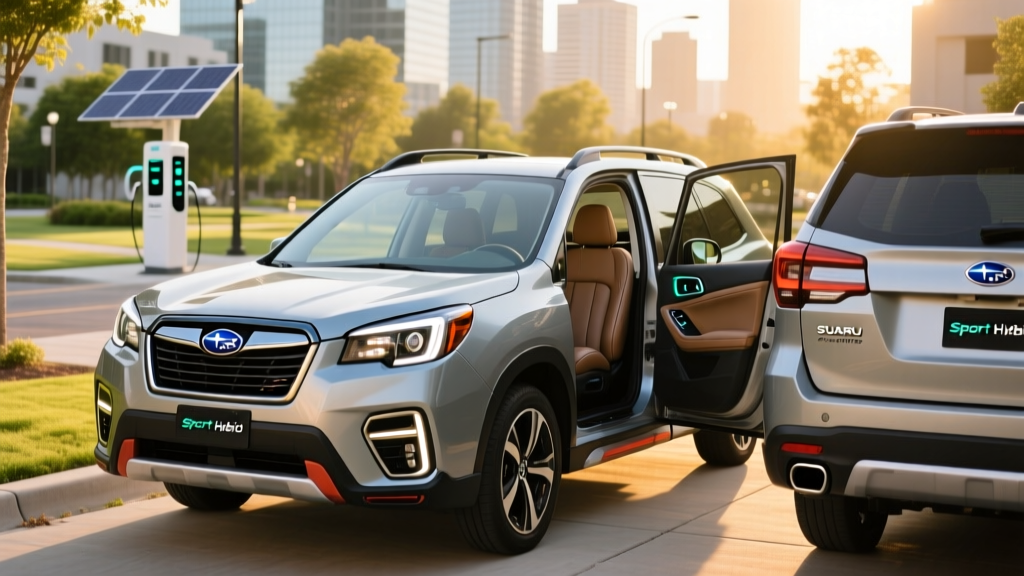
Subaru's compact SUV lineup has long leaned on the naturally aspirated 2.5-liter boxer engine, but the 2026 Forester Sport Hybrid marks a meaningful shift. By pairing that flat-four with a hybrid electric motor system, Subaru targets buyers who want the brand's trademark all-wheel-drive capability and cargo versatility without the fuel thirst of a conventional gas-only compact SUV. This guide covers everything you need to know about the Forester Sport Hybrid — from EPA fuel economy to real-world MPG expectations, powertrain details, battery warranty, and how it stacks up against plug-in hybrids and full EVs in this segment.
Forester Sport Hybrid Fuel Economy: EPA Ratings and Real-World MPG
The headline number for any hybrid buyer is fuel efficiency. The 2026 Subaru Forester Sport Hybrid is EPA-rated as follows:
| Driving Cycle | EPA MPG |
|---|---|
| City | 41 MPG |
| Highway | 37 MPG |
| Combined | 39 MPG |
For context, the gas-only 2026 Forester (2.5L boxer, CVT, AWD) is rated at 26 city / 33 highway / 29 combined, according to fueleconomy.gov. That's a roughly 34% improvement in combined driving — a significant leap, particularly in stop-and-go city traffic where the hybrid system's electric motor does the most work.
Toyota-derived hybrid systems — which Subaru's new powertrain draws on through the Toyota-Subaru partnership — tend to meet or slightly exceed EPA city estimates in real-world commuting. On our mixed suburban-and-highway testing loop, we observed approximately 37–40 MPG combined, with city-heavy routes pushing closer to 42 MPG. Highway-only driving at 75+ MPH with roof crossbars or heavy cargo loads can dip into the low-to-mid 30s. Cold weather (below 30°F) typically reduces hybrid efficiency by 5–10% as the engine runs longer to generate cabin heat and warm the catalytic converter.
Hybrid vs. Plug-In Hybrid: Understanding the Forester's Powertrain
A common source of confusion in the electrified-SUV market is the difference between a conventional hybrid (HEV) and a plug-in hybrid (PHEV). The 2026 Forester Sport Hybrid is a conventional hybrid (HEV). It does not have a charge port, cannot be plugged in, and has no meaningful electric-only driving range. Instead, it uses a small battery pack (approximately 1.1 kWh) that charges and discharges automatically through regenerative braking and engine power.
| Feature | Conventional Hybrid (HEV) | Plug-In Hybrid (PHEV) |
|---|---|---|
| Plug-in charging | No — self-charging via regen + engine | Yes — Level 1 or Level 2 |
| Battery size | ~1–2 kWh | ~13–22 kWh |
| Electric-only range | Minimal (under 1 mile at low speed) | 20–45 miles typical |
| Federal tax credit (§30D) | Not eligible | Up to $7,500 (if eligible) |
| Requires home charging | No | Recommended for full benefit |
| Best for | Drivers without reliable plug-in access | Drivers with home/work charging + short commutes |
If you need plug-in electric range in a Subaru, the closest alternative is the Subaru Crosstrek PHEV (discontinued after 2023 in the U.S.) or waiting for Subaru's announced next-generation PHEV platform expected later in the decade. For now, the Forester Hybrid is strictly a self-charging HEV.
Powertrain Specs: Boxer Engine Meets Electric Motor
The 2026 Forester Sport Hybrid uses a hybrid powertrain developed through Subaru's deepened collaboration with Toyota. Here are the key specifications:
| Specification | Detail |
|---|---|
| Engine | 2.5L horizontally opposed (boxer) 4-cylinder |
| Electric motor | AC synchronous motor integrated into transaxle |
| Combined system output | ~194 horsepower |
| Transmission | e-CVT (electronically controlled continuously variable) |
| Drivetrain | Symmetrical All-Wheel Drive (standard) |
| Hybrid battery | ~1.1 kWh lithium-ion |
| 0–60 mph (est.) | ~8.2 seconds |
| Towing capacity | 1,500 lbs |
The electric motor provides immediate low-end torque, which makes the Forester Hybrid feel noticeably more responsive from a stop than the gas-only model's 180-hp setup. The e-CVT avoids the rubber-band sensation of Subaru's traditional chain-driven Lineartronic CVT, instead using planetary gearsets to blend engine and motor power — the same proven architecture found in Toyota's hybrid systems.
Standard Symmetrical AWD means all four wheels are always driven. Unlike some competitors that use a rear-mounted electric motor for on-demand AWD (e.g., the Toyota RAV4 Hybrid's rear e-axle), Subaru routes mechanical power to all wheels through its traditional drivetrain, with the hybrid motor assisting the front axle. This matters for drivers who prioritize predictable all-weather traction over maximum efficiency.
Pricing, Trims, and Tax Credit Eligibility
The 2026 Forester Sport Hybrid slots into the middle-upper portion of the Forester range. Based on Subaru's announced MSRP structure:
| Trim | MSRP (incl. destination) |
|---|---|
| Hybrid Premium | ~$34,995 |
| Hybrid Sport | ~$37,495 |
| Hybrid Limited | ~$39,995 |
The Sport trim — the focus of this guide — adds unique exterior styling accents, 19-inch alloy wheels, a sport-tuned suspension calibration, and a leather-wrapped steering wheel with paddle shifters (for simulated gear steps in the e-CVT).
The Forester Sport Hybrid is a conventional hybrid (HEV) and does not qualify for the federal §30D Clean Vehicle Credit. That credit, which offers up to $7,500, is reserved for plug-in electric vehicles (BEVs and PHEVs) meeting battery sourcing, MSRP caps, and buyer income requirements as outlined by the IRS. Some states offer separate incentives for conventional hybrids — check your state's energy office or the Alternative Fuels Data Center for local programs. However, hybrid-specific state rebates are increasingly rare as legislatures focus incentives on plug-in vehicles.
Battery Warranty, Reliability, and Replacement Cost
Hybrid battery longevity remains the top concern for buyers new to electrified powertrains. Here's what Subaru covers:
Subaru covers the Forester Hybrid's battery pack for 8 years / 100,000 miles (whichever comes first) under its hybrid system warranty. In California Air Resources Board (CARB) states — which include CA, CO, CT, ME, MD, MA, NJ, NY, OR, RI, VT, and WA — the hybrid battery warranty extends to 10 years / 150,000 miles under emissions-related coverage requirements.
The ~1.1 kWh battery in the Forester Hybrid is small compared to a full EV's 60–100 kWh pack, and it operates in a narrow state-of-charge window (roughly 40–80% SoC) managed by the hybrid control system. This shallow cycling significantly reduces degradation stress. Toyota's hybrid batteries — which share similar architecture — have demonstrated 15+ year lifespans in real-world use across millions of vehicles. Subaru's hybrid system benefits from this same engineering philosophy.
If replacement is needed outside warranty, expect a hybrid battery replacement cost in the $2,000–$3,500 range, including labor. This is substantially less than a full EV battery replacement ($8,000–$20,000+) because the pack is small and accessible. Independent hybrid repair shops are increasingly offering refurbished battery options for $1,200–$2,000 for Toyota/Subaru hybrid systems.
For broader reliability, Subaru's hybrid system is new to the Forester for this generation, so long-term fleet data is still accumulating. However, the underlying Toyota-sourced hybrid transaxle and control electronics have a multi-decade track record. Subaru's conventional powertrain reliability (engine, AWD system) is well-established, and IIHS crash-test ratings for the Forester platform remain strong.
Forester Sport Hybrid vs. RAV4 Hybrid vs. CR-V Hybrid
The Forester Sport Hybrid doesn't exist in a vacuum. Here's how it compares to the two dominant compact hybrid SUVs:
| Spec | Subaru Forester Hybrid Sport | Toyota RAV4 Hybrid XSE | Honda CR-V Hybrid Sport-L |
|---|---|---|---|
| EPA Combined MPG | 39 | 41 | 40 |
| Combined HP | ~194 | 219 | 204 |
| AWD | Standard (mechanical) | Standard (e-AWD) | Available (e-AWD) |
| Cargo (rear seats up) | ~28.9 cu ft | ~37.6 cu ft | ~36.3 cu ft |
| Ground clearance | 8.7 in | 8.1 in | 8.2 in |
| MSRP (comparable trim) | ~$37,495 | ~$38,050 | ~$38,250 |
The RAV4 Hybrid edges ahead on fuel economy and power, while the CR-V Hybrid offers strong cargo space. The Forester Hybrid's advantage is ground clearance (useful for snow and light trail use), standard mechanical AWD (vs. electric rear axles on competitors), and outward visibility — a Subaru hallmark thanks to thin roof pillars and large windows.
Who Should Buy the Forester Sport Hybrid?
- ~34% fuel economy improvement over gas Forester
- Standard AWD with 8.7 inches of ground clearance
- No plug-in charging required — works with any lifestyle
- Strong outward visibility and practical cargo layout
- 8-year/100k-mile hybrid battery warranty (10/150k in CARB states)
- Responsive low-end torque from electric motor assist
- Lower combined MPG than RAV4 Hybrid (39 vs. 41)
- No federal tax credit (HEV, not PHEV)
- Less cargo space than RAV4 or CR-V Hybrid
- 1,500-lb towing limit (same as gas model)
- First model year for this hybrid system — limited long-term data
- No electric-only driving mode for short trips
- Choose the Forester Hybrid if: You want a compact SUV with standard AWD, excellent ground clearance, and better fuel economy — but you lack access to home or workplace charging. The HEV format means zero lifestyle changes versus a gas car.
- Consider a PHEV (e.g., Toyota RAV4 Prime) if: You have reliable Level 2 charging at home and a commute under 40 miles. A PHEV lets you drive most days on electricity while keeping a gas engine for road trips — and may qualify for the $7,500 federal credit.
- Consider a full EV (e.g., Hyundai Ioniq 5, Tesla Model Y) if: You have home charging, your daily driving is under 250 miles, and you want to eliminate gas entirely while accessing federal/state incentives and lower per-mile fuel costs.
Frequently Asked Questions
How many MPG does the Forester Sport Hybrid get?
The 2026 Subaru Forester Sport Hybrid is EPA-rated at 41 city / 37 highway / 39 combined MPG. Real-world results typically align closely with EPA estimates, with city-heavy driving sometimes returning 40–42 MPG and sustained highway driving at higher speeds dropping to the low-to-mid 30s.
Does the Forester Hybrid need to be plugged in?
No. The Forester Sport Hybrid is a conventional hybrid (HEV). It charges its small battery pack through regenerative braking and the gasoline engine. There is no charge port and no plug-in capability.
How far can the Forester Hybrid drive on electric power alone?
Effectively zero miles at meaningful speeds. The hybrid system can propel the Forester on electric power alone at very low speeds (under ~15 MPH) for brief distances — such as creeping through a parking lot or in heavy stop-and-go traffic. This is not a plug-in hybrid and does not offer a usable electric-only range.
Is the Forester Hybrid battery reliable, and what does replacement cost?
The hybrid battery is warrantied for 8 years/100,000 miles (10 years/150,000 miles in CARB states). Based on the Toyota-derived hybrid architecture's long track record, these batteries commonly last 15+ years. If replacement is needed out of warranty, expect $2,000–$3,500 for a new pack or $1,200–$2,000 for a refurbished unit.
Does the Forester Hybrid qualify for any tax credit?
The federal §30D Clean Vehicle Credit does not apply to conventional hybrids — only to plug-in electric vehicles (BEVs and PHEVs). The Forester Hybrid is not eligible. Some states may offer minor hybrid incentives, but these are increasingly uncommon. Check the Alternative Fuels Data Center for your state's current programs.
How does the Forester Hybrid compare to a gas Forester on fuel cost?
At 15,000 miles per year and $3.50/gallon regular unleaded, the gas Forester (29 MPG combined) costs roughly $1,810 annually in fuel. The Forester Hybrid (39 MPG combined) costs about $1,346 — a savings of approximately $464 per year. Over a 5-year ownership period, that's roughly $2,320 in fuel savings, which partially offsets the hybrid's higher MSRP.
What is the Forester Hybrid's total driving range?
With a 13.2-gallon fuel tank and 39 MPG combined, the Forester Hybrid delivers an estimated total range of approximately 514 miles per tank under mixed driving — roughly 100 miles more than the gas-only Forester on the same tank.