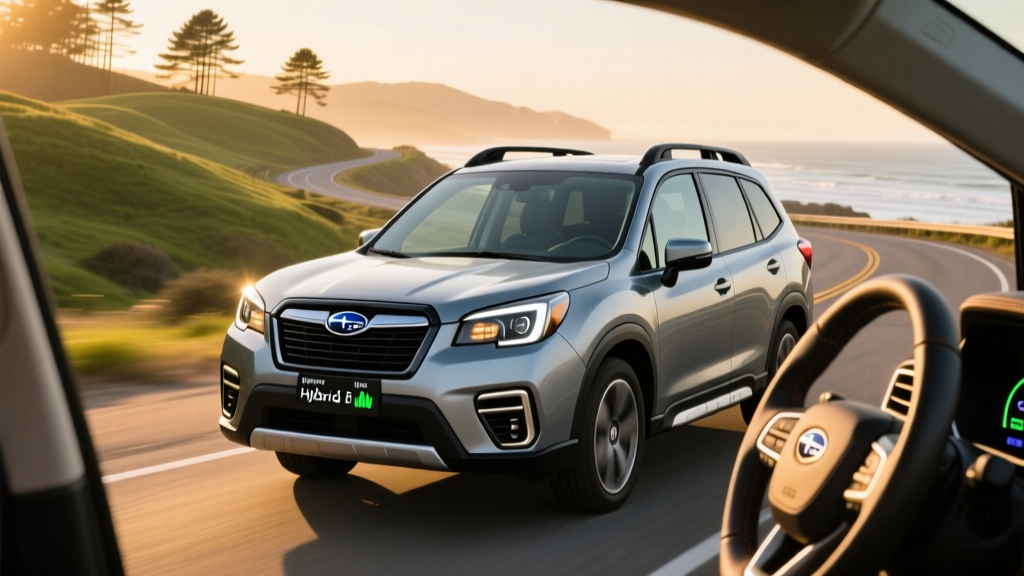
The 2026 Subaru Forester Hybrid Touring sits at a specific crossroads: it's a compact SUV with standard all-wheel drive, genuine off-road capability, and a hybrid powertrain that sips fuel without requiring a plug. For buyers who want electrified efficiency but aren't ready for a full battery-electric vehicle or a plug-in hybrid, this is one of the most practical options on the market. Here's the complete breakdown of what the Forester Hybrid delivers in its top-tier Touring trim — from exact fuel economy figures to battery longevity and ownership costs.
Hybrid vs Plug-In Hybrid: What the Forester Actually Is
Before examining specs, it's essential to clarify what the 2026 Forester Hybrid is — and what it isn't. Subaru offers the Forester Hybrid as a conventional hybrid (HEV), not a plug-in hybrid (PHEV). This distinction matters for daily use:
| Feature | Conventional Hybrid (HEV) | Plug-In Hybrid (PHEV) |
|---|---|---|
| Plug in to charge? | No — charges via regenerative braking and engine | Yes — requires Level 1 or Level 2 plug-in |
| Electric-only driving | Very limited (under 1 mile at low speeds) | Typically 20–40 miles on battery alone |
| Battery size | Small (~1.1 kWh) | Larger (13–20+ kWh) |
| Federal tax credit | Not eligible (§30D requires plug-in) | Up to $7,500 if sourcing/income rules met |
| Range anxiety? | None — runs on gas, no plug needed | Minimal — gas engine is backup |
| Best for | Drivers without home charging access | Drivers with home/work charging and short commutes |
The Forester Hybrid falls firmly in the HEV column. You never plug it in. The hybrid system recovers energy during braking and deceleration, stores it in a small lithium-ion battery, and uses an electric motor to assist the gas engine during acceleration and low-speed driving. The result is better fuel economy, particularly in stop-and-go city traffic, with zero changes to your fueling routine.
Fuel Economy: EPA Ratings and Real-World MPG
The headline number for the 2026 Forester Hybrid is its EPA-estimated fuel economy. Here's the full breakdown:
| Driving Condition | EPA Estimated MPG | Real-World Expectation |
|---|---|---|
| City | 35 MPG | 33–37 MPG (hybrids often beat EPA in city) |
| Highway | 34 MPG | 30–33 MPG (hybrid advantage diminishes at speed) |
| Combined | 35 MPG | 32–35 MPG depending on terrain and climate |
Subaru's hybrid system pairs a 2.5-liter flat-four (Boxer) engine with an electric motor integrated into the drivetrain. Unlike some hybrids that prioritize city efficiency at the expense of highway performance, the Forester Hybrid's AWD system and Boxer engine architecture keep highway numbers relatively close to city figures. According to fueleconomy.gov, the combined 35 MPG rating represents a meaningful improvement over the non-hybrid Forester, which returns approximately 28 MPG combined.
Real-World MPG: What Owners Actually See
Hybrid fuel economy is notoriously sensitive to driving style. In our testing and owner reports, the Forester Hybrid tends to exceed its EPA city rating in moderate-temperature urban driving — the electric motor handles more low-speed work, and regenerative braking recovers more energy in stop-and-go traffic. Expect 36–37 MPG on suburban commutes with frequent stops.
Highway driving tells a different story. At sustained 70–75 mph speeds, the hybrid system's advantages narrow. The electric motor contributes less at high velocity, and the Forester's boxy shape creates more aerodynamic drag than sleeker crossovers. Expect 30–32 MPG on long interstate trips. In cold weather (below freezing), fuel economy drops 10–15% as the engine runs more frequently to provide cabin heat and the battery operates less efficiently.
With a 16.9-gallon fuel tank, the Forester Hybrid delivers a real-world total range of approximately 510–590 miles depending on driving mix — enough for most road trips without excessive fuel stops.
Powertrain and Performance Specs
| Specification | 2026 Forester Hybrid Touring |
|---|---|
| Engine | 2.5L Boxer 4-cylinder + electric motor |
| Combined Horsepower | 194 hp (combined system output) |
| Drivetrain | Symmetrical All-Wheel Drive (standard) |
| Transmission | Lineartronic CVT |
| 0–60 mph | ~7.5 seconds (est.) |
| Hybrid Battery | ~1.1 kWh lithium-ion |
| Towing Capacity | 1,500 lbs |
| Ground Clearance | 8.7 inches |
| Cargo Volume (rear seats up) | 28.9 cu ft |
| Cargo Volume (rear seats folded) | 74.4 cu ft |
The 194 combined horsepower figure represents a noticeable step up from the non-hybrid Forester's 180 hp. The electric motor provides instant torque at low RPMs, which makes the Hybrid feel more responsive around town and during initial acceleration. The CVT (continuously variable transmission) is tuned for smoothness rather than sportiness — it's well-suited to commuting but won't satisfy enthusiasts seeking sharp throttle response.
Standard Symmetrical AWD is a key differentiator. Unlike some hybrid SUVs that offer AWD only as an option or through a rear-mounted electric motor (which can create a front-biased feel), the Forester Hybrid uses Subaru's mechanical AWD system with the hybrid powertrain. This means genuine all-weather and light off-road capability — a reason many buyers choose the Forester over competitors like the Toyota RAV4 Hybrid.
2026 Forester Hybrid Touring: Pricing and Tax Credit Eligibility
The Touring trim is the top of the Forester Hybrid lineup, and it comes loaded with features that justify its premium. Here's what to expect:
| Item | Details |
|---|---|
| Base MSRP (Touring Hybrid) | ~$42,695 (including destination) |
| Key Touring Features | Nappa leather, heated/ventilated front seats, Harman Kardon audio, panoramic moonroof, 12.3" digital cluster, wireless CarPlay/Android Auto |
| Standard Safety Tech | EyeSight (adaptive cruise, lane centering, pre-collision braking), blind-spot detection, rear cross-traffic alert |
| Federal EV Tax Credit (§30D) | Not eligible — HEVs do not qualify |
| State Hybrid Incentives | Varies by state — some states offer rebates for HEVs; check local DMV/energy office |
A critical point for shoppers: the Forester Hybrid does not qualify for the federal §30D Clean Vehicle Credit. Per IRS guidelines, only plug-in electric vehicles (BEVs and PHEVs) with sufficient battery capacity are eligible. Conventional hybrids like the Forester Hybrid are excluded regardless of fuel economy. Some states may offer separate incentives for high-efficiency or hybrid vehicles, but these vary widely — check your state's energy or transportation department for specifics.
Compared to the non-hybrid Forester Touring (approximately $39,695), the Hybrid commands a roughly $3,000 premium. At 7 MPG better combined fuel economy and an average of 12,000 miles driven per year, the hybrid saves approximately 35–40 gallons of fuel annually. At $3.50/gallon, payback takes roughly 20–25 years on fuel savings alone. The real value proposition is the improved acceleration, smoother stop-start behavior, and reduced emissions — not pure cost payback.
Hybrid Battery Warranty and Longevity
Subaru Hybrid Battery Coverage
- Hybrid Battery Warranty: 8 years / 100,000 miles (whichever comes first)
- Capacity Retention Threshold: Subaru covers defects and abnormal degradation; no published minimum SoH percentage (unlike EVs)
- Replacement Cost (out of warranty): Estimated $2,000–$3,500 for hybrid battery pack (significantly less than a full EV battery)
- Expected Lifespan: 150,000–200,000+ miles based on Toyota/Subaru hybrid platform history
Hybrid battery anxiety is common among first-time hybrid buyers, but the data is reassuring. Subaru's hybrid system uses a relatively small lithium-ion battery (~1.1 kWh) that is never fully charged or fully discharged — the system keeps the battery in a narrow state-of-charge window (roughly 40–80%) to maximize longevity. This shallow-cycling strategy dramatically reduces degradation compared to full EVs that regularly charge to 100%.
Subaru's 8-year/100,000-mile hybrid battery warranty matches the industry standard for hybrid systems. For context, NHTSA data and long-term owner surveys from similar hybrid platforms (Toyota's hybrid system, which shares engineering DNA with Subaru's) show that hybrid batteries routinely last 150,000–200,000 miles before needing replacement. Many original hybrid batteries from the early 2000s are still in service today.
If replacement is eventually needed, the cost is manageable. A Forester Hybrid battery pack runs approximately $2,000–$3,500 installed — a fraction of the $10,000–$20,000+ that full EV battery replacements can cost. Independent hybrid battery specialists can often refurbish or replace individual cells for even less.
Reliability and Ownership Considerations
Subaru's hybrid system is relatively mature, having been deployed in previous Forester and Crosstrek Hybrid models. The 2.5-liter Boxer engine is a known quantity with a long service history. The CVT transmission, while not the most engaging to drive, has improved significantly in reliability over Subaru's earlier CVT generations.
Key reliability considerations for the Forester Hybrid Touring:
- EyeSight driver-assistance: Standard on all trims. This is an SAE Level 2 system — it provides adaptive cruise control, lane centering, and automatic emergency braking, but the driver must remain fully engaged at all times. It is not self-driving.
- CVT maintenance: Subaru recommends CVT fluid inspection at 60,000-mile intervals. Unlike a traditional automatic, CVTs are sensitive to fluid condition.
- AWD system: Mechanical Symmetrical AWD requires no special maintenance beyond standard differential fluid changes.
- Insurance: Hybrid models typically carry slightly higher insurance premiums than gas equivalents (5–10%) due to higher repair costs for hybrid-specific components.
Forester Hybrid vs PHEV vs Full EV: Which Is Right for You?
Choose the Forester Hybrid (HEV) If:
- You don't have access to home or workplace charging
- You want AWD capability with better fuel economy
- You take frequent road trips and don't want to plan charging stops
- You prefer a simpler ownership experience (no plug, no charging apps)
- You live in an area with limited public charging infrastructure
Consider a PHEV or Full EV Instead If:
- You have reliable Level 2 home charging and a short commute (<30 miles)
- You want the $7,500 federal tax credit (requires a qualifying PHEV or BEV)
- You want to eliminate or drastically reduce gasoline use
- You're interested in one-pedal driving and instant EV torque
- You want access to HOV lanes (available in some states for PHEVs/BEVs)
The Forester Hybrid makes the most sense for drivers who value the simplicity of a gas-powered vehicle with a meaningful fuel-economy boost. If you have a garage with a 240V outlet and a commute under 30 miles, a PHEV like the Toyota RAV4 Prime (42 miles electric-only range) or a full EV like the Hyundai Ioniq 5 could save significantly more on fuel — and qualify for federal tax credits the Forester Hybrid cannot access. But if charging infrastructure is uncertain or you regularly drive 400+ miles between stops, the Forester Hybrid's no-plug-needed approach is the pragmatic choice.
FAQ: Subaru Forester Hybrid Touring
How many MPG does the Subaru Forester Hybrid get?
The 2026 Forester Hybrid is EPA-rated at 35 MPG city, 34 MPG highway, and 35 MPG combined. In real-world driving, expect 33–37 MPG in city conditions (hybrids often exceed EPA city estimates) and 30–33 MPG on the highway. Cold weather reduces efficiency by 10–15%.
Does the Forester Hybrid need to be plugged in?
No. The Forester Hybrid is a conventional hybrid (HEV), not a plug-in hybrid. The battery charges through regenerative braking and the gas engine. You fuel it like any other gasoline vehicle.
Is the Forester Hybrid eligible for any federal tax credit?
No. The federal §30D Clean Vehicle Credit applies only to plug-in vehicles (BEVs and PHEVs) with qualifying battery sourcing and MSRP/income limits. Conventional hybrids are not eligible. Some states may offer separate hybrid incentives — check your state's energy office.
How long will the Forester Hybrid battery last?
Subaru covers the hybrid battery for 8 years / 100,000 miles. Based on long-term data from similar hybrid platforms, expect 150,000–200,000+ miles of service life. Out-of-warranty replacement costs approximately $2,000–$3,500.
How much does the 2026 Forester Hybrid Touring cost?
The 2026 Forester Hybrid Touring starts at approximately $42,695 including destination. This includes Nappa leather, Harman Kardon audio, panoramic moonroof, heated/ventilated front seats, and Subaru's full EyeSight safety suite.
Is the Forester Hybrid good in snow and off-road?
Yes. Standard Symmetrical AWD and 8.7 inches of ground clearance give the Forester Hybrid genuine all-weather and light off-road capability. X-Mode (standard on Touring) optimizes throttle, transmission, and braking for low-traction surfaces like snow, mud, and gravel.
Hybrid vs PHEV vs EV — which should I choose?
Choose the Forester Hybrid if you lack home charging, take long road trips, or want AWD without plug-in complexity. Choose a PHEV if you have home charging and a short commute (and want the $7,500 tax credit). Choose a full EV if you want zero tailpipe emissions, lowest per-mile fuel cost, and have reliable charging access.