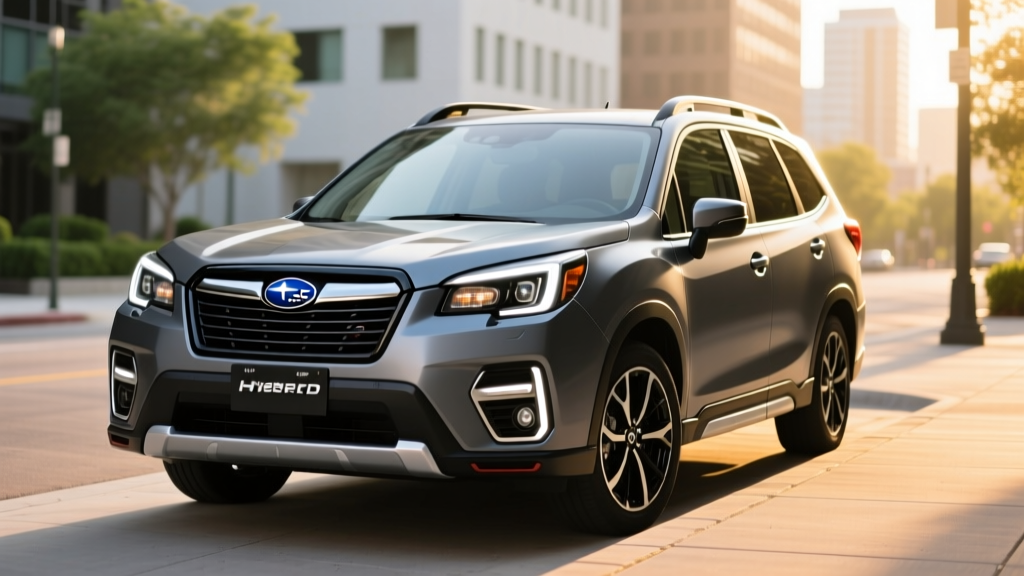
The 2026 Subaru Forester Hybrid Sport arrives at a moment when compact SUV buyers want fuel savings without plugging in. Built on the sixth-generation Forester platform, this conventional hybrid (HEV) pairs a 2.5-liter flat-four with an electric motor for a combined 194 horsepower and standard all-wheel drive. It is not a plug-in hybrid — you never need to find a charger. You just fill up with gas and drive, while the hybrid system recovers energy through regenerative braking to boost efficiency.
For shoppers cross-referencing the RAV4 Hybrid, CR-V Hybrid, and Tucson Hybrid, the Forester Hybrid Sport occupies a specific niche: a sport-tuned, rugged-looking compact hybrid SUV with Subaru's hallmark Symmetrical AWD and strong visibility. Here is everything you need to know about its fuel economy, powertrain, pricing, and where it fits in the hybrid-versus-EV decision.
Forester Hybrid Sport Fuel Economy: EPA and Real-World MPG
The EPA rates the 2026 Subaru Forester Hybrid Sport at 35 MPG city / 33 MPG highway / 34 MPG combined, according to fueleconomy.gov. These figures represent a meaningful improvement over the non-hybrid Forester, which returns approximately 26 MPG combined with its 2.5-liter engine and CVT.
| Driving Condition | Forester Hybrid Sport (EPA) | Forester Gas (EPA) | Toyota RAV4 Hybrid (EPA) |
|---|---|---|---|
| City | 35 MPG | 26 MPG | 41 MPG |
| Highway | 33 MPG | 27 MPG | 38 MPG |
| Combined | 34 MPG | 26 MPG | 39 MPG |
Real-world expectations: Hybrid SUVs frequently exceed their EPA city ratings in stop-and-go traffic because regenerative braking recovers more energy at low speeds. Expect to see 36–38 MPG in urban commuting. Highway driving at 75+ MPH will likely yield 30–32 MPG as aerodynamic drag increases and the electric motor contributes less at sustained high speeds. In cold weather (below 30°F), anticipate a 3–5 MPG drop as the engine runs more frequently to generate cabin heat and the battery operates less efficiently.
HEV vs PHEV vs EV: What the Forester Hybrid Is (and Isn't)
The Forester Hybrid Sport is a conventional hybrid (HEV), not a plug-in hybrid (PHEV) or battery-electric vehicle (BEV). Understanding the distinction matters for your daily routine and your wallet.
| Feature | HEV (Forester Hybrid) | PHEV (e.g., RAV4 Prime) | BEV (e.g., Ioniq 5) |
|---|---|---|---|
| Plug in to charge? | No | Yes (optional) | Yes (required) |
| Electric-only range | None (motor assists engine) | 25–42 mi typical | 250–350 mi (full battery) |
| Battery size | ~1.1 kWh (small, self-charging) | 13–18 kWh | 58–84 kWh |
| Fuel needed? | Yes (gasoline) | Yes (gasoline when battery depletes) | No |
| Federal tax credit (§30D)? | No | Up to $7,500 (if eligible) | Up to $7,500 (if eligible) |
| Home charging install needed? | No | Recommended (Level 2) | Essential (Level 2) |
The Forester Hybrid's small battery charges itself through regenerative braking and the gasoline engine. You cannot plug it in, and it cannot drive on electricity alone for meaningful distances. The electric motor's role is to assist the gas engine during acceleration, enable engine-off coasting at low speeds, and smooth out stop-start driving. This makes it ideal for buyers who want better fuel economy without any change to their refueling habits.
Powertrain and Performance Specs
The 2026 Forester Hybrid Sport uses Subaru's hybrid system built around the FB25 2.5-liter horizontally opposed (boxer) four-cylinder engine paired with an electric motor integrated into the transmission housing. Combined output is 194 horsepower, a notable bump over the gas-only Forester's 180 hp.
| Specification | 2026 Forester Hybrid Sport |
|---|---|
| Engine | 2.5L boxer-4 (Atkinson cycle) |
| Combined horsepower | 194 hp |
| Electric motor | AC synchronous, integrated |
| Transmission | Lineartronic CVT |
| Drivetrain | Symmetrical AWD (standard) |
| Hybrid battery | ~1.1 kWh lithium-ion |
| 0–60 MPH (est.) | ~7.9 seconds |
| Towing capacity | 1,500 lbs |
| Cargo volume (behind rear seats) | 28.9 cu ft |
On the road, the hybrid system's electric torque fill makes the Forester feel more responsive from a stoplight than the gas-only model, even though the 0–60 time remains in the high-seven-second range. The CVT is well-calibrated and avoids the rubber-band effect common to older continuously variable transmissions. Subaru's Symmetrical AWD distributes torque front-to-rear automatically, and the hybrid system does not compromise ground clearance — the Forester Hybrid Sport retains 8.7 inches, making it genuinely capable on unpaved roads and in snow.
Pricing, Trims, and Tax Credit Eligibility
The 2026 Subaru Forester Hybrid Sport carries a starting MSRP of approximately $37,615 (including destination). The Hybrid trim sits above the Premium and Limited gas-only trims in price, reflecting the hybrid powertrain and Sport-specific styling cues including black exterior accents, unique 18-inch wheels, and sport cloth upholstery.
Federal tax credit: The Forester Hybrid Sport does not qualify for the IRS §30D Clean Vehicle Credit. Under current IRS rules, only plug-in electric vehicles (PHEVs and BEVs) with sufficient battery capacity are eligible. Conventional hybrids like the Forester Hybrid are excluded. Some states may offer minor incentives for hybrid purchases — check your state's energy or DMV website for current programs.
The price premium over the gas-only Forester Premium (approximately $32,000) is roughly $5,600. At 34 MPG combined versus 26 MPG combined, and assuming 12,000 miles per year at $3.50/gallon, the hybrid saves approximately $425 annually in fuel. That puts the break-even point at roughly 13 years — meaning the hybrid's value proposition rests more on driving refinement and environmental benefit than pure payback math. Buyers who drive significantly more miles annually (18,000+) or face higher gas prices will close that gap faster.
Battery Warranty, Reliability, and Replacement Cost
Subaru Hybrid Battery Warranty: 8 years / 100,000 miles (whichever comes first), covering defects and capacity loss below functional thresholds. This aligns with the industry-standard hybrid battery warranty set by Toyota and Honda.
Subaru's hybrid system uses a relatively small lithium-ion battery pack (~1.1 kWh) that operates within a narrow state-of-charge window — typically between 40% and 80%. This shallow cycling dramatically reduces stress on the cells compared to a full EV battery that regularly cycles from 10% to 90%. As a result, hybrid battery degradation is minimal, and most HEV batteries outlast their warranty periods without issue.
Reliability data: Subaru's hybrid system shares engineering DNA with Toyota's hybrid architecture (Subaru and Toyota have a longstanding partnership). Toyota's hybrid systems have demonstrated exceptional longevity, with many RAV4 Hybrid and Prius batteries exceeding 200,000 miles. While the Forester Hybrid is newer to the market and long-term Subaru-specific data is still accumulating, the underlying technology is proven.
Battery replacement cost: If the hybrid battery does require replacement outside of warranty, expect a cost between $2,000 and $4,000 for the battery pack itself, plus labor. This is significantly less than a full EV battery replacement ($5,000–$20,000+) because the HEV battery is small. Independent hybrid battery repair shops can often replace individual cells or modules for $500–$1,500, extending the pack's life at a fraction of the dealer cost.
Who Should Choose the Forester Hybrid Sport?
The Forester Hybrid Sport is purpose-built for a specific buyer. Here is the decision framework:
Choose the Forester Hybrid Sport if:
- You want better fuel economy without changing your refueling routine (no plugging in)
- You need standard AWD for snow, rain, or light off-road use
- You value outward visibility and a commanding driving position
- You drive a mix of city and highway miles (the hybrid system benefits both)
- You want a sportier appearance without paying for a performance SUV
Consider a PHEV (e.g., RAV4 Prime, Tucson PHEV) instead if:
- You have home charging access and a commute under 35 miles (you could drive mostly on electricity)
- You want federal tax credit eligibility (up to $7,500 with §30D)
- You want the option of electric-only driving for short trips
Consider a full EV (e.g., Ioniq 5, EV6, Model Y) instead if:
- You have reliable home Level 2 charging
- Your daily driving is under 250 miles and you can plan road-trip charging
- You want to eliminate gasoline costs entirely and minimize maintenance
Pros and Cons at a Glance
Pros
- 34 MPG combined — strong improvement over gas Forester
- Standard Symmetrical AWD with 8.7" ground clearance
- No plug-in charging required — zero lifestyle change
- 194 hp provides responsive acceleration for the class
- Excellent outward visibility and spacious cabin
- 8-year/100,000-mile hybrid battery warranty
Cons
- No federal tax credit eligibility (HEV excluded from §30D)
- MPG trails RAV4 Hybrid (39 combined) and CR-V Hybrid (40 combined)
- ~$5,600 price premium over gas Forester with long fuel-payback period
- 1,500-lb towing capacity limits utility for boat/trailer owners
- Hybrid battery reduces under-floor cargo storage slightly
Frequently Asked Questions
How many MPG does the Forester Hybrid Sport get?
The EPA rates it at 35 city / 33 highway / 34 combined MPG. Real-world city driving often yields 36–38 MPG thanks to regenerative braking, while sustained highway speeds above 75 MPH may drop to 30–32 MPG.
Does the Forester Hybrid need to be plugged in?
No. The Forester Hybrid Sport is a conventional hybrid (HEV). Its small battery charges through regenerative braking and the gasoline engine. You refuel it exactly like a gas car — at the pump.
Can the Forester Hybrid drive on electric power only?
Only for very brief, low-speed moments (such as coasting to a stop or creeping in traffic). It does not have a meaningful electric-only driving range like a PHEV or EV. The electric motor primarily assists the gasoline engine.
Is the hybrid battery reliable, and what does replacement cost?
Hybrid batteries are among the most reliable battery systems in any vehicle because they operate in a shallow charge window that minimizes degradation. Subaru covers the battery for 8 years/100,000 miles. Out-of-warranty replacement runs $2,000–$4,000, with independent repair options available for less.
Does the Forester Hybrid Sport qualify for any tax credit?
Not the federal §30D credit — that is reserved for plug-in vehicles (PHEVs and BEVs). Some states may offer small hybrid incentives, but there is no federal tax benefit for purchasing a conventional HEV. Check your state's energy office for local programs.
How does the Forester Hybrid compare to the RAV4 Hybrid?
The RAV4 Hybrid leads on fuel economy (39 MPG combined vs. 34) and offers a PHEV variant (RAV4 Prime with 42 miles of electric range and tax credit eligibility). The Forester Hybrid counters with superior ground clearance, standard AWD across all trims, and Subaru's reputation for all-weather capability. The RAV4 Hybrid also starts at a lower price point.
Is the Forester Hybrid Sport good in snow?
Yes. Subaru's Symmetrical AWD, 8.7 inches of ground clearance, and standard X-MODE traction management make the Forester Hybrid Sport one of the most capable compact hybrid SUVs in winter conditions. The hybrid system does not compromise its off-road or snow performance.