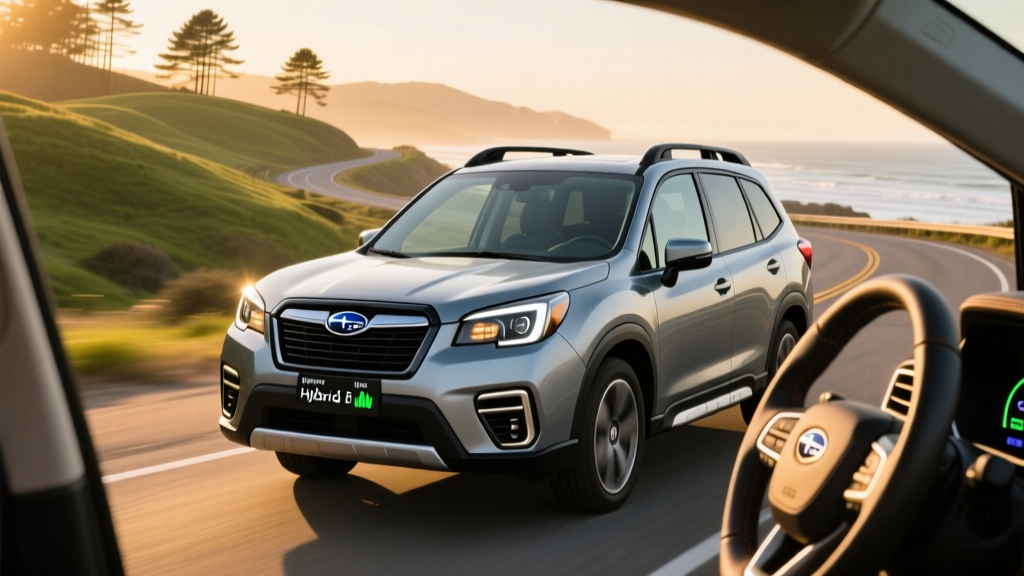
The compact SUV segment rarely rewards fuel-sipping buyers who also need all-weather traction. The 2025 Subaru Forester Hybrid changes that equation, pairing a new 2.5-liter hybrid powertrain with Subaru's standard symmetrical all-wheel drive and returning an EPA-estimated 39 MPG combined. For shoppers searching for a Subaru Forester 2025 hybrid that avoids the plug-in complexity while still cutting fuel costs meaningfully, this is one of the most practical compact crossovers available.
This guide covers the Forester Hybrid's powertrain specs, real-world fuel economy, pricing across trims, battery longevity, and where it fits against plug-in hybrid and full-electric alternatives.
HEV vs PHEV: What the Forester Hybrid Actually Is
Important distinction: The 2025 Forester Hybrid is a conventional hybrid (HEV), not a plug-in hybrid (PHEV). It has no charging port, requires no plug-in charging, and cannot drive on electric power alone for meaningful distances. It recovers energy through regenerative braking and uses a small battery to assist the gas engine — exactly like a Toyota RAV4 Hybrid.
Subaru previously offered a Forester PHEV (the e-Boxer in some markets), but the current US-spec 2025 Forester Hybrid is strictly a self-charging HEV. If you need plug-in electric-only range for short commutes, you'll need to look at competitors like the Toyota RAV4 Prime or Ford Escape PHEV.
| Feature | HEV (Forester Hybrid) | PHEV (e.g., RAV4 Prime) |
|---|---|---|
| Plug-in charging | No — gas only | Yes — Level 1/2 |
| Electric-only range | N/A (EV assist only) | 25–42 miles typical |
| Battery size | ~1.1 kWh (small) | 13–18 kWh |
| Federal tax credit | Not eligible (§30D) | Up to $7,500 if qualified |
| Best for | No home charging access | Home charging + short commutes |
Fuel Economy: EPA Estimates vs Real-World MPG
The headline number for the 2025 Forester Hybrid is strong for an all-wheel-drive compact SUV. According to EPA data at fueleconomy.gov, the Forester Hybrid achieves:
| Driving Cycle | MPG |
|---|---|
| City | 39 MPG |
| Highway | 37 MPG |
| Combined | 39 MPG (est.)* |
*Combined figure estimated based on EPA city/highway weighting; verify at fueleconomy.gov for final certification.
Real-world MPG note: Hybrids typically exceed their EPA city estimate in stop-and-go traffic because regenerative braking recovers energy that a gas car wastes as heat. On highway-only road trips at 75+ mph, expect fuel economy to drop closer to 33–35 MPG. In cold weather (below 30°F), the engine runs more frequently to heat the cabin, reducing hybrid efficiency by roughly 10–15%. Owners in mixed suburban driving commonly report 37–41 MPG over a full tank.
Powertrain and Performance Specs
The 2025 Forester Hybrid uses Subaru's newly developed hybrid system built around the familiar 2.5-liter flat-four (Boxer) engine, now paired with an electric motor integrated into the transmission housing. This is a meaningful upgrade from the previous-generation hybrid system, which was widely criticized for being underpowered and less refined.
| Specification | Detail |
|---|---|
| Engine | 2.5L DOHC Boxer 4-cylinder |
| Electric motor | Integrated transmission motor |
| Combined horsepower | ~194 hp (system net) |
| Drivetrain | Symmetrical AWD (standard) |
| Transmission | Lineartronic CVT |
| Hybrid battery | ~1.1 kWh lithium-ion |
| 0–60 mph | ~8.5 seconds (est.) |
| Towing capacity | 1,500 lbs (est.) |
The ~194 combined system horsepower represents a solid improvement over the non-hybrid Forester's 180 hp, and the electric motor's instant torque fills in the low-end gap that Subaru's naturally aspirated Boxer engine has historically exhibited. Acceleration won't thrill, but it's confident for highway merging and passing.
Pricing by Trim and Tax Credit Eligibility
The Forester Hybrid slots above the standard gas-only Forester in the lineup. Pricing for the 2025 model year starts in the low-to-mid $30,000s for the base hybrid trim and climbs with higher trims. Key pricing context:
- Base Hybrid trim: Estimated $33,000–$35,000 MSRP (destination included)
- Mid-tier Hybrid (Premium/Sport): Estimated $36,000–$38,000 MSRP
- Top Hybrid (Limited/Touring): Estimated $39,000–$42,000 MSRP
Federal tax credit: The Forester Hybrid does not qualify for the IRS §30D federal EV tax credit. That credit (up to $7,500) applies only to plug-in electric vehicles — battery-electric vehicles (BEVs) and plug-in hybrids (PHEVs) with sufficient battery capacity. A conventional HEV like this Forester is ineligible regardless of buyer income or MSRP.
Some states and utilities offer smaller rebates or incentives for conventional hybrids, but these vary widely by jurisdiction. Check your state energy office or local utility for current programs. A tax professional can confirm eligibility for any credits.
Reliability, Battery Warranty, and Replacement Cost
Hybrid battery warranty: Subaru covers the Forester Hybrid's battery and hybrid system components under a warranty of 8 years / 100,000 miles (whichever comes first), in line with industry standards set by Toyota and Honda. In states that follow California Air Resources Board (CARB) emissions rules — including CA, NY, MA, and others — hybrid battery coverage may extend to 10 years / 150,000 miles.
Reliability outlook: Subaru's new hybrid system is unproven in the US market, as the previous Forester Hybrid was discontinued after 2023 and used a different, less powerful system. However, the 2.5L Boxer engine is well-established and generally reliable. Subaru's hybrid architecture draws on Toyota's hybrid engineering principles (the companies have a partnership), which bodes well for long-term durability.
Battery replacement cost: If the hybrid battery fails outside of warranty, replacement typically costs between $2,000 and $4,000 for a compact-SUV-class hybrid battery, based on comparable Toyota and Honda hybrid replacement pricing. The small ~1.1 kWh battery is significantly cheaper to replace than a full EV battery pack. In practice, modern hybrid batteries regularly last 150,000–200,000+ miles before significant degradation, based on Toyota RAV4 Hybrid and Camry Hybrid long-term data.
The hybrid system's electric motor and power control unit are also covered under the hybrid warranty. Subaru's general vehicle warranty covers 3 years/36,000 miles bumper-to-bumper and 5 years/60,000 miles powertrain.
Who Should Buy the Forester Hybrid vs a PHEV or Full EV?
Choosing between a conventional hybrid, plug-in hybrid, and full electric vehicle depends on your daily driving pattern, charging access, and budget. Here's a practical decision framework:
Choose the Forester Hybrid (HEV) if:
- You don't have access to home or workplace charging (apartment, street parking)
- You want AWD and fuel savings with zero behavior change — just fill up with gas
- Your daily driving is variable (some days 10 miles, some days 300+)
- You want a lower purchase price than a PHEV or EV
- You frequently drive in cold climates where EV range drops significantly
Choose a PHEV (e.g., RAV4 Prime, Escape PHEV) if:
- You have home Level 2 charging and a commute under 30 miles
- You want electric-only daily driving but gas flexibility for road trips
- You can capture the federal §30D tax credit (subject to income, MSRP, and sourcing rules)
Choose a full EV (e.g., Tesla Model Y, Hyundai Ioniq 5) if:
- You have reliable home charging and want zero tailpipe emissions
- Your daily driving is under 250 miles and you road-trip infrequently
- You want the lowest per-mile fuel cost and minimal maintenance
The Forester Hybrid's strongest competitive position is against buyers who need AWD and fuel efficiency but lack charging infrastructure. It's also a natural fit for Subaru loyalists upgrading from an older Forester or Outback who want better fuel economy without the learning curve of plug-in ownership.
How It Compares to Hybrid Rivals
The Forester Hybrid doesn't exist in a vacuum. The compact hybrid SUV segment includes several established competitors with strong track records:
| Vehicle | EPA Combined MPG | AWD | Hybrid HP | Starting MSRP (est.) |
|---|---|---|---|---|
| Subaru Forester Hybrid | 39 MPG | Standard | ~194 hp | ~$33,500 |
| Toyota RAV4 Hybrid | 39–41 MPG | Available | 219 hp | ~$33,000 |
| Honda CR-V Hybrid | 37–40 MPG | Available | 204 hp | ~$34,000 |
| Kia Sportage Hybrid | 38–43 MPG | Available | 226 hp | ~$30,000 |
The Forester Hybrid matches or slightly trails the RAV4 Hybrid on pure MPG but wins on standard AWD (the RAV4 and CR-V charge extra for all-wheel drive). The Subaru also carries its traditional strengths: excellent outward visibility, strong safety ratings (the Forester typically earns IIHS Top Safety Pick status), and genuine off-road capability via X-Mode and 8.7 inches of ground clearance.
Where the Forester Hybrid may fall short is interior infotainment refinement and rear-seat space compared to the CR-V Hybrid, which leads the segment in cargo volume. Performance-oriented buyers may prefer the RAV4 Hybrid's 219 hp or the Sportage Hybrid's 226 hp.
Frequently Asked Questions
How many MPG does the 2025 Subaru Forester Hybrid get?
The EPA estimates the Forester Hybrid at approximately 39 MPG city and 37 MPG highway, for a combined estimate near 39 MPG. Real-world city driving often yields 37–41 MPG thanks to regenerative braking efficiency. Highway-only driving at high speeds will reduce that to roughly 33–35 MPG.
Does the Forester Hybrid need to be plugged in?
No. The Forester Hybrid is a conventional HEV. It charges its small battery through regenerative braking and the gas engine. There is no charging port and no plug-in capability.
Can the Forester Hybrid drive on electric power alone?
Only at very low speeds for very short distances (typically under 1 mile at parking-lot speeds). The electric motor primarily assists the gas engine during acceleration and captures energy during braking. It does not offer meaningful electric-only driving like a PHEV.
Does the 2025 Forester Hybrid qualify for a federal tax credit?
No. The IRS §30D federal tax credit applies only to plug-in electric vehicles (BEVs and qualifying PHEVs). Conventional hybrids like the Forester Hybrid are not eligible. Check your state and local utility for possible hybrid incentives, which vary by jurisdiction.
How long will the Forester Hybrid battery last?
Modern hybrid batteries in vehicles like the Toyota RAV4 Hybrid routinely last 150,000–200,000+ miles. Subaru covers the hybrid battery for 8 years/100,000 miles (10 years/150,000 miles in CARB states). If replacement is needed out of warranty, expect $2,000–$4,000 based on comparable hybrid battery pricing.
Is the Forester Hybrid slower than the gas-only Forester?
No — the hybrid system adds electric motor torque, bringing combined output to approximately 194 hp versus the gas Forester's 180 hp. Acceleration is slightly quicker in normal driving, and low-speed responsiveness is noticeably improved thanks to the electric motor's instant torque delivery.
Should I buy the Forester Hybrid or a RAV4 Prime PHEV?
If you have home charging and a short commute, the RAV4 Prime (42 miles electric-only, ~$44,500 MSRP) offers significant fuel savings and potential tax credits. If you lack charging access, drive variable distances, or want a lower purchase price, the Forester Hybrid's 39 MPG combined with standard AWD and no plug-in requirement is the more practical choice.
Pros
- 39 MPG combined with standard AWD — best-in-class traction
- No plug-in charging required — zero behavior change
- Improved powertrain (~194 hp) over previous Forester Hybrid
- Strong safety ratings and Subaru's X-Mode off-road capability
- Hybrid battery covered 8 yr/100k mi (10/150k in CARB states)
Cons
- No electric-only driving capability (HEV, not PHEV)
- No federal tax credit eligibility
- New hybrid system lacks long-term reliability track record in US
- Trailing RAV4 Hybrid in horsepower and market maturity
- Final pricing and trim details subject to Subaru's official release