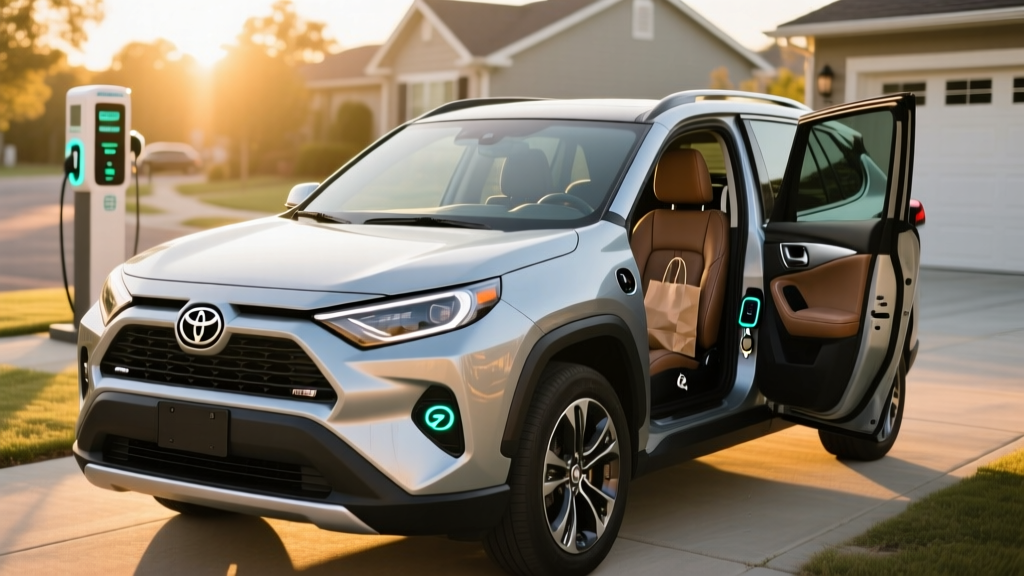
Quick Verdict: The 2018 RAV4 Hybrid in 2026
The 2018 Toyota RAV4 Hybrid is a conventional hybrid electric vehicle (HEV) — not a plug-in. It requires no charging infrastructure, delivers an EPA-estimated 32 MPG combined, and has earned a reputation as one of the most reliable compact hybrid SUVs ever sold. Eight years after its model year, it remains a strong used-vehicle buy for drivers who want hybrid efficiency without the complexity of plugging in.
This guide covers everything a 2026 buyer or current owner needs: exact fuel economy data, real-world MPG expectations, the hybrid battery warranty and replacement economics, how it compares to the RAV4 Prime (PHEV) and full EVs, and whether any tax credits still apply.
HEV vs PHEV: What the 2018 RAV4 Hybrid Actually Is
Conventional Hybrid (HEV): The 2018 RAV4 Hybrid uses a gasoline engine paired with electric motors and a small battery pack that recharges through regenerative braking and the engine. You never plug it in. The electric motor assists during acceleration and enables brief low-speed electric-only driving, but the gas engine is always the primary energy source.
Plug-In Hybrid (PHEV) — Not This Vehicle: Toyota introduced the RAV4 Prime (PHEV) for the 2021 model year. The RAV4 Prime has a larger 18.1 kWh battery, 42 miles of electric-only range, and requires plugging in to access its full benefit. The 2018 RAV4 Hybrid predates the Prime and is a fundamentally different powertrain.
| Attribute | 2018 RAV4 Hybrid (HEV) | 2026 RAV4 Prime (PHEV) |
|---|---|---|
| Plugs in? | No | Yes (Level 1/2) |
| Battery size | ~1.6 kWh (NiMH) | 18.1 kWh (Li-ion) |
| Electric-only range | ~0.5 mi at low speed | 42 mi (EPA) |
| Combined HP | 194 hp | 302 hp |
| EPA combined MPG/MPGe | 32 MPG | 94 MPGe / 38 MPG (gas) |
| 0–60 mph | 7.8 sec | 5.7 sec |
| Federal tax credit (new) | None | Up to $7,500 (§30D, if eligible) |
Fuel Economy: EPA Numbers and Real-World MPG
| Metric | Value |
|---|---|
| City MPG | 34 MPG |
| Highway MPG | 30 MPG |
| Combined MPG | 32 MPG |
| Fuel tank capacity | 14.8 gallons |
| Total driving range | ~474 miles |
Source: EPA fueleconomy.gov
Real-World MPG Expectations: Toyota's hybrid system excels in stop-and-go city driving, where regenerative braking recaptures energy and the electric motor handles low-speed propulsion. Many owners report 35–38 MPG in city driving, exceeding the EPA city estimate. Highway driving at sustained 70+ mph is where the hybrid advantage narrows — expect 28–31 MPG on the highway, slightly below the EPA figure. In cold weather (below 30°F), expect a 5–10% reduction as the engine runs more frequently for cabin heat and battery conditioning.
Powertrain and Performance Specs
The 2018 RAV4 Hybrid pairs a 2.5-liter inline-four Atkinson-cycle gasoline engine with Toyota's Hybrid Synergy Drive system. Here's the full breakdown:
| Spec | Value |
|---|---|
| Engine | 2.5L I4 Atkinson-cycle |
| Engine output | 150 hp / 135 lb-ft torque |
| Front electric motor | 105 kW (141 hp) |
| Rear electric motor (AWD models) | 50 kW (67 hp) |
| Net combined system horsepower | 194 hp |
| Transmission | eCVT (electronically controlled) |
| Drivetrain | AWD (electronic on-demand rear motor) |
| 0–60 mph | 7.8 seconds |
| Hybrid battery | ~1.6 kWh Nickel-Metal Hydride (NiMH) |
| Towing capacity | 1,750 lbs |
The eCVT is not a traditional belt-driven CVT — it uses a planetary gearset to blend engine and motor power, which contributes to the RAV4 Hybrid's long-term reliability since there are no belts or friction clutches to wear.
Hybrid Battery Warranty, Lifespan, and Replacement Cost
Toyota Hybrid Battery Warranty: For the 2018 model year, Toyota covers the hybrid battery with a 8-year / 100,000-mile warranty (10-year/150,000-mile in California and states that follow CARB emissions standards). This covers capacity loss below a defined threshold and manufacturing defects.
Real-World Lifespan: Toyota's NiMH hybrid batteries have proven exceptionally durable. Data from fleet operators and long-term owner surveys show these packs commonly lasting 150,000–200,000+ miles before significant degradation. Many first-generation Prius packs (a similar system) exceeded 200,000 miles with under 20% capacity loss.
Replacement cost in 2026: If the hybrid battery does eventually need replacement outside of warranty:
- New OEM Toyota battery pack: $3,000–$4,500 (parts + dealer labor)
- Refurbished/remanufactured pack: $1,500–$2,500 (independent hybrid specialist)
- Individual module replacement: $500–$1,200 (only failed modules replaced — viable option for NiMH packs with one or two bad cells)
The NiMH chemistry in the 2018 RAV4 Hybrid is less energy-dense than modern lithium-ion packs but is more tolerant of deep cycling and extreme temperatures, which contributes to its longevity. Unlike a full EV battery (60–100 kWh), this 1.6 kWh pack is small and relatively affordable to replace.
Pricing, Used Market Value, and Tax Credit Eligibility
The 2018 RAV4 Hybrid was sold in three trims when new:
| Trim | Original MSRP | 2026 Used Range (est.) |
|---|---|---|
| XLE | $30,790 | $16,000–$19,500 |
| SE | $32,450 | $17,500–$21,000 |
| Limited | $36,230 | $19,500–$24,000 |
Used pricing varies significantly by mileage, condition, and region. Check Kelley Blue Book or Edmunds for current local valuations.
Tax Credit Reality: The 2018 RAV4 Hybrid does not qualify for the federal §30D clean vehicle tax credit. Conventional hybrids (HEVs) have never been eligible for this credit — it applies only to plug-in electric vehicles (BEVs and PHEVs) with battery packs of at least 7 kWh. The used-EV credit (§25E, up to $4,000) also requires the vehicle to be a plug-in. No federal tax incentive is available for purchasing a used 2018 RAV4 Hybrid in 2026. Some states may offer registration or HOV-lane benefits — check your state's energy office for specifics.
2018 RAV4 Hybrid vs PHEV vs Full EV: Which Fits You?
This is the core decision framework for anyone cross-shopping the 2018 RAV4 Hybrid against newer plug-in alternatives:
Choose the 2018 RAV4 Hybrid (HEV) If:
- You cannot charge at home or work (apartment, street parking)
- Your budget is $16K–$24K
- You drive 10,000–15,000 miles/year and want lower fuel costs without behavior change
- You value maximum reliability and low maintenance
- You take frequent long road trips and don't want to plan around chargers
Choose a PHEV (RAV4 Prime) If:
- You can install a Level 2 charger at home
- Your daily commute is under 40 miles (cover it all on electricity)
- You want EV-like daily driving with gas-engine backup for road trips
- You qualify for the §30D tax credit on a new purchase (up to $7,500)
- You want significantly more power (302 hp vs 194 hp)
Choose a Full EV (e.g., Tesla Model Y, Hyundai Ioniq 5) If:
- You have reliable home Level 2 charging
- Your daily driving is under 250 miles and you're comfortable with road-trip charging stops
- You want the lowest per-mile energy cost (electricity at $0.12/kWh ≈ $0.04/mile vs gas at $3.50/gal ≈ $0.11/mile)
- You want to eliminate oil changes and reduce brake wear (regen braking)
- You qualify for federal/state EV incentives
Ownership Costs: 5-Year Fuel Savings
Here's how the 2018 RAV4 Hybrid's fuel costs compare to its gas-only counterpart over 5 years at 15,000 miles/year:
| Vehicle | Combined MPG | Gallons Used | Fuel Cost @ $3.50/gal |
|---|---|---|---|
| 2018 RAV4 Hybrid AWD | 32 MPG | 2,344 gal | $8,203 |
| 2018 RAV4 Gas AWD | 25 MPG | 3,000 gal | $10,500 |
| 5-Year Savings | 656 gal saved | $2,297 |
At higher gas prices ($4.50/gal), that savings grows to roughly $2,952. The hybrid premium on the used market has largely been absorbed by depreciation, so the fuel savings flow directly to the owner.
Reliability and Safety
The 2018 RAV4 Hybrid carries strong reliability credentials:
- Consumer Reports: Rated above average for predicted reliability across most model years of this generation (2016–2018).
- NHTSA: Received a 5-star overall safety rating. See full results at NHTSA.gov.
- IIHS: Earned "Good" ratings in most crash tests, though headlight ratings varied by trim.
- Toyota Safety Sense P (TSS-P): Standard on all 2018 RAV4 Hybrid trims — includes pre-collision system with pedestrian detection, lane departure alert with steering assist, automatic high beams, and full-speed-range dynamic radar cruise control.
Common maintenance items at 80,000–120,000 miles include brake actuator inspection (the regenerative braking system can cause the friction brakes to corroate from underuse — periodic inspection is recommended), coolant system service, and standard suspension wear.
Pros and Cons
Pros
- Proven, durable hybrid system with 200K+ mile track record
- No plug-in charging required — works everywhere gas does
- Standard AWD with electronic rear motor
- Standard Toyota Safety Sense (adaptive cruise, lane keep, AEB)
- City MPG exceeds EPA estimate in real-world driving
- Low maintenance costs (no turbo, no traditional transmission)
Cons
- Highway MPG falls slightly below EPA (28–31 real-world)
- Small NiMH battery limits electric-only driving to under 1 mile
- No DC fast charging capability (not applicable to HEV)
- Modest 194 hp — adequate but not quick by 2026 standards
- No federal tax credit available
- Older infotainment (no wireless CarPlay, dated UI)
Frequently Asked Questions
How many MPG does the 2018 Toyota RAV4 Hybrid get?
The EPA rates the 2018 RAV4 Hybrid at 34 city / 30 highway / 32 combined MPG. In real-world driving, city MPG often reaches 35–38 thanks to the hybrid system's regenerative braking, while highway driving at 70+ mph typically returns 28–31 MPG. Cold weather reduces efficiency by 5–10%.
Does the 2018 RAV4 Hybrid need to be plugged in?
No. The 2018 RAV4 Hybrid is a conventional hybrid (HEV). Its small 1.6 kWh NiMH battery charges entirely through regenerative braking and the gasoline engine. You simply fill it with gas like any other vehicle. This is fundamentally different from the RAV4 Prime (PHEV), which does require plugging in to access its 42-mile electric-only range.
Is the 2018 RAV4 Hybrid reliable, and what does battery replacement cost?
Yes — Toyota's hybrid system is among the most proven in the industry. The NiMH battery pack commonly lasts 150,000–200,000+ miles. The hybrid battery is warranted for 8 years/100,000 miles (10/150K in CARB states). If replacement is needed out of warranty, expect $3,000–$4,500 for a new OEM pack, $1,500–$2,500 for a refurbished unit, or $500–$1,200 for individual module replacement.
Does the 2018 RAV4 Hybrid qualify for any tax credit?
No federal tax credit is available for the 2018 RAV4 Hybrid. The §30D clean vehicle credit applies only to plug-in vehicles (BEVs and PHEVs). The used-EV credit (§25E) also excludes conventional hybrids. Some states offer minor incentives or HOV-lane access for hybrids — check your state's energy office or the Alternative Fuels Data Center for state-specific programs.
How does the 2018 RAV4 Hybrid compare to a full EV?
The RAV4 Hybrid offers 32 MPG combined with zero charging requirements and ~474 miles of total range. A full EV like the Tesla Model Y delivers 260–330 miles of range per charge, costs roughly $0.04/mile to fuel (vs ~$0.11/mile for the RAV4 Hybrid at $3.50/gal), but requires home charging infrastructure and planning for long trips. The RAV4 Hybrid is the right choice if you can't charge at home, take frequent road trips through areas with limited charging infrastructure, or want the lowest-complexity path to better fuel economy.
Can the 2018 RAV4 Hybrid's battery be upgraded or replaced with a larger one?
No. The hybrid system is designed around its specific 1.6 kWh NiMH pack. There is no factory or aftermarket upgrade path to a larger battery. If you want extended electric-only range, the RAV4 Prime (PHEV) with its 18.1 kWh lithium-ion pack is the correct vehicle — but it's a different platform introduced in 2021.