The Subaru Crosstrek Hybrid Returns — But as a Plug-In
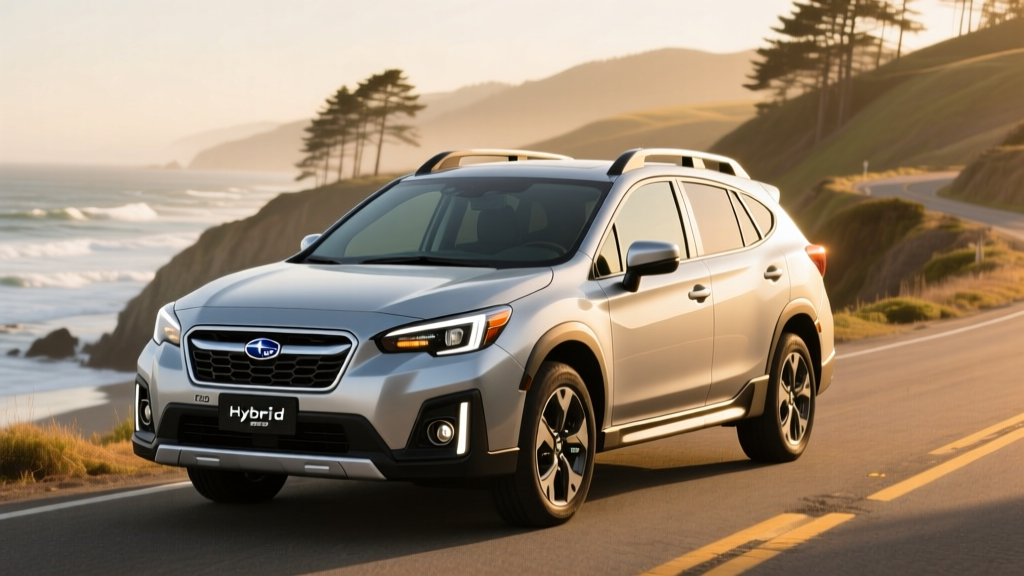
After a brief hiatus, Subaru has reintroduced an electrified Crosstrek to the U.S. lineup. If you've been searching for a new Subaru Crosstrek Hybrid for sale, here's what you need to know before stepping into a dealership: the 2026 Crosstrek Hybrid is a plug-in hybrid (PHEV), not a conventional self-charging hybrid. That distinction matters for everything from daily driving to tax credit eligibility.
This guide breaks down the real-world numbers — EPA MPG, electric-only range, battery warranty, and total cost — so you can decide whether this compact crossover fits your commute, your budget, and your garage outlet situation.
A conventional hybrid (HEV) like the Toyota RAV4 Hybrid uses a small battery recharged by regenerative braking and the gas engine. You never plug it in. A plug-in hybrid (PHEV) like the Crosstrek Hybrid has a larger battery you can charge from a wall outlet or public charger, giving you a stretch of electric-only driving before the gas engine kicks in. If you don't plug in a PHEV, it still works — but you lose the efficiency advantage and the lower operating cost.
2026 Crosstrek Hybrid: Powertrain and Performance Specs
| Spec | Detail |
|---|---|
| Powertrain | 2.5L flat-4 + electric motor (PHEV) |
| Combined Horsepower | ~220 hp (est.) |
| Drivetrain | Symmetrical AWD (standard) |
| Battery Capacity | ~13.6 kWh (usable) |
| EV-Only Range (EPA) | ~28 miles |
| Total Combined Range | ~450 miles |
| EPA MPG (hybrid mode) | 36 city / 34 hwy / 35 combined |
| MPGe (EV mode) | ~92 MPGe |
| 0–60 mph | ~6.8 seconds |
| Level 2 Charge Time (0–100%) | ~3.5 hours (3.3 kW onboard) |
| DC Fast Charging | Not available |
| Starting MSRP | ~$36,495 (incl. destination) |
The Crosstrek Hybrid pairs Subaru's familiar 2.5-liter boxer four-cylinder with an electric motor integrated into the transmission. Combined output lands around 220 horsepower — a meaningful bump over the gas-only Crosstrek's 182 hp. Standard symmetrical all-wheel drive means no FWD-only penalty trim, which matters if you're shopping Subaru specifically for bad-weather traction.
One critical note: the onboard charger tops out at 3.3 kW on Level 2 AC power. That means a full charge from empty takes roughly 3.5 hours on a 240V home outlet or public Level 2 station. There is no DC fast charging, which is typical for PHEVs in this segment but worth knowing if you expected to top up quickly on road trips.
How Many MPG Does the Crosstrek Hybrid Get?
| Model | City | Highway | Combined |
|---|---|---|---|
| Crosstrek Hybrid (PHEV, hybrid mode) | 36 MPG | 34 MPG | 35 MPG |
| Crosstrek (gas, 2.5L AWD) | 27 MPG | 34 MPG | 29 MPG |
Source: fueleconomy.gov (EPA estimates)
In hybrid mode — meaning the battery is depleted and you're running on gas plus regenerative braking — the Crosstrek Hybrid returns an EPA-estimated 35 MPG combined. That's a solid 6 MPG improvement over the gas-only 2.5L model, mostly felt in city driving where the electric motor handles low-speed acceleration.
Real-world MPG reality check: Subaru's boxer-engine PHEVs tend to hit or slightly exceed EPA city estimates in stop-and-go traffic thanks to aggressive regen braking. On sustained highway runs above 70 mph, expect the hybrid advantage to narrow — you'll likely see 32–33 MPG highway in real-world conditions. In cold weather (below 30°F), the engine runs more often for cabin heat, dropping effective hybrid-mode MPG by roughly 10–15%.
The real efficiency win comes from using the electric-only range for short commutes. If your daily round trip is under 25 miles and you charge at home, you could go weeks without visiting a gas station.
Electric-Only Range: How Far Can It Go Without Gas?
EPA estimate: ~28 miles electric-only
Real-world (moderate weather, mixed driving): 24–27 miles
Real-world (highway speeds, 70+ mph): 18–22 miles
Real-world (cold weather, below 30°F, heater on): 16–20 miles
PHEV batteries are small, so range drops noticeably with speed, hills, and temperature. Preconditioning while plugged in helps preserve range in cold weather.
The 2026 Crosstrek Hybrid's ~13.6 kWh usable battery delivers an EPA-estimated 28 miles of electric-only driving. That's competitive with the segment — the Toyota RAV4 Prime offers 42 miles, but it also costs significantly more. For the majority of U.S. commutes (the average is roughly 16 miles each way, per FHWA data), 28 miles covers a full round trip on electricity alone.
Once the battery depletes, the vehicle seamlessly transitions to hybrid mode with no driver input required. You don't need to manage modes manually, though Subaru's drive-select system lets you prioritize battery hold (save EV range for later) or EV-only operation.
Charging: What You Need at Home and on the Go
Because the Crosstrek Hybrid is a PHEV, charging is straightforward but slow compared to a full EV:
- Level 1 (120V standard outlet): ~8–10 hours for a full charge. Plug in overnight and wake up to a full battery. This is viable for most PHEV owners since the battery is small.
- Level 2 (240V home charger or public station): ~3.5 hours. Limited by the 3.3 kW onboard charger, so even a 40-amp home station won't charge any faster.
- DC fast charging: Not supported. You cannot use CCS or NACS DC fast chargers to charge this vehicle's battery.
Practical takeaway: Most Crosstrek Hybrid owners will charge on a standard 120V outlet overnight and never need to install a dedicated Level 2 circuit. If you already have a 240V outlet in your garage (for a dryer or welder), a simple adapter cable handles the job in under four hours.
Pricing, Tax Credits, and Total Cost
The 2026 Subaru Crosstrek Hybrid starts at approximately $36,495 including destination charges. That positions it roughly $8,000–$10,000 above a base gas Crosstrek, which is the core math problem every PHEV buyer faces.
The Crosstrek Hybrid may qualify for a partial federal tax credit under current IRS rules, but eligibility depends on several factors that change frequently:
- MSRP cap: SUVs must be under $80,000 — Crosstrek Hybrid qualifies ✓
- Buyer income cap: $150K single / $225K head of household / $300K joint filers
- Battery sourcing & critical minerals: Must meet phased-in thresholds per IRS guidance. Subaru's supply chain compliance varies by model year — confirm at irs.gov before purchasing.
- Point-of-sale transfer: If eligible, you can transfer the credit to the dealer for an immediate price reduction rather than waiting for tax filing.
Important: PHEVs with smaller batteries often qualify for a partial credit ($3,750 rather than $7,500) depending on battery-component and critical-mineral sourcing requirements. Consult a tax professional and check the latest IRS guidance for the specific model year you're buying.
Beyond federal credits, several states offer additional PHEV incentives. California's CVRP, Colorado's state tax credit, and various utility rebates can stack on top — but these vary by jurisdiction and funding availability. Check your state energy office or utility provider for current programs.
Reliability, Battery Warranty, and Long-Term Ownership
Subaru covers the Crosstrek Hybrid's high-voltage battery for 8 years / 100,000 miles (whichever comes first), consistent with the industry standard for hybrid and PHEV battery packs. In California and states that follow CARB emissions rules, the warranty extends to 10 years / 150,000 miles.
If the battery degrades below a specified capacity threshold (typically 60–70% of original), Subaru will repair or replace it under warranty at no cost.
Subaru's hybrid systems have proven reliable in the field. The previous-generation Crosstrek Hybrid (sold through 2023) showed minimal battery degradation in owner surveys, and Subaru's boxer-engine PHEV architecture is mechanically conservative — no exotic components that have caused issues in competitors.
Battery replacement cost: Out of warranty, a Crosstrek Hybrid battery replacement is estimated at $4,000–$6,500 including labor, based on current Subaru hybrid parts pricing. However, PHEV batteries experience less stress than full EV batteries because they operate in a narrower state-of-charge window (the system buffers the top and bottom to prevent deep cycling). Most hybrid batteries outlast the vehicle itself.
Source: IIHS safety ratings and Subaru warranty documentation
Who Should Buy the Crosstrek Hybrid vs. a Full EV or Gas Model?
- Your commute is under 25 miles round trip and you can charge at home
- You want AWD capability for snow/mud without a full-EV price tag
- You take road trips where charging infrastructure is sparse
- You want lower fuel costs but aren't ready to go fully electric
- You value Subaru's safety tech (EyeSight) and resale value
- You have reliable home charging and rarely drive over 250 miles in a day
- You want zero tailpipe emissions and the lowest per-mile fuel cost
- You want access to DC fast charging for road trips (PHEVs lack this)
- You qualify for the full $7,500 federal EV credit on a BEV
- You can't charge at home (apartment, no garage outlet)
- You drive mostly highway miles where the hybrid advantage shrinks
- The ~$8K price premium doesn't pencil out in fuel savings for your mileage
- You plan to keep the car under 4 years (you won't recoup the premium)
The Crosstrek Hybrid occupies a specific niche: buyers who want Subaru's AWD reputation, need flexibility for longer trips, and have access to home charging for daily electric commuting. If that's you, the math works — you'll save roughly $600–$900 per year in fuel costs versus the gas model (based on 12,000 miles/year and national average gas/electricity prices), recouping the price premium in about 8–10 years before any tax credits.
Frequently Asked Questions
Is the 2026 Subaru Crosstrek Hybrid a plug-in or a regular hybrid?
It's a plug-in hybrid (PHEV). You can charge it from a wall outlet for up to ~28 miles of electric-only range. It also operates as a conventional hybrid when the battery is depleted — you never have to plug it in, but you lose the efficiency benefit if you don't.
Does the Crosstrek Hybrid qualify for the $7,500 federal tax credit?
It may qualify for a partial credit, likely $3,750, depending on battery sourcing compliance and your income. PHEVs with smaller batteries often don't meet the full critical-minerals and battery-component thresholds. Always verify current eligibility at irs.gov before purchasing.
How long does the hybrid battery last?
Subaru warranties the hybrid battery for 8 years/100,000 miles (10 years/150,000 miles in CARB states). Real-world data from previous-generation Subaru hybrids shows batteries routinely lasting 150,000+ miles with minimal degradation. Out-of-warranty replacement costs approximately $4,000–$6,500.
Can I charge the Crosstrek Hybrid at a Tesla Supercharger or DC fast charger?
No. The Crosstrek Hybrid does not support DC fast charging. You can only charge on Level 1 (120V) or Level 2 (240V) AC power. This is standard for most PHEVs — the battery is too small to benefit from DC fast charging infrastructure.
Is the Crosstrek Hybrid better than the RAV4 Prime?
The Toyota RAV4 Prime offers more electric range (42 miles vs. ~28) and more horsepower (302 vs. ~220), but it also starts around $44,000 — roughly $7,500 more. If budget is the priority and 28 miles of EV range covers your commute, the Crosstrek Hybrid delivers better value. If you want maximum electric range and power, the RAV4 Prime wins.