The Toyota Camry Hybrid car has become one of the most compelling midsize sedans for buyers who want electrified efficiency without changing their driving or fueling habits. For 2026, Toyota continues its hybrid-only Camry strategy — meaning every new Camry rolling off the line is a hybrid. There's no gas-only option anymore, and frankly, there doesn't need to be. The fifth-generation Toyota Hybrid System (THS) delivers up to 51 MPG combined while maintaining the practical, roomy sedan formula that made the Camry a best-seller for decades.
But the Camry lineup also includes a plug-in hybrid variant — the Camry Prime — which adds genuine electric-only commuting capability. Understanding the difference between these two approaches is critical to choosing the right one. This guide breaks down every number that matters: EPA MPG, real-world fuel economy, powertrain output, battery warranty, pricing, and whether any tax credits apply.
HEV vs PHEV: Understanding the Two Camry Hybrid Options
Before diving into specs, it's essential to understand the fundamental difference between the standard Camry Hybrid (HEV) and the Camry Prime (PHEV). They share the same 2.5-liter four-cylinder engine and hybrid architecture, but their relationship to the electrical grid is completely different.
Conventional Hybrid (HEV) — Standard Camry Hybrid
You never plug it in. The battery recharges through regenerative braking and the gasoline engine. It's a self-contained system. You drive it exactly like a gas car — fill up at the station, and the hybrid system works invisibly in the background to cut your fuel consumption by roughly 40% compared to a non-hybrid midsize sedan.
Plug-In Hybrid (PHEV) — Camry Prime
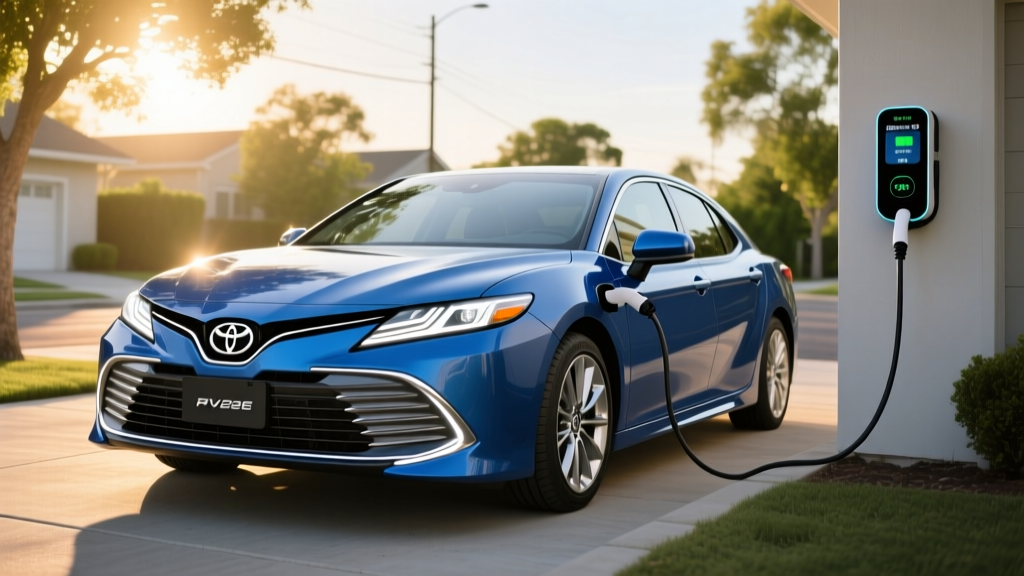
You can plug it in to charge a larger battery that provides roughly 40+ miles of pure electric driving before the gasoline engine kicks in. Once the battery depletes, it operates as a conventional hybrid. The PHEV gives you EV-like commuting with a gas-engine safety net for longer trips — but only if you have access to a place to plug in regularly.
If you cannot charge at home or at work, the standard HEV is the clear choice. A PHEV you never plug in is just a heavier, more expensive hybrid.
Fuel Economy: EPA MPG and Real-World Numbers
The headline number for the 2026 Toyota Camry Hybrid car is its EPA-rated fuel economy. Front-wheel-drive models achieve an outstanding 53 MPG city / 50 MPG highway / 51 MPG combined, according to fueleconomy.gov. All-wheel-drive variants sacrifice slightly, landing at 51 city / 49 highway / 50 combined.
| Trim / Drivetrain | City MPG | Highway MPG | Combined MPG |
|---|---|---|---|
| LE (FWD) | 53 | 50 | 51 |
| SE / XLE (FWD) | 53 | 50 | 51 |
| SE / XLE (AWD) | 51 | 49 | 50 |
| Camry Prime (PHEV, depleted battery) | 48 | 47 | 47 |
Powertrain Specs: Horsepower, Engine, and Battery
The 2026 Camry Hybrid uses Toyota's fifth-generation hybrid system, pairing a 2.5-liter Dynamic Force four-cylinder engine with one or two electric motor-generators. FWD models use a single front motor; AWD models add a rear-mounted electric motor that provides torque to the rear wheels when needed — there is no mechanical driveshaft connecting the engine to the rear axle.
| Specification | Camry Hybrid (HEV) | Camry Prime (PHEV) |
|---|---|---|
| Combined System Horsepower | 225 hp (FWD) / 232 hp (AWD) | 225 hp |
| Engine | 2.5L I4 Atkinson-cycle | 2.5L I4 Atkinson-cycle |
| Hybrid Battery (usable) | ~1.6 kWh (Lithium-ion) | ~13.6 kWh (Lithium-ion) |
| Electric-Only Range | N/A (assists only) | ~42 miles (EPA est.) |
| Total Combined Range | ~620 miles | ~580 miles |
| 0-60 mph (est.) | ~7.0 seconds | ~7.1 seconds |
| Transmission | eCVT | eCVT |
| Drivetrain | FWD or AWD | FWD |
The Camry Hybrid's 1.6 kWh battery is small by EV standards — it's not designed for electric-only driving. Instead, it acts as a buffer, capturing braking energy and providing electric-motor assist to reduce the engine's workload. The Camry Prime's 13.6 kWh pack is roughly 8.5 times larger, enabling genuine zero-emission commuting for most daily round trips.
Camry Prime Charging Details
The Camry Prime charges via a standard J1772 connector on Level 1 (120V) in approximately 10–12 hours, or on Level 2 (240V, ~3.3 kW) in roughly 4 hours. DC fast charging is not available on the Camry Prime. This is common for PHEVs — their smaller batteries don't justify the cost and weight of DC fast-charge hardware. For overnight home charging on a standard 240V outlet or Level 2 station, 4 hours is more than sufficient to fully replenish the battery each night.
Pricing, Trims, and Tax Credit Eligibility
The 2026 Toyota Camry Hybrid car starts at an MSRP of approximately $29,990 for the LE FWD trim, including destination charge. The lineup spans four main trims for the HEV, with the AWD option adding roughly $1,500 to any trim:
- LE (FWD/AWD): ~$29,990 / ~$31,490
- SE (FWD/AWD): ~$32,490 / ~$33,990
- XLE (FWD/AWD): ~$35,190 / ~$36,690
- XSE (FWD/AWD): ~$36,290 / ~$37,790
- Camry Prime SE (PHEV): ~$37,500
- Camry Prime XSE (PHEV): ~$39,500
Does the Camry Hybrid Qualify for a Federal Tax Credit?
This is where buyers need to be precise. Under current IRS §30D rules:
- Standard Camry Hybrid (HEV): Does NOT qualify for the federal clean vehicle tax credit. The §30D credit requires a minimum 7 kWh battery capacity and plug-in capability. The HEV's ~1.6 kWh battery does not meet this threshold.
- Camry Prime (PHEV): May qualify for up to $3,750 (partial credit) depending on battery-component and critical-mineral sourcing requirements. The full $7,500 credit requires both the battery-component and critical-minerals tests to be satisfied. Because Toyota's PHEV battery supply chain still involves non-qualifying sourcing for some components, the Camry Prime typically earns the $3,750 half-credit. Eligibility also depends on buyer income caps ($150K single / $300K joint) and MSRP caps ($55,000 for sedans). The credit can be transferred to the dealer at point of sale as an instant discount.
Always verify current credit eligibility with your tax professional and the IRS Clean Vehicle Credit pages before purchasing, as sourcing requirements tighten annually.
Battery Warranty, Reliability, and Replacement Costs
Hybrid battery longevity remains one of the top concerns for first-time hybrid buyers. Toyota addresses this with one of the strongest warranty packages in the industry.
Toyota Hybrid Battery Warranty
Coverage: 10 years / 150,000 miles (whichever comes first) for the hybrid battery pack on all 2026 Camry Hybrid and Camry Prime models.
What's covered: Battery capacity loss below a specified threshold (typically ~70% of original capacity) and any manufacturing defects in the hybrid battery, inverter, or related components.
Additional: The hybrid system (motor-generators, control unit) is also covered under the 8-year/100,000-mile hybrid system warranty, with the battery extending to the full 10/150K.
Real-World Battery Longevity
Toyota's hybrid battery track record is exceptional. Data from fleet operators and long-term owners shows that Toyota hybrid batteries routinely last 150,000–200,000+ miles before significant degradation. The Camry's hybrid battery is relatively small and operates within a narrow state-of-charge window (roughly 40–80%), which dramatically reduces stress on the cells compared to a full EV that cycles from 10–90% regularly.
For the Camry Prime PHEV, the larger battery experiences deeper cycles during electric-only driving, but Toyota's thermal management and charge-buffering strategies still prioritize longevity. Real-world data from earlier Toyota PHEV models (RAV4 Prime, Prius Prime) shows minimal degradation in the first 80,000–100,000 miles.
Battery Replacement Cost
If a hybrid battery does fail outside of warranty, replacement costs for the standard Camry HEV battery typically range from $2,000 to $4,000 (parts and labor). The Camry Prime's larger PHEV battery replacement runs higher, estimated at $5,000 to $8,000. However, given Toyota's track record and the 10-year warranty, most owners will never face this expense. Independent hybrid-battery repair shops can also replace individual modules for $500–$1,500 in some cases.
Who Should Choose the Camry Hybrid vs a Full EV or Gas Car?
Choose the Camry Hybrid (HEV) If:
- You want 50+ MPG without changing any habits — no plugging in, no route planning
- You don't have access to home or workplace charging
- You regularly take long road trips and don't want to deal with charging infrastructure
- You want lower upfront cost ($30K starting) with minimal maintenance
- You live in an area with extreme cold, where EV range loss is a concern
Choose the Camry Prime (PHEV) If:
- You have reliable home charging (even a 120V outlet works overnight)
- Your daily commute is under 40 miles round-trip — you could almost never use gas on weekdays
- You want EV-like daily driving with gas-engine flexibility for weekend road trips
- You want to reduce your gasoline consumption by 70–80% without range anxiety
Choose a Full EV (like the Tesla Model 3 or Hyundai Ioniq 6) If:
- You have reliable Level 2 home charging and access to DC fast chargers for road trips
- You want zero tailpipe emissions and the lowest per-mile "fuel" cost
- You want to eliminate oil changes and engine maintenance entirely
- You qualify for the full $7,500 federal EV tax credit, narrowing the price gap
The Camry Hybrid occupies a specific and valuable niche: it delivers hybrid efficiency to people who simply want to buy a car, drive it normally, and spend less on gas. No apps, no charging networks, no preconditioning — just fill up less often.
Pros and Cons at a Glance
✓ Pros
- 51 MPG combined — among the best of any midsize sedan
- No plug-in required; zero lifestyle changes
- AWD available across all trims
- 10-year / 150,000-mile hybrid battery warranty
- Proven Toyota reliability and strong resale value
- Spacious cabin with 15.1 cu ft trunk (HEV)
- Standard Toyota Safety Sense 3.0 (ADAS suite)
✗ Cons
- No federal tax credit for the HEV variant
- CVT drone under hard acceleration (eCVT, but still noticeable)
- PHEV (Prime) not eligible for full $7,500 credit
- No DC fast charging on the Prime
- AWD not available on Camry Prime
- Interior materials good but not premium at upper trims
- Hybrid battery replacement cost if out of warranty
Frequently Asked Questions
How many MPG does the 2026 Toyota Camry Hybrid get?
The EPA rates the FWD Camry Hybrid at 53 city / 50 highway / 51 combined MPG. AWD models achieve 51/49/50. In real-world city driving, many owners report exceeding the EPA city rating, seeing 52–56 MPG in stop-and-go traffic thanks to aggressive regenerative braking.
How far can the Camry Prime go on electric only?
The 2026 Camry Prime PHEV delivers an EPA-estimated 42 miles of electric-only range on a full charge. This covers the average American's daily commute (roughly 35 miles round-trip) entirely on electricity. Once the battery depletes, the car seamlessly transitions to hybrid mode at 47 MPG combined.
Is the Toyota Camry Hybrid reliable?
Toyota's hybrid system is one of the most proven electrified powertrains in the world, with over 25 years of continuous refinement since the original Prius. The Camry Hybrid consistently earns top reliability ratings from Consumer Reports and J.D. Power. The hybrid battery is warrantied for 10 years / 150,000 miles, and real-world data shows these batteries regularly lasting 150,000–200,000+ miles.
Does the Camry Hybrid qualify for any tax credit?
The standard Camry Hybrid (HEV) does not qualify for the federal §30D clean vehicle credit because its battery is too small and it cannot be plugged in. The Camry Prime (PHEV) may qualify for up to $3,750 in partial credit, subject to battery-sourcing requirements, buyer income limits, and MSRP caps. Some states offer additional hybrid or PHEV rebates — check your state energy office for local programs.
What is the Camry Hybrid battery replacement cost?
Out-of-warranty replacement for the standard HEV battery runs $2,000–$4,000, while the Prime's larger PHEV battery costs $5,000–$8,000. However, Toyota's 10-year/150,000-mile warranty and the proven longevity of their hybrid batteries mean most owners will never need a replacement.
Can I charge the standard Camry Hybrid at home?
No. The standard Camry Hybrid (HEV) has no plug and no charging port. It generates all its electrical energy internally through regenerative braking and the gasoline engine. Only the Camry Prime (PHEV) can be plugged in to charge.
Is the Camry Hybrid good for road trips?
Excellent. With a 13.2-gallon fuel tank and 51 MPG combined, the FWD Camry Hybrid can travel roughly 620+ miles between fill-ups. You'll stop for gas less often than in virtually any non-electric sedan, and you never need to plan around charging stations.