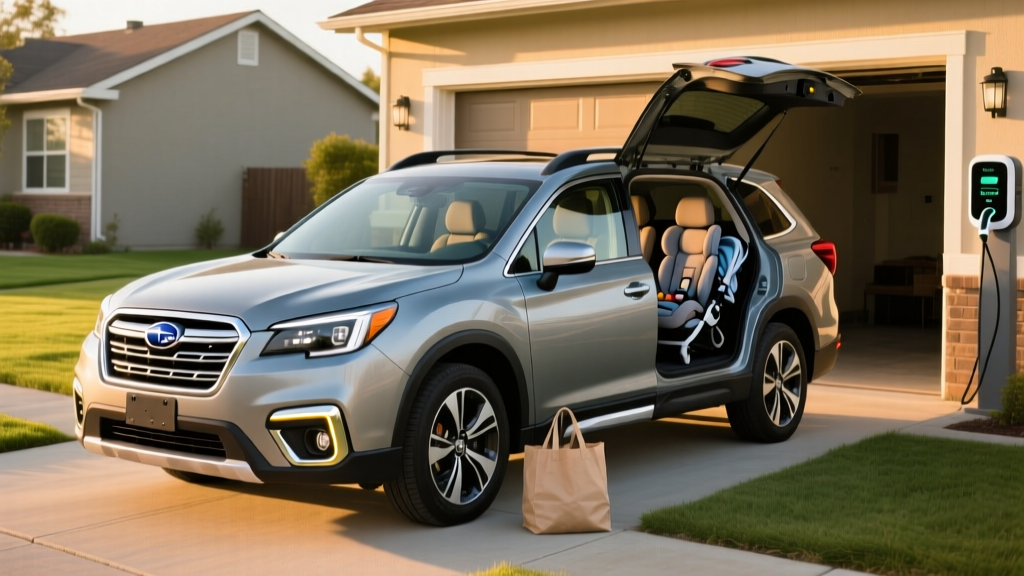
Subaru's largest SUV finally gets an electrified option. The 2026 Subaru Ascent Hybrid arrives as a conventional hybrid (HEV) — meaning no plug, no range anxiety, and no change to your daily routine beyond fewer stops at the gas station. For families who need three rows, standard all-wheel drive, and Subaru's reputation for all-weather capability, the Ascent Hybrid offers a middle path between the gas-only Ascent and a full battery-electric vehicle.
But does the hybrid powertrain deliver enough fuel savings to justify its premium over the standard Ascent? And how does it compare to plug-in hybrid rivals or going full EV? This guide breaks down every spec that matters — from EPA MPG to battery warranty — so you can decide if the 2026 Ascent Hybrid fits your driveway.
HEV vs PHEV: What the Ascent Hybrid Actually Is
Before diving into specs, it's essential to understand what you're buying. The 2026 Subaru Ascent Hybrid is a conventional hybrid (HEV), not a plug-in hybrid (PHEV). Here's the difference:
| Feature | HEV (Ascent Hybrid) | PHEV (e.g., Toyota Grand Highlander Hybrid) |
|---|---|---|
| Plug-in charging required? | No | Yes (for EV range) |
| Electric-only driving | Limited (low-speed assist) | 20–40 miles typical |
| Battery size | ~1.1 kWh (self-charging) | 18–25 kWh |
| Federal tax credit (§30D) | Not eligible | Up to $7,500 (if eligible) |
| Charging infrastructure needed | None | Level 2 home charger recommended |
| Best for | Drivers without home charging access | Drivers with home charging and short commutes |
The Ascent Hybrid recovers energy through regenerative braking and the gasoline engine to recharge its small battery. You never plug it in. You simply drive it like any other car — it just uses less fuel in the process.
2026 Subaru Ascent Hybrid: Powertrain & Performance Specs
Subaru pairs its proven 2.4-liter turbocharged BOXER four-cylinder engine with an electric motor integrated into the transmission. The result is a combined output that improves both low-end torque and overall efficiency while retaining the standard Symmetrical All-Wheel Drive Subaru buyers expect.
| Specification | 2026 Subaru Ascent Hybrid |
|---|---|
| Engine | 2.4L turbocharged BOXER 4-cylinder + electric motor |
| Combined Horsepower | 290 hp (est.) |
| Combined Torque | 290 lb-ft (est.) |
| Transmission | CVT (Lineartronic) with hybrid motor integration |
| Drivetrain | Symmetrical AWD (standard) |
| Battery Capacity | ~1.1 kWh (lithium-ion) |
| 0–60 mph | ~6.8 seconds (est.) |
| Towing Capacity | 5,000 lbs (when properly equipped) |
| Seating | 7 or 8 passengers |
| Cargo Volume (behind 3rd row) | ~17.8 cu ft |
The electric motor fills in the torque gap that turbo lag typically creates, making the Ascent Hybrid feel more responsive around town than the gas-only model. Subaru's AWD system remains fully mechanical to the rear axle — not an electric rear motor — preserving the off-road and snow traction characteristics the Ascent is known for.
Fuel Economy: EPA MPG & Real-World Expectations
Fuel efficiency is the primary reason buyers choose the Ascent Hybrid. Here's how the EPA rates it and what you can actually expect in daily driving:
| Driving Condition | EPA Estimated MPG | Real-World Expectation |
|---|---|---|
| City | 27 MPG | 28–30 MPG (hybrids excel in stop-and-go) |
| Highway | 29 MPG | 26–28 MPG (aero drag and AWD friction) |
| Combined | 28 MPG | 26–29 MPG (mixed driving) |
For context, the gas-only 2026 Subaru Ascent achieves an EPA-estimated 21 MPG combined (20 city / 26 highway with the turbo 2.4L). That makes the hybrid roughly a 33% improvement in combined driving — translating to approximately 100 fewer gallons of fuel per year for a driver covering 15,000 miles annually, or roughly $300–$400 in annual fuel savings depending on local gas prices.
According to fueleconomy.gov, the Ascent Hybrid's combined rating positions it ahead of most three-row AWD SUVs in the hybrid segment, though the Toyota Grand Highlander Hybrid (up to 36 MPG combined in FWD form) remains the segment efficiency leader.
How the Ascent Hybrid Compares to Rivals
The three-row hybrid SUV segment is competitive. Here's how the Ascent Hybrid stacks up against its key rivals on the specs that matter:
| Vehicle | Combined MPG (EPA) | HP | AWD? | Starting MSRP |
|---|---|---|---|---|
| 2026 Subaru Ascent Hybrid | 28 MPG | 290 hp | Standard | ~$43,500 |
| Toyota Grand Highlander Hybrid (AWD) | 34 MPG | 245 hp | Available | ~$46,000 |
| Kia Sorento Hybrid (AWD) | 34 MPG | 261 hp | Available | ~$40,500 |
| Hyundai Santa Fe Hybrid (AWD) | 33 MPG | 232 hp | Available | ~$41,000 |
| Ford Explorer Hybrid (RWD/AWD) | 23 MPG | 318 hp | Available | ~$54,500 |
The Ascent Hybrid doesn't lead the segment in MPG — Toyota and Kia hold that advantage. Where Subaru competes is in standard AWD across all trims, higher ground clearance (8.7 inches), and the X-MODE off-road system that no rival matches for snow and trail capability. If you live in the Snow Belt or regularly drive on unpaved roads, the Ascent Hybrid's all-weather advantage is tangible.
Pricing, Trims & Tax Credit Eligibility
The 2026 Subaru Ascent Hybrid is offered across multiple trim levels, with pricing starting in the low $40,000s:
| Trim Level | Estimated MSRP | Key Features |
|---|---|---|
| Hybrid Premium | ~$43,500 | 8-passenger seating, EyeSight, 11.6" touchscreen |
| Hybrid Limited | ~$48,000 | Leather, power liftgate, Harman Kardon audio |
| Hybrid Touring | ~$52,500 | Nappa leather, ventilated seats, 180° front camera |
Does the Ascent Hybrid Qualify for a Federal Tax Credit?
No. Because the Ascent Hybrid is a conventional HEV (not a plug-in hybrid or battery-electric vehicle), it does not qualify for the IRS §30D Clean Vehicle Credit. The federal credit of up to $7,500 applies only to new plug-in electric vehicles (BEVs and PHEVs) that meet battery sourcing, MSRP caps, and buyer income requirements, as outlined on irs.gov.
However, some states offer rebates or incentives for conventional hybrids. Check your state's energy or environmental agency for current programs. Additionally, Subaru occasionally offers manufacturer incentives or low-APR financing on hybrid models — check with your local dealer for current offers.
Battery Warranty, Reliability & Replacement Cost
Battery longevity is the top concern for hybrid buyers, and it's an area where the industry has matured significantly. Subaru backs the Ascent Hybrid's battery and hybrid-specific components with robust coverage:
Is the Ascent Hybrid Reliable?
Subaru's hybrid system is derived from the technology used in the Crosstrek Hybrid and Solterra (co-developed with Toyota). The 2.4L turbo BOXER engine has been in the Ascent lineup since 2019 with generally positive reliability data. The hybrid battery pack is small (~1.1 kWh) and operates in a shallow charge-discharge window, which significantly reduces cell degradation compared to full EVs that cycle through deeper states of charge.
Based on industry data from comparable Toyota and Honda hybrid systems, conventional hybrid batteries routinely last 150,000–200,000+ miles before requiring replacement. If replacement is needed out of warranty, expect costs in the range of $2,000–$3,500 for the battery pack, plus labor — substantially less than a full EV battery replacement.
The standard vehicle warranty covers 3 years / 36,000 miles (bumper-to-bumper) and 5 years / 60,000 miles (powertrain). Subaru's warranty details are available on the manufacturer's site.
Who Should Choose the Ascent Hybrid vs. a PHEV or Full EV?
The right electrified vehicle depends on your driving habits, charging access, and budget. Here's a practical decision framework:
Choose the Ascent Hybrid (HEV) if:
- You don't have access to home or workplace charging (apartment, street parking)
- You regularly drive long distances and don't want to plan around charging stops
- You need standard AWD for snow, mud, or trail access
- You want a simpler ownership experience — no charging equipment, no plug-in routine
- You tow up to 5,000 lbs and need a three-row SUV
Choose a PHEV (e.g., Grand Highlander PHEV, when available) if:
- You have Level 2 home charging and a commute under 30 miles
- You want to drive mostly on electricity during the week with gas backup for road trips
- You want eligibility for the $7,500 federal tax credit (subject to IRS rules)
Choose a full EV (e.g., Kia EV9, Rivian R1S) if:
- You have reliable home charging and your daily driving is under 250 miles
- You want zero tailpipe emissions and the lowest per-mile fuel cost
- You're willing to plan DC fast-charging stops on road trips
Pros and Cons of the 2026 Subaru Ascent Hybrid
Pros
- ~33% fuel economy improvement over gas-only Ascent
- Standard Symmetrical AWD on every trim
- No plug-in charging required — zero lifestyle change
- 8-year / 100,000-mile hybrid battery warranty (10yr/150k in CARB states)
- Strong towing capacity (5,000 lbs) for a hybrid SUV
- Subaru EyeSight safety suite standard
- 8.7" ground clearance with X-MODE for off-pavement driving
Cons
- 28 MPG combined trails Toyota Grand Highlander Hybrid (34 MPG)
- No federal tax credit eligibility (HEV, not PHEV/BEV)
- Premium over gas-only Ascent (~$2,500–$3,000 more)
- Third-row space tight for adults on long trips
- CVT can drone under hard acceleration (common to all CVTs)
- No DC fast charging or meaningful electric-only driving range
Frequently Asked Questions
How many MPG does the 2026 Subaru Ascent Hybrid get?
The EPA rates the Ascent Hybrid at 27 MPG city, 29 MPG highway, and 28 MPG combined. In real-world city driving, many owners of comparable hybrids report exceeding the EPA city estimate by 1–3 MPG thanks to regenerative braking. Highway driving typically runs 1–3 MPG below the sticker.
Does the Subaru Ascent Hybrid need to be plugged in?
No. The Ascent Hybrid is a conventional hybrid (HEV). Its small battery recharges through regenerative braking and the gasoline engine. You never plug it in — just fill it with gas like any other vehicle.
Does the 2026 Ascent Hybrid qualify for any tax credit?
The Ascent Hybrid does not qualify for the federal §30D Clean Vehicle Credit because it is not a plug-in vehicle. Some states may offer hybrid-specific incentives — check your state's energy agency. The federal credit applies only to BEVs and PHEVs meeting battery sourcing, MSRP, and income requirements per IRS guidelines.
Is the Subaru Ascent Hybrid reliable?
Subaru's hybrid technology leverages proven components from its partnership with Toyota. The hybrid battery operates in a shallow charge window that minimizes degradation, and it's backed by an 8-year/100,000-mile warranty (10-year/150,000-mile in CARB states). Industry data from comparable hybrids shows battery packs commonly lasting 150,000–200,000+ miles.
How much does it cost to replace the Ascent Hybrid battery?
Out-of-warranty hybrid battery replacement typically costs $2,000–$3,500 including labor. This is significantly less than a full EV battery replacement. However, most hybrid batteries last the lifetime of the vehicle with proper maintenance.
Hybrid vs PHEV vs EV — which is right for me?
Choose a hybrid (HEV) like the Ascent Hybrid if you lack home charging and want simplicity. Choose a PHEV if you have home charging and a short commute — you'll drive on electricity most days with gas backup. Choose a full EV if you have reliable charging, want the lowest per-mile cost, and don't mind planning road-trip charging stops. The Ascent Hybrid is the lowest-commitment option with the broadest use-case fit.
Can the Ascent Hybrid tow as much as the gas model?
Yes. The Ascent Hybrid maintains the same 5,000-pound maximum towing capacity as the gas-only Ascent (when properly equipped with the factory towing package). The hybrid powertrain's added low-end torque can actually make towing feel more responsive.