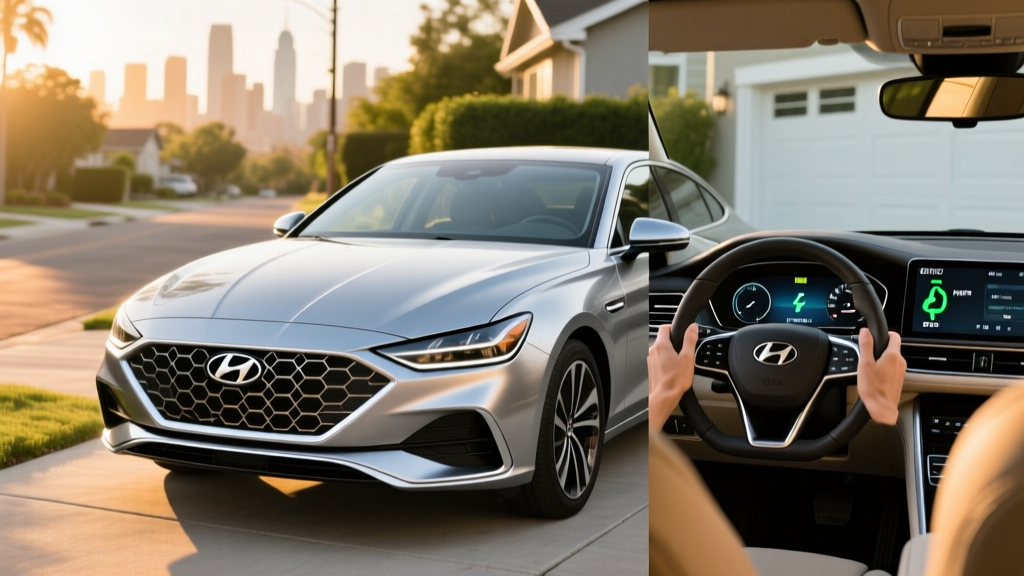
Hyundai's Sonata Plug-In Hybrid occupies a narrow but practical lane: it offers genuine electric-only commuting range for daily drivers who aren't ready to commit to a full battery-electric vehicle. For 2026, the Sonata PHEV continues with a 13.8 kWh battery pack, a combined 202 horsepower, and an EPA-estimated 32 miles of zero-emission driving before the gasoline engine engages. That formula works well for a specific buyer — someone with home charging access, a sub-30-mile round-trip commute, and the occasional road trip where plugging in isn't an option.
But there's a critical detail many shoppers miss: Hyundai also sells a conventional Sonata Hybrid (HEV) that requires no plug at all. The two powertrains share a name but serve different needs. This guide breaks down exactly what the Sonata Plug-In Hybrid offers in 2026, how it compares to the standard hybrid, and whether the plug-in premium makes financial sense.
HEV vs PHEV: Which Sonata Hybrid Is Which?
Before diving into specs, it's essential to separate the two Sonata hybrid variants. Hyundai markets both, and the terminology can trip up first-time hybrid shoppers.
| Feature | Sonata Hybrid (HEV) | Sonata Plug-In Hybrid (PHEV) |
|---|---|---|
| Plugs in? | No — charges via engine and regen | Yes — Level 1 (120V) or Level 2 (240V) |
| Battery size | 1.6 kWh (lithium-ion) | 13.8 kWh (lithium-ion polymer) |
| Electric-only range | None (EV assist only) | 32 miles (EPA est.) |
| Combined horsepower | 192 hp | 202 hp |
| EPA combined MPG | 52 MPG | 52 MPG (hybrid mode) / 99 MPGe (electric mode) |
| Starting MSRP (2026) | ~$30,250 | ~$36,500 |
| Federal tax credit | Not eligible | Eligible — up to $3,751 under §30D |
The HEV is the simpler choice: drive it like any gas car, and the regenerative braking system plus the gasoline engine keep a small battery charged. The PHEV adds a much larger battery, a more powerful electric motor, and a charging port — giving you the option to drive on electricity alone for shorter trips while retaining the gas engine for longer journeys.
Powertrain and Performance Specs
The Sonata Plug-In Hybrid pairs a 2.0-liter four-cylinder gasoline engine (150 hp, 139 lb-ft torque) with a 50 kW electric motor (67 hp, 151 lb-ft torque) integrated into the transmission housing. Combined system output is 202 horsepower and 271 lb-ft of torque, routed through a six-speed automatic transmission to the front wheels.
| Specification | 2026 Sonata Plug-In Hybrid |
|---|---|
| Gas engine | 2.0L 4-cylinder, 150 hp / 139 lb-ft |
| Electric motor | 50 kW (67 hp / 151 lb-ft) |
| Combined output | 202 hp / 271 lb-ft |
| Transmission | 6-speed automatic |
| Drivetrain | Front-wheel drive |
| Battery capacity | 13.8 kWh (lithium-ion polymer) |
| EV-only range (EPA) | 32 miles |
| Total range (EV + gas) | ~450 miles |
| 0-60 mph | ~7.5 seconds |
| Cargo volume | 13.3 cu ft (reduced by battery placement) |
| Base MSRP | ~$36,500 |
The 0-60 time of roughly 7.5 seconds isn't sportscar territory, but the electric motor's instant torque delivery makes the Sonata PHEV feel quicker in city traffic than the number suggests. The six-speed automatic is a deliberate choice over a CVT — Hyundai prioritized natural shift feel and highway passing confidence over maximum efficiency optimization, and the tradeoff works in daily driving.
Fuel Economy: EPA Numbers vs Real-World Results
Fuel economy is where the Sonata PHEV gets interesting — and where understanding the difference between its two operating modes matters.
| Driving Mode | City | Highway | Combined |
|---|---|---|---|
| Charge-depleting (EV mode) | 99 MPGe combined (EPA est.) | ||
| Charge-sustaining (hybrid mode) | 45 MPG | 51 MPG | 52 MPG (EPA est.) |
Real-world MPG reality check: In charge-sustaining (hybrid) mode, the Sonata PHEV typically matches or slightly exceeds its EPA combined rating in city driving — regenerative braking recaptures more energy at lower speeds with frequent stops. On sustained highway runs at 75+ mph, expect closer to 42-46 MPG as aerodynamic drag increases and regen opportunities decrease. In cold weather (below 35°F), the gasoline engine runs more frequently to provide cabin heat, which can reduce both EV-only range and hybrid-mode efficiency by 15-25%.
For EV-only driving, the EPA's 32-mile estimate assumes moderate temperatures and speeds. In practice, expect 26-30 miles in warm weather at city speeds, and as few as 20-24 miles in freezing temperatures or sustained highway driving above 65 mph. The battery's thermal management system is passive (no active liquid heating/cooling for the traction battery), so cold-weather range loss is more pronounced than in full EVs with dedicated heat pump systems.
Charging the Sonata PHEV: Times and Connectors
The Sonata Plug-In Hybrid uses a standard J1772 connector for AC charging. There is no DC fast charging capability — this is typical for PHEVs with smaller battery packs, as the added cost and weight of DC hardware rarely justifies itself on a 13.8 kWh battery.
| Charging Level | Voltage | Power (kW) | Full Charge Time (0-100%) | Practical Use |
|---|---|---|---|---|
| Level 1 (included cord) | 120V | 1.4 kW | ~9 hours | Overnight top-up from standard outlet |
| Level 2 (home/public) | 240V | 3.3 kW (onboard charger limit) | ~3.5 hours | Daily home charging, workplace charging |
| DC Fast Charge | N/A | N/A | Not supported | N/A |
An important specification often overlooked: the Sonata PHEV's onboard charger is limited to 3.3 kW. Even if you plug into a 7.2 kW or 11.5 kW Level 2 station, the car will only accept 3.3 kW. This means a full charge always takes roughly 3.5 hours on Level 2, regardless of the charger's maximum output. For nightly top-ups this is rarely an issue — most commutes use 15-25 miles of range, which replenishes in 1.5-2 hours on Level 2.
Home charging setup: If you have a dedicated 240V outlet (NEMA 14-50 or hardwired Level 2 station) in your garage, the Sonata PHEV will fully recharge overnight with room to spare. The included Level 1 cord works from any standard 120V household outlet but requires a full workday to refill the battery — adequate for low-mileage drivers but slow for anyone using the full 32-mile EV range daily.
Pricing, Trims, and Federal Tax Credit Eligibility
The 2026 Sonata Plug-In Hybrid is offered in a single well-equipped SEL trim at a starting MSRP of approximately $36,500 (destination included). Standard features include a 12.3-inch infotainment display, wireless Apple CarPlay and Android Auto, Hyundai SmartSense (adaptive cruise, lane-keeping, forward collision avoidance), heated front seats, and a power sunroof.
Does the Sonata PHEV Qualify for a Federal Tax Credit?
Yes, but not the full $7,500 that many buyers expect. Under the current IRS §30D rules, the Sonata Plug-In Hybrid qualifies for a partial credit of approximately $3,751, based on its battery capacity and critical mineral sourcing requirements. The credit amount is determined by two components:
- Battery capacity requirement: The 13.8 kWh pack exceeds the 7 kWh minimum for PHEVs, satisfying the base qualification threshold.
- Critical minerals requirement ($3,750 portion): The Sonata PHEV's battery sourcing partially meets the 2026 critical minerals threshold, earning the partial $3,751 credit.
- Battery components requirement ($3,750 portion): The battery cell sourcing does not fully satisfy the 2026 domestic content threshold, so the second $3,750 half is not awarded.
- MSRP cap: The Sonata PHEV's ~$36,500 price falls well below the $55,000 sedan cap for §30D eligibility.
- Buyer income cap: AGI must not exceed $150,000 (single), $225,000 (head of household), or $300,000 (joint filing).
- Point-of-sale transfer: Under current rules, eligible buyers can transfer the credit to the dealer at purchase for an immediate price reduction, rather than waiting to claim it on their tax return.
After the federal credit, the effective price drops to roughly $32,749. Several states offer additional PHEV incentives — check the IRS clean vehicle credits page and your state energy office for current programs. Tax eligibility depends on individual circumstances; consult a tax professional before relying on credit amounts for purchase decisions.
Reliability, Battery Warranty, and Replacement Costs
Hyundai Hybrid/PHEV Battery Warranty: 10 years / 100,000 miles (whichever comes first) for the high-voltage lithium-ion battery pack. Coverage includes defects and capacity loss below a specified threshold under normal use. The standard powertrain warranty covers 10 years / 100,000 miles as well.
Hyundai's 10-year/100,000-mile hybrid battery warranty is among the longest in the industry, and it directly addresses the top concern PHEV buyers raise: "What happens when the battery dies?"
In practice, Hyundai's lithium-ion polymer packs have demonstrated strong longevity. Data from earlier-generation Sonata PHEVs (2016-2020) shows typical degradation of 8-12% over the first 100,000 miles — meaning a battery that originally delivered 32 EV miles might deliver 28-29 miles at the 100,000-mile mark. This is well within the warranty threshold.
Battery replacement cost: If replacement is needed outside warranty coverage, expect $3,500-$5,500 for the battery pack plus $500-$1,000 in labor at a Hyundai dealership. Third-party hybrid battery specialists may offer refurbished packs for $2,000-$3,500. However, given the 10-year warranty and observed degradation rates, out-of-pocket battery replacement is rare for Sonata PHEV owners who maintain the vehicle normally.
The Sonata lineup earns strong safety marks: the 2026 model carries a 5-star overall rating from NHTSA and typically earns IIHS Top Safety Pick designation. Hyundai SmartSense ADAS features are SAE Level 2 driver-assist systems — the driver must remain attentive with hands on the wheel at all times.
Who Should Choose the Sonata PHEV vs a Full EV or Gas Car?
The Sonata Plug-In Hybrid isn't for everyone. It solves a specific set of problems, and understanding where it fits helps avoid buyer's remorse.
Reasons to Choose the Sonata PHEV
- Daily commute under 30 miles — you'll drive most days on electricity alone
- Home or workplace Level 2 charging available
- Frequent road trips where charging infrastructure is uncertain
- Single-vehicle household that needs both EV efficiency and long-range flexibility
- Not ready for full EV range anxiety or public charging dependency
- Strong warranty coverage (10yr/100k battery + powertrain)
Reasons to Look Elsewhere
- No access to home/work charging — without plugging in, you're just carrying extra weight and paying a premium
- Daily commute exceeds 40+ miles — EV range covers only part of your driving
- Want zero gasoline use — consider a full BEV like the Ioniq 6 or Tesla Model 3
- Prioritize cargo space — the PHEV battery reduces trunk volume to 13.3 cu ft vs 16.0 in the HEV
- Want AWD — the Sonata PHEV is front-wheel drive only
Choose the Sonata PHEV if: You have a sub-30-mile commute, can charge at home nightly, take road trips 4+ times per year, and want to minimize gasoline use without range compromise.
Choose the Sonata HEV if: You can't charge at home, want maximum simplicity, or prioritize cargo space and a lower purchase price over EV-only driving.
Choose a full EV if: You have reliable home charging, your daily driving rarely exceeds 200 miles, and you want to eliminate gasoline costs and maintenance entirely.
5-Year Ownership Cost Snapshot
Assuming 15,000 miles/year, 60% of driving within EV range, electricity at $0.14/kWh, and gasoline at $3.40/gallon:
| Cost Category | Sonata PHEV (est.) | Sonata HEV (est.) | Gas Sonata (est.) |
|---|---|---|---|
| Purchase price (after credit) | $32,749 | $30,250 | $28,500 |
| Fuel/energy (5 years) | $3,200 | $4,900 | $8,500 |
| Maintenance (5 years) | $2,400 | $2,600 | $3,200 |
| Insurance (5 years, avg.) | $7,500 | $7,200 | $6,900 |
| Estimated depreciation | $14,000 | $12,500 | $13,000 |
| 5-year total | $59,849 | $57,450 | $60,100 |
The PHEV's fuel savings over the gas Sonata are substantial (~$5,300 over 5 years), and the federal credit narrows the gap with the HEV. However, the HEV remains the lowest total-cost option for buyers who can't charge at home and therefore won't capture the PHEV's electricity savings. For a detailed comparison, see fueleconomy.gov to model your specific driving pattern and local energy costs.
Frequently Asked Questions
How many MPG does the Sonata Plug-In Hybrid get?
In hybrid mode (after the battery is depleted), the Sonata PHEV achieves an EPA-estimated 45 city / 51 highway / 52 combined MPG. In EV mode, it earns 99 MPGe combined. Real-world city driving in hybrid mode often matches or slightly exceeds the EPA combined figure thanks to regenerative braking; highway driving at 75+ mph typically returns 42-46 MPG.
How far can the Sonata PHEV go on electric only?
The EPA rates the Sonata PHEV at 32 miles of electric-only range. Real-world results vary: expect 26-30 miles in warm weather at moderate speeds, and 20-24 miles in cold weather or sustained highway driving. The gasoline engine provides an additional ~420 miles of range for a total of approximately 450 miles.
Does the Sonata Plug-In Hybrid qualify for a federal tax credit?
Yes. Under current IRS §30D rules, the Sonata PHEV qualifies for a partial credit of approximately $3,751 (not the full $7,500). Eligibility depends on buyer income limits ($150K single / $300K joint), the vehicle's MSRP (under the $55K sedan cap), and battery sourcing requirements. The credit can be transferred to the dealer at point of sale for an immediate price reduction. Always verify current rules at irs.gov and consult a tax professional.
Is the Sonata hybrid reliable, and what does battery replacement cost?
Hyundai's hybrid and PHEV powertrains have demonstrated strong reliability, backed by a 10-year/100,000-mile battery and powertrain warranty. Observed battery degradation in earlier Sonata PHEV generations averages 8-12% over 100,000 miles. Out-of-warranty battery replacement costs $3,500-$5,500 at a dealership, though the warranty coverage makes this an unlikely expense for most owners.
Do I need to plug in the Sonata PHEV, or does it charge itself?
The Sonata Plug-In Hybrid has a charge port and is designed to be plugged in to capture its 32-mile EV range. If you never plug it in, the gasoline engine and regenerative braking will keep the battery partially charged, and the car will function as a conventional hybrid — but you'll have paid a premium for EV capability you're not using. If you can't plug in regularly, the conventional Sonata HEV is the better financial choice.
How long does it take to charge the Sonata PHEV at home?
On a standard 120V outlet (Level 1), a full charge takes approximately 9 hours using the included charging cord. On a 240V Level 2 home charger, a full charge takes about 3.5 hours. The onboard charger is limited to 3.3 kW, so higher-power Level 2 stations will not reduce charge time further.