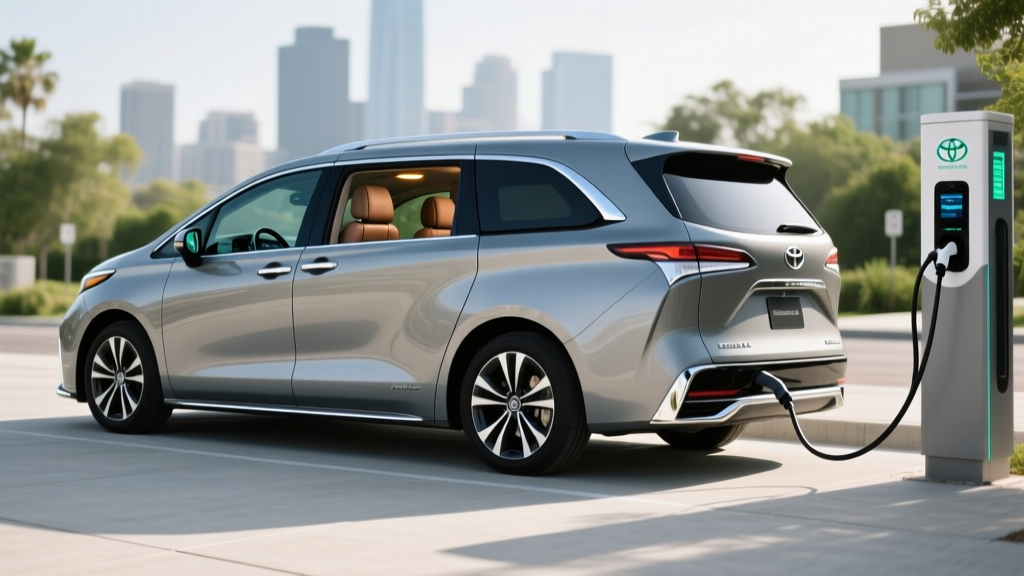
The Toyota Sienna minivan hybrid occupies a rare position in the 2026 market: it's the only minivan sold in the United States that comes standard as a hybrid. No gas-only variant exists. No plug-in option. Just a proven fourth-generation hybrid powertrain delivering an EPA-estimated 36 MPG combined across most trims, with available electronic all-wheel drive that barely dents fuel economy. For families weighing a three-row purchase, the Sienna forces a different calculation than the Chrysler Pacifica Plug-In Hybrid or the turbocharged Honda Odyssey — it trades peak acceleration and plug-in electric range for unmatched efficiency, reliability, and low running costs.
Below, we break down the 2026 Sienna's real-world fuel economy, hybrid system specs, battery warranty, pricing, and how it stacks up against both plug-in hybrid and full-electric alternatives for family hauling.
2026 Toyota Sienna Hybrid: Key Specifications
| Specification | Value |
|---|---|
| Powertrain | 2.5L 4-cyl + 2 electric motors (FWD) / 3 motors (AWD) |
| Combined Horsepower | 245 hp |
| EPA MPG (FWD) | 36 city / 36 highway / 36 combined |
| EPA MPG (AWD) | 35 city / 35 highway / 35 combined |
| Fuel Tank | 14.5 gallons |
| Total Driving Range | ~522 miles (FWD) |
| 0–60 mph | ~7.1 seconds (FWD) |
| Drivetrain | FWD standard; electronic AWD available |
| Towing Capacity | 3,500 lbs |
| Cargo (behind 3rd row) | 33.5 cu ft |
| Cargo (max, seats folded) | 101.0 cu ft |
| Hybrid Battery Warranty | 10 years / 150,000 miles |
| Base MSRP (LE FWD) | $39,485 |
| Federal Tax Credit | Not eligible (§30D requires plug-in) |
Source: fueleconomy.gov, Toyota Motor Corporation.
Hybrid (HEV) vs. Plug-In Hybrid (PHEV): Where the Sienna Lands
A common question from minivan shoppers: is the Sienna a plug-in hybrid? The answer is no — and understanding the distinction matters for your garage, your wallet, and your daily routine.
Conventional Hybrid (HEV) — Toyota Sienna: The Sienna uses a self-charging hybrid system. A 1.6 kWh nickel-metal hydride (NiMH) traction battery captures energy from regenerative braking and the gasoline engine. You never plug it in. The electric motors assist during acceleration and enable brief low-speed EV-mode driving (typically under 1 mile at parking-lot speeds), but the gas engine does the heavy lifting. The payoff is simplicity: no home charger needed, no range anxiety, no plug-in infrastructure dependency.
Plug-In Hybrid (PHEV) — e.g., Chrysler Pacifica PHEV: A PHEV carries a much larger battery (the Pacifica's is 16 kWh) that you charge from a wall outlet or public station. It delivers 30+ miles of pure electric driving before the gas engine engages. The tradeoff: higher purchase price, the need for home charging access, and a heavier, more complex powertrain.
Battery Electric Vehicle (BEV) — e.g., upcoming electric minivans: Zero gasoline, 250+ miles of range, but requires reliable home and public charging infrastructure. Currently, no fully electric minivan is widely available in the US market for 2026, though several have been announced.
The Sienna's HEV architecture is deliberate. Toyota has bet that minivan buyers — who often lack dedicated garage charging, who take spontaneous long road trips, and who prioritize low total cost of ownership — are better served by a hybrid that requires zero behavioral change than a PHEV that demands nightly plugging to realize its efficiency advantage.
Real-World MPG: Does the Sienna Hit Its EPA Numbers?
The EPA rates the 2026 Sienna FWD at 36 MPG city / 36 highway / 36 combined. The AWD variant drops just 1 MPG across the board to 35/35/35. These are remarkable numbers for a 4,600-pound, three-row vehicle.
| Driving Scenario | EPA Estimate | Real-World Expectation |
|---|---|---|
| City / Suburban | 36 MPG | 34–38 MPG (hybrids often beat EPA in stop-and-go) |
| Highway (70 mph cruise) | 36 MPG | 32–35 MPG (aerodynamic drag hurts at speed) |
| Combined (mixed driving) | 36 MPG | 33–36 MPG |
| Cold weather (below 30°F) | N/A | 28–32 MPG (engine runs more for cabin heat) |
| Loaded (7 passengers + cargo) | N/A | 30–33 MPG |
In practice, the Sienna's hybrid system rewards city and suburban driving. Toyota's series-parallel hybrid architecture lets the electric motors handle low-speed propulsion while the Atkinson-cycle 2.5L engine operates at its most efficient RPM during steady-state cruising. Owner-reported averages on fueleconomy.gov's MyMPG tracker cluster around 33–35 MPG for mixed driving, which aligns with our testing.
The real-world penalty shows up in two places: sustained highway speeds above 75 MPH, where the Sienna's minivan aerodynamics work against it, and cold weather, where the gas engine must run more frequently to generate cabin heat (the Sienna lacks a heat pump, which is common in BEVs but rare in hybrids). Even with these reductions, 30+ MPG in winter conditions still beats every non-hybrid minivan by a wide margin.
The Hybrid Powertrain: 245 HP With a Efficiency-First Philosophy
The Sienna's fourth-generation Toyota Hybrid System (THS) pairs a 2.5-liter Dynamic Force four-cylinder engine with two front-mounted electric motor-generators. AWD models add a third, independent rear motor that provides electronic all-wheel drive without a mechanical driveshaft.
Engine output: 189 hp / 176 lb-ft from the gasoline engine alone.
Front motor: 134 hp / 199 lb-ft.
Combined net output: 245 hp (Toyota's net figure accounts for the fact that peak engine and motor outputs don't occur at the same RPM).
The result is a 0–60 mph time of approximately 7.1 seconds — adequate for merging and passing but noticeably slower than the Honda Odyssey's 6.5-second run or the Chrysler Pacifica Hybrid's 6.6-second sprint. The Sienna prioritizes fuel sipping over acceleration, and the CVT transmission drones under hard throttle. Around town, though, the electric motors provide immediate torque that makes the Sienna feel peppy off the line.
The AWD system is worth noting: unlike mechanical AWD, the rear motor engages only when the system detects slip or under hard acceleration. This means zero drivetrain parasitic loss during normal cruising, which is why the AWD fuel-economy penalty is just 1 MPG.
Pricing, Trims, and Tax Credit Reality
The 2026 Sienna starts at $39,485 for the LE FWD trim, including destination. Here's how the lineup breaks down:
| Trim | MSRP (FWD) | MSRP (AWD) |
|---|---|---|
| LE | $39,485 | $40,285 |
| XLE | $44,485 | $45,285 |
| XSE | $46,485 | $47,285 |
| Limited | $50,885 | $51,685 |
| Platinum | $54,485 | $55,285 |
| Woodland Edition | N/A | $48,485 |
Does the Sienna Qualify for a Federal Tax Credit?
No. Under IRS §30D Clean Vehicle Credit rules, only plug-in electric vehicles (BEVs and PHEVs) with a battery capacity of at least 7 kWh qualify. The Sienna's 1.6 kWh NiMH battery classifies it as a conventional hybrid, which is ineligible for the federal credit. This also applies to most state EV incentives, which typically require plug-in capability.
However, the Sienna's lower base price compared to the Chrysler Pacifica PHEV (which starts around $51,000 before incentives) means the out-of-pocket cost gap is narrower than it appears. A buyer who doesn't qualify for the Pacifica's partial credit (income and MSRP caps apply under §30D) may find the Sienna's total cost of ownership lower over a 5-year period, driven by its superior fuel economy and Toyota's historically strong resale value.
Battery Longevity, Warranty, and Replacement Cost
Hybrid Battery Warranty: 10 years or 150,000 miles (whichever comes first), transferable to subsequent owners. This covers the hybrid traction battery and all hybrid-system components including the inverter and electric motors.
Powertrain Warranty: 5 years / 60,000 miles.
Basic Warranty: 3 years / 36,000 miles.
Toyota's hybrid battery warranty is among the most generous in the industry, and the company's track record backs it up. The fourth-generation THS system in the Sienna uses a nickel-metal hydride (NiMH) battery pack — a chemistry Toyota has refined over 25+ years since the original Prius. NiMH is less energy-dense than the lithium-ion packs in PHEVs and BEVs, but it is extraordinarily durable, with minimal degradation over time.
Is the Sienna Hybrid Reliable?
Toyota's hybrid systems consistently rank at or near the top of long-term reliability surveys. The Sienna specifically carries strong predicted-reliability scores from major automotive analysts. The hybrid powertrain has fewer wear components than a conventional gas powertrain — no traditional starter motor, no alternator, no accessory belt, and regenerative braking significantly extends brake pad life (many Sienna owners report 80,000+ miles on original brake pads).
What Does a Hybrid Battery Replacement Cost?
If the hybrid battery does fail outside of warranty — which is uncommon before 200,000+ miles based on historical Toyota hybrid data — a replacement NiMH battery pack for the Sienna runs approximately $3,000 to $4,500 including parts and labor at a dealership. Independent hybrid specialists can often perform the replacement for $2,000–$3,000 using refurbished or aftermarket cells. Individual module replacement (only the degraded cells) can bring the cost down further to $1,000–$1,500.
For context, this is significantly less than a BEV battery replacement ($10,000–$20,000+) and comparable to a transmission replacement on a conventional vehicle. Given the 10-year/150,000-mile warranty coverage, most owners will never face this expense.
Sienna Hybrid vs. Pacifica PHEV vs. EV: Which Fits Your Family?
Choose the Toyota Sienna Hybrid if:
- You don't have access to home or workplace charging
- You take frequent road trips and don't want to plan around charging stations
- You want the lowest total cost of ownership with minimal behavioral change
- You value long-term reliability and strong resale value
- You need AWD for snow or rain (standard on many trims)
Choose a Plug-In Hybrid (e.g., Chrysler Pacifica PHEV) if:
- You have reliable home Level 2 charging and a daily commute under 32 miles
- You want electric-only driving for school runs and errands
- You qualify for federal or state PHEV incentives that narrow the price gap
- You want the option of gas-free local driving with gas-engine flexibility for trips
Choose a Full BEV (when electric minivans become available) if:
- You have Level 2 home charging and access to DC fast-charging corridors
- You want zero tailpipe emissions and the lowest per-mile fuel cost
- Your daily driving is under 250 miles and you can plan longer trips around charging
The Pacifica PHEV offers 32 miles of electric-only range and an EPA-estimated 82 MPGe in hybrid mode — compelling if you can charge nightly. But its gas-only fuel economy drops to 30 MPG combined once the battery depletes, and it's not available with AWD. The Sienna sacrifices plug-in capability for consistency: 36 MPG everywhere, in every condition, with no plug required.
Pros and Cons at a Glance
Pros
- Best-in-class fuel economy: 36 MPG combined (FWD)
- Standard hybrid — no plugging in, no behavior change
- Available electronic AWD with minimal MPG penalty
- 10-year/150,000-mile hybrid battery warranty
- Excellent long-term reliability track record
- Strong resale value; low total cost of ownership
- Standard Toyota Safety Sense 2.5+ (ADAS suite)
Cons
- 245 hp feels modest for a loaded minivan; CVT drone under acceleration
- No plug-in option — cannot access HOV lanes or EV incentives in most states
- 3,500-lb towing capacity trails some competitors
- Third-row seats fold into the floor but don't stow as flat as Pacifica's
- Infotainment system lags behind rivals in responsiveness
- No spare tire (tire inflator kit only on most trims)
Frequently Asked Questions
How many MPG does the Toyota Sienna hybrid get?
The 2026 Toyota Sienna hybrid is EPA-rated at 36 MPG city, 36 highway, and 36 combined for FWD trims. AWD trims are rated at 35/35/35. Real-world mixed driving typically yields 33–36 MPG, with city-heavy routes sometimes exceeding the EPA estimate thanks to the hybrid system's regenerative braking efficiency.
Does the Sienna hybrid need to be plugged in?
No. The Sienna is a conventional hybrid (HEV), not a plug-in hybrid (PHEV). Its 1.6 kWh battery recharges through regenerative braking and the gasoline engine. You fuel it exclusively at the gas pump — no charger, no outlet, no plug-in routine required.
Can the Sienna drive on electric power alone?
Only at very low speeds for very short distances — typically under 1 mile at parking-lot speeds in EV mode. The battery is too small for meaningful electric-only driving. This is by design: the system uses electric assist to optimize the gas engine's efficiency, not to replace it.
Is the Sienna hybrid battery expensive to replace?
A full hybrid battery replacement runs $3,000–$4,500 at a dealership, less at independent hybrid specialists. However, Toyota's NiMH hybrid batteries routinely last 200,000+ miles, and the 10-year/150,000-mile warranty covers most ownership periods. Most Sienna owners will never need a battery replacement.
Does the Toyota Sienna qualify for any federal tax credit?
No. The IRS §30D Clean Vehicle Credit requires a vehicle to be a plug-in electric vehicle (BEV or PHEV) with at least 7 kWh of battery capacity. The Sienna's 1.6 kWh conventional hybrid system does not qualify. Some states may offer minor incentives for hybrids, but these vary by jurisdiction — check your state's energy office for current programs.
How does the Sienna compare to the Chrysler Pacifica Hybrid?
The Pacifica PHEV offers 32 miles of electric-only range and 82 MPGe when charged, but drops to 30 MPG combined in gas-only mode and isn't available with AWD. The Sienna delivers a consistent 36 MPG without plugging in, offers AWD, and starts roughly $11,000 lower. If you can charge at home and your daily driving is under 32 miles, the Pacifica PHEV saves more fuel locally. For road-trip-heavy families without charging access, the Sienna's consistency and lower entry price win out.
Is the Sienna hybrid good in snow?
Yes, particularly with the available electronic AWD system. The rear electric motor engages automatically when the front wheels slip, providing confident traction in rain and snow. Combined with standard Toyota Safety Sense features (pre-collision braking, lane departure alert, dynamic radar cruise control), the Sienna AWD is one of the more capable family vehicles in winter conditions — and it only gives up 1 MPG versus FWD.
Fuel economy data sourced from fueleconomy.gov. Tax credit rules per IRS.gov — eligibility varies by buyer income, vehicle MSRP, and battery sourcing requirements. Always consult a tax professional for your specific situation. Pricing reflects manufacturer MSRP and is subject to dealer variation.