Quick Verdict: The RAV4 XSE Hybrid Balances Sport and Thrift
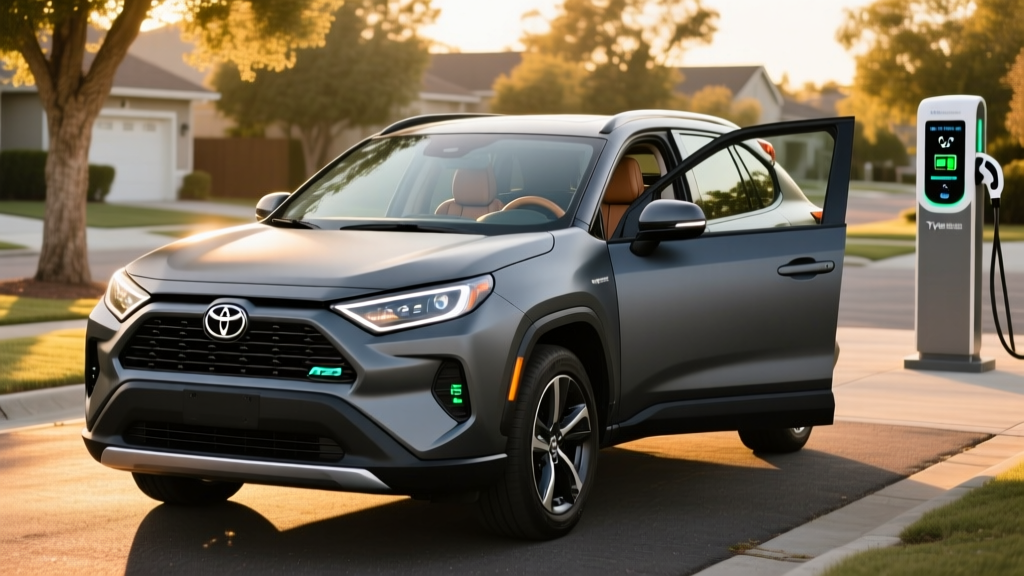
The Toyota RAV4 Hybrid remains one of the best-selling hybrid SUVs in America for good reason. The XSE trim sits at the sporty end of the lineup, pairing a 219-horsepower hybrid powertrain with a firmer suspension tune, unique styling, and a starting MSRP of $37,895 for the 2026 model year. It delivers an EPA-estimated 39 MPG combined without ever needing to be plugged in — a conventional hybrid (HEV) that recovers energy through regenerative braking and its gasoline engine.
If you're cross-shopping the RAV4 XSE Hybrid against the RAV4 Prime (the plug-in variant) or a full battery-electric SUV, the decision hinges on your daily mileage, charging access, and budget. This guide breaks down every spec that matters.
HEV vs PHEV: Where the RAV4 XSE Hybrid Fits
Conventional Hybrid (HEV) — RAV4 XSE Hybrid: No plug required. A 1.6 kWh nickel-metal hydride (NiMH) battery is charged by the engine and regenerative braking. You refuel with gasoline only. Electric motor assists the engine at low speeds and during acceleration but cannot propel the vehicle alone for meaningful distances.
Plug-In Hybrid (PHEV) — RAV4 Prime: Requires plug-in charging. An 18.1 kWh lithium-ion battery delivers an EPA-estimated 42 miles of electric-only range before the gas engine kicks in. Eligible for the full $7,500 federal tax credit under IRS §30D (subject to income and MSRP caps). MSRP starts at $44,990 for 2026.
The RAV4 XSE Hybrid is an HEV. It does not have a charge port, does not qualify for the federal EV tax credit, and cannot drive on electricity alone beyond very short, low-speed maneuvers. This distinction matters — Toyota sells both under the RAV4 nameplate, and buyers sometimes confuse them.
Fuel Economy: EPA Numbers and Real-World MPG
| Metric | EPA Estimate | Real-World Expectation |
|---|---|---|
| City MPG | 41 MPG | 38–43 MPG (hybrids often exceed EPA in stop-and-go) |
| Highway MPG | 38 MPG | 34–37 MPG (aerodynamic drag and sustained speeds reduce hybrid advantage) |
| Combined MPG | 39 MPG | 37–40 MPG |
| Fuel Tank Capacity | 14.5 gallons | — |
| Total Range | ~565 miles | ~520–580 miles depending on driving mix |
Source: fueleconomy.gov
Toyota's hybrid system excels in city driving because the electric motor handles low-speed propulsion and regenerative braking recovers energy that a conventional car wastes as heat. In real-world commuting with frequent stops, many RAV4 Hybrid owners report matching or slightly exceeding the 41 MPG city EPA figure. Highway cruising tells a different story — at 70+ mph, the 2.5-liter four-cylinder does most of the work, and the hybrid system's advantage narrows.
In cold weather (below 32°F), expect a 5–10% reduction in fuel economy. The engine runs more frequently to maintain cabin heat and bring the catalytic converter up to operating temperature.
Powertrain and Performance Specs
| Specification | 2026 RAV4 XSE Hybrid |
|---|---|
| Powertrain Type | Conventional Hybrid (HEV) |
| Engine | 2.5L Dynamic Force 4-cylinder |
| Engine Output | 176 hp / 163 lb-ft torque |
| Front Electric Motor | 118 hp / 149 lb-ft |
| Rear Electric Motor (AWD) | 54 hp / 89 lb-ft |
| Combined Net Horsepower | 219 hp |
| 0–60 mph | 7.4 seconds |
| Drivetrain | Electronic On-Demand AWD (standard on XSE) |
| Transmission | eCVT (electronically controlled continuously variable) |
| Hybrid Battery | 1.6 kWh NiMH (not plug-in) |
| Towing Capacity | 1,750 lbs |
| Cargo Volume | 37.5 cu ft (rear seats up) / 69.8 cu ft (folded) |
The XSE's 219 combined horsepower gives it confident highway merging and passing ability — noticeably quicker than the 203-hp gas-only RAV4. The rear electric motor provides electronic all-wheel drive without a mechanical driveshaft, engaging only when slippage is detected. This keeps efficiency high while adding all-weather capability.
The eCVT is smooth but can produce a droning sensation under hard acceleration, a trait common to Toyota's hybrid system. The XSE trim partially compensates with paddle shifters that simulate six fixed gear ratios, giving a more traditional feel when you want it.
What the XSE Trim Adds Over Lower Hybrid Trims
The XSE Hybrid occupies the sporty position between the comfort-oriented XLE and the off-road-focused Woodland Edition. For $37,895 (2026 MSRP before destination), it includes:
- SofTex-trimmed heated front seats with blue contrast stitching
- Sport-tuned suspension with stiffer damping
- 18-inch black alloy wheels
- Black roof (two-tone paint, $400 extra on some colors)
- 8-inch Toyota Audio Multimedia touchscreen with wireless Apple CarPlay and Android Auto
- Qi wireless phone charging pad
- Toyota Safety Sense 2.5+ (adaptive cruise, lane tracing, pre-collision with pedestrian detection, blind-spot monitor)
- Power liftgate
Adding the Premium Package ($2,350) brings a 10.5-inch navigation display, panoramic glass roof, and a 9-speaker JBL audio system. Fully loaded with destination and packages, the XSE Hybrid tops out near $42,500.
Battery Warranty, Lifespan, and Replacement Cost
Hybrid Battery Warranty: 10 years / 150,000 miles (whichever comes first), per Toyota's standard hybrid battery coverage. This applies in all 50 states.
Hybrid System Components Warranty: 8 years / 100,000 miles — covers the inverter, transaxle, and control modules.
Expected Battery Lifespan: Toyota NiMH hybrid batteries routinely last 150,000–200,000+ miles with minimal degradation. Unlike full EVs, the hybrid battery operates in a narrow state-of-charge window (roughly 40–80%), which dramatically reduces cycle wear.
Replacement Cost (out of warranty): $2,000–$4,000 for a refurbished or new OEM hybrid battery pack, installed. Independent hybrid specialists often charge less than dealerships.
Hybrid battery failure in the RAV4 is uncommon. Toyota's hybrid system has been in production since the 1997 Prius, and the NiMH chemistry used in the RAV4 Hybrid is among the most proven in the industry. The narrow charge window managed by the battery control module is the key to longevity — the system never lets the battery fully charge or fully discharge, which is where lithium and nickel chemistries degrade fastest.
For comparison, a full EV battery replacement (e.g., Tesla Model Y) runs $12,000–$20,000. The RAV4 Hybrid's small, simple battery is one of its lowest-risk ownership costs.
Tax Credits and Incentives
The RAV4 XSE Hybrid (HEV) does not qualify for the federal §30D Clean Vehicle Credit. That credit is reserved for plug-in electric vehicles — battery-electric vehicles (BEVs) and plug-in hybrids (PHEVs) with at least 7 kWh of battery capacity. Since the RAV4 Hybrid has a 1.6 kWh NiMH pack and no charge port, it is ineligible.
If the federal tax credit is a priority, the RAV4 Prime PHEV ($44,990 MSRP) qualifies for up to $7,500 under §30D, subject to:
- Buyer income caps: AGI ≤ $150,000 (single) / $300,000 (joint) — per IRS §30D rules
- MSRP cap: SUVs must be ≤ $80,000 (RAV4 Prime clears this easily)
- Battery sourcing: Critical minerals and battery components must meet phased-in domestic/content requirements (verify current-year compliance at purchase)
- Point-of-sale transfer: Eligible buyers can apply the credit as a down-payment reduction at the dealer
Some states offer additional rebates for hybrids or PHEVs. Check your state energy office or the AFDC state incentives database for local programs.
RAV4 XSE Hybrid vs RAV4 Prime vs Full EV: Which Fits You?
Choose the RAV4 XSE Hybrid (HEV) if:
- You have no access to home or workplace charging
- Your budget is $35,000–$42,000
- You drive 10,000–15,000 miles/year and want simple, proven efficiency
- You take frequent long road trips and don't want to plan around chargers
- You want AWD and strong cargo capacity without complexity
Choose the RAV4 Prime (PHEV) if:
- You can charge at home (Level 1 or Level 2) and your daily commute is under 42 miles
- You want to drive mostly on electricity but need gas flexibility for longer trips
- You qualify for the $7,500 federal tax credit (effectively bringing the Prime's price close to the XSE Hybrid)
- You want 302 combined horsepower — the Prime is the quickest RAV4 Toyota makes
Choose a full EV (e.g., Tesla Model Y, Hyundai Ioniq 5) if:
- You have reliable home Level 2 charging
- You want zero tailpipe emissions and the lowest per-mile fuel cost
- You rarely drive more than 250 miles without stopping
- You want minimal drivetrain maintenance (no oil changes, no engine)
Reliability and Ownership Costs
Toyota's hybrid powertrain carries one of the strongest reliability reputations in the industry. The RAV4 Hybrid consistently earns top marks from Consumer Reports and holds strong resale value. Key ownership considerations:
- Oil changes: Every 10,000 miles or 12 months (0W-16 synthetic)
- Brake pad life: Often 60,000–80,000+ miles thanks to regenerative braking reducing friction brake use
- Insurance: Typically 5–10% higher than the gas-only RAV4, but lower than most full EVs
- Fuel cost at 39 MPG: ~$0.10/mile at $3.80/gallon (vs ~$0.15/mile for the 30 MPG gas RAV4)
- 5-year fuel savings vs gas RAV4: Approximately $2,200–$2,800 depending on local gas prices and mileage
Toyota Safety Sense 2.5+ is standard across all RAV4 Hybrid trims and includes full-speed adaptive cruise control, lane centering, and automatic emergency braking with pedestrian and cyclist detection. The RAV4 holds a 2025 IIHS Top Safety Pick+ rating when equipped with the optional front-side airbags.
Pros and Cons
Pros
- 39 MPG combined is outstanding for an AWD SUV
- No charging infrastructure needed — fill up at any gas station
- 219 hp provides confident acceleration for the class
- 10-year/150,000-mile hybrid battery warranty
- Strong resale value and proven Toyota reliability
- Standard AWD with no fuel-economy penalty vs FWD
- 37.5 cu ft cargo space with seats up
Cons
- No federal tax credit eligibility (HEV, not PHEV)
- eCVT drone under hard acceleration
- 1,750-lb towing capacity is limited for the class
- Infotainment screen is 8-inch (competitors offer larger)
- Rear-seat legroom is tight for taller passengers
- XSE sport suspension is slightly firmer over rough pavement
- No DC fast charging (not applicable — no plug)
Frequently Asked Questions
How many MPG does the RAV4 XSE Hybrid get?
The EPA rates the 2026 RAV4 XSE Hybrid at 41 MPG city, 38 MPG highway, and 39 MPG combined. In real-world city driving with frequent stops, many owners report matching or slightly exceeding the city figure. Highway driving at sustained speeds typically yields 34–37 MPG.
Does the RAV4 XSE Hybrid need to be plugged in?
No. The RAV4 XSE Hybrid is a conventional hybrid (HEV). It has no charge port. The hybrid battery is charged by the gasoline engine and regenerative braking. You only ever refuel with gasoline.
What's the difference between the RAV4 Hybrid and the RAV4 Prime?
The RAV4 Hybrid is a conventional HEV — no plug, no electric-only range. The RAV4 Prime is a plug-in hybrid (PHEV) with an 18.1 kWh battery, 42 miles of electric-only range, 302 combined horsepower, a charge port (Level 1/Level 2 AC only, no DC fast charging), and eligibility for the $7,500 federal tax credit. The Prime starts at $44,990 vs $37,895 for the XSE Hybrid.
Is the RAV4 Hybrid battery expensive to replace?
Out-of-warranty replacement runs $2,000–$4,000 for the NiMH hybrid battery pack, installed. However, Toyota covers the hybrid battery for 10 years/150,000 miles, and these batteries routinely last well beyond 200,000 miles because the system keeps them in a narrow, low-stress state-of-charge window.
Does the RAV4 XSE Hybrid qualify for any tax credit?
No. The federal §30D Clean Vehicle Credit requires a plug-in vehicle with at least 7 kWh of battery capacity. The RAV4 Hybrid's 1.6 kWh NiMH battery does not qualify. The RAV4 Prime PHEV does qualify (up to $7,500, subject to income and sourcing requirements). Some states may offer separate hybrid incentives — check your local programs.
How does the RAV4 XSE Hybrid compare to a full EV?
A full EV like the Hyundai Ioniq 5 or Tesla Model Y costs less per mile to "fuel" (roughly $0.04/mile on home electricity vs $0.10/mile on gas at 39 MPG) and requires less maintenance. However, EVs require home charging access, cost more upfront, and require route planning on road trips beyond 250 miles. The RAV4 Hybrid offers simpler ownership with no charging dependency at the cost of higher per-mile fuel expense and tailpipe emissions.
What is the real-world range of the RAV4 XSE Hybrid?
With a 14.5-gallon fuel tank and real-world fuel economy of 37–40 MPG combined, expect 520–580 miles between fill-ups depending on your driving mix. Cold weather and heavy cargo loads will push you toward the lower end of that range.