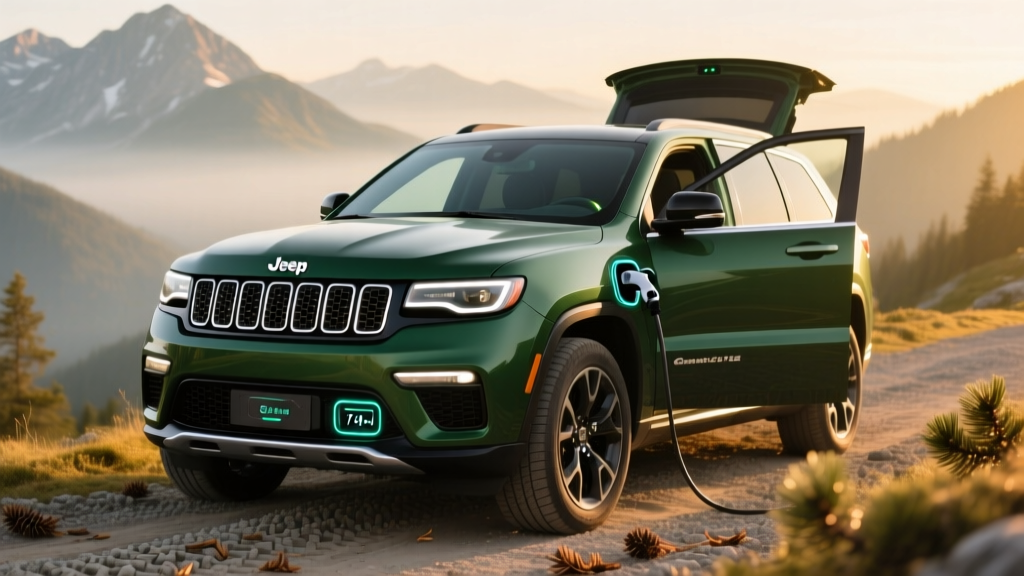
The Jeep Grand Cherokee has long been a benchmark midsize SUV for buyers who want off-road credibility, a premium cabin, and genuine towing capability. The hybrid Grand Cherokee — officially called the Grand Cherokee 4xe (pronounced "four-by-e") — adds a plug-in hybrid powertrain that lets most owners commute on electricity alone while keeping a gas engine for road trips and trail runs. For 2026, the 4xe remains the only plug-in hybrid in its class that pairs serious electric-only range with Jeep's full-time 4x4 system and available air suspension.
But the 4xe is just one flavor of electrified Grand Cherokee. Jeep also offers a conventional mild-hybrid system on certain gas trims. Understanding the difference between these two setups — and knowing what the 4xe actually delivers in daily driving — is critical before you sign a lease or purchase order.
HEV vs. PHEV: Which Hybrid Grand Cherokee Are You Looking At?
Jeep sells the Grand Cherokee with two distinct types of electrification. Confusing them is the single most common mistake shoppers make.
Conventional Hybrid (HEV) — eTorque Mild Hybrid
Available on select gas-powered Grand Cherokee trims (3.6L V6), the eTorque system uses a small 48-volt belt-driven motor-generator. It does not drive the wheels on electric power alone. Instead, it smooths stop-start transitions, provides a brief torque fill during acceleration, and enables slightly longer engine-off coasting. You never plug it in. Fuel economy improvement over the non-hybrid V6 is marginal — typically 1-2 MPG combined.
Plug-In Hybrid (PHEV) — Grand Cherokee 4xe
The 4xe pairs a 2.0L turbocharged inline-4 with two electric motors and a 17.3 kWh lithium-ion battery pack. It can drive 25 miles on electricity alone before the gas engine engages. You plug it in to recharge (Level 1 or Level 2 — no DC fast charging). Combined output is 375 horsepower and 470 lb-ft of torque, making it the most powerful Grand Cherokee short of the Trackhawk. This is the model most buyers mean when they search for a "hybrid Grand Cherokee."
From here, this guide focuses on the Grand Cherokee 4xe PHEV, since that's where the meaningful efficiency gains and electric-driving capability live.
Fuel Economy and Electric Range: The Numbers That Matter
The EPA rates the 2026 Grand Cherokee 4xe at 56 MPGe (miles per gallon equivalent) when operating in combined electric-gas mode, and 23 MPG combined once the battery is depleted and it runs as a conventional hybrid. Here's the full breakdown:
| Metric | EPA Rating | Real-World Expectation |
|---|---|---|
| Electric-only range | 25 miles | 20–23 mi (highway/cold weather) |
| MPGe (charge-sustaining + electric) | 56 MPGe | 48–54 MPGe (mixed driving) |
| MPG (battery depleted, gas-only) | 23 combined (21 city / 24 hwy) | 20–22 combined (heavy cargo, hilly terrain) |
| Total combined range | ~440 miles | ~380–420 mi |
If your daily commute is under 25 miles round-trip and you charge at home every night, you could go weeks without visiting a gas station. But on a 500-mile road trip, the 4xe operates mostly as a 4,700-pound hybrid SUV returning low-20s MPG — respectable for its size, but not Prius territory.
Powertrain Specs: 375 HP With a Turbo-Four and Two Electric Motors
| Specification | 2026 Grand Cherokee 4xe |
|---|---|
| Gas engine | 2.0L turbo I-4, 270 hp / 295 lb-ft |
| Electric motors | 2 integrated (134 hp combined motor output) |
| Combined system output | 375 hp / 470 lb-ft |
| Battery capacity | 17.3 kWh (usable ~14.1 kWh) |
| Battery chemistry | NMC (nickel manganese cobalt) |
| Transmission | 8-speed automatic (TorqueFlite) |
| Drivetrain | Full-time 4WD (Selec-Terrain) |
| 0–60 mph | ~6.0 seconds |
| Towing capacity | 6,000 lbs (properly equipped) |
| EPA electric range | 25 miles |
| EPA MPGe / MPG (depleted) | 56 MPGe / 23 MPG |
The 4xe's powertrain architecture places one electric motor between the engine and transmission (providing torque fill and regenerative braking) and a second motor integrated into the front axle. The result is seamless transitions between electric-only, gas-only, and blended operation. Jeep's Selec-Terrain system adds an "Electric" mode that prioritizes battery power, a "Hybrid" mode that optimizes both sources, and an "eSave" mode that preserves battery charge for later use — useful if you want electric-only driving in a city center after a highway stretch.
Charging the 4xe: Level 1, Level 2, and What You Need at Home
The Grand Cherokee 4xe uses a standard J1772 connector for AC charging. It does not support DC fast charging — a limitation shared with most PHEVs in this class. Here's what charging looks like in practice:
| Charging Level | Power | 0–100% Time | Equipment Needed |
|---|---|---|---|
| Level 1 (120V household) | ~1.4 kW | ~12 hours | Included portable cordset |
| Level 2 (240V home/public) | 7.2 kW (max onboard) | ~2.5 hours | Wall connector or public L2 station |
| DC Fast Charge | Not supported | N/A | N/A |
For most 4xe owners, a Level 2 home charger is the sweet spot. Plug in when you get home, and the battery is full by morning — well within the 2.5-hour charge window. A 240V/32-amp Level 2 wall connector costs $300–$600 for the equipment, plus $500–$1,500 for professional installation depending on your electrical panel's proximity to the garage and whether a panel upgrade is needed. (Always have a licensed electrician assess your panel capacity before installation.)
Level 1 charging from a standard 120V outlet works overnight if your daily electric usage is under 15 miles — the 12-hour full charge means you'll recover roughly 2 miles of range per hour plugged in.
Pricing, Trims, and Federal Tax Credit Eligibility
The 2026 Grand Cherokee 4xe is offered across multiple trims, from the base 4xe to the Summit Reserve. Pricing starts around $60,490 MSRP (including destination) for the base 4xe and climbs to approximately $78,000 for a fully loaded Summit Reserve 4xe. Key trims include:
- 4xe (base): ~$60,490 — cloth/leatherette, 10.1" infotainment, basic Selec-Terrain
- 4xe Trailhawk: ~$67,000 — air suspension, skid plates, all-terrain tires, electronic rear diff lock
- 4xe Overland: ~$70,000 — leather, panoramic roof, premium audio
- 4xe Summit Reserve: ~$75,000–$78,000 — Nappa leather, McIntosh audio, front-passenger display, night vision
Federal §30D Tax Credit: Does the Grand Cherokee 4xe Qualify?
Under current IRS rules, the Grand Cherokee 4xe may qualify for up to $3,750 of the federal plug-in vehicle tax credit, depending on battery component and critical mineral sourcing requirements that phase in progressively. Key eligibility rules:
- MSRP cap: SUVs must be under $80,000 MSRP. Most 4xe trims qualify; a fully optioned Summit Reserve may exceed the cap.
- Buyer income cap: Modified adjusted gross income must not exceed $150,000 (single) / $300,000 (joint).
- Battery sourcing: The credit splits into two $3,750 halves — one for critical minerals, one for battery components. Sourcing requirements tighten annually. Check the latest IRS clean vehicle credit page for current eligibility.
- Point-of-sale transfer: You can transfer the credit to the dealer at purchase to reduce your out-of-pocket cost immediately, rather than waiting to claim it on your tax return.
Note: Tax credit eligibility depends on VIN-specific battery sourcing, which can change mid-model-year. Verify with your dealer and a tax professional before relying on a specific credit amount.
Battery Warranty, Reliability, and Long-Term Costs
4xe Battery Warranty
Jeep covers the Grand Cherokee 4xe's high-voltage battery with a 10-year / 100,000-mile warranty (whichever comes first), with a capacity retention threshold of approximately 70%. If the battery degrades below that level within the warranty period, Jeep will repair or replace it at no cost. The hybrid system components (electric motors, power electronics, onboard charger) carry an 8-year / 100,000-mile warranty.
For context, federal law mandates a minimum of 8 years / 80,000 miles for hybrid battery coverage. Jeep exceeds this baseline, which is a meaningful reassurance for second- and third-owners.
What does a battery replacement cost out of warranty? Based on current parts pricing and labor, a full 4xe battery replacement runs approximately $8,000–$12,000 at a dealership. However, PHEV batteries of this size (17.3 kWh) experience less stress than full EV batteries because they operate in a narrower state-of-charge window and are smaller overall. Real-world data from Stellantis PHEVs (including the Wrangler 4xe, which shares this powertrain) shows minimal degradation in the first 3–5 years of typical ownership.
On general reliability, the Grand Cherokee platform has historically scored average to below-average in third-party reliability surveys. The 4xe powertrain adds complexity (two electric motors, high-voltage cabling, additional cooling circuits), but the core turbo-four engine and 8-speed transmission are well-proven across the Stellantis lineup. The NHTSA has not flagged the 4xe for specific high-voltage safety concerns, and the vehicle earned strong crash-test ratings in its most recent evaluation.
Who Should Buy the Hybrid Grand Cherokee — And Who Shouldn't?
Choose the Grand Cherokee 4xe If:
- Your daily commute is under 25 miles round-trip and you have home charging access
- You want a premium midsize SUV that can tow 6,000 lbs and handle real off-road trails
- You take regular road trips where a pure EV's charging logistics would be inconvenient
- You value the 375-hp torque punch for merging and mountain driving
- You want to reduce (not eliminate) your gas consumption without range anxiety
Choose a Full EV Instead If:
- You want zero tailpipe emissions and zero gas station visits
- Your daily driving is predictable and under 250 miles, and you take flights for long trips
- You want lower per-mile "fuel" costs (electricity vs. gas) and minimal maintenance (no oil changes, fewer moving parts)
- You have reliable home or workplace charging
Choose the Gas-Only Grand Cherokee If:
- You don't have access to any form of plug-in charging at home or work
- Your budget is tighter — gas trims start ~$15,000 lower than the 4xe
- You primarily drive long highway miles where the 4xe's electric range provides negligible benefit
- You prefer simpler mechanical systems with fewer components that could require service
Pros
- 25 miles electric-only covers most commutes
- 375 hp / 470 lb-ft — genuinely quick for a 4,700-lb SUV
- Full Jeep 4x4 capability retained (Trailhawk trim)
- 6,000-lb towing — no EV in this price range matches it
- 10-year/100,000-mile battery warranty
- No range anxiety on road trips — just fill up with gas
Cons
- $60K+ starting price — significant premium over gas trims
- 23 MPG gas-only is mediocre for a hybrid
- No DC fast charging
- Real-world electric range drops to 15–18 mi in winter
- Higher curb weight affects braking feel and tire wear
- Tax credit eligibility is partial (~$3,750, not $7,500) and subject to sourcing rules
Frequently Asked Questions
How many MPG does the hybrid Grand Cherokee get?
The Grand Cherokee 4xe is EPA-rated at 56 MPGe combined when using both its battery and gas engine. Once the battery is depleted, it returns 23 MPG combined (21 city / 24 highway) running purely on gasoline. The mild-hybrid eTorque V6 trims return about 19–21 MPG combined — a much smaller improvement. For the most current EPA data, check fueleconomy.gov.
How far can the Grand Cherokee 4xe go on electric only?
The EPA rates the 4xe at 25 miles of electric-only range. In real-world conditions — highway speeds, air conditioning, or cold weather — expect 18–23 miles. This covers the majority of American commutes (the U.S. average one-way commute is roughly 16 miles, according to Census data), but it won't cover a full day of errands without the gas engine kicking in.
Does the Grand Cherokee 4xe qualify for a tax credit?
It may qualify for up to $3,750 of the federal §30D clean vehicle credit, depending on current battery-sourcing requirements and your income level. The full $7,500 credit is unlikely due to critical mineral and component sourcing rules that apply to vehicles assembled in North America with globally sourced battery materials. Always verify eligibility on the IRS website and with your tax advisor before purchasing.
Is the Grand Cherokee 4xe reliable? What about battery replacement cost?
The 4xe powertrain shares components with the Wrangler 4xe, which has been on sale since 2021 and has not shown widespread high-voltage system failures. The battery is warrantied for 10 years / 100,000 miles. Out-of-warranty replacement costs approximately $8,000–$12,000, though most owners will never need this service. General vehicle reliability is average for the segment — expect typical Stellantis build-quality quirks (infotainment glitches, minor trim issues) rather than powertrain failures.
Can I charge the Grand Cherokee 4xe at a public fast charger?
No. The 4xe only supports AC charging (Level 1 at 120V and Level 2 at 240V via J1772). It does not have a DC fast-charge port. This is standard for PHEVs — their smaller batteries don't require (or benefit from) DC fast charging. A Level 2 charge from empty to full takes about 2.5 hours.
How does the 4xe compare to a full-electric SUV like the Rivian R1S or Hyundai Ioniq 5?
A full EV gives you 250–350 miles of range, zero gas, and lower per-mile fuel costs — but requires planning for road-trip charging and typically can't match the 4xe's 6,000-lb towing capacity. The 4xe is the better choice if you need serious towing, genuine off-road capability, and the flexibility to drive cross-country without charging stops. The EV is better if your priority is minimizing operating cost and emissions.
The hybrid Grand Cherokee 4xe occupies a specific niche: it's for buyers who want premium-SUV comfort, real off-road and towing capability, and some electric driving — without committing fully to a battery-electric vehicle. At $60,000+ and with a partial tax credit, it's not the cheapest path to electrification. But if your lifestyle demands what only a Grand Cherokee can do, the 4xe lets you do it with a plug.