The Toyota RAV4 Hybrid has held the compact hybrid SUV crown for years, and the XLE Premium trim sits in the sweet spot of the lineup — offering upgraded interior materials, a power liftgate, and Toyota's latest Safety Sense suite without the top-trim price premium. For 2026, the RAV4 XLE Premium Hybrid continues with the proven 2.5-liter four-cylinder hybrid powertrain, standard electronic all-wheel drive, and EPA-estimated fuel economy that remains among the best in its class.
This guide breaks down everything a buyer needs to know: real-world MPG versus the EPA sticker, how the conventional hybrid (HEV) system works, battery longevity and warranty coverage, tax credit eligibility, and whether this trim makes more sense than stepping up to the RAV4 Prime plug-in hybrid or going full electric.
HEV vs. PHEV: Understanding What the RAV4 XLE Premium Hybrid Actually Is
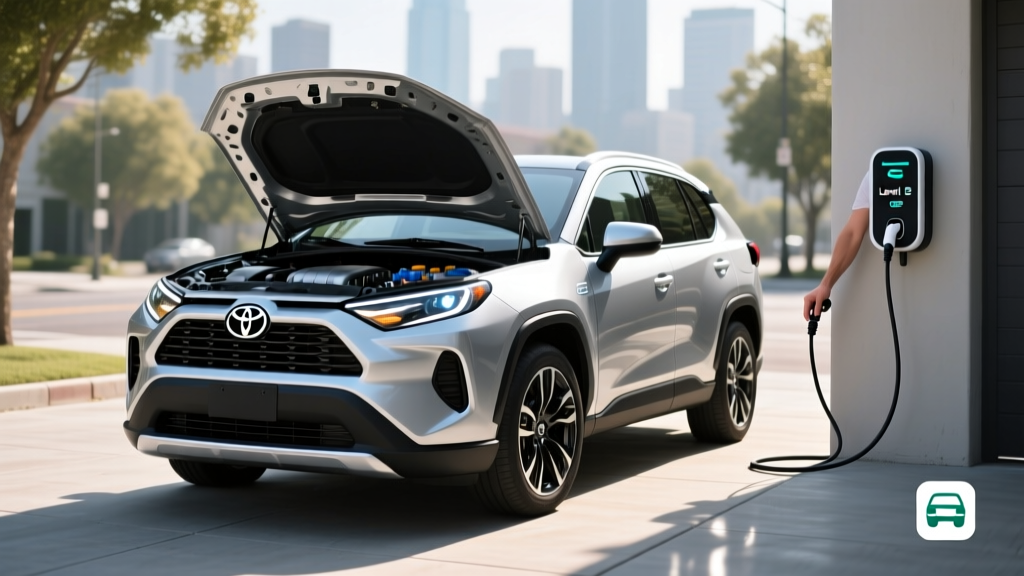
The RAV4 XLE Premium Hybrid is a conventional hybrid electric vehicle (HEV) — not a plug-in hybrid. This distinction matters because it shapes your entire ownership experience.
| Feature | RAV4 Hybrid (HEV) | RAV4 Prime (PHEV) |
|---|---|---|
| Plug-in charging required? | No — self-charging via engine & regen | Yes — 18.1 kWh battery, Level 1/2 charging |
| Electric-only range | ~1 mile at low speed | 42 miles (EPA) |
| Combined horsepower | 219 hp | 302 hp |
| EPA combined MPG / MPGe | 39 MPG combined | 94 MPGe (electric) / 38 MPG (gas-only) |
| Battery size | ~1.6 kWh (NiMH) | 18.1 kWh (lithium-ion) |
| Federal tax credit (§30D) | Not eligible | Eligible (up to $7,500, subject to rules) |
| Starting MSRP (2026 est.) | ~$36,500 | ~$44,500 |
If you don't have access to home or workplace charging, the HEV is the simpler, lower-cost path. You never plug in — the gasoline engine and regenerative braking keep the small hybrid battery charged. If you do have reliable charging access and a commute under 42 miles, the RAV4 Prime PHEV can eliminate most daily gasoline use, but it costs roughly $8,000 more before incentives.
Fuel Economy: EPA Ratings and Real-World MPG
The 2026 RAV4 Hybrid with AWD carries the following EPA-estimated fuel economy:
| Driving Cycle | EPA Estimate | Real-World Expectation |
|---|---|---|
| City | 41 MPG | 38–44 MPG (hybrids often exceed EPA in stop-and-go) |
| Highway | 38 MPG | 34–38 MPG (less regen benefit at sustained speed) |
| Combined | 39 MPG | 36–41 MPG |
Why real-world city MPG often beats the sticker: Conventional hybrids recapture kinetic energy during braking and use the electric motor heavily at low speeds, where gasoline engines are least efficient. Owners in dense urban environments with frequent stops regularly report 42–45 MPG in warm weather. Conversely, sustained highway driving at 75+ MPH and cold-weather operation (below 30°F) can drop combined figures into the low-to-mid 30s, as the engine runs more often for cabin heat and battery conditioning.
Over a 15,000-mile year at $3.40/gallon, the RAV4 Hybrid at 39 MPG combined costs roughly $1,308 in fuel — compared to about $1,929 for a comparable gas-only compact SUV at 26 MPG combined. That's approximately $620 in annual fuel savings.
Powertrain and Performance Specs
| Specification | 2026 RAV4 XLE Premium Hybrid |
|---|---|
| Engine | 2.5L inline-4 Atkinson-cycle |
| Electric motors | Front motor + rear motor (eAWD) |
| Combined net horsepower | 219 hp |
| 0–60 mph | 7.4 seconds (est.) |
| Drivetrain | Electronic on-demand AWD |
| Transmission | eCVT (planetary gearset) |
| Hybrid battery | ~1.6 kWh, nickel-metal hydride (NiMH) |
| Towing capacity | 1,750 lbs |
| Cargo volume (rear seats up) | 37.5 cu ft |
| Cargo volume (rear seats folded) | 69.8 cu ft |
The eAWD system uses a dedicated rear-axle electric motor that engages automatically when the front wheels slip or under hard acceleration. It's not a heavy-duty off-road system, but it provides confident traction in rain, snow, and light trail conditions. The 219 hp combined output delivers adequate passing power, and the eCVT is smooth — though it can drone under heavy throttle, a characteristic of Toyota's hybrid synergy drive.
XLE Premium Trim: What You Get for the Price
The XLE Premium sits one step above the XLE in the RAV4 Hybrid lineup. For 2026, the estimated MSRP is $36,500 (including destination). Key features that distinguish the Premium trim include:
- SofTex synthetic leather-trimmed seats
- Power liftgate with height adjustment
- Leather-wrapped steering wheel and shift knob
- 10.5-inch Toyota Audio Multimedia touchscreen with wireless Apple CarPlay and Android Auto
- Wireless Qi-compatible smartphone charging pad
- Blind Spot Monitor with Rear Cross-Traffic Alert
- Toyota Safety Sense 3.0 (pre-collision, lane tracing, adaptive cruise, road sign assist)
- 18-inch alloy wheels
- Dual-zone automatic climate control
The step up from the XLE (~$34,000) is roughly $2,500 and primarily adds the SofTex interior, power liftgate, and upgraded infotainment screen. For buyers who value a more premium cabin feel without moving to the Limited (~$40,000), the XLE Premium offers strong value.
Battery Warranty, Lifespan, and Replacement Cost
Toyota Hybrid Battery Warranty
Coverage: 10 years / 150,000 miles (whichever comes first)
What's covered: Defects and capacity loss below a defined threshold (typically 60–70% of original capacity)
Transferable: Yes — warranty transfers to subsequent owners at no cost
Toyota's hybrid battery track record is one of the best in the industry. The RAV4 Hybrid's NiMH battery pack is proven technology — less energy-dense than lithium-ion but extremely durable and tolerant of thousands of shallow charge-discharge cycles. Based on long-term fleet data from Toyota hybrids (Prius, Camry Hybrid, Highlander Hybrid), most hybrid batteries last 150,000–200,000+ miles before significant degradation.
If replacement is needed out of warranty, a new OEM hybrid battery for the RAV4 Hybrid costs approximately $3,000–$4,500 including labor. Third-party refurbished packs are available for $1,500–$2,500. This is dramatically less than a full EV battery replacement, which can exceed $12,000–$20,000.
According to NHTSA recall data, Toyota hybrid battery failures in the RAV4 Hybrid have been rare, with no widespread recall campaigns targeting the hybrid battery pack itself.
Federal Tax Credits and Incentives
This is where the HEV/PHEV distinction has real financial consequences. The RAV4 XLE Premium Hybrid (HEV) does not qualify for the federal §30D clean vehicle tax credit. Under current IRS rules, the §30D credit applies only to plug-in electric vehicles (BEVs and PHEVs) that meet battery capacity, critical mineral sourcing, MSRP caps, and buyer income thresholds.
If you want a RAV4 that does qualify, the RAV4 Prime (PHEV) may be eligible for up to $7,500 under §30D, subject to:
- Buyer AGI income caps ($150K single / $300K joint)
- MSRP cap of $80,000 for SUVs
- Battery critical mineral and component sourcing requirements (which tighten annually)
- Point-of-sale transfer option available at participating dealers
Some states offer additional hybrid incentives. For example, certain utility companies provide rebates for hybrid purchases or reduced electricity rates for PHEV owners who charge at home. Check your state energy office and local utility for current programs — these vary by jurisdiction and change frequently.
RAV4 Hybrid vs. RAV4 Prime vs. Full EV: Which Fits You?
Choose the RAV4 XLE Premium Hybrid (HEV) if:
- You don't have access to home or workplace charging
- You want maximum simplicity — no plugs, no charging apps, no range planning
- Your budget is under $38,000 and you don't qualify for or want to chase tax credits
- You drive 12,000–15,000 miles/year in mixed city/highway conditions
- You want proven long-term reliability with minimal maintenance
Choose the RAV4 Prime (PHEV) if:
- You have Level 2 home charging and a commute under 42 miles
- You want to drive mostly electric daily but need gas flexibility for road trips
- You qualify for the §30D credit, narrowing the price gap with the HEV
- You value the 302 hp performance upgrade
Choose a full EV (e.g., Tesla Model Y, Hyundai Ioniq 5) if:
- You have reliable home Level 2 charging
- Your daily driving is under 250 miles and you're comfortable with road-trip charging planning
- You want zero tailpipe emissions and the lowest per-mile fuel cost
- You qualify for the full $7,500 federal credit and any state incentives
For buyers in apartments or condos without charging access, the RAV4 Hybrid HEV remains one of the most practical and efficient vehicles on the market. You get roughly 40 MPG without changing any habits — just fill up with gas less often.
Pros and Cons at a Glance
Pros
- 39 MPG combined EPA — among the best in compact SUVs
- No plug-in charging required — zero lifestyle change
- Standard eAWD for confident all-weather traction
- 10-year / 150,000-mile hybrid battery warranty
- Strong reliability history; low cost of battery replacement if needed
- XLE Premium trim adds upscale touches at a reasonable price
- Toyota Safety Sense 3.0 standard (adaptive cruise, lane tracing)
Cons
- No federal tax credit eligibility (HEV)
- eCVT can drone under hard acceleration
- 1,750-lb towing capacity trails turbocharged competitors
- Rear-seat legroom is adequate but not class-leading
- No DC fast charging capability (not applicable to HEV, but a PHEV limitation to note)
- Infotainment, while improved, still lags some competitors in responsiveness
Frequently Asked Questions
How many MPG does the RAV4 XLE Premium Hybrid get?
The EPA rates the 2026 RAV4 Hybrid AWD at 41 city / 38 highway / 39 combined MPG. In real-world driving, city-heavy commuters often see 42–45 MPG in warm weather, while sustained highway driving and cold climates can bring the combined average into the low-to-mid 30s.
Does the RAV4 Hybrid need to be plugged in?
No. The RAV4 Hybrid is a conventional HEV. The hybrid battery charges through regenerative braking and the gasoline engine. You never plug it in — just refuel at any gas station as normal.
Is the RAV4 Hybrid reliable, and what does battery replacement cost?
Toyota's hybrid system is among the most proven in the industry, with millions of units on the road. The hybrid battery is covered by a 10-year / 150,000-mile warranty. Out-of-warranty replacement runs approximately $3,000–$4,500 for an OEM pack. Most batteries last 150,000+ miles.
Does the RAV4 XLE Premium Hybrid qualify for any tax credit?
No. The federal §30D clean vehicle credit applies only to plug-in vehicles (BEVs and PHEVs). The RAV4 Hybrid HEV is not eligible. The RAV4 Prime PHEV may qualify for up to $7,500, subject to IRS income, MSRP, and battery sourcing rules. Some state or utility incentives may apply to hybrids — check local programs.
How does the RAV4 Hybrid compare to the RAV4 Prime?
The Prime is a plug-in hybrid with 42 miles of electric-only range, 302 hp, and a significantly higher starting price (~$44,500 vs. ~$36,500). The Prime makes sense if you can charge at home and want electric daily commuting with gas backup. The HEV is simpler, cheaper upfront, and doesn't require any charging infrastructure.
Can the RAV4 Hybrid tow?
Yes, but modestly. The RAV4 Hybrid is rated to tow up to 1,750 pounds — sufficient for a small utility trailer, a couple of dirt bikes, or a light camper. If you need to tow 3,500+ pounds, you'll need to look at turbocharged gas competitors or larger SUVs.
What safety ratings does the RAV4 Hybrid have?
The RAV4 has consistently earned top marks from both IIHS and NHTSA. For the most current crash-test ratings, check the latest model-year results on iihs.org and nhtsa.gov, as ratings are updated with each test cycle. Toyota Safety Sense 3.0 is standard across all RAV4 Hybrid trims.