Quick Verdict: The RAV4 Prime Still Sets the PHEV Benchmark
The 2026 Toyota RAV4 Plug-In Hybrid — marketed as the RAV4 Prime — remains one of the most compelling vehicles in the compact SUV segment for buyers who want meaningful electric-only commuting without sacrificing the flexibility of a gas engine for road trips. With an EPA-rated 42 miles of electric-only range, 302 combined horsepower, and the ability to operate as a highly efficient hybrid once the battery depletes, the RAV4 Prime occupies a practical sweet spot between a conventional hybrid and a full battery-electric vehicle.
This guide covers everything you need to evaluate the 2026 RAV4 Plug-In Hybrid: real-world range and MPG expectations, charging logistics, powertrain specs, pricing by trim, federal tax credit eligibility under current IRS §30D rules, battery longevity, and how it compares to both the standard RAV4 Hybrid and a full EV like the Toyota bZ4X or Tesla Model Y.
HEV vs. PHEV: Understanding the RAV4 Lineup
Toyota sells two electrified RAV4 variants, and confusing them is the most common buyer mistake. Here is the fundamental difference:
Conventional Hybrid (RAV4 Hybrid — HEV)
- Does NOT plug in. The battery recharges through regenerative braking and the gasoline engine.
- Smaller battery (~1.6 kWh usable), limited or zero electric-only driving at very low speeds.
- EPA-rated at approximately 39 MPG combined (city/highway blend).
- Lower starting price — roughly $33,000–$40,000 depending on trim.
- No federal tax credit eligibility under current §30D rules (not a plug-in vehicle).
Plug-In Hybrid (RAV4 Prime — PHEV)
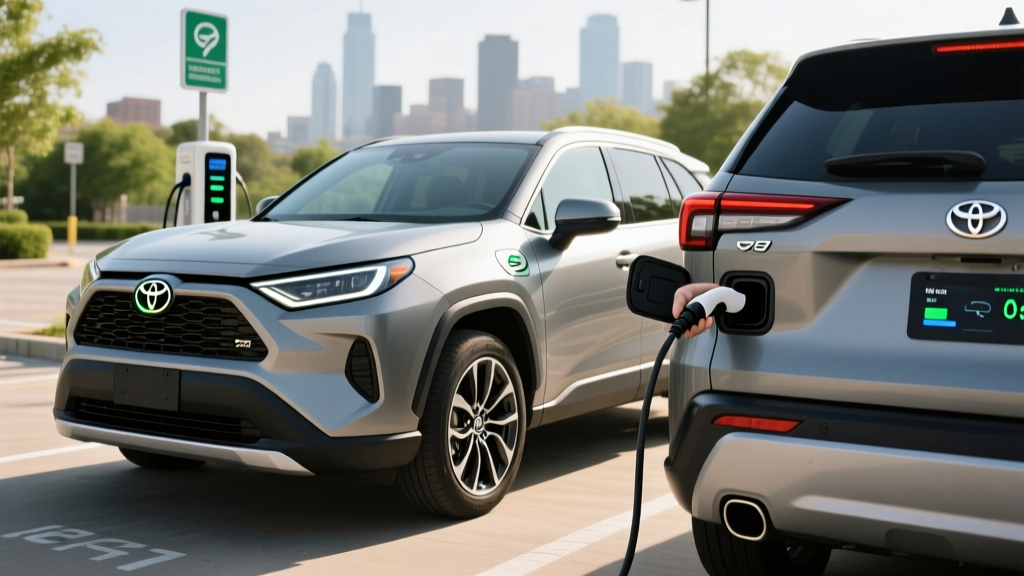
- Plugs in to charge via a standard J1772 connector (Level 1 or Level 2 AC charging).
- Larger 18.1 kWh battery pack enabling 42 miles of EPA-rated electric-only range.
- Once the battery is depleted, operates as a conventional hybrid at ~38 MPG combined.
- Higher starting price — approximately $44,500–$50,000 depending on trim.
- May qualify for federal and state incentives (details below).
If you can charge at home and your daily commute falls within 30–40 miles round trip, the PHEV lets you drive almost entirely on electricity during the week while retaining full gas-engine range for weekend trips. If you lack home charging access, the conventional HEV is the more practical choice.
Electric-Only Range and Total Driving Range
The 2026 RAV4 Prime carries an 18.1 kWh lithium-ion battery pack (gross capacity). The EPA rates it at 42 miles of electric-only range, which is among the highest in the compact PHEV SUV class.
EPA Electric-Only Range: 42 miles
Real-World Expectation: Expect 35–40 miles in mixed driving during mild weather (55–75°F). In cold conditions (below 32°F), range can drop to 28–33 miles due to cabin heating demands and reduced battery efficiency. Highway-speed electric-only driving (70+ mph) will also reduce range to approximately 30–34 miles.
Total Combined Range (EV + Gas): Approximately 600 miles when starting with a full battery and full 14.5-gallon fuel tank.
The RAV4 Prime uses an EV/HEV auto mode that intelligently blends electric and gas power. You can also manually select EV-only mode to preserve battery for city driving, or charge mode to use the engine to recharge the battery during highway cruising — useful if you're heading into an urban area where electric-only operation is more efficient.
Fuel Economy: EPA MPG and Real-World Numbers
Once the 42-mile electric range is exhausted, the RAV4 Prime operates as a conventional hybrid. Here is the full efficiency breakdown according to fueleconomy.gov (EPA):
| Mode | City | Highway | Combined |
|---|---|---|---|
| Electric + Gas (MPGe) | 94 MPGe | 94 MPGe | 94 MPGe |
| Gas-Only (Hybrid Mode, MPG) | 40 MPG | 36 MPG | 38 MPG |
Real-world MPG note: Toyota hybrids consistently achieve or slightly exceed their EPA city ratings in stop-and-go traffic thanks to aggressive regenerative braking. In our experience and owner reports, the RAV4 Prime in hybrid mode typically returns 36–41 MPG combined depending on driving style, terrain, and climate control usage. Highway-heavy driving at 75+ mph tends toward the lower end (34–36 MPG), while suburban and city driving frequently yields 39–42 MPG.
For context, the conventional RAV4 Hybrid is EPA-rated at 41/38/39 MPG (city/highway/combined) on the XLE and most trims. The Prime sacrifices roughly 1 MPG in gas-only mode due to the added weight of the larger battery pack (~350 lbs more than the HEV).
Powertrain, Performance, and Specifications
The RAV4 Prime pairs a 2.5-liter four-cylinder Atkinson-cycle engine with front and rear electric motors for standard all-wheel drive (AWD). The combined system output is 302 horsepower, making it the quickest RAV4 variant Toyota sells.
| Specification | 2026 RAV4 Prime (PHEV) |
|---|---|
| Engine | 2.5L 4-cyl Atkinson-cycle + dual electric motors |
| Combined Horsepower | 302 hp |
| Drivetrain | Electronic AWD (eAWD) standard |
| 0–60 mph | 5.7 seconds |
| Battery Capacity | 18.1 kWh (gross), ~14.5 kWh usable |
| Battery Chemistry | Lithium-ion (NMC) |
| EV Range (EPA) | 42 miles |
| EV Top Speed | ~84 mph (EV-only mode) |
| Fuel Tank | 14.5 gallons |
| Max DC Fast Charge | Not supported (AC only) |
| Level 2 Charge Rate | 3.3 kW (standard) / 6.6 kW (available on XSE w/ Premium pkg) |
| Charge Time (Level 1, 120V) | ~12 hours (full charge) |
| Charge Time (Level 2, 240V, 6.6 kW) | ~2.5 hours (full charge) |
| Charge Time (Level 2, 240V, 3.3 kW) | ~5.5 hours (full charge) |
| Charging Connector | J1772 (AC) |
| Towing Capacity | 2,500 lbs |
| Cargo Volume (behind rear seats) | 33.5 cu ft |
Charging reality check: The RAV4 Prime does not support DC fast charging. This is typical for PHEVs — the battery is small enough that Level 2 AC charging replenishes it fully in 2.5 hours (with the 6.6 kW onboard charger), which is sufficient for overnight charging and midday top-ups. If you opt for a base trim with the 3.3 kW charger, a full charge takes roughly 5.5 hours on Level 2. We strongly recommend selecting a trim with the 6.6 kW onboard charger if you plan to charge during the workday or at public Level 2 stations.
Pricing, Trims, and Tax Credit Eligibility
The 2026 RAV4 Prime is offered in two primary trims:
- SE: Starting at approximately $44,590 (including destination). Includes the 3.3 kW onboard charger, 18-inch wheels, heated front seats, and Toyota Safety Sense 3.0.
- XSE: Starting at approximately $48,090. Adds the 6.6 kW onboard charger, SofTex seats, 19-inch wheels, panoramic moonroof option, and available Premium Package with additional features.
Federal Tax Credit: Does the RAV4 Prime Qualify?
Under the IRS §30D Clean Vehicle Credit rules for 2026, the RAV4 Prime may qualify for up to $7,500 — but eligibility depends on several conditions that must all be met:
- MSRP cap: The vehicle's MSRP must not exceed $80,000 for SUVs. The RAV4 Prime clears this easily.
- Buyer income cap: Adjusted gross income must not exceed $150,000 (single), $225,000 (head of household), or $300,000 (married filing jointly).
- Battery sourcing requirements: A percentage of critical minerals and battery components must be sourced from the U.S. or free-trade-agreement countries. Toyota's supply chain has been evolving — verify current-year eligibility on IRS.gov before purchasing, as component-sourcing percentages are updated annually.
- Point-of-sale transfer: As of 2024, the credit can be transferred to the dealer at the point of sale, reducing your purchase price directly rather than waiting for a tax refund.
- North American assembly: The RAV4 Prime is assembled in Japan, which may affect eligibility depending on final assembly rules in effect for the 2026 tax year.
⚠️ Tax Credit Caution: Because the RAV4 Prime is assembled in Japan (not North America), it has historically been ineligible for the full §30D federal tax credit under the final-assembly requirement that took effect in 2023. Always confirm current eligibility on the DOE's fueleconomy.gov tax credit page and consult a tax professional before relying on the credit in your purchase decision. Some state-level incentives (e.g., California, New York, Colorado) may still apply regardless of assembly location.
Battery Longevity, Warranty, and Replacement Cost
Battery lifespan is a top concern for hybrid and PHEV buyers, and this is where Toyota's track record provides significant reassurance.
| Coverage | Term |
|---|---|
| Hybrid Battery Warranty | 10 years / 150,000 miles (whichever comes first) |
| Hybrid System Components | 8 years / 100,000 miles |
| Basic Vehicle Warranty | 3 years / 36,000 miles |
| Powertrain Warranty | 5 years / 60,000 miles |
The 10-year/150,000-mile hybrid battery warranty applies in all 50 states (previously it was extended only in CARB states, but Toyota standardized it nationwide). The warranty covers the battery if it drops below a specified capacity threshold — typically around 60–70% of original capacity, though exact terms vary.
Real-world degradation data: Toyota's hybrid battery management system is conservative — it maintains a large buffer (roughly 20% of gross capacity is reserved and inaccessible to the driver), which dramatically reduces stress on the cells. Owner reports and fleet data show RAV4 Prime batteries retaining 90%+ capacity after 5 years and 60,000+ miles. The Prius Prime, which uses similar battery technology, has documented cases of batteries lasting 200,000+ miles with minimal degradation.
Out-of-warranty replacement cost: If the battery does need replacement after the warranty expires, a new RAV4 Prime traction battery currently costs between $4,000 and $6,500 (parts and labor at a Toyota dealer). Third-party refurbished or remanufactured options may be available for $2,500–$4,000 as the vehicle ages and the aftermarket develops.
Who Should Buy the RAV4 Prime vs. a Full EV or Gas Car?
Choose the RAV4 Prime (PHEV) if:
- You have access to home Level 2 charging (240V outlet or installed charger).
- Your daily commute is under 40 miles round trip, letting you drive mostly on electricity.
- You regularly take road trips exceeding 200+ miles and don't want to plan around public charging.
- You want AWD and a quick 0–60 time (5.7 seconds) in a practical compact SUV.
- You live in an area with limited public DC fast-charging infrastructure.
Choose the RAV4 Hybrid (HEV) if:
- You cannot charge at home (apartment, street parking, no garage).
- You want a lower purchase price and don't mind always using some gasoline.
- You drive mostly highway miles where the PHEV's electric-only advantage is minimal.
Choose a Full EV (e.g., Tesla Model Y, Hyundai Ioniq 5) if:
- You want zero gasoline use and zero tailpipe emissions.
- You have reliable home charging and your trips are mostly under 250 miles, or you're willing to use DC fast charging on road trips.
- You want lower per-mile "fuel" costs (electricity is typically $0.04–$0.06 per mile vs. $0.12–$0.16 for gas in the RAV4 Prime's hybrid mode).
Pros
- 42-mile EV range covers most daily commutes entirely on electricity
- 302 hp and 5.7-second 0–60 — the quickest RAV4 you can buy
- Standard AWD with no drivetrain hump or compromise
- Operates as a 38 MPG hybrid once battery is depleted — no range anxiety
- 10-year/150,000-mile hybrid battery warranty nationwide
- Strong resale value — RAV4 Primes consistently hold value well
Cons
- $44,500+ starting price — significant premium over the RAV4 Hybrid
- Assembled in Japan — likely ineligible for the $7,500 federal §30D tax credit
- No DC fast charging — AC only, max 6.6 kW
- 3.3 kW charger on SE trim means slow Level 2 charging (~5.5 hours)
- Only 33.5 cu ft cargo space (battery slightly reduces rear cargo floor height)
- High demand can lead to dealer markups and limited inventory
Charging at Home: What You Need
Charging the RAV4 Prime at home is straightforward but requires some planning:
| Level | Voltage | Power (kW) | Charge Time (Full) | Miles of Range per Hour |
|---|---|---|---|---|
| Level 1 (standard outlet) | 120V | ~1.4 kW | ~12 hours | ~3.5 mi/hr |
| Level 2 (3.3 kW onboard) | 240V | 3.3 kW | ~5.5 hours | ~7.5 mi/hr |
| Level 2 (6.6 kW onboard) | 240V | 6.6 kW | ~2.5 hours | ~16 mi/hr |
Level 1 (included cord): The RAV4 Prime comes with a 120V charging cord. Plugging into a standard household outlet overnight will add roughly 35 miles of range in 10 hours — enough to fully recharge the battery for most commuters. This is viable if you drive less than 35 miles daily and park near an outlet.
Level 2 (recommended): A 240V Level 2 home charger (such as a ChargePoint Home Flex or Emporia Level 2) installed on a 30A or 40A circuit will fully charge the Prime in 2.5 hours with the 6.6 kW onboard charger. Installation costs typically range from $500 to $1,500 depending on your electrical panel capacity and distance from the panel to the charger location. A licensed electrician should evaluate your panel — a 200-amp service is usually sufficient, but older homes with 100-amp panels may need an upgrade ($1,500–$3,000).
Cost to "fuel": At the U.S. average electricity rate of ~$0.16/kWh, fully charging the RAV4 Prime's ~14.5 kWh usable battery costs approximately $2.32 — yielding a cost of about $0.055 per electric mile. Compare this to hybrid-mode gas operation at 38 MPG with $3.40/gallon fuel: roughly $0.089 per mile. Over 12,000 miles of annual electric driving, you'd save approximately $400–$600 per year in fuel costs versus running exclusively in hybrid mode.
Safety Ratings and Driver Assistance
The 2026 RAV4 Prime comes standard with Toyota Safety Sense 3.0, which includes:
- Pre-Collision System with Pedestrian Detection
- Full-Speed Range Dynamic Radar Cruise Control
- Lane Departure Alert with Steering Assist
- Lane Tracing Assist
- Road Sign Assist
- Automatic High Beams
- Proactive Driving Assist (low-speed collision avoidance)
The RAV4 has historically earned top marks from both the NHTSA (5-Star Overall) and IIHS (Top Safety Pick+). Toyota Safety Sense is a Level 2 driver-assistance system per SAE automation standards — it provides steering and speed assistance but requires the driver to remain fully engaged at all times. It is not a self-driving system.
Frequently Asked Questions
How many MPG does the 2026 RAV4 Plug-In Hybrid get?
In hybrid mode (after the battery is depleted), the RAV4 Prime achieves an EPA-rated 40 city / 36 highway / 38 combined MPG. When factoring in the initial 42 miles of electric-only driving, the combined rating is 94 MPGe. Real-world owner reports typically show 36–42 MPG in hybrid mode depending on driving conditions.
How far can the RAV4 Prime go on electric only?
The EPA rates the RAV4 Prime at 42 miles of electric-only range. In real-world driving, expect 35–40 miles in mild weather and 28–33 miles in freezing temperatures. Highway driving at 70+ mph will reduce EV range to roughly 30–34 miles.
Does the RAV4 Prime qualify for the $7,500 federal tax credit?
Most likely not under current IRS §30D rules. The RAV4 Prime is assembled in Japan, and the federal credit requires final assembly in North America. Always verify current eligibility on fueleconomy.gov and consult a tax professional. Some state incentives (California's CVRP, Colorado's state credit, New York's Drive Clean Rebate) may still apply regardless of assembly location.
Is the RAV4 Prime reliable, and what does a battery replacement cost?
Toyota's hybrid systems have an excellent reliability track record spanning two decades. The RAV4 Prime's battery is covered by a 10-year/150,000-mile warranty. Real-world data shows minimal degradation (90%+ capacity retention after 5 years). Out-of-warranty replacement costs are estimated at $4,000–$6,500 at a dealer, with refurbished options potentially available for $2,500–$4,000 as the vehicle ages.
Can the RAV4 Prime DC fast charge?
No. The RAV4 Prime only supports AC charging via a J1772 connector — either Level 1 (120V) or Level 2 (240V). Maximum charge rate is 6.6 kW on XSE trims with the upgraded onboard charger, or 3.3 kW on the SE trim. A full charge takes 2.5 to 5.5 hours depending on the onboard charger.
Should I get the RAV4 Prime or a full EV?
If you can charge at home, drive under 40 miles daily, but also take frequent road trips of 200+ miles without wanting to plan charging stops, the RAV4 Prime is ideal. If your trips are mostly local and you want the lowest operating costs and zero gas use, a full EV like the Tesla Model Y or Hyundai Ioniq 5 may be a better fit — provided you're comfortable with public fast-charging on longer trips.