RAV4 Prime vs. RAV4 Hybrid: Understanding the PHEV Difference
Toyota sells two electrified RAV4 variants, and confusing them is the most common buyer mistake. Here's the essential distinction:
RAV4 Hybrid (HEV)
A conventional hybrid. The small battery recharges from regenerative braking and the gasoline engine — no plug required. You simply fill up with gas and the hybrid system optimizes efficiency automatically. EPA-rated at up to 41 MPG city / 38 MPG highway.
RAV4 Prime (PHEV)
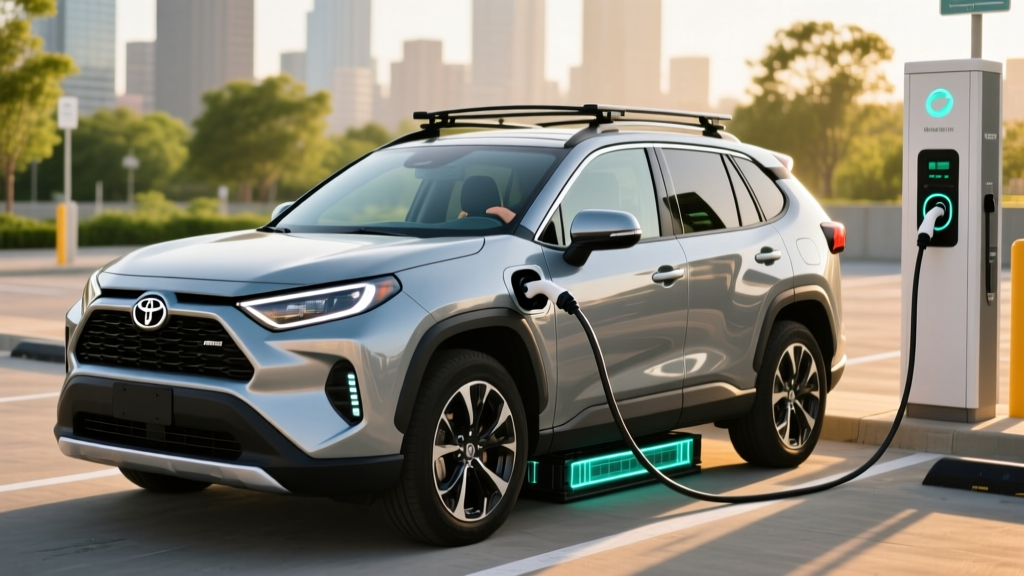
A plug-in hybrid with a larger 18.1 kWh battery. You plug it in to unlock 42 miles of pure electric driving. Once the battery depletes, it seamlessly switches to hybrid mode at ~38 MPG combined. Home charging is key to maximizing value.
If you lack access to home or workplace charging, the conventional RAV4 Hybrid is the smarter buy — you'll never benefit from the Prime's larger battery without plugging in, and you'll pay a $6,000+ premium for capability you can't use.
EPA Range, MPGe, and Fuel Economy Breakdown
The 2026 RAV4 Prime carries over the powertrain and battery that made the previous model years a success. Here are the official EPA figures from fueleconomy.gov:
| Metric | Value |
|---|---|
| Electric-only range | 42 miles |
| MPGe (electric + gas combined) | 94 MPGe |
| Gas-only MPG (after battery depletes) | 38 MPG combined |
| City MPG (hybrid mode) | 40 MPG |
| Highway MPG (hybrid mode) | 36 MPG |
| Total combined range (electric + gas) | ~600 miles |
| Fuel tank capacity | 14.5 gallons |
- Summer, city driving: 40–44 miles (regen braking extends range)
- Highway at 70 mph: 34–38 miles (aerodynamic drag reduces EV efficiency)
- Cold weather (below 32°F): 28–35 miles (cabin heating and battery resistance reduce range by 15–30%)
The RAV4 Prime uses a heat pump on XSE Premium trims, which mitigates cold-weather EV range loss compared to resistive heating.
Once the battery is depleted, the RAV4 Prime operates as a conventional hybrid. Real-world hybrid-mode MPG tends to exceed the EPA city rating in stop-and-go traffic thanks to aggressive regenerative braking — owners frequently report 42–45 MPG in urban driving. Highway hybrid mode settles closer to 34–36 MPG.
Powertrain, Performance, and Battery Specs
The RAV4 Prime pairs a 2.5-liter four-cylinder Atkinson-cycle engine with front and rear electric motors for standard electronic AWD (eAWD). Combined output is 302 horsepower — making it the quickest RAV4 in the lineup.
| Spec | Detail |
|---|---|
| Combined horsepower | 302 hp |
| Gas engine | 2.5L 4-cyl Atkinson (177 hp) |
| Front electric motor | 134 kW (180 hp) |
| Rear electric motor | 40 kW (54 hp) |
| Battery capacity (gross / usable) | 18.1 kWh / ~14.9 kWh usable |
| Battery chemistry | Lithium-ion (NMC) |
| 0–60 mph | 5.7 seconds |
| Drivetrain | Electronic AWD (eAWD) |
| Towing capacity | 2,500 lbs |
The 18.1 kWh battery is significantly larger than the standard RAV4 Hybrid's ~1.6 kWh pack, which is what enables the 42-mile EV range. Toyota uses a buffer strategy — roughly 3.2 kWh is reserved (top and bottom) to protect long-term battery health, giving ~14.9 kWh of usable capacity.
Charging: Times, Levels, and the DC Fast-Charge Limitation
Charging the RAV4 Prime is straightforward but comes with one notable limitation: no DC fast charging. The Prime uses a J1772 connector for AC charging only.
| Charging Level | Power | 0–100% Time | Connector |
|---|---|---|---|
| Level 1 (120V outlet) | ~1.4 kW | ~12 hours | J1772 |
| Level 2 (240V, SE trim) | 3.3 kW | ~5.5 hours | J1772 |
| Level 2 (240V, XSE trim) | 6.6 kW | ~2.5 hours | J1772 |
| DC Fast Charge | Not available | ||
The trim-level charging difference matters. The SE base trim includes a 3.3 kW onboard charger, while the XSE upgrades to a 6.6 kW unit — cutting charge time in half. If you plan to charge at home overnight, either works fine. But if you need mid-day top-ups between errands, the XSE's 6.6 kW charger is meaningfully faster.
For home charging, a standard 120V outlet (Level 1) works but is slow — roughly 4–5 miles of EV range per hour of charging. A 240V Level 2 home charger (like a ChargePoint Home Flex or Toyota-recommended unit) is strongly recommended for daily PHEV use and typically costs $500–$1,500 installed depending on your electrical panel's proximity to the garage.
Pricing, Trims, and Tax Credit Eligibility
The 2026 RAV4 Prime comes in two trims. Pricing reflects Toyota's MSRP before destination charges:
| Trim | MSRP | Onboard Charger | Key Features |
|---|---|---|---|
| SE | $44,500 | 3.3 kW | eAWD, TSS 3.0, 8" touchscreen |
| XSE | $48,500 | 6.6 kW | SofTex seats, heat pump, 10.5" display, ambient lighting |
Federal Tax Credit (§30D) Status
The RAV4 Prime's eligibility for the federal §30D clean vehicle credit is nuanced and subject to change based on battery-sourcing and critical-mineral requirements that tighten annually. As of the 2026 tax year:
- Potential credit: Up to $7,500 if the vehicle meets both critical-mineral and battery-component sourcing requirements
- MSRP cap: SUVs must be at or below $80,000 — both trims qualify
- Buyer income cap: $150,000 single / $225,000 head of household / $300,000 joint filers (modified AGI)
- Point-of-sale transfer: Eligible buyers can transfer the credit to the dealer for an upfront price reduction
- Assembly requirement: Final assembly must be in North America (the RAV4 Prime is assembled in Japan — this may disqualify it from the §30D credit depending on current-year rules)
Battery Longevity, Warranty, and Reliability
Toyota's hybrid system reliability is among the most proven in the industry, with over two decades of real-world data from the Prius lineup. The RAV4 Prime's larger battery follows the same engineering philosophy with robust thermal management.
- Hybrid battery: 10 years / 150,000 miles (whichever comes first)
- Hybrid system components: 8 years / 100,000 miles
- Basic vehicle warranty: 3 years / 36,000 miles
- Powertrain warranty: 5 years / 60,000 miles
Toyota defines hybrid battery warranty coverage as replacement if capacity drops below ~60–70% of original capacity during the warranty period. Real-world degradation data from earlier Prime model years (2021–2024) shows minimal loss — most owners report 95%+ battery health after 50,000+ miles.
Battery Replacement Cost
If the traction battery requires replacement out of warranty, current estimates place the cost at $3,500–$6,000 for the battery pack plus labor at a Toyota dealer. Third-party hybrid specialists may offer refurbished packs for $2,000–$3,500. Given Toyota's track record with hybrid battery longevity (many Prius packs exceed 200,000 miles), this is a low-probability expense for most owners.
The RAV4 Prime consistently earns top safety ratings. The IIHS has historically awarded the RAV4 platform TOP SAFETY PICK status, and Toyota Safety Sense 3.0 (TSS 3.0) comes standard with pre-collision braking, lane tracing assist, adaptive cruise control, and road sign assist.
RAV4 Prime vs. Full EV vs. Gas: Which Should You Choose?
Choose the RAV4 Prime (PHEV) if:
- You have home or workplace Level 2 charging access
- Your daily commute is under ~40 miles round-trip
- You want electric daily driving but need gas flexibility for road trips
- You live in a region with extreme cold or limited public charging infrastructure
- You want 302 hp and standard AWD without range anxiety
Choose a Full EV (e.g., Tesla Model Y, Ioniq 5) if:
- You have reliable home charging and access to DC fast-charging networks
- You want zero tailpipe emissions and minimal maintenance (no oil changes, fewer moving parts)
- Your daily driving is predictable and under ~250 miles
- You want to maximize fuel savings and qualify for the full §30D credit (many EVs qualify where the Prime does not)
Choose the RAV4 Hybrid (HEV) if:
- You cannot charge at home or work (apartment, street parking, no outlet access)
- You want hybrid efficiency (~41 MPG city) without any plug-in behavior
- You want a lower purchase price (~$33,000 starting MSRP)
- You prefer the simplest ownership experience — just fill up with gas
Pros and Cons
✅ Pros
- 42 miles EV range covers most daily commutes
- 302 hp with 5.7-second 0–60 — quickest RAV4
- Standard eAWD for all-weather confidence
- 38 MPG hybrid mode when battery depletes
- ~600-mile total range eliminates road-trip anxiety
- Proven Toyota hybrid reliability and 10-year battery warranty
- Strong resale value
❌ Cons
- No DC fast charging — AC only
- Assembled in Japan — likely ineligible for §30D federal credit
- Base MSRP $44,500+ — significant premium over RAV4 Hybrid
- Limited dealer inventory; waitlists common
- SE trim limited to 3.3 kW charging (slow for Level 2)
- Cold weather reduces EV range to ~28–35 miles
- Cargo space slightly reduced vs. gas RAV4 (battery placement)
2026 RAV4 Prime FAQ
How many MPG does the RAV4 Prime get?
The RAV4 Prime achieves 94 MPGe when combining electric and gas operation. Once the battery is depleted, it operates as a hybrid at an EPA-rated 38 MPG combined (40 city / 36 highway). Real-world city driving often yields 42–45 MPG in hybrid mode due to strong regenerative braking.
How far can the RAV4 Prime go on electric only?
The EPA rates the RAV4 Prime at 42 miles of electric-only range. Real-world results vary: expect 40–44 miles in warm city driving, 34–38 miles on the highway, and 28–35 miles in freezing temperatures. Total combined range (electric + full gas tank) is approximately 600 miles.
Does the RAV4 Prime qualify for the federal tax credit?
Likely not. The §30D federal clean vehicle credit requires final assembly in North America, and the RAV4 Prime is assembled in Japan. This disqualifies it from the up-to-$7,500 federal credit. However, state-level incentives in California, Colorado, and other states may still apply. Always verify current eligibility on the IRS and DOE websites before purchasing.
Is the RAV4 Prime reliable, and what does battery replacement cost?
Toyota's hybrid systems are among the most reliable in the automotive industry. The RAV4 Prime's battery is covered by a 10-year / 150,000-mile warranty. Out-of-warranty replacement costs approximately $3,500–$6,000 at a dealer. Real-world data from 2021–2024 Primes shows minimal degradation, with most owners retaining 95%+ battery health past 50,000 miles.
Can the RAV4 Prime DC fast charge?
No. The RAV4 Prime only supports AC charging via a J1772 connector. Level 1 (120V) takes ~12 hours for a full charge. Level 2 (240V) takes ~5.5 hours on the SE trim (3.3 kW) or ~2.5 hours on the XSE trim (6.6 kW). This is typical for PHEVs — the smaller battery doesn't require DC fast charging for overnight home replenishment.
Is the RAV4 Prime worth it over the regular RAV4 Hybrid?
If you can charge at home and your daily driving is under ~40 miles, the Prime saves significant fuel costs and delivers dramatically more power (302 hp vs. 219 hp). The $11,000+ price premium pays back over time through fuel savings, but the math depends on your electricity rates, driving patterns, and how long you plan to keep the vehicle. If you can't charge at home, the standard RAV4 Hybrid at ~$33,000 is the better value.