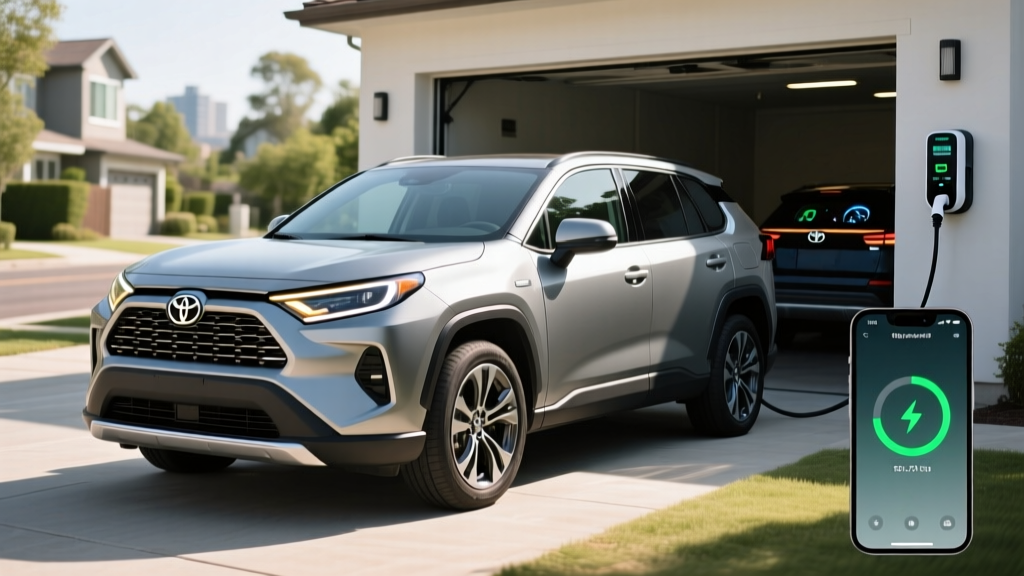
Quick Verdict: The RAV4 Limited Hybrid Still Sets the Compact SUV Benchmark
The Toyota RAV4 Hybrid has been the best-selling hybrid in America for years, and the 2026 RAV4 Limited Hybrid trim sits at the top of that lineup with premium features, all-wheel drive standard, and an EPA-estimated 39 MPG combined. If you want the efficiency of electrification without changing your fueling habits — no plugs, no range anxiety, no charging infrastructure dependency — this powertrain remains the most practical bridge between a conventional gas car and a full battery-electric vehicle.
The Limited trim adds features the lower LE, XLE, and XSE trims don't: a 12.3-inch digital instrument cluster, SofTex-trimmed heated and ventilated front seats, a panoramic moonroof, a 360-degree camera, and Toyota's Premium JBL audio system. It's the most expensive RAV4 Hybrid you can buy before stepping into the RAV4 Prime plug-in hybrid territory, and for many buyers, it's the sweet spot of value, efficiency, and equipment.
HEV vs. PHEV: What the RAV4 Hybrid Actually Is (and Isn't)
Before diving into specs, it's essential to distinguish between the two electrified RAV4 variants Toyota sells, because confusion here leads to purchase mistakes:
| Feature | RAV4 Hybrid (HEV) | RAV4 Prime (PHEV) |
|---|---|---|
| Powertrain Type | Conventional hybrid — self-charging | Plug-in hybrid — requires external charging for EV mode |
| Needs to Plug In? | No — regenerative braking and engine recharge the battery | Yes — for full electric-only range benefit |
| Battery Capacity | ~1.6 kWh (small buffer) | 18.1 kWh usable |
| Electric-Only Range | ~1 mile at very low speeds | 42 miles EPA |
| Combined Horsepower | 219 hp | 302 hp |
| EPA Combined MPG / MPGe | 39 MPG | 94 MPGe (EV mode) / 38 MPG (gas-only) |
| Starting MSRP (top trim) | ~$42,645 (Limited) | ~$48,575 (XSE Premium) |
| Federal Tax Credit (§30D) | Not eligible | Not eligible (credit exhausted for Toyota PHEVs) |
The RAV4 Hybrid (HEV) uses a small battery that charges itself through regenerative braking and the gasoline engine. You never plug it in. It simply makes the gas engine more efficient by supplementing it with electric motor assist, particularly in city driving where electric torque fills in the gaps the engine can't.
The RAV4 Prime (PHEV) has a much larger battery you charge from a wall outlet or charger, giving you 42 miles of pure electric driving before the gasoline engine kicks in. It's the more powerful, more efficient option — if you can charge at home. But it also costs roughly $6,000 more and, as of 2026, no longer qualifies for the federal §30D tax credit because Toyota has exceeded the manufacturer cap.
Fuel Economy: EPA Ratings vs. Real-World MPG
| Driving Condition | EPA Estimate | Real-World Expectation |
|---|---|---|
| City | 41 MPG | 40–44 MPG (hybrids often exceed EPA in stop-and-go) |
| Highway | 38 MPG | 34–38 MPG (aerodynamic drag and sustained speed reduce hybrid advantage) |
| Combined | 39 MPG | 37–41 MPG depending on driving mix |
According to fueleconomy.gov, the 2026 RAV4 Hybrid AWD earns an EPA-estimated 41 city / 38 highway / 39 combined MPG across all trims, including the Limited. These numbers are consistent with the mechanical package shared across the Hybrid lineup — the Limited's extra weight from premium features has a negligible effect on efficiency.
Real-world nuance matters here. Hybrids like the RAV4 Hybrid tend to exceed their EPA city estimate in real-world urban driving. The reason is physics: regenerative braking recaptures kinetic energy during frequent stops, and the electric motor handles low-speed propulsion where gasoline engines are least efficient. Owners who commute in heavy traffic routinely report 42–44 MPG in city-dominant driving cycles.
Highway driving tells the opposite story. At sustained 70–80 MPH speeds, the gasoline engine does nearly all the work — the electric motor can't meaningfully assist against aerodynamic drag at those velocities. Expect 34–37 MPG on long interstate trips, especially with roof cargo boxes or in high wind. Cold weather (below 35°F) typically knocks 2–4 MPG off combined figures because the engine runs more often to heat the cabin and because battery chemistry is less efficient at low temperatures.
Powertrain Deep Dive: 219 HP from Engine + Motors
| Specification | 2026 RAV4 Hybrid Limited |
|---|---|
| Engine | 2.5L Dynamic Force 4-cylinder (176 hp / 163 lb-ft) |
| Front Electric Motor | Permanent magnet synchronous (118 hp / 149 lb-ft) |
| Rear Electric Motor (AWD) | 40 hp / 89 lb-ft (independent rear axle drive) |
| Net Combined System Output | 219 hp |
| Transmission | eCVT (electronically controlled continuously variable) |
| Drivetrain | Electronic On-Demand AWD standard |
| 0–60 MPH | ~7.4 seconds |
| Battery Type | Nickel-metal hydride (NiMH), ~1.6 kWh |
| Towing Capacity | 1,750 lbs |
The RAV4 Hybrid uses Toyota's fourth-generation hybrid synergy drive. The 2.5-liter four-cylinder runs on the Atkinson cycle — a modified combustion cycle that sacrifices some low-end power for greater thermal efficiency (up to 41% in this engine). The front electric motor fills in the torque gap the Atkinson cycle creates, delivering smooth, immediate thrust from a stop.
The rear axle has its own dedicated electric motor, which provides all-wheel-drive traction without a mechanical driveshaft connecting front and rear. This "e-AWD" system engages the rear motor automatically when slip is detected or during hard acceleration, then disengages it during cruising to save energy. It's not a rock-crawling system, but it handles rain, light snow, and gravel roads confidently.
The eCVT is not a belt-and-pulley CVT like those in some competitors. It uses a planetary gearset to blend engine and motor power seamlessly. There are no fixed gear ratios, no shift shock, and no rubber-band revving sensation. It's one of the smoothest powertrain experiences in the compact SUV segment.
Pricing, Trim Features, and Tax Credit Reality
The 2026 RAV4 Hybrid Limited starts at an MSRP of approximately $42,645 (including destination charge). That positions it roughly $10,000 above the base Hybrid LE ($32,995) and about $3,500 above the XLE Premium. For that premium, the Limited adds:
- 12.3-inch digital instrument cluster with hybrid energy flow display
- SofTex-trimmed heated and ventilated front seats
- Panoramic glass moonroof with power sunshade
- 360-degree bird's-eye view camera with perimeter scan
- 11-speaker JBL premium audio with Clari-Fi
- 10.5-inch Toyota Audio Multimedia touchscreen with wireless Apple CarPlay and Android Auto
- Digital rearview mirror with HomeLink
- Qi-compatible wireless smartphone charging
Federal Tax Credit Eligibility
The conventional RAV4 Hybrid (HEV) does not qualify for the federal §30D clean vehicle tax credit. That credit applies only to plug-in electric vehicles (BEVs and PHEVs) that meet battery sourcing, MSRP cap, and buyer income requirements under current IRS rules.
However, some states offer rebates or tax incentives for conventional hybrids. Check your state energy office or department of revenue for current programs — these vary significantly by jurisdiction and change frequently.
Hybrid Battery Longevity, Warranty, and Replacement Cost
Battery lifespan is the single most common concern among first-time hybrid buyers. Here's what the data actually shows:
Toyota covers the RAV4 Hybrid's battery with a 10-year / 150,000-mile warranty (in states that follow California Air Resources Board emissions standards, which is most states). In the remaining states, coverage is 8 years / 100,000 miles. The warranty guarantees that the battery will retain sufficient capacity to function properly — if it fails or degrades beyond Toyota's threshold, replacement is covered at no cost.
| Component | Warranty Coverage |
|---|---|
| Hybrid Battery | 10 years / 150,000 miles (CARB states) or 8 years / 100,000 miles |
| Hybrid System Components (inverter, motors, control module) | 8 years / 100,000 miles |
| Powertrain (engine, eCVT) | 5 years / 60,000 miles |
| Bumper-to-Bumper | 3 years / 36,000 miles |
The RAV4 Hybrid uses a nickel-metal hydride (NiMH) battery pack rather than the lithium-ion packs found in full EVs. NiMH chemistry is less energy-dense but exceptionally durable — Toyota Prius taxis have exceeded 300,000 miles on original hybrid batteries. Real-world failure data from Toyota dealerships and independent hybrid specialists shows that RAV4 Hybrid battery replacements before 150,000 miles are uncommon.
If you do need an out-of-warranty replacement, expect to pay between $3,000 and $4,500 for a new OEM battery pack installed at a Toyota dealer. Refurbished or aftermarket NiMH packs from reputable hybrid specialists typically run $1,500–$2,500 installed. For context, that's roughly the cost of a single major transmission repair on a conventional vehicle — and far less than a full EV battery replacement.
RAV4 Hybrid vs. RAV4 Prime vs. Full EV: Which Fits You?
Choose the RAV4 Hybrid (HEV) if:
- You cannot charge at home (apartment, street parking, no garage outlet)
- You want maximum efficiency with zero behavior change — just fill up with gas
- Your budget tops out around $43,000 and you want the most feature-rich option
- You drive a mix of city and highway and want 37–41 MPG without thinking about it
- You plan to keep the vehicle 8+ years and value Toyota's long-term reliability track record
Choose the RAV4 Prime (PHEV) if:
- You can install a Level 2 home charger and your daily commute is under 40 miles round-trip
- You want 302 hp and 0–60 in 5.7 seconds alongside hybrid efficiency for longer trips
- You're willing to pay ~$6,000 more upfront for the larger battery and electric-only driving
- You want to drive mostly on electricity during the week but take gas-powered road trips on weekends
Choose a Full EV (e.g., Tesla Model Y, Hyundai Ioniq 5) if:
- You have reliable home Level 2 charging and access to DC fast chargers on your routes
- You want the lowest per-mile fuel cost (~$0.04–0.06/mile on home electricity vs. ~$0.12–0.15/mile on gas at 39 MPG)
- You qualify for the §30D federal tax credit (up to $7,500) based on income, MSRP cap, and battery sourcing
- You're ready to plan charging stops on road trips and accept cold-weather range reduction of 20–30%
The honest reality: the RAV4 Hybrid is the lowest-risk electrified choice. You pay a modest premium over the gas-only RAV4 (~$1,500–$2,000 at the Limited trim level), save roughly $500–$700 per year in fuel compared to the gas model (based on 15,000 miles/year at $3.50/gallon), and recoup that premium in 3–4 years. After that, it's pure savings. You never need to think about charging, battery preconditioning, or charger availability.
Pros, Cons, and Ownership Realities
Pros
- 39 MPG combined EPA — best in the compact hybrid SUV class alongside the Honda CR-V Hybrid
- Standard electronic AWD with dedicated rear motor — no fuel-economy penalty for all-wheel drive
- 10-year/150,000-mile hybrid battery warranty provides long-term peace of mind
- No charging infrastructure needed — works with existing gas station habits
- Limited trim is genuinely well-equipped: panoramic roof, JBL audio, ventilated seats, 360° camera
- Toyota's hybrid reliability data spans 25+ years and millions of vehicles
- Strong resale value — RAV4 Hybrids hold value better than nearly any competitor
Cons
- No federal tax credit eligibility — HEVs are excluded from §30D
- eCVT lacks the engagement of a stepped automatic — fine for commuting, dull for enthusiasts
- 1,750-lb towing capacity is low for the class (Kia Sportage Hybrid tows 2,000 lbs)
- Limited trim at $42,645 pushes into RAV4 Prime territory where PHEV benefits begin
- Cargo space slightly reduced vs. gas RAV4 due to hybrid battery placement under rear seat (37.6 cu ft behind rear seats vs. 37.5 — effectively identical, but frunk is not available)
- Road noise at highway speeds is noticeable — Toyota's insulation hasn't caught up to Hyundai/Kia
Frequently Asked Questions
How many MPG does the 2026 RAV4 Limited Hybrid get?
The EPA rates the 2026 RAV4 Hybrid (all trims including Limited) at 41 MPG city, 38 MPG highway, and 39 MPG combined. In real-world driving, city-dominant commuters often see 40–44 MPG, while highway-heavy drivers should expect 34–38 MPG. Cold weather reduces combined efficiency by roughly 2–4 MPG.
Does the RAV4 Hybrid need to be plugged in?
No. The RAV4 Hybrid is a conventional hybrid (HEV). Its small battery recharges through regenerative braking and the gasoline engine. You fuel it exclusively at gas stations, exactly like a conventional car. If you want plug-in capability with electric-only range, you're looking for the RAV4 Prime (PHEV).
Is the RAV4 Hybrid reliable, and what does a battery replacement cost?
Toyota's hybrid system has over two decades of proven reliability data. The hybrid battery is covered for 10 years/150,000 miles in most states. Out-of-warranty replacement costs $3,000–$4,500 for a new OEM pack or $1,500–$2,500 for a refurbished unit. Real-world data shows most RAV4 Hybrid batteries last well beyond 150,000 miles without intervention.
Does the RAV4 Hybrid qualify for any tax credit?
The conventional RAV4 Hybrid (HEV) does not qualify for the federal §30D clean vehicle tax credit, which is reserved for plug-in vehicles. Some states offer hybrid-specific rebates or HOV lane access — check your state's energy office. The RAV4 Prime (PHEV) previously qualified but has exhausted Toyota's manufacturer cap under current IRS §30D rules.
How does the RAV4 Hybrid compare to the Honda CR-V Hybrid?
The 2026 Honda CR-V Hybrid Sport Touring is the closest competitor, rated at 40 MPG combined (37 city/43 highway — note Honda's AWD system splits power differently). The CR-V Hybrid offers slightly more cargo space and a more refined ride, while the RAV4 Hybrid delivers stronger real-world city MPG, a longer track record, and typically better resale value. Both are excellent choices; test-drive both before deciding.
Should I get the Limited trim or save money on the XLE?
The XLE Hybrid ($35,895) includes most features daily drivers need: heated front seats, power liftgate, dual-zone climate, blind-spot monitoring, and the 10.5-inch touchscreen. The $6,750 jump to Limited buys the panoramic moonroof, ventilated seats, JBL audio, 360° camera, and digital cluster. If you plan to keep the vehicle 7+ years and value those comforts, the Limited holds its value well. If you're budget-conscious, the XLE delivers 95% of the driving experience at a meaningfully lower price.