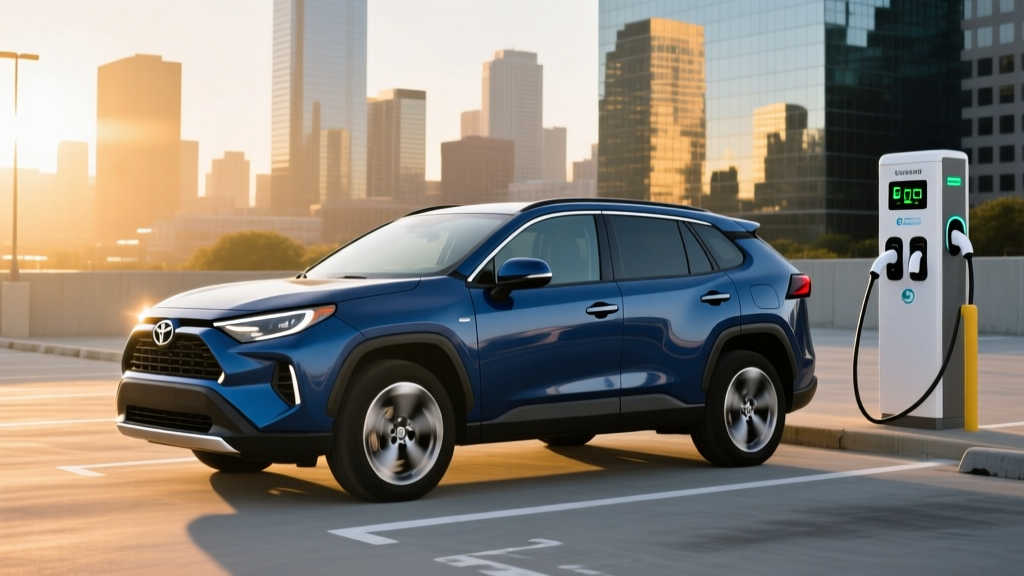
The Toyota RAV4 Hybrid has held the compact SUV sales crown for years, and for good reason. Buyers keep coming back to one metric above all others: fuel economy. Whether you're eyeing the conventional RAV4 Hybrid (HEV) that never needs a plug or the RAV4 Prime plug-in hybrid (PHEV) that can run on electricity alone, understanding the real-world MPG picture is critical before you sign a purchase agreement.
This guide breaks down the 2026 RAV4 Hybrid and RAV4 Prime fuel economy with exact EPA figures, real-world testing expectations, powertrain specs, battery warranty details, and tax credit eligibility — so you can decide which version actually fits your driving life.
2026 RAV4 Hybrid MPG: EPA Numbers and Real-World Results
The conventional RAV4 Hybrid uses Toyota's fifth-generation hybrid system, pairing a 2.5-liter four-cylinder engine with front and rear electric motors for standard all-wheel drive (AWD). It never needs to be plugged in — the battery charges through regenerative braking and the gasoline engine.
| Trim | City MPG | Highway MPG | Combined MPG |
|---|---|---|---|
| LE / XLE / XLE Premium | 41 | 38 | 40 |
| SE / XSE | 41 | 38 | 40 |
| Limited / Woodland Edition | 41 | 38 | 40 |
Source: EPA Fuel Economy
In mixed driving, most owners report 38–43 MPG combined. The RAV4 Hybrid consistently exceeds its EPA city estimate in stop-and-go traffic because regenerative braking recovers energy that a gas car would waste as heat. Highway-only driving at 75+ mph can drop to 34–36 MPG, especially with roof cargo boxes or in cold weather below 30°F where the engine runs more frequently for cabin heat.
For a compact AWD SUV, 40 MPG combined is exceptional. Compare this to the gas-only RAV4 AWD at 30 MPG combined — that's a 33% improvement that translates to roughly $500–$700 less per year in fuel costs at national average gas prices.
RAV4 Prime PHEV: Electric Range, MPGe, and Total Range
The RAV4 Prime is the plug-in hybrid variant. It has a significantly larger battery pack that you do charge by plugging in, giving it a meaningful electric-only driving range before the gasoline engine engages.
| Metric | Value |
|---|---|
| Electric-Only Range | 42 miles (EPA) |
| MPGe (Electric + Gas) | 94 MPGe combined |
| Gas-Only MPG (after battery depletes) | 38 MPG combined |
| Total Combined Range | ~600 miles |
| Battery Capacity | 18.1 kWh (gross) |
Source: EPA Fuel Economy
In practice, the 42-mile electric range holds up well for daily commutes under 50 mph. At highway speeds of 70+ mph, expect closer to 32–35 miles of electric-only driving. In cold weather (below freezing), electric range can drop 15–25% due to battery chemistry limitations and cabin heating demands.
Once the battery depletes, the RAV4 Prime operates as a conventional hybrid at 38 MPG combined — slightly lower than the standard RAV4 Hybrid's 40 MPG due to the added weight of the larger battery pack.
HEV vs. PHEV: Which RAV4 Hybrid Fits You?
| Factor | RAV4 Hybrid (HEV) | RAV4 Prime (PHEV) |
|---|---|---|
| Needs to be plugged in? | No — self-charging | Yes — for electric range |
| Combined MPG | 40 MPG | 38 MPG (gas) / 94 MPGe (combined) |
| Electric-only driving | Not possible | 42 miles EPA |
| Battery size | 1.6 kWh (small buffer) | 18.1 kWh |
| Charging hardware | None needed | Level 1 (120V) included; Level 2 optional |
| Level 2 charge time (0–100%) | N/A | ~2.5 hours at 6.6 kW |
| DC fast charging | N/A | Not supported |
| Combined horsepower | 219 hp | 302 hp |
| 0–60 mph | 7.4 seconds | 5.7 seconds |
| Starting MSRP (2026) | ~$33,500 | ~$44,500 |
| Federal tax credit (§30D) | Not eligible | Eligible — up to $7,500* |
*Tax credit eligibility depends on buyer income limits, vehicle MSRP caps, and battery component/critical mineral sourcing requirements under current IRS rules. See IRS §30D guidelines for current-year eligibility. Point-of-sale transfer is available through participating dealers.
Powertrain Breakdown: Engine, Motors, and Performance
Both RAV4 Hybrid variants use Toyota's 2.5-liter Dynamic Force four-cylinder engine paired with electric motors, but the execution differs significantly.
RAV4 Hybrid (HEV) Powertrain
- Engine: 2.5L inline-4, 176 hp / 163 lb-ft torque
- Front motor: 134 hp
- Rear motor (AWD): 54 hp
- Net combined output: 219 hp
- Transmission: eCVT (electronically controlled continuously variable)
- 0–60 mph: 7.4 seconds
RAV4 Prime (PHEV) Powertrain
- Engine: 2.5L inline-4, 177 hp / 165 lb-ft torque
- Front motor: 180 hp (larger than HEV)
- Rear motor (AWD): 54 hp
- Net combined output: 302 hp
- Transmission: eCVT
- 0–60 mph: 5.7 seconds
The Prime's 302 hp makes it the quickest RAV4 Toyota sells — quicker than the gas-only V6-era models and competitive with sport compact SUVs. The additional power comes from the larger front electric motor that can draw heavily from the 18.1 kWh battery.
| Spec | RAV4 Hybrid | RAV4 Prime |
|---|---|---|
| Drivetrain | AWD (standard) | AWD (standard) |
| Combined HP | 219 hp | 302 hp |
| 0–60 mph | 7.4 sec | 5.7 sec |
| Towing capacity | 1,750 lbs | 1,750 lbs |
| Cargo volume (rear seats up) | 37.5 cu ft | 33.5 cu ft |
| Cargo volume (rear seats folded) | 69.8 cu ft | 63.2 cu ft |
| Curb weight | ~3,710 lbs | ~4,235 lbs |
Note the cargo penalty on the Prime: the larger battery sits under the rear floor, raising it slightly and reducing cargo volume by about 4–6 cubic feet.
Battery Warranty, Lifespan, and Replacement Cost
- RAV4 Hybrid (HEV): 10 years / 150,000 miles (whichever comes first)
- RAV4 Prime (PHEV): 10 years / 150,000 miles for the traction battery
- Coverage: Defects and capacity loss below ~70% of original capacity
- Transferable: Yes — warranty follows the vehicle, not the original owner
Toyota's nickel-metal hydride (HEV) and lithium-ion (Prime) hybrid batteries have an excellent longevity track record. Data from fleet operators and long-term owners show the RAV4 Hybrid's 1.6 kWh battery routinely lasting 150,000–200,000+ miles with minimal degradation, largely because the hybrid system only uses a narrow state-of-charge window (roughly 40–80%), avoiding the deep cycles that stress batteries.
The RAV4 Prime's 18.1 kWh lithium-ion pack sees deeper cycling, but Toyota's thermal management and conservative buffer strategy keep degradation modest. Owners at 100,000 miles typically report 5–10% range loss — meaning the 42-mile electric range might become 37–39 miles over time.
Replacement cost if out of warranty:
- RAV4 Hybrid (HEV) battery: $3,000–$4,500 (parts + labor at a dealership)
- RAV4 Prime (PHEV) battery: $8,000–$12,000 (parts + labor)
These costs are significant, but actual out-of-warranty replacements remain rare for vehicles under 200,000 miles. Third-party refurbishment options are emerging at lower price points, though OEM replacement is recommended for warranty continuity.
Pricing, Trims, and Tax Credit Eligibility
The RAV4 Hybrid spans a wide price range across its trim lineup. Here's where the 2026 models land:
| Trim | MSRP |
|---|---|
| RAV4 Hybrid LE | $33,500 |
| RAV4 Hybrid XLE | $34,900 |
| RAV4 Hybrid XLE Premium | $36,750 |
| RAV4 Hybrid SE | $37,400 |
| RAV4 Hybrid XSE | $38,800 |
| RAV4 Hybrid Limited | $41,100 |
| RAV4 Hybrid Woodland Edition | $37,200 |
| RAV4 Prime SE | $44,500 |
| RAV4 Prime XSE | $47,900 |
| RAV4 Prime XSE Premium | $51,400 |
Destination charge: approximately $1,350 additional.
Federal Tax Credit for the RAV4 Prime
The RAV4 Hybrid (HEV) does not qualify for the federal §30D clean vehicle credit — it is not a plug-in vehicle. Only the RAV4 Prime (PHEV) is potentially eligible.
- Vehicle MSRP must be at or below $80,000 (SUV cap) — all Prime trims qualify
- Buyer modified AGI must not exceed $150,000 (single) / $300,000 (joint) / $225,000 (head of household)
- Battery critical minerals and component sourcing must meet annual phase-in thresholds — confirm with dealer at point of sale
- Credit amount: up to $7,500 ($3,750 for critical minerals + $3,750 for battery components)
- Point-of-sale transfer available: the credit can be applied as a down payment reduction at participating dealerships
- Vehicle must be assembled in North America — the RAV4 Prime is built in Japan, which may affect eligibility depending on current-year sourcing rules
Critical note: The RAV4 Prime is manufactured at Toyota's Tahara plant in Japan. Under current §30D rules, North American final assembly is required for credit eligibility. This has historically disqualified the Prime from the federal credit. Always verify current eligibility at fueleconomy.gov's tax credit tool before purchasing, as trade agreements and rule changes can shift eligibility.
Some states offer additional rebates for PHEVs regardless of assembly location — check your state's energy office or AFDC state incentive database for local programs.
RAV4 Hybrid vs. PHEV vs. Full EV: Which Should You Choose?
- You have no access to home or workplace charging
- You want maximum simplicity — no plug, no new habits
- Your budget is under $40,000
- You drive 12,000–15,000 miles/year and want reliable 40 MPG everywhere
- You want proven long-term reliability with minimal maintenance
- You can install a Level 2 charger at home (240V outlet or hardwired)
- Your daily commute is under 40 miles round-trip (you'll rarely use gas)
- You want 302 hp and 5.7-second 0–60 performance
- You take occasional road trips and want no range anxiety
- You qualify for state PHEV incentives that offset the price premium
- You have reliable home Level 2 charging
- You want zero tailpipe emissions and minimal maintenance
- Your daily driving is under 250 miles and you can plan road-trip charging
- You want to fully escape gasoline price volatility
The RAV4 Hybrid's 40 MPG combined is hard to beat for buyers who can't plug in. The $11,000 price gap between the Hybrid XLE ($34,900) and the Prime SE ($44,500) takes years of fuel savings to recoup — roughly 8–10 years at average mileage unless you drive primarily in electric mode and have cheap electricity.
Pros and Cons at a Glance
- 40 MPG combined (HEV) — class-leading for an AWD compact SUV
- Standard AWD on all trims with no fuel economy penalty vs FWD
- 10-year / 150,000-mile hybrid battery warranty
- RAV4 Prime delivers 302 hp and 42 miles of electric range
- Excellent reliability record — Toyota's hybrid system is battle-tested
- Strong resale value — RAV4 Hybrids hold value better than most competitors
- RAV4 Prime's ~$44,500 starting price is steep; may not qualify for federal credit due to Japan assembly
- eCVT drone under hard acceleration — not a sporty driving experience
- Prime loses 4–6 cu ft of cargo space due to larger battery
- Highway MPG drops to 34–36 at sustained 75+ mph speeds
- No DC fast charging on the Prime — Level 2 only
- Long dealer wait times on popular trims — markups still common in some markets
Frequently Asked Questions
How many MPG does the RAV4 Hybrid actually get in real driving?
The EPA rates it at 41 city / 38 highway / 40 combined. In real-world testing, city drivers often see 42–44 MPG thanks to regenerative braking, while highway-only drivers at 75+ mph should expect 34–36 MPG. Cold weather (below 30°F) typically drops combined MPG by 3–5 points due to increased engine operation for cabin heating.
How far can the RAV4 Prime go on electric only?
The EPA rates the RAV4 Prime at 42 miles of electric-only range. In practice, expect 35–42 miles depending on speed and temperature. At highway speeds above 65 mph, the range drops to roughly 32–35 miles. In freezing weather, plan for 28–33 miles. Once depleted, it seamlessly transitions to hybrid mode at 38 MPG combined.
Do I need to plug in the RAV4 Hybrid?
No. The standard RAV4 Hybrid (HEV) is a self-charging hybrid. It uses regenerative braking and the gasoline engine to keep its small 1.6 kWh battery charged. You simply fill it with gas and drive. Only the RAV4 Prime (PHEV) benefits from being plugged in.
Is the RAV4 Hybrid battery reliable, and what does replacement cost?
Toyota's hybrid battery systems have an industry-leading reliability record. The hybrid battery is covered by a 10-year / 150,000-mile warranty. Out-of-warranty replacement for the HEV battery runs $3,000–$4,500; the Prime's larger pack costs $8,000–$12,000. However, many Toyota hybrid batteries last 200,000+ miles without needing replacement.
Does the RAV4 Hybrid or Prime qualify for a federal tax credit?
The standard RAV4 Hybrid (HEV) does not qualify for any federal tax credit — it is not a plug-in vehicle. The RAV4 Prime (PHEV) is theoretically eligible for up to $7,500 under §30D, but its Japan assembly may disqualify it under the North American final assembly requirement. Always check fueleconomy.gov and consult a tax professional before relying on credit eligibility.
How long does it take to charge the RAV4 Prime?
On a standard 120V Level 1 outlet, a full charge takes approximately 12 hours — practical only for overnight top-ups. On a 240V Level 2 charger at the Prime's maximum 6.6 kW rate, a full charge takes about 2.5 hours. The RAV4 Prime does not support DC fast charging.
RAV4 Hybrid vs. Honda CR-V Hybrid — which gets better MPG?
The 2026 Honda CR-V Hybrid AWD is EPA-rated at 40 city / 34 highway / 37 combined. The RAV4 Hybrid's 41/38/40 rating edges it out, particularly on the highway where the Toyota's advantage is 4 MPG. Both are excellent choices, but the RAV4 Hybrid holds a slight fuel economy edge.