Quick Verdict: The RAV4 Hybrid Lineup in 2024
Toyota's 2024 RAV4 Hybrid and its plug-in sibling, the RAV4 Prime, occupy two very different positions in the electrified SUV market. The conventional hybrid (HEV) delivers a stout 39 MPG combined with zero plug-in hassle, starting under $33,000. The RAV4 Prime PHEV adds 42 miles of electric-only range and 302 combined horsepower, but commands nearly $11,000 more and no longer qualifies for the full federal tax credit when purchased new.
If you're searching for a rav4 2024 hybrid, you'll need to decide between these two flavors. This guide breaks down every spec that matters — from real-world fuel economy to battery longevity — so you can pick the right one.
HEV vs PHEV: What's the Actual Difference?
Conventional Hybrid (RAV4 Hybrid): A 2.5L four-cylinder engine pairs with electric motors and a small ~1.6 kWh nickel-metal hydride battery. The battery charges itself through regenerative braking and the engine — you never plug it in. It operates as a seamless blended system, switching between gas and electric dozens of times per drive without driver input.
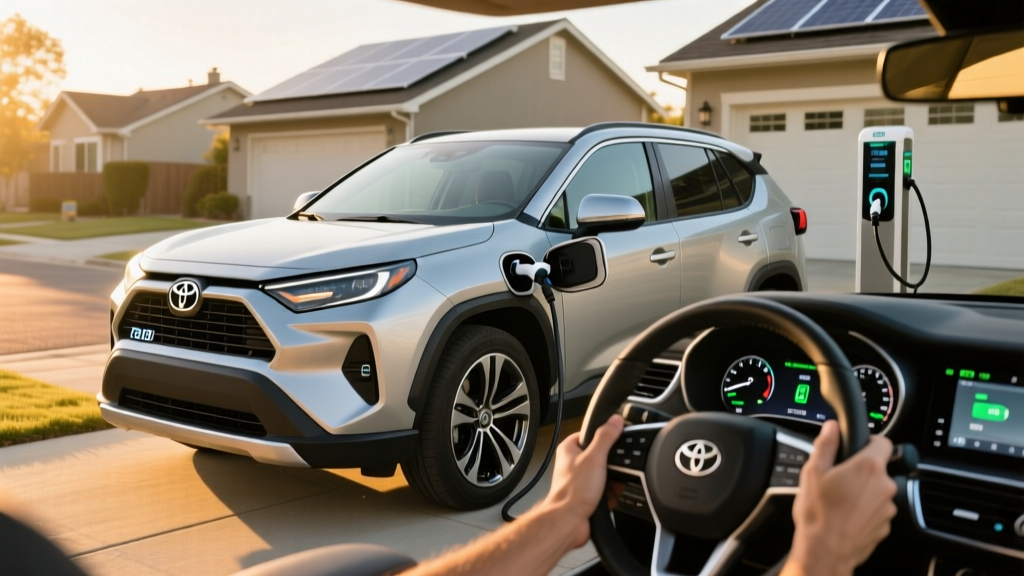
Plug-In Hybrid (RAV4 Prime): A larger 18.1 kWh lithium-ion battery pack powers the vehicle for up to 42 miles on electricity alone. When that depletes, the Prime reverts to conventional hybrid operation at roughly 38 MPG combined. You plug it in to recharge the battery, typically overnight at home on a Level 2 (240V) charger.
The distinction matters enormously for your wallet and daily routine. The HEV suits drivers who want maximum fuel economy with zero lifestyle change. The PHEV rewards those with home charging access and short-to-medium commutes who want EV-like daily driving with a gas safety net.
Fuel Economy: EPA Ratings vs Real-World MPG
Toyota publishes strong EPA figures for both models, but real-world results depend heavily on your driving mix.
| Model | City MPG | Highway MPG | Combined MPG | MPGe (PHEV EV mode) |
|---|---|---|---|---|
| RAV4 Hybrid (AWD) | 41 | 38 | 39 | N/A |
| RAV4 Hybrid (FWD LE) | 27 | 35 | 30 | N/A |
| RAV4 Prime (PHEV, EV mode) | — | — | — | 94 MPGe |
| RAV4 Prime (hybrid mode) | 40 | 36 | 38 | N/A |
Source: fueleconomy.gov
Real-world note: The RAV4 Hybrid's city MPG often exceeds the EPA sticker. Hybrids thrive in stop-and-go traffic where regenerative braking recaptures energy and the engine shuts off at stops. Owners on fuel-tracking platforms routinely report 42–45 MPG in urban driving. Highway cruising, where the gas engine runs continuously, tends to land closer to 35–37 MPG — below the 38 MPG EPA highway estimate.
For the RAV4 Prime, the 94 MPGe figure only applies while operating on battery power. Once the 42-mile electric range depletes, you're driving a 38 MPG hybrid — still excellent, but the MPGe number becomes irrelevant.
RAV4 Prime PHEV: Electric-Only Range and Charging
The RAV4 Prime's headline feature is its 42-mile EPA-rated electric-only range — enough to cover the average American's one-way commute without burning a drop of gasoline. Here's what you need to know about living with it:
| Specification | RAV4 Prime PHEV |
|---|---|
| Battery capacity | 18.1 kWh (lithium-ion) |
| EPA electric-only range | 42 miles |
| Real-world EV range (moderate temps) | 36–40 miles |
| Real-world EV range (cold, below 32°F) | 28–34 miles |
| Total combined range (EV + gas) | ~600 miles |
| Level 1 charging (120V, 12A) | ~12 hours (0–100%) |
| Level 2 charging (240V, 32A) | ~2.5 hours (0–100%) |
| DC fast charging | Not supported |
Cold-weather reality: Lithium-ion batteries lose efficiency in cold temperatures, and cabin heating draws heavily from the pack. Expect the Prime's electric range to drop to roughly 28–34 miles in sub-freezing conditions. This is typical for all PHEVs, not a RAV4-specific flaw.
No DC fast charging: The RAV4 Prime uses a J1772 connector for Level 1 and Level 2 AC charging only. There is no CCS or CHAdeMO DC fast-charge port. For overnight home charging on a Level 2 circuit, 2.5 hours is more than adequate — you'll wake up to a full battery every morning.
Powertrain: Horsepower, Engines, and Motors
Both RAV4 hybrid variants use Toyota's proven 2.5-liter Dynamic Force four-cylinder engine, but the motor configurations and total output differ significantly.
| Specification | RAV4 Hybrid (HEV) | RAV4 Prime (PHEV) |
|---|---|---|
| Engine | 2.5L I4 + 2 electric motors (AWD-i) or 3 motors (FWD) | 2.5L I4 + front/rear electric motors |
| Combined horsepower | 219 hp | 302 hp |
| 0–60 mph | 7.4 seconds | 5.7 seconds |
| Drivetrain | AWD (most trims), FWD (LE) | AWD (all trims) |
| Towing capacity | 1,750 lbs | 2,500 lbs |
The Prime's 302 hp makes it the quickest RAV4 Toyota has ever built — quicker, in fact, than many V6 midsize SUVs. The HEV's 219 hp is adequate for daily driving and highway merging, though it won't win any stoplight sprints. Both use an electronically controlled CVT (eCVT), which is smooth but can produce the characteristic drone under hard acceleration.
Pricing, Trims, and Tax Credit Eligibility
Here's where the math gets interesting — and where many buyers get tripped up on incentives.
| Trim | 2024 MSRP | Powertrain |
|---|---|---|
| RAV4 Hybrid LE (FWD) | $32,845 | HEV |
| RAV4 Hybrid LE (AWD) | $33,695 | HEV |
| RAV4 Hybrid XLE (AWD) | $34,845 | HEV |
| RAV4 Hybrid XLE Premium (AWD) | $36,645 | HEV |
| RAV4 Hybrid Woodland Edition (AWD) | $36,420 | HEV |
| RAV4 Hybrid Limited (AWD) | $39,945 | HEV |
| RAV4 Prime SE (AWD) | $44,215 | PHEV |
| RAV4 Prime XSE (AWD) | $47,515 | PHEV |
Prices include destination charge. Source: Toyota.com
Federal Tax Credit Update (2024–2026)
RAV4 Hybrid (HEV): Conventional hybrids do not qualify for the IRS §30D federal clean vehicle credit. This credit applies only to plug-in electric vehicles (BEVs and PHEVs).
RAV4 Prime (PHEV): As of 2024, the RAV4 Prime no longer qualifies for the $7,500 federal tax credit when purchased new. Toyota's PHEV sales exceeded the manufacturer cap under prior rules, and under the updated IRS §30D sourcing requirements, the Prime's battery components and critical minerals do not meet the domestic-content thresholds. Some buyers may find remaining dealer inventory eligible under transition rules — verify with your tax professional and the IRS before relying on this credit.
Used RAV4 Prime: The §25E used clean vehicle credit offers up to $4,000 (or 30% of sale price, whichever is lower) for qualifying used PHEVs purchased from a dealer for $25,000 or less. Income caps apply. Check current IRS §25E rules for eligibility.
Battery Warranty, Lifespan, and Replacement Cost
Battery anxiety is the number-one concern for first-time hybrid buyers. Here's what Toyota covers and what the data shows:
| Item | RAV4 Hybrid (HEV) | RAV4 Prime (PHEV) |
|---|---|---|
| Hybrid battery warranty | 10 years / 150,000 miles | 10 years / 150,000 miles |
| Hybrid system warranty | 8 years / 100,000 miles | 8 years / 100,000 miles |
| Battery chemistry | NiMH (nickel-metal hydride) | Lithium-ion |
| Estimated replacement cost (out of warranty) | $3,000–$5,000 | $8,000–$12,000 |
Real-world longevity: Toyota's hybrid battery track record is among the best in the industry. The Prius, which shares similar hybrid architecture, routinely exceeds 200,000 miles on its original battery pack. The RAV4 Hybrid's NiMH pack is less energy-dense than lithium-ion but is exceptionally durable and tolerant of temperature extremes. Failures within the warranty period are rare; failures outside warranty typically involve individual cell modules that can be replaced for a fraction of a full pack swap.
The Prime's larger lithium-ion pack carries higher replacement costs but benefits from more sophisticated thermal management. Toyota's 10-year/150,000-mile hybrid battery warranty (extended from 8 years/100,000 miles starting with 2020 models) provides strong protection. Most owners will trade the vehicle before the battery reaches end-of-life.
Who Should Buy the RAV4 Hybrid vs Prime vs a Full EV?
Choose the RAV4 Hybrid (HEV) if:
- You don't have access to home or workplace charging
- You want maximum MPG with zero behavior change — no plugging in, no apps, no charging stations
- Your budget is under $40,000
- You drive a mix of city and highway and value the 41 MPG city rating
- You want Toyota's proven reliability with minimal complexity
Choose the RAV4 Prime (PHEV) if:
- You have Level 2 home charging and a commute under 40 miles round-trip
- You want EV-like daily driving but need gas flexibility for road trips
- You value the 302 hp performance upgrade and 2,500-lb towing capacity
- You live in a state offering PHEV incentives (check local programs)
- You're not ready for full EV range limitations in cold weather or rural areas
Choose a full EV (like the Toyota bZ4X or Hyundai Ioniq 5) if:
- You have reliable home charging and your daily driving stays under 250 miles
- You want zero tailpipe emissions and minimal maintenance (no oil changes, no gas engine)
- You qualify for the full $7,500 federal tax credit on a qualifying BEV
- You're comfortable with public DC fast charging for road trips
Pros and Cons at a Glance
RAV4 Hybrid (HEV) — Pros
- 41 MPG city / 39 MPG combined — best-in-class for compact SUV hybrids
- No plug-in charging required — zero lifestyle adjustment
- Starts at $32,845 — accessible pricing
- 10-year/150,000-mile hybrid battery warranty
- Strong resale value; Toyota reliability reputation
- Standard Toyota Safety Sense 2.5 (ADAS suite)
RAV4 Hybrid (HEV) — Cons
- FWD LE trim drops to 30 MPG combined (AWD strongly recommended)
- eCVT drone under hard acceleration
- No federal tax credit eligibility
- Interior materials feel dated vs rivals (Honda CR-V Hybrid, Hyundai Tucson Hybrid)
- 1,750-lb towing capacity is modest
RAV4 Prime (PHEV) — Pros
- 42-mile electric-only range covers most commutes
- 302 hp and 5.7-second 0–60 — genuinely quick
- 2,500-lb towing capacity
- 38 MPG hybrid mode after battery depletes — no range cliff
- Standard AWD with dedicated rear motor
RAV4 Prime (PHEV) — Cons
- $44,215 starting price — significant premium over HEV
- No longer eligible for $7,500 federal tax credit (new)
- No DC fast charging — Level 2 only
- Electric range drops to ~28–34 miles in cold weather
- Limited dealer availability; markups common in some markets
Frequently Asked Questions
How many MPG does the 2024 RAV4 Hybrid get?
The AWD RAV4 Hybrid achieves an EPA-rated 41 city / 38 highway / 39 combined MPG. The FWD LE trim is rated lower at 27/35/30 MPG. In real-world city driving, many owners report 42–45 MPG thanks to aggressive regenerative braking and frequent engine shutoff. Highway cruising typically yields 35–37 MPG.
How far can the RAV4 Prime go on electric only?
The EPA rates the RAV4 Prime at 42 miles of electric-only range. In moderate temperatures with mixed driving, expect 36–40 real-world miles. In cold weather (below 32°F), battery efficiency drops and cabin heating draws additional power, reducing range to approximately 28–34 miles. Once the battery depletes, the Prime operates as a conventional hybrid at 38 MPG combined.
Hybrid vs PHEV vs EV — which should I choose?
The RAV4 Hybrid (HEV) is ideal if you lack home charging or want zero behavior change. The RAV4 Prime (PHEV) fits drivers with home charging and sub-40-mile commutes who want EV-like daily driving plus road-trip flexibility. A full BEV makes sense if you have home charging, mostly drive under 250 miles daily, and want the lowest operating costs and zero tailpipe emissions. The PHEV is the bridge option — it removes range anxiety while still cutting fuel consumption dramatically.
Is the RAV4 Hybrid reliable, and what does battery replacement cost?
Toyota's hybrid system is among the most proven in the industry, with millions of units on the road and a track record of 200,000+ mile battery life in models like the Prius. The RAV4 Hybrid is backed by a 10-year/150,000-mile hybrid battery warranty. Out-of-warranty NiMH battery replacement for the HEV runs $3,000–$5,000; the Prime's lithium-ion pack costs $8,000–$12,000. Most owners will never need a replacement.
Does the 2024 RAV4 Hybrid or Prime qualify for a tax credit?
The conventional RAV4 Hybrid (HEV) does not qualify for any federal clean vehicle tax credit — §30D applies only to plug-in vehicles. The RAV4 Prime (PHEV) no longer qualifies for the $7,500 new-vehicle credit due to battery sourcing requirements under current IRS rules. A used RAV4 Prime purchased for $25,000 or less may qualify for the §25E used clean vehicle credit (up to $4,000), subject to income limits. Always verify with a tax professional before making a purchase decision based on credits.
Does the RAV4 Hybrid need to be plugged in?
No. The conventional RAV4 Hybrid charges its own battery through regenerative braking and the gasoline engine. You fuel it exactly like a standard gas car. Only the RAV4 Prime (PHEV) benefits from being plugged in — and even the Prime operates normally as a hybrid if you never plug it in (though you'd miss the entire point of the electric range).