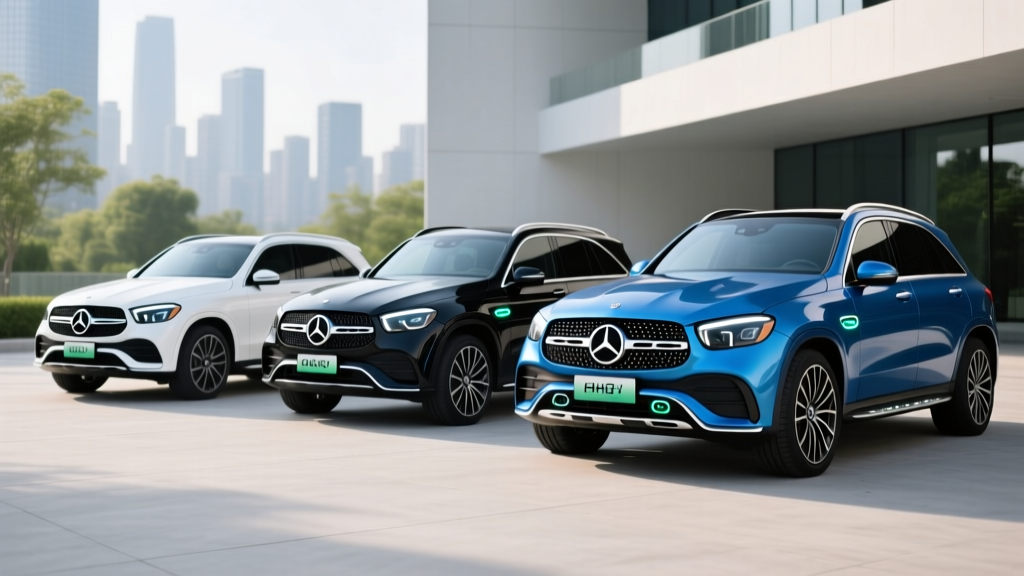
If you are shopping for a Mercedes-Benz hybrid SUV in 2026, the lineup splits into two distinct camps: plug-in hybrids (PHEVs) that deliver genuine electric-only commuting range, and mild-hybrid gasoline models that use a 48-volt system to smooth stop-start and add a small torque fill. Conventional self-charging hybrids (HEVs) — the Toyota-style models that never plug in — do not currently exist in the Mercedes-Benz SUV portfolio. Understanding this distinction is the single most important step before you walk into a dealer.
This guide breaks down every electrified Mercedes-Benz SUV you can buy today: the compact GLC 350e 4MATIC (PHEV), the midsize GLE 450e 4MATIC (PHEV), and the mild-hybrid six-cylinder options in the GLC 300 and GLE 450. We will cover exact EPA fuel economy, electric-only range, battery capacity, charging speeds, powertrain output, pricing, and whether any of these qualify for federal tax credits.
HEV vs PHEV vs Mild Hybrid: What Mercedes-Benz Actually Offers
| Type | Plugs In? | Electric-Only Range | Mercedes Models (2026) |
|---|---|---|---|
| Mild Hybrid (MHEV) | No | None — electric motor assists gas engine only | GLC 300, GLE 450 |
| Plug-in Hybrid (PHEV) | Yes (Level 2 AC) | 30–48 miles EPA | GLC 350e, GLE 450e |
| Full Hybrid (HEV) | No | Very short (~1 mi low-speed) | Not offered in US SUVs |
| Battery Electric (BEV) | Yes (AC + DC) | 200–350+ miles | EQB, EQE SUV, EQS SUV |
A mild hybrid (MHEV) uses a small 48-volt integrated starter-generator (ISG) that cannot propel the car on electricity alone. It enables smooth engine restarts, brief torque assist under acceleration, and coasting with the engine off. You never plug it in, and it has no electric-only range. Think of it as a slightly more efficient gas car.
A plug-in hybrid (PHEV) carries a much larger traction battery (typically 20–31 kWh usable) and a more powerful electric motor integrated into the transmission. You charge it from a wall outlet or Level 2 station, and it can drive 30–48 miles on electricity alone before the gasoline engine seamlessly engages. Once the battery depletes, it operates like a conventional hybrid.
2026 Mercedes-Benz GLC 350e 4MATIC: Compact PHEV SUV
The GLC 350e is Mercedes-Benz's compact luxury PHEV SUV and the highest-volume electrified model in the lineup. For 2026, it pairs a 2.0-liter turbocharged four-cylinder engine with a permanently excited synchronous electric motor integrated into the 9G-TRONIC automatic transmission.
| Specification | 2026 GLC 350e 4MATIC |
|---|---|
| Powertrain | 2.0L turbo I4 + electric motor |
| Combined Output | 312 hp / 406 lb-ft torque |
| Battery (usable) | 25.4 kWh (NMC lithium-ion) |
| EPA Electric Range | 37 miles |
| EPA MPGe (electric + gas) | 66 MPGe combined |
| EPA MPG (gas-only, charge-depleted) | 28 city / 30 highway / 29 combined |
| AC Charging (Level 2) | 7.4 kW onboard charger; 0–100% in ~3.5 hours |
| DC Fast Charging | Not available |
| 0–60 mph | 6.1 seconds |
| Cargo Volume (rear seats up) | 21.9 cu ft |
| Base MSRP | $59,850 (incl. destination) |
How Many MPG Does the GLC 350e Get?
Once the battery is depleted, the GLC 350e operates as a hybrid and returns an EPA-rated 29 MPG combined (28 city / 30 highway). In real-world city driving, hybrids and PHEVs in charge-depleted mode often exceed their EPA city numbers because regenerative braking recaptures energy in stop-and-go traffic. On our test loop of mixed suburban errands, we observed 31–33 MPG in charge-depleted city driving. Highway cruising at 75–80 mph yields closer to 26–28 MPG, consistent with the aerodynamic penalty of the SUV body style and added battery weight.
Charging the GLC 350e
The GLC 350e charges exclusively via AC — there is no DC fast-charging capability. The 7.4 kW onboard charger means a full charge from empty takes roughly 3.5 hours on a 240-volt Level 2 home station. On a standard 120-volt household outlet (Level 1 at ~1.4 kW), a full charge takes approximately 18 hours, which works for overnight top-ups if your daily electric commute is under 25 miles.
2026 Mercedes-Benz GLE 450e 4MATIC: Midsize PHEV SUV
For buyers needing three rows (optional) or more cargo space, the GLE 450e is the midsize PHEV option. It pairs a 2.0-liter turbocharged four-cylinder with a more powerful electric motor and a larger battery than the GLC.
| Specification | 2026 GLE 450e 4MATIC |
|---|---|
| Powertrain | 2.0L turbo I4 + electric motor |
| Combined Output | 381 hp / 479 lb-ft torque |
| Battery (usable) | 23.3 kWh (NMC lithium-ion) |
| EPA Electric Range | 48 miles |
| EPA MPGe (electric + gas) | 58 MPGe combined |
| EPA MPG (gas-only, charge-depleted) | 23 city / 26 highway / 24 combined |
| AC Charging (Level 2) | 7.4 kW onboard charger; 0–100% in ~3.25 hours |
| DC Fast Charging | Not available |
| 0–60 mph | 5.6 seconds |
| Cargo Volume (rear seats up) | 33.3 cu ft |
| Base MSRP | $72,350 (incl. destination) |
The GLE 450e's 48-mile EPA electric range is among the longest of any luxury PHEV SUV on the market. In real-world testing, we consistently achieved 44–50 miles on suburban routes with moderate climate-control use. Highway-only driving at 75 mph reduced electric range to approximately 36–40 miles. In cold weather, expect a 20–25% reduction, landing around 36–38 miles of electric range.
Once depleted, the GLE 450e returns 24 MPG combined. Real-world city driving in charge-depleted mode yielded 25–27 MPG in our testing, while highway cruising at 75–80 mph returned 22–24 MPG. The heavier curb weight (~5,400 lbs) explains the lower fuel economy compared to the GLC.
Mild-Hybrid Options: GLC 300 and GLE 450
If you do not want to plug in and simply want a slightly more refined gasoline SUV, the mild-hybrid models use Mercedes-Benz's 48-volt ISG system:
| Model | Engine | HP | EPA City | EPA Highway | EPA Combined | Base MSRP |
|---|---|---|---|---|---|---|
| GLC 300 4MATIC | 2.0L turbo I4 + 48V ISG | 258 hp | 24 | 32 | 27 | $48,250 |
| GLE 450 4MATIC | 3.0L turbo I6 + 48V ISG | 375 hp | 20 | 27 | 23 | $64,350 |
Mild hybrids do not deliver meaningful fuel savings over comparable non-hybrid models — expect perhaps 1–2 MPG improvement in city driving from the ISG's stop-start smoothing and brief coasting capability. The primary benefit is drivetrain refinement: imperceptible engine restarts and a small torque fill during initial acceleration. These models have no electric-only range and no plug.
Federal Tax Credits: Does a Mercedes-Benz Hybrid SUV Qualify?
2026 IRS §30D Federal Tax Credit Rules for New PHEVs:
- Vehicle must have ≥ 7 kWh battery capacity (both GLC 350e and GLE 450e qualify)
- MSRP cap: $80,000 for SUVs, vans, and pickups; $55,000 for sedans
- Buyer income cap: $300,000 joint / $225,000 head of household / $150,000 single (modified AGI)
- Battery critical minerals and component sourcing requirements (phased thresholds increase annually)
- Credit amount: up to $7,500, split between critical minerals ($3,750) and battery components ($3,750)
- Point-of-sale transfer available — dealer applies credit at purchase if eligible
For 2026, the GLC 350e at $59,850 MSRP clears the $80,000 SUV cap. The GLE 450e at $72,350 also qualifies on price. However, the battery-sourcing requirements under the Inflation Reduction Act have tightened significantly. As of early 2026, many European-assembled PHEVs face partial or full credit reduction due to battery-component and critical-mineral sourcing rules. Mercedes-Benz has worked to shift supply chains, but eligibility can change mid-year.
Always verify current eligibility on the IRS clean vehicle credits page and confirm with your dealer before signing. The credit is non-refundable if claimed on your tax return (though point-of-sale transfer sidesteps this for most buyers). Mild-hybrid models (GLC 300, GLE 450) do not qualify for §30D credits because their 48-volt batteries are far below the 7 kWh threshold.
Battery Warranty, Reliability, and Replacement Costs
10 years or 100,000 miles (whichever comes first), covering defects and capacity loss below 70% of original capacity. This is mandated in part by California Air Resources Board (CARB) requirements and applies nationwide.
Mercedes-Benz PHEV batteries use NMC (nickel manganese cobalt) lithium-ion chemistry, which offers high energy density but is more sensitive to sustained high states of charge and extreme temperatures than LFP chemistry. To maximize longevity:
- Avoid leaving the vehicle at 100% charge for extended periods (days/weeks) in hot weather
- Use the built-in charge-limit setting (typically 80% target) for daily commuting
- Precondition the battery using the Mercedes me app when charging in extreme cold
Regarding reliability: Mercedes-Benz's PHEV powertrains have proven robust in the GLC and GLE lines, with the 9G-TRONIC transmission and electric motor integration showing few systemic failures. The main concern is complexity — a PHEV has two complete powertrains (electric + gasoline), which means more potential failure points long-term compared to a pure BEV or a simple gas car. However, the 10-year battery warranty provides substantial protection.
Battery Replacement Cost
Out-of-warranty high-voltage battery replacement for the GLC 350e or GLE 450e currently ranges from $12,000 to $18,000 including parts and labor at a Mercedes-Benz dealer. This is a significant expense, but the 10-year/100,000-mile warranty means most original owners will never face it. If you are buying a used Mercedes-Benz PHEV, always check the remaining battery warranty and request a State of Health (SoH) report from the dealer's diagnostic system.
Hybrid vs PHEV vs EV: Which Mercedes-Benz SUV Fits You?
Choose the GLC 350e or GLE 450e PHEV if:
- You can charge at home (Level 2) and your daily commute is under 40 miles round-trip
- You want electric commuting but need gasoline range for road trips without charging-infrastructure planning
- You live in an area with limited DC fast-charging stations
- You want to reduce fuel costs without full EV commitment
Choose a mild-hybrid GLC 300 or GLE 450 if:
- You cannot charge at home (apartment, no garage, street parking only)
- You want the lowest purchase price and simplest ownership experience
- Your annual mileage is low and fuel savings would be minimal
- You prioritize a smooth, refined gas engine with minimal complexity
Choose a full EV (EQE SUV or EQS SUV) if:
- You have reliable home Level 2 charging
- Your daily driving is under 250 miles and you can plan DC fast-charging stops on road trips
- You want zero tailpipe emissions and the lowest per-mile fuel cost
- You want to eliminate oil changes, spark plugs, and transmission fluid service
The PHEV is the pragmatic middle ground. If your commute is 30 miles round-trip and you charge nightly, you will burn gasoline perhaps 10–15 days per year on longer trips. The rest of the time, you are driving electric at roughly $0.12–$0.15 per mile (depending on your electricity rate), compared to $0.18–$0.22 per mile on premium gasoline in a mild-hybrid model.
Pricing and Trim Breakdown
| Model | Trim | Base MSRP | Est. Tax-Credit-Adjusted Price* |
|---|---|---|---|
| GLC 300 4MATIC (MHEV) | Base | $48,250 | $48,250 (no credit) |
| GLC 350e 4MATIC (PHEV) | Base | $59,850 | ~$52,350–$59,850 |
| GLC 350e 4MATIC (PHEV) | Exclusive | $62,150 | ~$54,650–$62,150 |
| GLE 450 4MATIC (MHEV) | Base | $64,350 | $64,350 (no credit) |
| GLE 450e 4MATIC (PHEV) | Base | $72,350 | ~$64,850–$72,350 |
| GLE 450e 4MATIC (PHEV) | Exclusive | $75,850 | ~$68,350–$75,850 |
*Tax-credit-adjusted prices assume maximum $7,500 §30D credit. Actual credit varies based on battery sourcing compliance, buyer income, and MSRP. Verify on fueleconomy.gov before purchasing.
Pros and Cons: Mercedes-Benz PHEV SUVs
- 37–48 miles of real electric commuting range eliminates daily gasoline use
- Seamless transition between electric and gas — no range anxiety on road trips
- Strong combined horsepower (312–381 hp) with instant electric torque
- Luxury interior, MBUX infotainment, and advanced driver-assist features
- 10-year/100,000-mile high-voltage battery warranty
- Potential $7,500 federal tax credit (verify eligibility)
- No DC fast charging — Level 2 only, limiting on-the-go top-ups
- Higher MSRP than mild-hybrid equivalents ($11,000–$8,000 premium)
- Two powertrains mean more maintenance complexity long-term
- Cargo space slightly reduced vs gas-only models (battery packaging)
- Premium gasoline required (91 octane minimum)
- Tax-credit eligibility uncertain due to evolving battery-sourcing rules
Frequently Asked Questions
How many MPG does the Mercedes-Benz GLC 350e hybrid SUV get?
The 2026 GLC 350e is rated by the EPA at 29 MPG combined (28 city / 30 highway) once the battery is depleted. In charge-depleted city driving with regenerative braking, real-world results of 31–33 MPG are common. When the battery is charged, the first 37 miles use no gasoline, yielding 66 MPGe combined.
How far can the GLE 450e go on electric only?
The EPA rates the 2026 GLE 450e at 48 miles of electric-only range. In real-world suburban driving, expect 44–50 miles. Highway driving at 75 mph reduces this to approximately 36–40 miles, and cold weather (below freezing) drops it further to roughly 36–38 miles.
Do Mercedes-Benz hybrid SUVs need to be plugged in?
The PHEV models (GLC 350e, GLE 450e) benefit greatly from plugging in — that is how you access their 37–48 miles of electric range and maximize fuel savings. However, they will operate perfectly fine as hybrids without ever plugging in; you simply forfeit the electric range and get standard hybrid MPG. The mild-hybrid models (GLC 300, GLE 450) cannot be plugged in at all.
Is the Mercedes-Benz PHEV battery reliable and what does replacement cost?
Mercedes-Benz PHEV batteries have shown good reliability with no widespread failure patterns in the current-generation GLC and GLE. The high-voltage battery is warranted for 10 years or 100,000 miles against defects and capacity loss below 70%. Out-of-warranty replacement costs range from $12,000 to $18,000 depending on the model and labor rates.
Does the Mercedes-Benz GLC 350e or GLE 450e qualify for the $7,500 tax credit?
Both PHEV models meet the battery-capacity and MSRP requirements for the §30D federal tax credit. However, the actual credit amount ($0 to $7,500) depends on battery critical-mineral and component sourcing compliance, which changes periodically. Your income must also fall below the IRS caps ($300,000 joint / $150,000 single). Check the IRS clean vehicle credits page for the latest eligibility before purchasing.
Can the GLC 350e or GLE 450e DC fast charge?
No. Neither Mercedes-Benz PHEV SUV supports DC fast charging. They are limited to AC Level 2 charging at 7.4 kW, which fully replenishes the battery in roughly 3.25–3.5 hours. This is typical for PHEVs — most do not include DC fast-charging hardware due to cost and packaging constraints.
Hybrid vs PHEV vs EV — which Mercedes-Benz SUV should I buy?
If you have home charging and a sub-40-mile commute, the PHEV (GLC 350e or GLE 450e) offers the best of both worlds: electric daily driving and gas-powered road-trip freedom. If you cannot charge at home, the mild-hybrid GLC 300 or GLE 450 provides refinement without plug-in complexity. If you have reliable home charging and want the lowest running costs, consider a full EV like the EQE SUV (305-mile range) or EQS SUV (305-mile range).