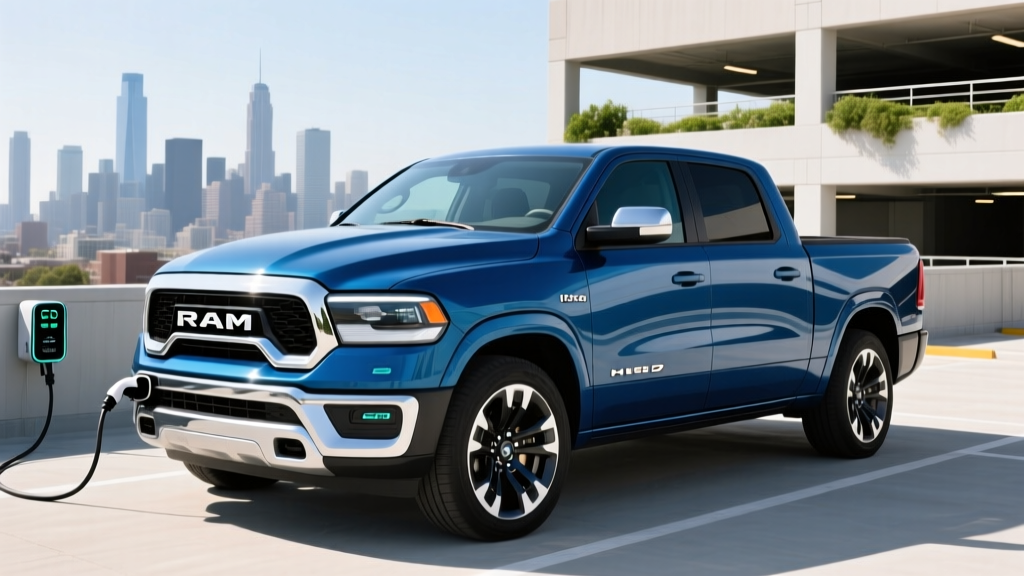
The Ram 1500 Ramcharger is not a conventional plug-in hybrid. It is a series-hybrid (often called an extended-range electric vehicle, or EREV) that uses a 3.6-liter Pentastar V6 purely as an onboard generator — the engine never drives the wheels. For 2026, this is Ram's answer to the Ford F-150 PowerBoost hybrid and the incoming Silverado EV, slotting into a unique middle ground: the low running costs of an EV with the unlimited range of a gas truck.
If you've been searching for a Ram PHEV, the Ramcharger is currently the only plug-in option in the Ram 1500 lineup. Below, we break down exactly what the powertrain does, how far it goes on electricity alone, what charging looks like at home and on the road, and whether the §30D federal tax credit applies.
HEV vs PHEV vs EREV: Where the Ramcharger Fits
Before diving into specs, it's worth clarifying terminology, because the Ramcharger blurs lines that most buyers take for granted.
| Type | Plug-In? | Electric-Only Range | Engine Role | Example |
|---|---|---|---|---|
| HEV (Hybrid) | No | ~1-2 mi at low speed | Drives wheels + charges small battery | Ford F-150 PowerBoost |
| PHEV (Plug-In Hybrid) | Yes | 20-50 mi typical | Drives wheels + charges battery | Toyota RAV4 Prime, Jeep Wrangler 4xe |
| EREV (Extended-Range EV) | Yes | 50-170+ mi | Generator only — never drives wheels | Ram 1500 Ramcharger |
| BEV (Battery Electric) | Yes | 200-400+ mi | No engine | Ford F-150 Lightning, Rivian R1T |
The Ramcharger's 92 kWh battery pack is far larger than any conventional PHEV (the RAV4 Prime has 18.1 kWh). This gives it an EPA-estimated 69 miles of all-electric range before the V6 generator kicks in. Once the battery is depleted, the truck operates like a diesel-electric locomotive: the engine spins a generator, which feeds electricity to the dual electric drive motors. Ram calls this the Ramcharger system, and it's built on the STLA Frame platform shared with the fully electric Ram 1500 REV.
Powertrain and Performance Specs
| Specification | 2026 Ram 1500 Ramcharger |
|---|---|
| Powertrain Type | Series hybrid (EREV) |
| Battery (Usable) | 92 kWh, NMC lithium-ion |
| Onboard Generator | 3.6L Pentastar V6 (174 kW output) |
| Drive Motors | Dual electric (front + rear AWD) |
| Combined Horsepower | 663 hp |
| Combined Torque | 615 lb-ft |
| 0-60 mph | 4.4 seconds (estimated) |
| EPA Electric-Only Range | 69 miles |
| Total Range (Battery + Fuel) | ~690 miles (est.) |
| MPGe (Electric Mode) | 62 MPGe combined (est.) |
| MPG (Generator Mode) | ~20-22 MPG combined (est.) |
| Towing Capacity | Up to 14,000 lbs |
| Payload Capacity | Up to 2,625 lbs |
Because both axles are driven by electric motors at all times, the Ramcharger delivers full-time AWD with instant torque. The 663 horsepower figure is competitive with the F-150 Lightning's extended-range dual-motor setup (580 hp) and well above the F-150 PowerBoost hybrid (430 hp). Towing at 14,000 pounds is serious heavy-duty territory for a half-ton truck, though real-world range while towing will drop substantially — expect electric-only range to fall to 25-35 miles under a heavy trailer load.
Electric Range, MPG, and Real-World Efficiency
The EPA-estimated 69 miles of electric-only range is the headline figure, but real-world results depend heavily on driving style, temperature, and payload.
Real-World Expectation: 55-65 miles in mixed driving; 45-55 miles in cold weather (below 32°F) or at sustained highway speeds above 70 mph; 25-40 miles while towing near max capacity.
| Driving Mode | City | Highway | Combined |
|---|---|---|---|
| Electric-Only (MPGe) | 68 MPGe (est.) | 56 MPGe (est.) | 62 MPGe (est.) |
| Generator Mode (MPG) | 22 MPG (est.) | 19 MPG (est.) | 20 MPG (est.) |
When the battery is depleted and the V6 generator takes over, efficiency drops to roughly 20 MPG combined. That's comparable to a gas V8 Ram 1500 but below the Ford F-150 PowerBoost hybrid's EPA rating of 23 MPG combined. The trade-off is clear: if your daily commute is under 60 miles and you charge at home, you'll rarely burn gas. If you regularly drive 200+ miles without charging, the Ramcharger operates as a conventional (and somewhat thirsty) truck.
One real-world advantage of the series-hybrid layout is that the V6 generator can run at its most efficient RPM regardless of vehicle speed — unlike a parallel hybrid where the engine must match wheel speed. This means generator-mode MPG stays relatively consistent whether you're crawling in traffic or cruising at 75 mph.
Charging: Home Level 2 and Public DC Fast Charging
The Ramcharger uses a CCS1 connector for public DC fast charging and a J1772/NACS-compatible inlet for Level 2 home charging. Ram has confirmed NACS (Tesla-style) compatibility through an adapter, and future model years may adopt the native NACS port.
| Charging Level | Power (kW) | Time (10-80%) | Miles of EV Range Added/Hour |
|---|---|---|---|
| Level 1 (120V household) | ~1.4 kW | ~45+ hours | ~4-5 mi/hr |
| Level 2 (240V home/public) | Up to 11.5 kW | ~7 hours | ~28-32 mi/hr |
| DC Fast Charge | Up to 145 kW peak | ~27 minutes (10-80%) | N/A |
The 145 kW peak DC fast charge rate is modest compared to full BEVs like the F-150 Lightning (which peaks around 150-190 kW depending on pack). However, because the Ramcharger's usable battery is 92 kWh — smaller than the Lightning's 131 kWh extended-range pack — the 10-80% session completes in a reasonable 27 minutes at a compatible station.
For home charging, a Level 2 wallbox at 11.5 kW will refill the 92 kWh pack from empty in roughly 8 hours, or overnight for a 10-80% top-up in about 7 hours. A standard 240V/48A hardwired charger (like the ChargePoint Home Flex or Tesla Wall Connector) is the practical choice. Expect a full home installation — charger, wiring, permit, and electrician labor — to cost between $800 and $2,500, depending on panel capacity and run length from your electrical panel to the garage. If your home has a 100-amp service panel, a $1,500-$3,000 panel upgrade to 200 amps may be required; consult a licensed electrician for a site-specific quote.
Pricing, Trims, and Federal Tax Credit Eligibility
The 2026 Ram 1500 Ramcharger starts at an MSRP of approximately $60,995 (including destination) for the Tradesman trim, with higher trims climbing significantly:
- Tradesman: ~$60,995
- Warlock: ~$65,000 (est.)
- Laramie: ~$72,000 (est.)
- Limited: ~$85,000+ (est.)
These prices place the Ramcharger well above the F-150 PowerBoost hybrid (starting ~$56,000) but below the F-150 Lightning extended-range models and the Rivian R1T.
§30D Federal Tax Credit — Does the Ramcharger Qualify?
The Ram 1500 Ramcharger may qualify for up to $7,500 under the IRS §30D Clean Vehicle Credit, but eligibility depends on several conditions that change annually. As of 2026, buyers must verify:
- MSRP cap: Trucks/vans/SUVs must have an MSRP ≤ $80,000. The Tradesman, Warlock, and some Laramie builds qualify; Limited trims may exceed the cap.
- Buyer income cap: Modified AGI ≤ $300,000 (joint), $225,000 (head of household), $150,000 (single).
- Battery sourcing: Critical minerals and battery components must meet phased-in percentages from US or FTA-partner countries. Ram has indicated compliance for US-built Ramchargers, but verify per-VIN at fueleconomy.gov.
- Point-of-sale transfer: Since 2024, buyers can transfer the credit to the dealer for an immediate price reduction at purchase — no need to wait until tax filing.
Always confirm eligibility with your dealer and a tax professional before purchase. Rules are subject to legislative change. See IRS.gov Clean Vehicle Credit for current requirements.
Battery Warranty, Reliability, and Replacement Cost
Powertrain Warranty: 5 years / 60,000 miles (engine generator + drive motors).
Bumper-to-Bumper: 3 years / 36,000 miles.
The 92 kWh NMC battery pack is the most expensive single component in the Ramcharger. Out-of-warranty replacement cost is estimated at $12,000-$18,000 based on current NMC pricing per kWh for packs of this size — though prices are expected to decline as battery manufacturing scales. For context, most EV and PHEV batteries degrade slowly; industry data from Recurrent Auto and other battery-health trackers shows average capacity loss of 5-10% over the first 100,000 miles for liquid-cooled NMC packs. The Ramcharger's active liquid thermal management system should keep degradation in line with or better than these averages.
Reliability is an open question for the Ramcharger specifically, as it is a first-year powertrain with no long-term ownership data yet. However, the Pentastar 3.6L V6 is one of Stellantis's most proven engines (used in millions of vehicles since 2011), and the electric drive modules share architecture with the Ram 1500 REV and other STLA-platform vehicles. The series-hybrid design is mechanically simpler than a parallel hybrid — no multi-speed transmission, no torque converter, no mechanical linkage between engine and wheels — which reduces potential failure points.
Who Should Buy the Ram PHEV (Ramcharger)?
Choose the Ramcharger if:
- Your daily commute is under 60 miles and you can charge at home — you'll drive on electricity most days and rarely visit a gas station.
- You need full-size truck towing and payload (14,000 lbs / 2,625 lbs) but want lower fuel costs for around-town use.
- You frequently take long road trips or drive in areas with sparse charging infrastructure — the V6 generator eliminates range anxiety entirely.
- You want EV-like acceleration (4.4 sec 0-60) without committing to a full BEV.
Choose a full BEV (Ram 1500 REV, F-150 Lightning) if:
- You want zero tailpipe emissions and lower maintenance (no engine oil, spark plugs, or generator service).
- You have reliable home and destination charging and rarely drive more than 300 miles without stopping.
Choose a conventional hybrid (F-150 PowerBoost) if:
- You want better MPG in generator/highway mode without the plug-in requirement or higher MSRP.
- Your budget is closer to $55,000-$65,000 and you don't need 69 miles of electric range.
Pros
- 69 miles electric-only — longest of any PHEV/EREV truck
- 663 hp / 615 lb-ft with instant electric torque
- 14,000-lb towing capacity
- No range anxiety — V6 generator provides unlimited range
- Series-hybrid simplicity (no transmission)
- Potential §30D tax credit up to $7,500
Cons
- Starting MSRP ~$61,000 — premium over gas and hybrid trucks
- Generator-mode MPG (~20) is not class-leading
- 145 kW DC fast charge is slower than some BEV trucks
- First-year powertrain — no long-term reliability data
- Heavy curb weight (~7,200 lbs) impacts tire wear and handling
- Limited trims may exceed $80K MSRP cap for tax credit
Frequently Asked Questions
How many MPG does the Ram 1500 Ramcharger get?
In electric-only mode, the Ramcharger achieves an estimated 62 MPGe combined. Once the battery is depleted and the V6 generator runs, expect approximately 20 MPG combined (22 city / 19 highway). If you charge nightly and drive under 60 miles daily, you may use very little gasoline.
How far can the Ramcharger go on electric only?
The EPA-estimated electric-only range is 69 miles. In real-world mixed driving, expect 55-65 miles. In cold weather or at sustained highway speeds, plan for 45-55 miles. While towing near the 14,000-lb maximum, electric range drops to roughly 25-40 miles before the generator activates.
Does the Ram PHEV qualify for the $7,500 federal tax credit?
The Ramcharger may qualify for up to $7,500 under §30D, provided the specific trim's MSRP is ≤ $80,000, the buyer's income is under the cap, and battery sourcing requirements are met. Verify per-VIN at fueleconomy.gov and consult a tax professional. The credit can be transferred to the dealer at point of sale for an immediate price reduction.
Is the Ramcharger reliable? What does a battery replacement cost?
The Ramcharger is a first-year powertrain, so long-term reliability data is not yet available. The 3.6L Pentastar V6 generator is a well-proven engine. The 92 kWh battery is covered by an 8-year/100,000-mile warranty. Out-of-warranty replacement is estimated at $12,000-$18,000, though battery prices are trending downward.
Can the Ramcharger DC fast charge?
Yes. It supports DC fast charging at up to 145 kW peak via a CCS1 connector, achieving a 10-80% charge in approximately 27 minutes at a compatible station. NACS (Tesla Supercharger) compatibility is available through an adapter.
What is the difference between the Ramcharger and a regular hybrid truck?
A conventional hybrid like the Ford F-150 PowerBoost uses its engine to drive the wheels directly, supplemented by a small electric motor and a ~1.5 kWh battery. The Ramcharger is a series hybrid (EREV): the engine never drives the wheels — it only generates electricity for the dual drive motors. This gives the Ramcharger 69 miles of electric-only range versus essentially zero for a conventional hybrid, but at a higher purchase price.
Hybrid vs PHEV vs EV — which truck fits me?
If you can charge at home and drive under 70 miles daily, the Ramcharger (PHEV/EREV) lets you commute on electricity while keeping gas capability for road trips and towing. If you want the lowest operating cost and have reliable charging, a full BEV like the F-150 Lightning or Ram 1500 REV eliminates gas entirely. If you can't charge at home or want the lowest upfront cost, a conventional hybrid like the F-150 PowerBoost offers modest MPG gains with no lifestyle change.