Quick Verdict: A Super Sedan That Moonlights as an EV Commuter
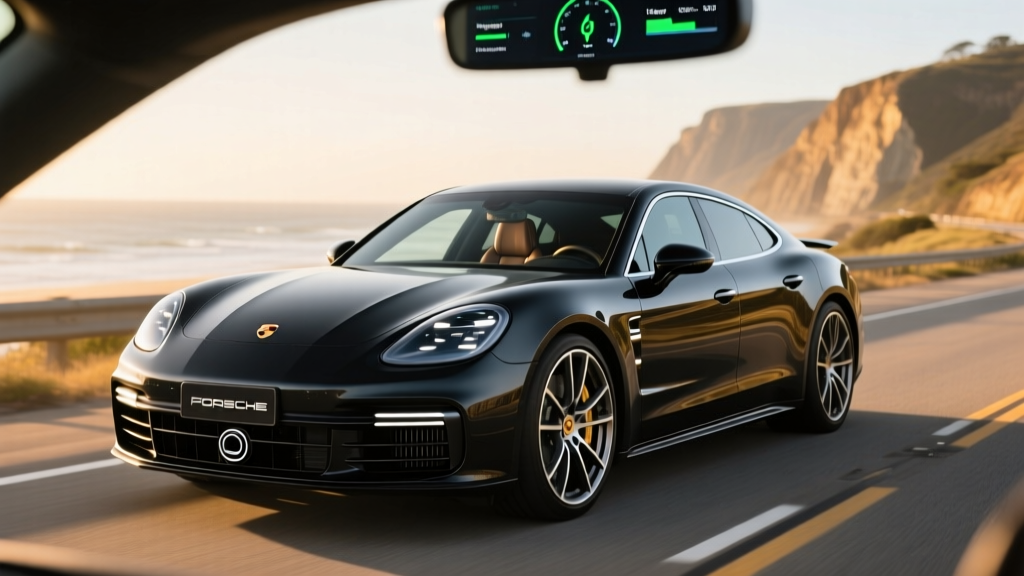
The Porsche Panamera Turbo E-Hybrid occupies a rare slot in the luxury-performance market: a plug-in hybrid (PHEV) that delivers genuine electric-only commuting range without sacrificing the flat-plane snarl and chassis composure Porsche is known for. For the 2025 model year (carried into 2026 with minimal changes), the Turbo E-Hybrid pairs a twin-turbocharged 4.0-liter V8 with a permanently excited synchronous electric motor integrated into the 8-speed PDK transmission. The result is 670 combined horsepower, a 2.8-second 0-60 mph time, and up to 48 miles of EPA-rated electric-only driving.
This is not a conventional hybrid (HEV) like the Toyota Prius that simply recaptures braking energy. The Panamera Turbo E-Hybrid is a full PHEV with a 25.9 kWh (gross) lithium-ion battery pack that you plug in to recharge. Drive it daily on short commutes, and you may go weeks without visiting a gas station. Take it cross-country, and the V8 picks up seamlessly with no range anxiety.
A conventional hybrid (HEV) uses a small battery recharged only by regenerative braking and the engine — you never plug it in. A plug-in hybrid (PHEV) like the Panamera Turbo E-Hybrid has a much larger battery you charge from a wall outlet or public charger, enabling extended electric-only driving before the gas engine engages.
Spec Table: 2026 Porsche Panamera Turbo E-Hybrid at a Glance
| Specification | Value |
|---|---|
| Powertrain | 4.0L Twin-Turbo V8 + Electric Motor (PHEV) |
| Combined Horsepower | 670 hp |
| Combined Torque | 627 lb-ft |
| 0–60 mph | 2.8 seconds (with Launch Control) |
| Top Speed | 196 mph |
| Battery (Gross / Usable) | 25.9 kWh / ~20.7 kWh |
| EPA Electric-Only Range | 48 miles |
| Total Combined Range (Est.) | ~460 miles |
| EPA MPGe (Electric + Gas) | 52 MPGe |
| EPA MPG (Gas Only, Combined) | 22 MPG |
| Onboard AC Charger | 11 kW (Level 2) |
| DC Fast Charging | Not available |
| Level 2 Charge Time (0–100%) | ~2 hours 39 minutes |
| Drivetrain | All-Wheel Drive (AWD) |
| Base MSRP | $191,700 (excl. $1,650 delivery) |
| Federal §30D Tax Credit | Not eligible (MSRP exceeds $55,000 sedan cap) |
| Hybrid Battery Warranty | 8 years / 100,000 miles |
Fuel Economy: EPA Ratings vs Real-World MPG
The EPA rates the Panamera Turbo E-Hybrid at 52 MPGe when operating in combined electric-and-gas mode, and 22 MPG combined once the battery is depleted and the V8 runs solo. Here's the full breakdown per fueleconomy.gov:
| Mode | City | Highway | Combined |
|---|---|---|---|
| Charge-Depleted (Gas Only) | 19 MPG | 26 MPG | 22 MPG |
| Combined (EV + Gas) | 52 MPGe | ||
Real-world expectations: In mixed suburban driving with a full battery charge, owners consistently report that the electric motor handles the majority of miles below 80 mph, pushing effective fuel consumption far below the 22 MPG gas-only figure. Expect 35–45 MPG equivalent in daily commuting if you charge nightly and your round trip stays under 40 miles. On long highway runs at 75+ mph with a depleted battery, the twin-turbo V8's appetite becomes apparent — figure 20–23 MPG depending on terrain and speed. Cold weather (below 30°F) reduces electric-only range by roughly 15–25%, so winter commutes may see the engine fire up sooner than the EPA sticker suggests.
Electric-Only Range and Charging Setup
The 25.9 kWh gross battery (approximately 20.7 kWh usable to protect longevity) delivers an EPA-rated 48 miles of electric-only range. In real-world conditions at moderate temperatures and suburban speeds, 42–46 miles is achievable. Highway-speed electric-only driving at 70 mph will drop that to roughly 32–36 miles due to aerodynamic drag and the sedan's 5,100-pound curb weight.
Charging is AC-only via the J1772/Type 2 connector. There is no DC fast-charging capability — a deliberate Porsche engineering choice to save weight and packaging space in a performance sedan. The onboard 11 kW AC charger is robust for a PHEV:
| Charging Level | Power | 0–100% Time | Miles Added per Hour |
|---|---|---|---|
| Level 1 (120V household) | ~1.4 kW | ~15 hours | ~3 miles/hr |
| Level 2 (240V, 48A) | 11 kW | ~2 hr 39 min | ~18 miles/hr |
For most owners, a home Level 2 wallbox (such as the Porsche Mobile Charger Connect or a ChargePoint Home Flex) is the practical choice. Plug in when you arrive home, and the battery is full before morning. Level 1 from a standard 120V outlet works but is painfully slow for daily use — it adds only about 3 miles of electric range per hour.
A dedicated 240V/50A circuit with a hardwired Level 2 charger typically costs $800–$2,500 installed, depending on panel proximity and local permit fees. If your electrical panel needs a 200A upgrade, add $1,500–$3,500. Always hire a licensed electrician for the final install.
Powertrain Deep Dive: V8 Meets Electric Motor
The Panamera Turbo E-Hybrid's powertrain is a masterclass in integration. The 4.0-liter twin-turbo V8 produces 518 horsepower and 568 lb-ft of torque on its own. The electric motor, sandwiched between the engine and the 8-speed PDK dual-clutch transmission, adds 188 horsepower and 332 lb-ft. A disconnect clutch allows the engine to shut down entirely during electric-only operation, eliminating parasitic drag.
Combined system output is 670 hp and 627 lb-ft, routed through Porsche's all-wheel-drive system. The result: 0–60 mph in 2.8 seconds with Launch Control engaged, making this one of the quickest four-door sedans on the market. The electric motor also fills the torque gap at low RPM before the turbos spool, giving instant off-the-line thrust that a gas-only Turbo cannot match.
Driving modes let you prioritize efficiency or performance. E-Power mode runs electric-only whenever possible. Hybrid Auto manages the blend intelligently. Sport and Sport Plus modes deploy both powertrains aggressively and use the engine to recharge the battery for sustained track or canyon use. An E-Hold mode preserves battery charge for later electric driving — useful when entering a city zero-emission zone after a highway stint.
Pricing, Trims, and Tax Credit Eligibility
The 2026 Porsche Panamera Turbo E-Hybrid starts at $191,700 (plus $1,650 destination). The Executive long-wheelbase variant adds approximately $10,000. Porsche's options list can push a well-equipped example past $220,000 quickly — the Rear Axle Steering, Burmester audio, and Sport Chrono package are popular additions.
Under current IRS §30D rules, the Panamera Turbo E-Hybrid does not qualify for the federal plug-in vehicle tax credit. Two barriers apply:
- MSRP Cap: Sedans must have an MSRP at or below $55,000. At $191,700, the Panamera Turbo E-Hybrid far exceeds this.
- Income Cap: Even if it met the price cap, buyer adjusted gross income must not exceed $150,000 (single) / $300,000 (joint).
Some states offer separate PHEV rebates (California's CVRP, for example) — check your local program for current eligibility.
Battery Longevity, Warranty, and Replacement Cost
Porsche covers the high-voltage battery for 8 years or 100,000 miles, whichever comes first. The warranty guarantees the battery will retain at least 70% of its original capacity during that period. This aligns with the federal mandate for PHEV battery coverage and matches competitors like BMW and Mercedes-AMG.
Porsche uses a liquid-cooled lithium-ion pack with NMC (nickel-manganese-cobalt) chemistry, chosen for its high energy density in a performance application. Real-world degradation data from earlier Panamera E-Hybrid generations suggests these packs hold up well — typical capacity loss after 5 years and 60,000 miles is in the 5–10% range, well within warranty thresholds.
Out-of-warranty replacement cost: If the battery requires full replacement beyond the warranty period, expect a dealer-quoted price in the $15,000–$22,000 range including labor. This is a significant sum, though it's unlikely to be needed during typical first- and second-ownership periods. Individual module replacement (if only some cells degrade) can reduce the cost substantially.
To maximize battery lifespan, Porsche's battery management system (BMS) maintains a buffer at the top and bottom of the charge window, avoiding the stress of true 0% or 100% states. Avoid leaving the car plugged in at 100% for days on end in hot weather — use the departure timer to charge closer to when you'll drive.
Who Should Choose the Panamera Turbo E-Hybrid?
Pros
- 48 miles EV range covers most daily commutes gas-free
- 670 hp with 2.8s 0–60 — supercar performance in a sedan
- No range anxiety on road trips; V8 takes over seamlessly
- 11 kW onboard charger fills battery in under 3 hours
- Porsche build quality, chassis dynamics, and interior refinement
- 8-year/100k-mile hybrid battery warranty
Cons
- $191,700+ starting price; options escalate rapidly
- No DC fast charging — AC only
- No federal tax credit (MSRP far above $55K sedan cap)
- 22 MPG gas-only is thirstier than rival PHEV sedans
- 5,100-lb curb weight is noticeable on tight corners vs gas Panamera
- EV range drops to ~32 mi at sustained highway speeds
Decision Framework
Choose the Panamera Turbo E-Hybrid if: You want a luxury performance sedan that can commute on electricity during the week and devour canyons or cross-country highways on weekends — without the charging-planning burden of a full BEV.
Choose a full EV (like the Porsche Taycan Turbo) if: You have reliable home and destination charging, your daily driving is under 250 miles, and you want zero tailpipe emissions with lower per-mile energy costs.
Choose the gas-only Panamera Turbo if: You lack home charging access, your commutes regularly exceed 50 miles one-way, or you want to save ~$30,000 on the purchase price and don't care about electric-only driving.
Frequently Asked Questions
How many MPG does the Porsche Panamera Turbo E-Hybrid get?
Once the battery is depleted, the EPA rates it at 19 city / 26 highway / 22 combined MPG. In daily use with regular charging, effective fuel economy is far higher — many owners report using only a few gallons per week on sub-40-mile commutes. The combined MPGe rating (blending electric and gas operation) is 52 MPGe.
How far can the Panamera Turbo E-Hybrid go on electric only?
The EPA rates it at 48 miles of electric-only range. Real-world suburban driving yields 42–46 miles; sustained highway driving at 70+ mph reduces that to roughly 32–36 miles. Cold weather (below 30°F) can reduce EV range by 15–25%.
Does the Panamera Turbo E-Hybrid qualify for a tax credit?
No. The federal §30D tax credit has a $55,000 MSRP cap for sedans, and the Panamera Turbo E-Hybrid starts at $191,700. Buyer income caps ($300K joint / $150K single) would also disqualify many buyers. Some state-level PHEV incentives may apply — check your local program.
Is the hybrid system reliable, and what does battery replacement cost?
Porsche's E-Hybrid system has proven reliable across two generations, and the battery is covered for 8 years / 100,000 miles with a 70% capacity retention guarantee. Out-of-warranty full battery replacement is estimated at $15,000–$22,000, though partial module replacement is often possible at lower cost.
Can the Panamera Turbo E-Hybrid DC fast charge?
No. Porsche equipped it with an 11 kW AC onboard charger only. A full Level 2 charge takes approximately 2 hours and 39 minutes. DC fast charging is not supported — a trade-off to reduce weight and complexity in a performance sedan.
Hybrid vs PHEV vs EV — which fits me?
A conventional hybrid (HEV) is best if you have no charging access and want better MPG with zero behavior change. A PHEV like this Panamera suits drivers who can charge at home, want electric commuting, but also need long-range flexibility without planning charging stops. A full EV (BEV) is ideal if you have reliable charging and want the lowest operating costs and zero tailpipe emissions — but requires accepting range limits and charging infrastructure dependence.