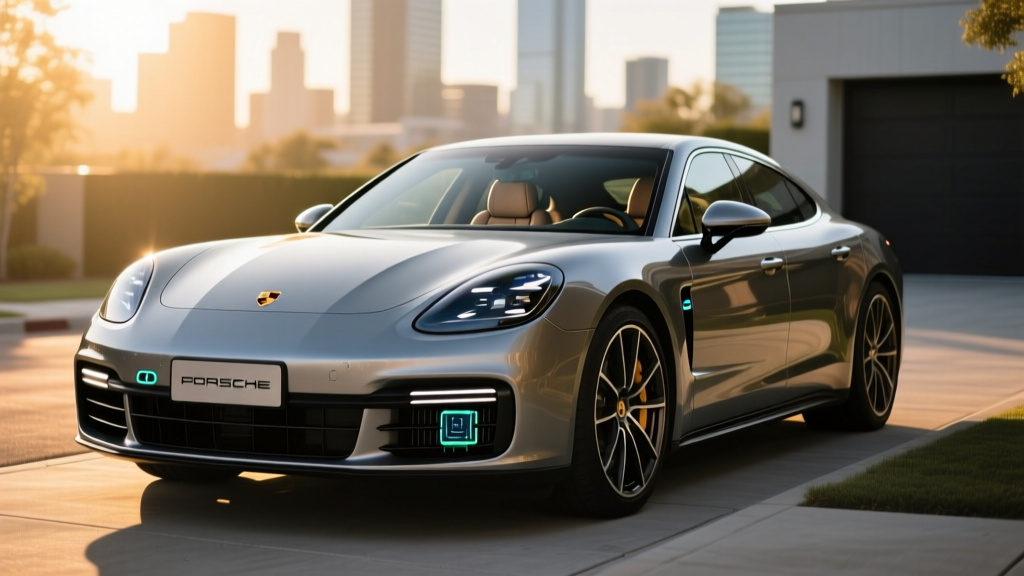
The Porsche Panamera 4 E-Hybrid occupies a narrow but compelling lane: a full-size luxury sedan with genuine sports-car reflexes, a plug-in hybrid powertrain that covers most daily commutes on electricity alone, and the badge cachet of Stuttgart. For 2026, Porsche has refined the E-Hybrid formula with a larger battery pack, improved electric-only range, and updated power electronics. But does the math work when you stack up real-world efficiency, charging logistics, and ownership costs against both full EVs and conventional luxury sedans?
This guide breaks down every number that matters — from EPA fuel economy and electric range to battery warranty, tax credit eligibility, and the kind of driver who should (and shouldn't) put this car on their shortlist.
Porsche Panamera 4 E-Hybrid: Core Specifications at a Glance
| Specification | 2026 Panamera 4 E-Hybrid |
|---|---|
| Powertrain Type | Plug-in Hybrid (PHEV) |
| Combined Horsepower | 463 hp |
| Combined Torque | 516 lb-ft |
| Gas Engine | 2.9L twin-turbo V6 (325 hp) |
| Electric Motor | 174 hp (integrated in 8-speed PDK) |
| Battery Capacity | 25.9 kWh (usable) |
| EPA Electric-Only Range | 34 miles |
| Total Combined Range | ~440 miles |
| EPA MPGe (electric + gas) | 52 MPGe |
| EPA MPG (charge-sustaining, combined) | 22 MPG |
| 0–60 mph | 4.1 seconds |
| Top Track Speed | 174 mph |
| Max AC Charging Rate | 11 kW (Level 2) |
| DC Fast Charging | Not available |
| Base MSRP | $112,500 |
HEV vs. PHEV: Where the Panamera 4 E-Hybrid Fits
Before getting into the numbers, it's worth clarifying the terminology, because Porsche's lineup can confuse shoppers coming from conventional hybrids.
Conventional Hybrid (HEV): Uses a small battery (typically 1–2 kWh) charged entirely by regenerative braking and the gas engine. You never plug it in. Examples: Toyota Prius, Honda Accord Hybrid. The electric motor assists the engine but cannot drive the car alone for meaningful distances.
Plug-in Hybrid (PHEV): Uses a much larger battery (the Panamera 4 E-Hybrid carries 25.9 kWh usable) that you charge from an external source — a home Level 2 charger or standard wall outlet. This enables genuine electric-only driving for a defined range before the gas engine takes over. The Panamera 4 E-Hybrid is a PHEV.
The distinction matters because PHEVs demand charging infrastructure to deliver their efficiency promise. If you never plug in a PHEV, you're lugging around several hundred pounds of battery and electric motor hardware while getting worse fuel economy than a conventional hybrid. The Panamera 4 E-Hybrid returns a middling 22 MPG combined when running on gas alone — respectable for a 4,900-pound V6 luxury sedan, but not exceptional.
Electric-Only Range and Real-World Efficiency
The EPA rates the 2026 Panamera 4 E-Hybrid at 34 miles of electric-only range. That's a meaningful improvement over the prior generation's ~17-mile figure, and it's enough to cover the average American's one-way commute (roughly 16 miles, per Census Bureau data) with room to spare.
Real-World Range Expectation: EPA 34 miles electric-only. Expect 28–31 miles in mixed driving with climate control active. Highway-speed electric-only range (70+ mph) drops to roughly 22–25 miles due to aerodynamic drag. In cold weather (below 35°F), plan for 20–25 miles of electric range due to battery chemistry and cabin heating demands.
The electric motor produces 174 hp on its own, which means electric-only driving feels genuinely capable — not the limp-along experience of earlier PHEVs. You can merge onto highways and sustain 80 mph without the V6 waking up, though aggressive acceleration will trigger the engine.
EPA Fuel Economy Breakdown
| Driving Mode | City | Highway | Combined |
|---|---|---|---|
| Electric + Gas (MPGe) | 54 MPGe | 50 MPGe | 52 MPGe |
| Charge-Sustaining / Gas Only (MPG) | 21 MPG | 24 MPG | 22 MPG |
Real-world MPG vs. EPA: PHEVs behave differently from conventional hybrids in everyday use. If you charge nightly and drive under 34 miles per day, your actual gasoline consumption may approach zero — some owners go weeks between fill-ups. On long road trips where the battery depletes in the first hour, you're operating at the 22 MPG combined figure. Owners who charge regularly and drive moderate distances report lifetime averages between 60 and 90 MPGe, while those who rarely plug in see 20–23 MPG. Your charging discipline is the single biggest variable.
Battery, Charging, and Powertrain Details
The 25.9 kWh battery pack (lithium-ion, NMC chemistry) is mounted beneath the rear cargo floor. It adds weight but keeps the center of gravity low and preserves the Panamera's cabin space. Porsche uses an 8-speed PDK dual-clutch transmission with the electric motor integrated between the engine and gearbox — a packaging approach that maintains the direct, responsive feel Porsche demands.
Charging Speed and Options
| Charging Level | Power | Time (0–100%) | Practical Notes |
|---|---|---|---|
| Level 1 (120V outlet) | ~1.4 kW | ~18 hours | Emergency/top-up only; insufficient for daily full charge |
| Level 2 (240V home charger) | Up to 11 kW | ~2.5 hours | Recommended for daily use; a 48A charger (e.g., ChargePoint Home Flex) maximizes speed |
| DC Fast Charging | N/A | N/A | Porsche does not offer DC fast charging on the Panamera E-Hybrid |
The lack of DC fast charging is a notable limitation. Porsche's decision reflects the PHEV's intended use case: charge at home or the office, then drive. You won't be topping up at an Electrify America station on a road trip. For the battery size involved, a 2.5-hour Level 2 charge is practical — plug in when you get home, and the car is ready by morning.
Home charging setup: A Level 2 home charger is effectively mandatory to make the PHEV proposition work. Installation typically runs $800–$2,000 depending on your electrical panel's capacity and the distance from panel to charger location. If your home has a 200-amp panel with available capacity, expect the lower end. Older homes with 100-amp service may require a panel upgrade ($1,500–$3,000) before adding a 48-amp EV circuit.
Powertrain Performance
The combined output of 463 hp and 516 lb-ft of torque makes the Panamera 4 E-Hybrid genuinely quick. The 0–60 mph sprint in 4.1 seconds puts it in sports-sedan territory — a BMW M550i xDrive takes 4.2 seconds for comparison. The electric motor fills in the torque curve at low RPMs where the twin-turbo V6 is still spooling, creating seamless, instantaneous acceleration from a stop.
Porsche's hybrid system also enables an "E-Launch" mode that uses the electric motor for silent, torque-rich takeoffs in residential areas before the engine engages. It's a small feature, but one that owners appreciate in practice.
Pricing, Tax Credits, and Ownership Economics
The 2026 Panamera 4 E-Hybrid starts at $112,500 (including destination). With typical options — Premium Package, adaptive cruise control, larger wheels, sport exhaust — most examples leave the dealership between $125,000 and $140,000.
Federal Tax Credit Eligibility (§30D)
Under current IRS rules for the §30D New Clean Vehicle Credit, PHEVs can qualify for up to $7,500, but several strict requirements apply:
- MSRP Cap: Sedans must have an MSRP at or below $55,000. The Panamera 4 E-Hybrid at $112,500 exceeds this cap and does not qualify for the federal tax credit.
- Battery Capacity: Must be at least 7 kWh — the Panamera's 25.9 kWh pack clears this threshold.
- Buyer Income Limits: AGI must not exceed $150,000 (single) / $300,000 (joint) — irrelevant here since the MSRP cap already disqualifies the vehicle.
- Critical Minerals & Battery Sourcing: Must meet phased-in percentage requirements for North American-sourced minerals and battery component manufacturing.
- Final Assembly: Must occur in North America — the Panamera is assembled in Leipzig, Germany, which is a second disqualifying factor.
Bottom line: The Panamera 4 E-Hybrid does not qualify for the federal §30D tax credit due to both its MSRP and foreign assembly. Some states offer their own PHEV incentives (California's CVRP, for example, has historically offered rebates, though program details change frequently). Check your state's energy or environmental agency for current programs.
Reliability, Battery Warranty, and Long-Term Costs
Battery & Powertrain Warranty: Porsche covers the high-voltage battery for 8 years or 100,000 miles (whichever comes first), with a capacity retention threshold of 70%. The conventional powertrain warranty is 4 years / 50,000 miles. Porsche also includes 4 years of roadside assistance and a complimentary first maintenance visit.
Porsche's PHEV systems have proven generally reliable in the field. The company has been building plug-in hybrids since the 2014 Panamera S E-Hybrid and the 918 Spyder, giving them over a decade of production hybrid experience. The most common reported issues in earlier Panamera E-Hybrids involved the onboard charger module and coolant system components — not the high-voltage battery itself.
Battery Replacement Cost
If the high-voltage battery fails outside warranty, replacement costs are significant. Based on current Porsche parts pricing and labor estimates, a full battery pack replacement runs $18,000–$25,000 at a dealership. However, catastrophic battery failure within the first 10–12 years is uncommon. NMC lithium-ion packs in moderate climates with regular (but not exclusive) DC fast charging typically retain 80–85% capacity at 100,000 miles. The Panamera's lack of DC fast charging actually helps battery longevity, as slower Level 2 charging generates less thermal stress.
For context, Porsche's 70% capacity retention warranty threshold means the battery could lose 30% of its original capacity (reducing electric range from 34 miles to roughly 24 miles) before a warranty claim is valid. Most owners will find 24 miles of range still functional, even if diminished.
Panamera 4 E-Hybrid vs. Full EV vs. Gas Sedan: Which Fits You?
The Panamera 4 E-Hybrid isn't the only way to spend $115,000+ on a luxury performance sedan. Here's how it stacks up against the alternatives:
Pros
- 34 miles electric covers most daily commutes gas-free
- 463 hp with instant electric torque — genuinely fast
- No range anxiety: 440+ miles total range for road trips
- Porsche build quality, driving dynamics, and interior materials
- Silent electric-only mode for residential driving
- All-wheel drive standard
Cons
- No federal tax credit (MSRP + foreign assembly)
- No DC fast charging — home Level 2 is mandatory
- 22 MPG on gas alone is unremarkable for the segment
- $112,500+ starting price; well-optioned examples exceed $130K
- Battery replacement cost ($18K–$25K) out of warranty
- Cargo space reduced vs. non-hybrid Panamera
Decision Framework
Choose the Panamera 4 E-Hybrid if: You can charge at home, your daily driving is under 35 miles, you want sports-sedan performance without full-EV range limitations on road trips, and you value Porsche's driving dynamics over outright efficiency.
Choose a full EV (e.g., Porsche Taycan, Lucid Air, Tesla Model S) if: You want zero gasoline costs, have reliable home charging, drive under 300 miles between charges, and prefer lower running costs and fewer moving parts.
Choose a gas-only luxury sedan (e.g., BMW M550i, Mercedes-AMG E53) if: You can't charge at home, you drive long distances frequently, and you'd rather not manage charging routines or pay the PHEV price premium.
Ownership Costs: 5-Year Estimate
| Cost Category | Panamera 4 E-Hybrid | Notes |
|---|---|---|
| Purchase Price (base) | $112,500 | Before options, taxes, or fees |
| Federal Tax Credit | $0 | Exceeds MSRP cap; assembled in Germany |
| Home Level 2 Charger Install | $1,000–$2,000 | One-time cost; varies by electrical panel |
| Annual Electricity (charging) | ~$400–$600 | Based on 12,000 mi/yr, 60% on electric, $0.14/kWh avg |
| Annual Gasoline | ~$800–$1,400 | Highly dependent on charging frequency; assumes 40% gas driving |
| Insurance (annual avg) | ~$3,200–$4,000 | Varies significantly by driver profile and state |
| Maintenance (annual avg) | ~$1,200–$1,800 | Higher than average; Porsche dealer labor rates |
| Estimated 5-Year Depreciation | ~$50,000–$60,000 | Luxury sedans depreciate steeply; PHEV residual values improving |
Total 5-year cost of ownership lands in the $185,000–$210,000 range depending on options, driving habits, and depreciation. This is competitive with a similarly priced gas sedan when you factor in fuel savings from electric driving, but the Panamera E-Hybrid does not deliver the dramatic running-cost advantage of a full EV.
Frequently Asked Questions
How many MPG does the Panamera 4 E-Hybrid get?
The EPA rates it at 52 MPGe combined when using both electric and gas power, and 22 MPG combined when running on gasoline alone (charge-sustaining mode). Real-world fuel economy depends entirely on how often you charge: owners who plug in daily and drive under 34 miles may use almost no gasoline, while those who never plug in will see 20–24 MPG.
How far can the Panamera 4 E-Hybrid go on electric only?
The EPA rates it at 34 miles of electric-only range. In real-world mixed driving with climate control, expect 28–31 miles. Highway-speed electric driving reduces this to roughly 22–25 miles, and cold weather (below 35°F) can cut it to 20–25 miles. The electric motor's 174 hp output means electric-only driving feels responsive, not sluggish.
Does the Panamera 4 E-Hybrid qualify for any tax credit?
No. Under current IRS §30D rules, the Panamera 4 E-Hybrid fails two requirements: its MSRP ($112,500) exceeds the $55,000 sedan cap, and it is assembled in Leipzig, Germany, not North America. Some state-level incentives for PHEVs may apply — check your state's clean vehicle program for details.
Is the Panamera 4 E-Hybrid reliable, and what does battery replacement cost?
Porsche's PHEV systems have proven generally reliable over a decade of production. The high-voltage battery is warrantied for 8 years/100,000 miles at 70% capacity retention. Out-of-warranty battery replacement runs $18,000–$25,000. The lack of DC fast charging actually favors battery longevity, as Level 2 charging produces less thermal stress. Most reported issues in earlier model years involved ancillary components (onboard charger, coolant system), not the battery pack itself.
Do I need to plug in the Panamera 4 E-Hybrid?
Yes — unlike a conventional hybrid (HEV) such as a Toyota Prius, a plug-in hybrid requires external charging to deliver its electric range and efficiency benefits. Without regular plug-in charging, the Panamera 4 E-Hybrid operates as a heavy, less-efficient gas sedan at ~22 MPG. A home Level 2 charger is strongly recommended; relying on a standard 120V outlet takes ~18 hours for a full charge and is impractical for daily use.
Can the Panamera 4 E-Hybrid DC fast charge?
No. Porsche does not offer DC fast charging capability on the Panamera E-Hybrid. Maximum charge rate is 11 kW via Level 2 AC charging, which fully replenishes the 25.9 kWh battery in approximately 2.5 hours. This is adequate for overnight home charging but means you cannot top up quickly on road trips.
How does the Panamera 4 E-Hybrid compare to the Porsche Taycan?
The Taycan is a full battery-electric vehicle with 200+ miles of EPA range, DC fast charging up to 320 kW (on 800V architecture), and zero gasoline use. The Panamera 4 E-Hybrid offers more total range (~440 miles), a traditional luxury sedan form factor with a larger trunk, and no dependency on charging infrastructure for long trips. If you can charge at home and rarely drive over 250 miles in a day, the Taycan offers lower running costs and a simpler ownership experience. If road-trip flexibility and sedan practicality are priorities, the PHEV has the edge.