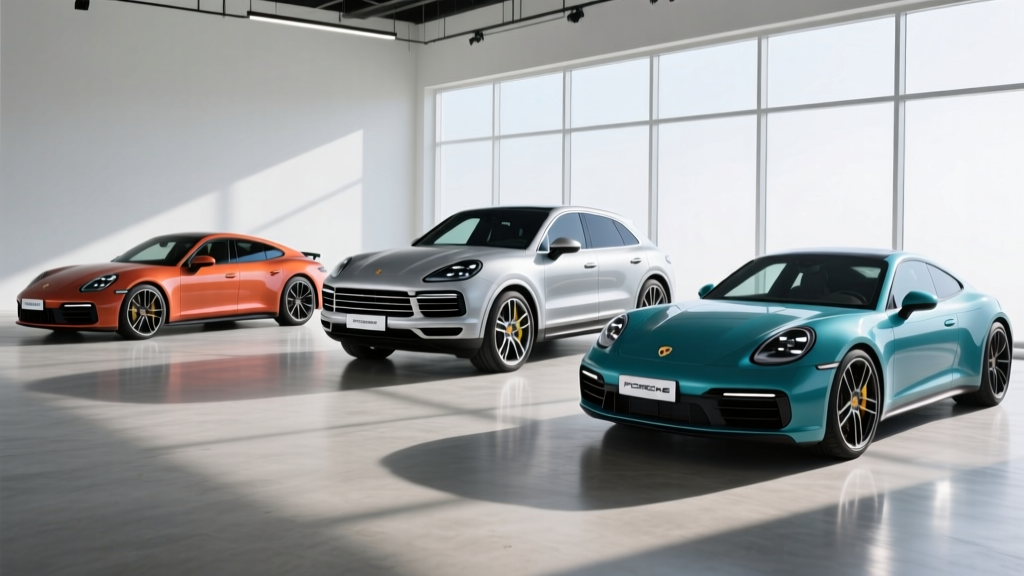
Porsche's E-Hybrid strategy has evolved from a niche offering into a core part of the lineup. For 2026, the Stuttgart automaker fields three distinct plug-in hybrid (PHEV) platforms: the Cayenne E-Hybrid SUV, the Panamera E-Hybrid sedan, and the newly introduced 911 Carrera GTS with the T-Hybrid system. Each takes a fundamentally different approach to electrification, and understanding those differences is critical before spending six figures on one.
This guide breaks down every current Porsche E-Hybrid model with exact EPA figures, real-world expectations, battery specs, charging realities, and ownership economics — the data you need to decide which one fits your garage.
Porsche E-Hybrid Models at a Glance: HEV vs. PHEV
Before diving into specs, it's essential to understand the distinction between Porsche's hybrid systems, because not all E-Hybrids are created equal.
PHEV (Plug-In Hybrid) — Cayenne E-Hybrid & Panamera E-Hybrid
These models carry larger battery packs (17.9–25.9 kWh usable) that you plug in to charge. They deliver meaningful electric-only range (20–35 miles EPA) before the gasoline engine engages. You can charge them at home on a Level 2 charger or via a standard 120V outlet. They also regenerate energy during braking and deceleration.
HEV (Conventional Hybrid) — 911 Carrera GTS T-Hybrid
The 911 T-Hybrid uses a small 1.9 kWh battery and an integrated electric motor. It does not plug in. The system is designed for performance enhancement — filling turbo lag, enabling brief electric boost, and recovering energy under braking. There is no meaningful electric-only driving range. Think of it as a performance hybrid, not an efficiency hybrid.
This distinction matters enormously for buyers: if you want to drive on electricity alone for your daily commute, you need the Cayenne or Panamera E-Hybrid. If you want a hybrid sports car that simply goes faster and slightly more efficiently, the 911 T-Hybrid is your answer.
2026 Cayenne E-Hybrid: Range, MPG, and Powertrain
The Cayenne E-Hybrid is Porsche's best-selling electrified model in the U.S., and for good reason. It combines genuine electric-only commuting capability with the performance and practicality buyers expect from a Cayenne.
| Specification | Cayenne E-Hybrid | Cayenne S E-Hybrid |
|---|---|---|
| Powertrain | 3.0L turbo V6 + electric motor | 3.0L turbo V6 + electric motor |
| Combined Horsepower | 394 hp | 512 hp |
| Combined Torque | 479 lb-ft | 553 lb-ft |
| 0-60 mph | 5.2 sec | 4.4 sec |
| Battery (usable) | ~17.9 kWh (NMC) | ~25.9 kWh (NMC) |
| Electric-Only Range (EPA) | ~20 mi | ~30 mi |
| EPA Combined MPGe | ~46 MPGe | ~49 MPGe |
| EPA MPG (gas-only, combined) | ~21 mpg | ~22 mpg |
| DC Fast Charging | No (AC only) | No (AC only) |
| Level 2 Charge Time (full) | ~2.5 hr at 7.2 kW | ~3.5 hr at 7.2 kW |
| Base MSRP | $93,450 | $107,350 |
| Battery/Powertrain Warranty | 8 yr / 100,000 mi | 8 yr / 100,000 mi |
Real-World Range Reality Check
The EPA electric-only range of 20–30 miles assumes moderate temperatures and mixed driving. In real-world testing, expect 15–25 miles on the base E-Hybrid and 24–35 miles on the S E-Hybrid with the larger battery pack. Highway-speed driving and cold weather (below 40°F) can reduce electric range by 20–30%. When the battery is depleted, the Cayenne operates as a conventional hybrid, delivering approximately 21–22 mpg combined — respectable for a 5,000+ lb luxury SUV, but not class-leading.
The Cayenne E-Hybrid cannot DC fast charge. This is a deliberate engineering choice by Porsche: the battery is small enough that a 7.2 kW Level 2 home charger replenishes it fully in 2.5–3.5 hours, which Porsche considers sufficient for overnight or workplace charging. If you rely exclusively on public fast-charging infrastructure, this is a significant limitation.
2026 Panamera E-Hybrid: Sedan Efficiency Meets Performance
The Panamera E-Hybrid targets buyers who want a luxury performance sedan with daily electric commuting capability. It shares the same PHEV architecture as the Cayenne but in a lower, sleeker package with slightly better efficiency.
| Specification | Panamera 4 E-Hybrid | Panamera 4S E-Hybrid | Panamera Turbo S E-Hybrid |
|---|---|---|---|
| Powertrain | 2.9L turbo V6 + e-motor | 2.9L turbo V6 + e-motor | 4.0L twin-turbo V8 + e-motor |
| Combined Horsepower | 463 hp | 536 hp | 717 hp |
| 0-60 mph | 4.3 sec | 3.7 sec | 2.9 sec |
| Battery (usable) | ~25.9 kWh (NMC) | ~25.9 kWh (NMC) | ~25.9 kWh (NMC) |
| Electric-Only Range (EPA) | ~30 mi | ~28 mi | ~26 mi |
| EPA Combined MPGe | ~52 MPGe | ~49 MPGe | ~45 MPGe |
| EPA MPG (gas, combined) | ~24 mpg | ~22 mpg | ~19 mpg |
| Level 2 Charge (full) | ~3.5 hr at 7.2 kW | ~3.5 hr at 7.2 kW | ~3.5 hr at 7.2 kW |
| Base MSRP | $109,250 | $126,550 | $199,550 |
The Panamera 4 E-Hybrid stands out as the efficiency sweet spot: 30 miles of electric-only range covers most daily commutes, and 24 mpg combined on gasoline alone is strong for a 463-hp all-wheel-drive sedan. The Turbo S E-Hybrid sacrifices some efficiency for supercar-rivaling performance — 717 hp and a 2.9-second 0-60 time, making it the quickest Panamera ever sold.
According to fueleconomy.gov, the Panamera E-Hybrid's MPGe ratings assume you're regularly charging the battery. If you never plug in, you'll see only the gas-only MPG figures — which still outperform the equivalent non-hybrid Panamera trims thanks to regenerative braking and engine optimization.
2026 911 Carrera GTS T-Hybrid: The Performance Hybrid
The 911 T-Hybrid is a fundamentally different animal. Porsche explicitly calls this a performance hybrid system, not an efficiency system. Here's how it works:
| Specification | 911 Carrera GTS T-Hybrid |
|---|---|
| Powertrain | 3.6L turbo flat-6 + integrated e-motor |
| Combined Horsepower | 532 hp |
| Combined Torque | 457 lb-ft |
| 0-60 mph | 2.9 sec |
| Battery (usable) | ~1.9 kWh (lithium-ion) |
| Electric-Only Range | None (no EV-only mode) |
| Plug-In Charging | No — self-charging HEV |
| EPA MPG (combined) | ~22 mpg (est.) |
| EPA MPG (city / highway) | ~19 city / ~25 hwy (est.) |
| Base MSRP | $164,900 |
| Battery/Powertrain Warranty | 8 yr / 100,000 mi (hybrid components) |
The 1.9 kWh battery is charged exclusively through regenerative braking and the engine. The electric motor sits between the engine and the 8-speed PDK transmission, providing instant torque to eliminate turbo lag and enable brief torque-fill during gear changes. The result is a 911 that accelerates harder and responds faster than its non-hybrid predecessor, with a modest efficiency improvement.
Real-world fuel economy for the 911 T-Hybrid will closely mirror EPA estimates since there's no electric-only buffer to exploit. Expect 19–21 mpg in mixed driving, with highway cruising potentially reaching 25–26 mpg. This is a meaningful improvement over the prior non-hybrid 911 GTS, which returned roughly 18 mpg combined.
Fuel Economy Deep Dive: Real-World MPG vs. EPA Stickers
Porsche's EPA ratings for its E-Hybrid models assume regular plug-in charging. If you charge nightly and your commute falls within the electric-only range, you'll burn minimal gasoline and approach the MPGe figures. If you never plug in, you're driving a heavy conventional hybrid.
| Model | EPA Combined (gas only) | Real-World Gas-Only (mixed) | EPA Electric Range | Real-World EV Range |
|---|---|---|---|---|
| Cayenne E-Hybrid | 21 mpg | 19–23 mpg | 20 mi | 15–25 mi |
| Cayenne S E-Hybrid | 22 mpg | 20–24 mpg | 30 mi | 24–35 mi |
| Panamera 4 E-Hybrid | 24 mpg | 22–27 mpg | 30 mi | 25–34 mi |
| Panamera Turbo S E-Hybrid | 19 mpg | 17–21 mpg | 26 mi | 20–28 mi |
| 911 Carrera GTS T-Hybrid | 22 mpg | 19–24 mpg | N/A | N/A |
A critical pattern emerges: PHEVs reward charging discipline. A Panamera 4 E-Hybrid owner who charges every night and commutes 25 miles will use gasoline only on weekends and road trips, potentially averaging 60+ MPGe over a month. The same car, never plugged in, delivers 22–27 mpg — still better than a gas-only Panamera, but nowhere near the sticker's promise.
City driving favors hybrids and PHEVs. Regenerative braking recovers energy in stop-and-go traffic, and the electric motor handles low-speed acceleration where gasoline engines are least efficient. Highway driving erodes electric range quickly and relies more on the gasoline engine, which is why real-world highway MPG for these models often falls 1–3 mpg below the EPA highway figure.
Charging the PHEVs: Home Setup, Times, and Limitations
Only the Cayenne and Panamera E-Hybrid models require plug-in charging. The 911 T-Hybrid is self-charging and needs no charging infrastructure.
For the PHEVs, here's what charging looks like in practice:
- Level 1 (120V household outlet): Adds roughly 4–5 miles of range per hour. A full charge from empty takes 7–10 hours depending on battery size. Viable if you drive short distances and can plug in overnight.
- Level 2 (240V, 7.2 kW onboard charger): Adds approximately 15–20 miles of range per hour. A full charge takes 2.5–3.5 hours. This is the recommended setup for daily PHEV use.
- DC Fast Charging: Not available on any Porsche E-Hybrid. Porsche has chosen not to equip its PHEVs with DC fast-charge capability, reasoning that the battery sizes don't justify the added weight, cost, and complexity.
Home Level 2 installation for a PHEV typically costs $800–$2,500, including a quality EVSE (like the ChargePoint Home Flex or Emporia Vue) and electrician labor for a 240V/40A circuit. If your electrical panel needs upgrading to support the additional load, costs can reach $3,000–$5,000. Consult a licensed electrician for your specific situation.
One practical note: Porsche's onboard charger is limited to 7.2 kW. Even if you install a 48A/11.5 kW home charger, the car will only draw 7.2 kW. Don't overspend on a high-power EVSE for a PHEV — a 32A/7.7 kW unit is perfectly matched to these vehicles.
Hybrid vs. PHEV vs. Full EV: Which Porsche Fits You?
Choosing between Porsche's hybrid options — or deciding to go full electric with the Taycan — depends on your driving patterns, charging access, and priorities.
Choose the Cayenne/Panamera E-Hybrid (PHEV) if:
- You can charge at home or work every day
- Your daily commute is under 30 miles round-trip
- You take regular road trips exceeding 200 miles and don't want to plan around charging stops
- You want the performance of a Porsche with a meaningful reduction in fuel consumption
- You live in an area with limited public DC fast-charging infrastructure
Choose the 911 T-Hybrid (HEV) if:
- You want maximum performance with no behavioral change required
- You have no interest in plugging in a vehicle
- You prioritize driving dynamics over fuel economy
- You want the latest 911 technology in a sports car package
Choose the Porsche Taycan (Full EV) if:
- You have reliable home Level 2 charging
- Your typical daily driving is under 250 miles
- You want the lowest per-mile "fuel" cost and minimal maintenance
- You're comfortable planning longer road trips around DC fast-charging stops
The PHEV is the bridge solution: it rewards daily charging with electric-only commuting while eliminating range anxiety on long trips. But if you can't charge regularly, a PHEV becomes an expensive, heavy conventional hybrid. In that scenario, the 911 T-Hybrid (which requires no charging) or a full EV like the Taycan (which eliminates gasoline entirely) may serve you better.
Pricing, Tax Credits, and Total Cost of Ownership
Porsche's E-Hybrid models command a premium over their gasoline-only counterparts, but the value equation involves more than MSRP.
| Model | Base MSRP | Estimated Well-Equipped Price | Gas-Only Equivalent | Premium Over Gas |
|---|---|---|---|---|
| Cayenne E-Hybrid | $93,450 | $105,000–$115,000 | Cayenne ($86,350) | ~$7,100 |
| Cayenne S E-Hybrid | $107,350 | $118,000–$130,000 | Cayenne S ($97,350) | ~$10,000 |
| Panamera 4 E-Hybrid | $109,250 | $120,000–$135,000 | Panamera 4 ($103,050) | ~$6,200 |
| 911 Carrera GTS T-Hybrid | $164,900 | $180,000–$200,000 | N/A (only hybrid) | — |
Federal Tax Credit Eligibility (§30D)
Under current IRS §30D rules, PHEVs may qualify for up to $7,500 in federal tax credits — but Porsche's E-Hybrid models face significant hurdles:
- Battery sourcing and critical minerals: The §30D credit requires that a percentage of battery components be manufactured in North America and that critical minerals be sourced from the U.S. or FTA partners. Porsche's batteries are primarily sourced from Asian and European supply chains, which likely disqualifies most E-Hybrid trims from the full credit.
- MSRP caps: The §30D credit applies to SUVs (including the Cayenne) with an MSRP under $80,000 and sedans (Panamera) under $55,000. Every Porsche E-Hybrid exceeds these caps, making them ineligible for the federal new-vehicle EV credit regardless of sourcing compliance.
- Buyer income caps: Even if a vehicle qualified, adjusted gross income must be below $300,000 (joint), $225,000 (head of household), or $150,000 (single).
- Point-of-sale transfer: For qualifying vehicles, the credit can be transferred to the dealer at purchase as a down-payment reduction. However, since Porsche E-Hybrids don't qualify, this option is moot.
Bottom line: No Porsche E-Hybrid qualifies for the federal §30D new-vehicle tax credit due to MSRP caps. Some states offer their own rebates for PHEVs (California's CVRP, for example, has historically offered rebates, though program details change frequently). Check your state's energy or environmental agency for current programs.
On the ownership-cost side, PHEVs save on fuel if charged regularly. A Panamera 4 E-Hybrid driven 12,000 miles annually with nightly charging might use 300–400 gallons of gasoline per year (~$1,200–$1,600 at $4/gal) plus ~$500–$700 in electricity. A gas-only Panamera 4 would consume roughly 550–600 gallons (~$2,200–$2,400). Annual fuel savings of $500–$1,000 are realistic, but they won't offset the purchase premium quickly.
Reliability, Battery Longevity, and Warranty Coverage
Hybrid battery longevity is the top concern for buyers spending over $100,000 on a PHEV. Here's what the data shows:
Porsche Hybrid Battery & Powertrain Warranty
- Hybrid battery warranty: 8 years / 100,000 miles (whichever comes first)
- Capacity retention threshold: Porsche warrants that the high-voltage battery will retain at least 70% of its original usable capacity during the warranty period
- Powertrain warranty: 4 years / 50,000 miles (standard Porsche limited warranty)
- Hybrid-specific components: Electric motor, power electronics, and onboard charger covered under the 8-year/100,000-mile hybrid warranty
Porsche uses NMC (nickel manganese cobalt) chemistry in the Cayenne and Panamera E-Hybrid batteries, which offers high energy density but is more sensitive to sustained high states of charge and extreme temperatures than LFP chemistry. To maximize longevity:
- Avoid leaving the battery at 100% SoC for extended periods — charge to 80–90% for daily use if your charger supports scheduling
- Use the vehicle's built-in battery preconditioning and thermal management — Porsche's liquid-cooled battery system actively manages temperature
- Don't consistently drain the battery to 0% — the system maintains a hidden buffer, but habitual deep discharges still stress NMC cells
Based on industry data from similar PHEV platforms (BMW, Mercedes-Benz, Audi), hybrid battery degradation in Porsche E-Hybrids is typically 8–12% over the first 5 years / 60,000 miles. Out-of-warranty battery replacement costs range from $12,000 to $18,000 depending on the model and battery size, though replacements before 150,000 miles are uncommon with proper care.
According to J.D. Power reliability data, Porsche as a brand has shown average to slightly-below-average reliability ratings in recent years, with electronics and infotainment being more common complaint areas than powertrain components. The hybrid systems themselves have been relatively trouble-free across the industry, as the e-motor and power electronics have fewer moving parts than a conventional transmission.
Frequently Asked Questions
How many MPG does the Porsche Cayenne E-Hybrid get?
The 2026 Cayenne E-Hybrid achieves an EPA-estimated 21 mpg combined when running on gasoline alone, with 46 MPGe when factoring in electric-only driving. The Cayenne S E-Hybrid returns 22 mpg combined / 49 MPGe. Real-world gas-only figures typically range from 19–24 mpg depending on driving style and conditions. With nightly charging and a short commute, many owners report using gasoline only a few times per month.
How far can the Porsche Panamera E-Hybrid go on electric only?
The 2026 Panamera 4 E-Hybrid delivers an EPA-estimated 30 miles of electric-only range. In real-world conditions, expect 25–34 miles depending on temperature, terrain, and driving speed. The Turbo S E-Hybrid, with its more powerful drivetrain and heavier curb weight, sees its range dip to approximately 26 miles EPA / 20–28 miles real-world.
Does the Porsche 911 T-Hybrid need to be plugged in?
No. The 911 Carrera GTS T-Hybrid is a conventional hybrid (HEV), not a plug-in hybrid. Its 1.9 kWh battery charges exclusively through regenerative braking and the gasoline engine. There is no plug, no electric-only mode, and no charging infrastructure required. The hybrid system exists to enhance performance — filling turbo lag and providing instant electric torque — not to enable emissions-free driving.
Do Porsche E-Hybrids qualify for any tax credit?
No Porsche E-Hybrid currently qualifies for the federal §30D new clean vehicle tax credit. The primary disqualifying factor is the MSRP cap: the credit applies only to SUVs priced under $80,000 and sedans under $55,000. Every Porsche E-Hybrid model exceeds these thresholds. Some states may offer separate PHEV incentives — check your state energy office or the Alternative Fuels Data Center for current state-level programs.
What is the battery replacement cost for a Porsche E-Hybrid?
Out-of-warranty high-voltage battery replacement for the Cayenne or Panamera E-Hybrid ranges from approximately $12,000 to $18,000, including parts and labor. The 911 T-Hybrid's much smaller 1.9 kWh battery is estimated at $4,000–$7,000. However, based on industry-wide PHEV data, battery failures before 150,000 miles are rare, and Porsche's 8-year/100,000-mile hybrid warranty provides substantial coverage. Most owners will sell or trade the vehicle before facing a battery replacement expense.
Hybrid vs. PHEV vs. EV — which Porsche should I buy?
If you can charge at home daily and your commute is under 30 miles, a PHEV (Cayenne or Panamera E-Hybrid) offers the best of both worlds: electric-only commuting with gasoline backup for long trips. If you can't charge at home, a PHEV becomes an expensive, heavy conventional hybrid — consider the 911 T-Hybrid (no charging needed) or a gas model instead. If you have home charging and rarely drive more than 250 miles in a day, the all-electric Porsche Taycan offers lower running costs, less maintenance, and stronger performance per dollar — but requires trip planning for longer drives.
Porsche E-Hybrid Pros
- Genuine electric-only commuting range (PHEV models, 20–30+ mi)
- Performance credentials intact — 0-60 times rival pure sports cars
- No range anxiety on road trips (gasoline engine backup)
- 8-year/100,000-mile hybrid battery warranty
- Lower fuel costs with regular charging discipline
- Quieter, smoother low-speed driving in EV mode
Porsche E-Hybrid Cons
- No federal §30D tax credit eligibility (MSRP exceeds caps)
- No DC fast-charging capability on PHEV models
- Added weight from battery/motor reduces agility vs. gas-only counterparts
- Premium pricing — $7,000–$10,000 more than gas-only equivalents
- NMC battery chemistry requires more careful charge management than LFP
- PHEV benefits disappear entirely without regular plug-in charging