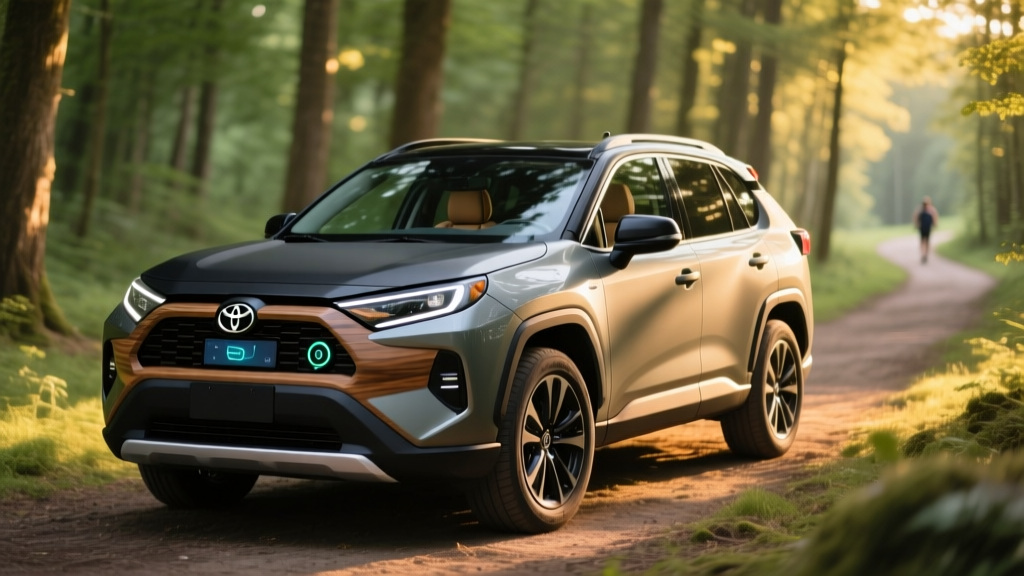
The Toyota RAV4 Hybrid remains one of the best-selling hybrid SUVs in the United States, and the Woodland Edition occupies a specific niche in the lineup: a rugged-styled, standard all-wheel-drive hybrid that doesn't demand a plug. For 2025, Toyota carries over the Woodland Edition with the proven 2.5-liter four-cylinder hybrid powertrain, TRD-tuned suspension, and all-terrain tires. If you're researching the 2025 Toyota RAV4 Hybrid Woodland Edition, this guide breaks down the exact EPA fuel economy, real-world MPG expectations, powertrain specs, pricing, battery longevity, and how it stacks up against the RAV4 Prime PHEV and full-electric alternatives.
2025 Toyota RAV4 Hybrid Woodland Edition: Quick Specs
| Spec | Value |
|---|---|
| Powertrain | 2.5L 4-cyl + 3 electric motors (HEV) |
| Combined Horsepower | 219 hp |
| Drivetrain | Electronic AWD (eAWD) |
| EPA MPG (City / Hwy / Combined) | 41 / 38 / 39 |
| Fuel Tank Capacity | 14.5 gallons |
| Total Driving Range (EPA est.) | ~565 miles |
| 0-60 mph | ~7.4 seconds |
| Towing Capacity | 1,750 lbs |
| Cargo Volume (behind rear seats) | 37.5 cu ft |
| Ground Clearance | 8.6 inches |
| Hybrid Battery Warranty | 10 years / 150,000 miles |
| Starting MSRP | ~$36,350 (incl. destination) |
Fuel Economy: EPA Numbers and Real-World MPG
The 2025 RAV4 Hybrid Woodland Edition carries an EPA rating of 41 MPG city, 38 MPG highway, and 39 MPG combined, per fueleconomy.gov. These figures are slightly lower than the standard RAV4 Hybrid LE/XLE (which achieve 41/38/40) due to the Woodland's all-terrain tires and TRD-tuned suspension, which add rolling resistance and weight.
Hybrids like the RAV4 tend to exceed their EPA city rating in stop-and-go traffic, where regenerative braking and low-speed electric-only driving dominate. In mixed suburban driving, owners commonly report 40-43 MPG. Highway-only trips at 75+ mph typically yield 34-37 MPG — the electric motors contribute less at sustained high speeds, and the Woodland's all-terrain tires increase aerodynamic drag and rolling resistance. In cold weather (below 30°F), expect a 5-10% reduction as the engine runs more frequently for cabin heat and battery conditioning.
HEV vs PHEV: RAV4 Hybrid vs RAV4 Prime
The RAV4 Hybrid Woodland Edition is a conventional hybrid (HEV). It charges its battery through regenerative braking and the gasoline engine — there is no plug and no electric-only driving range beyond very low-speed creep (roughly 1 mile at under 25 mph). If you want plug-in capability, Toyota offers the RAV4 Prime, a plug-in hybrid (PHEV).
- HEV (RAV4 Hybrid): No plug. Battery recharges via regen and engine. ~1.6 kWh battery. Never needs external charging. Lower upfront cost.
- PHEV (RAV4 Prime): Plugs in. 18.1 kWh battery delivers ~42 miles of electric-only range (EPA). Total range ~600 miles. Higher MSRP but eligible for federal tax credit.
- BEV (full electric): No gas engine. Requires home or public charging infrastructure. Lowest running cost if charging access exists.
| Spec | RAV4 Hybrid Woodland (HEV) | RAV4 Prime SE (PHEV) |
|---|---|---|
| Combined HP | 219 hp | 302 hp |
| EPA MPG (combined) | 39 MPG | 38 MPG (gas) / 94 MPGe (electric) |
| Electric-Only Range | N/A | 42 miles |
| Battery Capacity | ~1.6 kWh | 18.1 kWh |
| Plug-In Charging | No | Yes (Level 1/2; no DC fast charge) |
| Level 2 Charge Time (0-100%) | N/A | ~2.5 hours (6.6 kW) |
| 0-60 mph | ~7.4 sec | ~5.7 sec |
| Starting MSRP | ~$36,350 | ~$44,490 |
| Federal Tax Credit (§30D) | Not eligible | Up to $7,500 (see eligibility) |
Powertrain and Performance
The Woodland Edition uses Toyota's fourth-generation hybrid system: a 2.5-liter Dynamic Force four-cylinder engine paired with two front electric motors (integrated into the transaxle) and one rear electric motor for electronic AWD. Combined system output is 219 horsepower. The rear motor activates on-demand to provide traction — there is no mechanical driveshaft connecting the front and rear axles.
The TRD-tuned suspension includes revised spring rates and dampers compared to the standard RAV4 Hybrid, giving the Woodland slightly firmer ride quality and improved body control on uneven surfaces. The all-terrain tires (225/65R17) are optimized for light off-road traction — gravel, dirt, mud, and snow — at a modest highway noise and efficiency penalty.
Acceleration is adequate for daily driving. The 0-60 mph time of approximately 7.4 seconds places it in the middle of the compact hybrid SUV segment. The continuously variable transmission (eCVT) is smooth and avoids the rubber-band feel that older CVTs exhibit, though it won't satisfy drivers seeking sporty shift behavior.
Pricing and Tax Credit Eligibility
The 2025 Toyota RAV4 Hybrid Woodland Edition starts at approximately $36,350 including destination charges. Toyota typically offers it in a single, well-equipped trim with standard features including an 8-inch touchscreen, wireless Apple CarPlay/Android Auto, heated front seats, a power liftgate, and Toyota Safety Sense 2.5+ (adaptive cruise, lane-keeping, automatic emergency braking, blind-spot monitoring).
The RAV4 Hybrid Woodland Edition is a conventional hybrid (HEV), not a plug-in. Under current IRS §30D rules, the federal clean vehicle credit (up to $7,500) applies only to plug-in electric vehicles (BEVs and PHEVs) that meet battery sourcing, MSRP cap, and buyer income requirements. The RAV4 Hybrid does not qualify for the §30D credit. If tax-credit eligibility is a priority, consider the RAV4 Prime PHEV — though its eligibility depends on current-year critical mineral and battery component sourcing rules, which change periodically. Always verify on IRS.gov before purchasing.
Some states offer additional rebates for hybrids. For example, certain utility companies provide modest incentives ($250-$500) for purchasing any hybrid or PHEV. Check your state energy office and local utility for current programs.
Battery Longevity, Warranty, and Replacement Cost
Toyota covers the RAV4 Hybrid's nickel-metal hydride (NiMH) traction battery for 10 years or 150,000 miles, whichever comes first. This warranty guarantees the battery against defects and excessive capacity loss. The hybrid system components (inverter, control module, electric motors) are covered under the same 10-year/150,000-mile hybrid system warranty.
Toyota's hybrid battery track record is among the best in the industry. The RAV4 Hybrid has been in production since the 2016 model year, and widespread battery failure reports are rare. NiMH chemistry, while less energy-dense than the lithium-ion packs in PHEVs and BEVs, is extremely durable and thermally stable. Real-world data from fleet operators and long-term owners suggests these packs routinely exceed 200,000 miles before significant degradation.
If replacement is needed out of warranty, a new OEM RAV4 Hybrid battery currently costs between $3,000 and $4,500 including labor at a Toyota dealer. Refurbished and aftermarket options are available for $1,500-$2,500. For context, a replacement battery for the RAV4 Prime's much larger 18.1 kWh lithium-ion pack runs $6,000-$8,000+ — another reason the conventional HEV appeals to cost-conscious buyers.
Who Should Buy the RAV4 Hybrid Woodland Edition?
Choose the RAV4 Hybrid Woodland Edition (HEV) if:
- You want 39+ MPG combined without ever plugging in
- You lack access to home or workplace Level 2 charging
- You want AWD capability for light off-road, snow, or gravel
- Your budget is under $40,000 and you don't want to wait for PHEV inventory
- You plan to keep the vehicle 8-10+ years and value Toyota's reliability reputation
Choose the RAV4 Prime (PHEV) if:
- You have Level 2 charging at home and a commute under 42 miles
- You want to drive primarily on electricity most days with gas backup for road trips
- You want 302 hp and significantly quicker acceleration (5.7 sec 0-60)
- You may qualify for the federal §30D tax credit (verify current sourcing rules on IRS.gov)
Choose a full EV (e.g., Tesla Model Y, Hyundai Ioniq 5) if:
- You have reliable home charging and rarely drive more than 250 miles between stops
- You want the lowest per-mile fuel cost and minimal maintenance
- You're ready to adopt DC fast charging for road trips
Pros and Cons
- 39 MPG combined with no plug-in requirement
- Proven, durable hybrid powertrain with 10-year battery warranty
- Standard eAWD with 8.6" ground clearance for snow and light trails
- Strong cargo capacity (37.5 cu ft) and practicality
- Comprehensive Toyota Safety Sense 2.5+ suite included
- Excellent long-term resale value
- No federal tax credit eligibility (HEV)
- All-terrain tires reduce highway MPG vs. standard Hybrid trims
- Modest 1,750-lb towing capacity
- No DC fast charging option (irrelevant for HEV but limits Prime comparison)
- Single trim limits customization — no sunroof or premium audio upgrade
- eCVT lacks the engagement of a geared transmission
Frequently Asked Questions
How many MPG does the 2025 RAV4 Hybrid Woodland Edition get?
The EPA rates it at 41 MPG city, 38 MPG highway, and 39 MPG combined. Real-world results typically range from 34-37 MPG on highway road trips to 42-45 MPG in city and suburban stop-and-go driving. Cold weather and aggressive acceleration reduce these figures by 5-10%.
Does the RAV4 Hybrid Woodland Edition need to be plugged in?
No. It is a conventional hybrid (HEV). The battery recharges automatically through regenerative braking and the gasoline engine. There is no charging port and no electric-only driving mode beyond very low-speed maneuvering.
How far can the RAV4 Hybrid go on a full tank?
With a 14.5-gallon fuel tank and 39 MPG combined, the EPA-estimated total range is approximately 565 miles. Real-world highway-only range may be closer to 500-520 miles; city-heavy driving can push it past 580 miles.
Is the RAV4 Hybrid battery reliable and what does replacement cost?
Toyota's hybrid battery warranty is 10 years/150,000 miles, and the NiMH pack has an excellent longevity track record — many exceed 200,000 miles without replacement. If needed out of warranty, a new OEM battery costs $3,000-$4,500 installed; refurbished options start around $1,500.
Does the RAV4 Hybrid qualify for any tax credit?
The conventional RAV4 Hybrid (HEV) does not qualify for the federal §30D clean vehicle credit, which requires plug-in capability. The RAV4 Prime PHEV may qualify for up to $7,500 depending on current-year battery sourcing, MSRP caps, and buyer income limits — verify at IRS.gov. Some state and utility rebates may apply to hybrids; check local programs.
How does the Woodland Edition differ from the standard RAV4 Hybrid?
The Woodland Edition adds TRD-tuned suspension, all-terrain tires on 17-inch wheels, a front skid plate, unique exterior badging, and standard roof rails with cross bars. It sacrifices roughly 1 MPG combined compared to the LE/XLE trims due to the tire choice, and it comes in a single trim with limited option flexibility.
Can the RAV4 Hybrid Woodland Edition tow?
Yes, it is rated for 1,750 pounds — enough for a small utility trailer, a pair of dirt bikes, or a lightweight pop-up camper. This is standard for the RAV4 Hybrid lineup. If you need more towing capacity, the RAV4 Prime PHEV is rated identically; for 3,500-lb towing, you would need to look at the RAV4 Adventure or TRD Off-Gas (non-hybrid) trims.