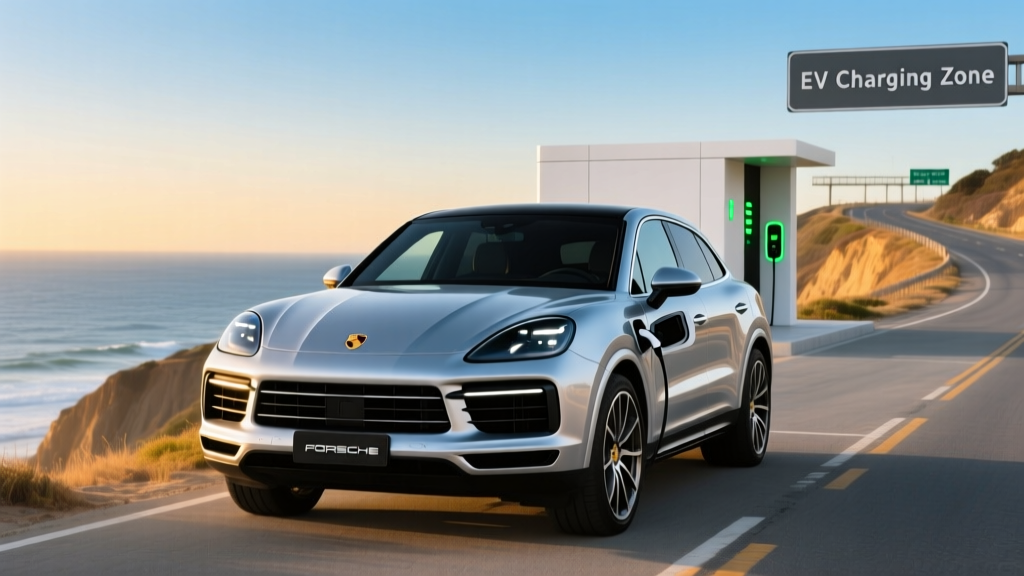
The Porsche Cayenne has long bridged the gap between sports-car dynamics and family-SUV practicality. For 2026, the hybrid Porsche Cayenne lineup — specifically the Cayenne E-Hybrid and the more powerful Cayenne S E-Hybrid — continues as Porsche's plug-in hybrid (PHEV) offering in the midsize luxury SUV segment. These aren't conventional hybrids that simply sip a bit less fuel; they're plug-in vehicles with meaningful electric-only range, serious combined horsepower, and the ability to drive on electricity alone for daily commutes.
But with a starting price north of $95,000, a relatively modest 27-mile EPA electric range, and no DC fast-charging capability, the Cayenne E-Hybrid demands a clear-eyed look at what it actually delivers. This guide breaks down every number that matters — from real-world MPG to battery warranty — so you can decide if Porsche's electrified Cayenne fits your garage.
HEV vs PHEV: Where the Cayenne Hybrid Fits
Porsche does not sell a conventional hybrid (HEV) Cayenne in the United States. Every electrified Cayenne is a plug-in hybrid electric vehicle (PHEV). That distinction matters:
| Feature | Conventional Hybrid (HEV) | Plug-In Hybrid (PHEV) — Cayenne E-Hybrid |
|---|---|---|
| Plug in to charge? | No — regenerative braking only | Yes — plug in for full battery charge |
| Electric-only range | 0–2 miles at low speed | 27 miles (EPA est.) |
| Battery size | ~1–2 kWh | 25.9 kWh (gross) / ~20.8 kWh usable |
| Federal tax credit eligible? | No | Not under current §30D rules (see below) |
| Typical use case | Set-and-forget fuel savings | Electric commute + gas road trips |
If you're shopping for a hybrid Porsche Cayenne, you're looking at a PHEV. That means access to a Level 2 home charger (or at least a dedicated 120V outlet) is important to extract the full value of the electric drivetrain.
2026 Cayenne E-Hybrid Powertrain and Performance Specs
The 2026 Cayenne E-Hybrid pairs a turbocharged 3.0-liter V6 with an electric motor integrated into the 8-speed Tiptronic S automatic transmission. The Cayenne S E-Hybrid steps up to a turbocharged 2.9-liter V6 with a more powerful electric motor. Here's how they compare:
| Specification | Cayenne E-Hybrid | Cayenne S E-Hybrid |
|---|---|---|
| Engine | 3.0L Turbo V6 | 2.9L Twin-Turbo V6 |
| Engine output | 348 hp / 332 lb-ft | 348 hp / 369 lb-ft |
| Electric motor output | 174 hp / 295 lb-ft | 174 hp / 295 lb-ft |
| Combined system output | 391 hp / 369 lb-ft | 463 hp / 479 lb-ft |
| 0–60 mph | 5.2 seconds | 4.4 seconds |
| Top track speed | 152 mph | 157 mph |
| Drivetrain | AWD (all-wheel drive) | AWD (all-wheel drive) |
| Transmission | 8-speed Tiptronic S | 8-speed Tiptronic S |
| Towing capacity | 7,700 lbs (w/ factory hitch) | 7,700 lbs (w/ factory hitch) |
| Battery (gross / usable) | 25.9 kWh / ~20.8 kWh | 25.9 kWh / ~20.8 kWh |
| EPA electric-only range | 27 miles | 25 miles |
| Base MSRP | $97,200 | $108,400 |
Both models use the same 25.9 kWh lithium-ion battery pack (NMC chemistry). The S E-Hybrid's slightly lower electric range comes from its more aggressive power delivery and standard wider tires increasing rolling resistance.
EPA Fuel Economy and Real-World MPG
Once the battery is depleted and the Cayenne E-Hybrid operates as a conventional hybrid, the EPA rates it as follows:
| Model | City MPG | Highway MPG | Combined MPG | Combined MPGe (w/ charge) |
|---|---|---|---|---|
| Cayenne E-Hybrid | 21 | 22 | 21 | 46 MPGe |
| Cayenne S E-Hybrid | 20 | 22 | 21 | 44 MPGe |
| Cayenne (gas-only baseline) | 17 | 22 | 19 | N/A |
Source: fueleconomy.gov
The MPGe figure (miles per gallon equivalent) accounts for both electric and gasoline operation with a full charge. It's useful for comparing PHEVs to full EVs and gas cars on a single scale, but your actual cost per mile depends heavily on how often you plug in. According to EPA data, a driver who charges regularly and commutes within the electric range will use significantly less fuel than the combined MPG suggests.
Electric-Only Range and Charging Details
The 2026 Cayenne E-Hybrid's EPA-rated electric-only range is 27 miles (25 miles for the S E-Hybrid). That's enough to cover the average American one-way commute of roughly 16 miles, according to FHWA data, with a small buffer.
| Charging Method | Power (kW) | 0–100% Time | Notes |
|---|---|---|---|
| Level 1 (120V household) | ~1.4 kW | ~15 hours | Emergency/trickle; not practical for daily full charges |
| Level 2 (240V, included charger) | 7.2 kW | ~2.5 hours | Standard home charging; overnight top-up |
| DC Fast Charging | Not supported | N/A | Cayenne E-Hybrid has no DC fast-charge port |
The onboard AC charger maxes out at 7.2 kW. Porsche includes a Porsche Mobile Charger Connect with the vehicle, which can be plugged into a NEMA 14-50 outlet (240V, 50A circuit) for the full 7.2 kW rate. For daily use, plugging in overnight on Level 2 means the battery will fully replenish well before morning — a 2.5-hour charge time is more than adequate for a PHEV with a 25.9 kWh pack.
The lack of DC fast charging is typical for PHEVs in this class. BMW's X5 xDrive50e and Mercedes GLE 350e also skip DC capability. The smaller battery simply doesn't justify the added cost, weight, and packaging complexity of a DC charge port.
Tax Credits and Pricing: Does the Cayenne E-Hybrid Qualify?
Under current IRS §30D rules, the 2026 Porsche Cayenne E-Hybrid does not qualify for the $7,500 federal tax credit. The reasons are twofold:
- MSRP cap: §30D limits the credit to SUVs with an MSRP at or below $80,000. The Cayenne E-Hybrid starts at $97,200 — well above the threshold.
- Battery sourcing: Even if pricing qualified, the critical minerals and battery component sourcing requirements under the Inflation Reduction Act have eliminated most European-assembled PHEVs from eligibility.
- Income cap: Buyers must also fall under adjusted gross income limits ($300,000 joint / $150,000 single) to claim §30D, regardless of the vehicle.
Source: IRS.gov — Clean Vehicle Credits
Some state-level incentives may partially offset the cost. California's CVRP, for example, has historically offered rebates for PHEVs, though income caps and program funding vary. Check your state's energy office or the Alternative Fuels Data Center for current local incentives.
2026 Cayenne E-Hybrid Pricing by Trim
| Trim | Base MSRP | Est. w/ Destination & Common Options | Federal Tax Credit |
|---|---|---|---|
| Cayenne E-Hybrid | $97,200 | $105,000–$120,000 | $0 |
| Cayenne S E-Hybrid | $108,400 | $118,000–$135,000 | $0 |
| Cayenne E-Hybrid Coupe | $101,400 | $110,000–$128,000 | $0 |
Options like the Premium Package, air suspension, and larger wheels can add $15,000–$25,000 to the final price. Porsche's options strategy is extensive — budget accordingly.
Battery Warranty, Reliability, and Replacement Cost
Porsche PHEV Battery Warranty
Porsche covers the Cayenne E-Hybrid's high-voltage battery for 8 years or 100,000 miles (whichever comes first), with a capacity retention threshold of 70%. If the battery degrades below 70% of its original capacity within the warranty period, Porsche will repair or replace it at no cost.
The hybrid-specific components (electric motor, power electronics, onboard charger) are covered under the same 8-year/100,000-mile warranty. The conventional powertrain (V6 engine, transmission) carries Porsche's standard 4-year/50,000-mile limited warranty.
Reliability context: Porsche's PHEV powertrain in the Cayenne has been in production since the 2019 model year (current generation), giving it a solid track record. The 25.9 kWh battery uses proven NMC (nickel manganese cobalt) chemistry with liquid thermal management — the same approach used by most European PHEV manufacturers. PHEV batteries experience less stress than full EV batteries because they operate in a narrower state-of-charge window (typically 15–85%), which reduces degradation over time.
Out-of-warranty replacement cost: If the high-voltage battery requires replacement after the warranty expires, expect a dealer-installed cost in the range of $12,000–$18,000, based on current Porsche parts pricing and labor rates. Module-level repair (replacing individual cell groups rather than the full pack) may reduce this to $5,000–$8,000 at an independent EV specialist, though Porsche's dealer network typically performs full-pack replacements.
For context, PHEV batteries in normal use rarely require replacement. Most degrade 1–2% per year, meaning a 10-year-old Cayenne E-Hybrid battery might retain 82–88% of its original capacity — well above the 70% warranty threshold.
Who Should Buy the Hybrid Cayenne — and Who Shouldn't
Pros
- Genuine 27-mile electric commute covers most daily driving
- 391–463 hp combined output delivers sports-car acceleration in an SUV
- No range anxiety — gas engine for road trips, electric for errands
- 7,700-lb towing capacity (when properly equipped)
- Porsche build quality, interior materials, and driving dynamics
- Regenerative braking extends brake life significantly
Cons
- $97,200+ starting price with no federal tax credit
- 27-mile electric range is shorter than rivals (BMW X5 PHEV: ~38 mi)
- No DC fast charging
- Charge-sustaining MPG (21 combined) is modest for a hybrid
- Porsche options can push price past $130,000
- Requires home charging access to justify the PHEV premium
Hybrid vs PHEV vs EV — Which Cayenne Fits You?
Choose the Cayenne E-Hybrid if: You have home charging, a commute under 30 miles, want to drive electric daily but need a gas engine for weekend road trips or towing, and value Porsche driving dynamics.
Choose the gas-only Cayenne if: You lack reliable home charging access, drive mostly highway miles (where PHEV advantage shrinks), or want to keep the purchase price lower. The base Cayenne starts around $84,000 and gets 19 MPG combined.
Choose a full EV (like the Porsche Taycan Cross Turismo or a Tesla Model X) if: You want maximum fuel savings, have home charging, rarely tow heavy loads, and your longest regular trips fall within 250–300 miles or you're comfortable with DC fast-charging stops.
Real-World Ownership: What to Expect
Owners who plug in nightly report dramatically different fuel consumption than the EPA combined figure suggests. In practice:
- Weekday commuting (under 27 miles, plugged in nightly): Near-zero gasoline use. You might visit a gas station once a month for the tank-maintenance top-up the car requests.
- Mixed driving (some electric, some gas): Expect 30–40 MPG equivalent, depending on the ratio of electric to gas miles.
- Road trips (all highway, battery depleted): 19–21 MPG, consistent with the charge-sustaining EPA rating. The Cayenne is a heavy vehicle (over 5,200 lbs) with a turbocharged V6 — it won't match a Toyota RAV4 Hybrid.
- Cold weather: Electric range drops roughly 15–25% in freezing temperatures (down to ~20–23 miles), as the battery uses energy for thermal management and cabin heating draws from the pack. The gas engine may engage sooner to provide heat.
The Cayenne E-Hybrid's E-Charge mode deserves mention: it lets you use the gas engine to charge the battery while driving — useful if you're approaching a city zone where you want electric-only operation, or if you forgot to plug in and want to recapture some range. However, this is less efficient than simply plugging in, as you're burning gasoline to generate electricity.
Frequently Asked Questions
How many MPG does the hybrid Porsche Cayenne get?
The 2026 Cayenne E-Hybrid is EPA-rated at 21 MPG combined (21 city / 22 highway) in charge-sustaining mode — after the battery is depleted. With regular plug-in charging, the effective MPGe is 46. Real-world city driving with regenerative braking can yield 23–25 MPG on gas alone, while sustained highway driving above 75 mph drops closer to 19–20 MPG.
How far can the Cayenne E-Hybrid go on electric only?
The EPA rates the 2026 Cayenne E-Hybrid at 27 miles of electric-only range (25 miles for the S E-Hybrid). In mild weather with conservative driving, some owners report 29–31 miles. In cold weather or at highway speeds, expect 20–23 miles before the gas engine engages.
Does the Porsche Cayenne Hybrid qualify for a tax credit?
No. The 2026 Cayenne E-Hybrid does not qualify for the federal §30D clean vehicle credit. Its MSRP exceeds the $80,000 SUV cap, and its battery sourcing does not meet critical-mineral requirements. Some state incentives may apply — check your state's EV rebate program and the Alternative Fuels Data Center for details. Consult a tax professional for personal eligibility.
Is the Cayenne E-Hybrid reliable, and what does battery replacement cost?
Porsche's PHEV system has been in the Cayenne since 2019 with no widespread reliability failures reported. The high-voltage battery is warrantied for 8 years / 100,000 miles at 70% capacity retention. Out-of-warranty battery replacement runs approximately $12,000–$18,000 at a Porsche dealer, though PHEV batteries rarely require full replacement in normal use.
Can the Cayenne E-Hybrid DC fast charge?
No. The Cayenne E-Hybrid only supports AC charging up to 7.2 kW via its Level 2 onboard charger. A full charge from empty takes about 2.5 hours on a 240V Level 2 connection. This is standard for PHEVs — the smaller battery doesn't require DC fast-charging infrastructure.
What's the total range of the Cayenne E-Hybrid?
With a full battery and a full 19.8-gallon fuel tank, total combined range is approximately 440–460 miles — 27 miles electric plus roughly 415 miles on gasoline. That's comparable to or better than the gas-only Cayenne, since the electric miles add to the total.
Is the Cayenne E-Hybrid a conventional hybrid or a plug-in?
It is exclusively a plug-in hybrid (PHEV). You must plug it in to access the 27-mile electric-only range and achieve the 46 MPGe rating. If you never plug in, it operates as a conventional hybrid at 21 MPG combined — still better than the gas-only model's 19 MPG, but you'd be paying a significant premium for electric capability you're not using.