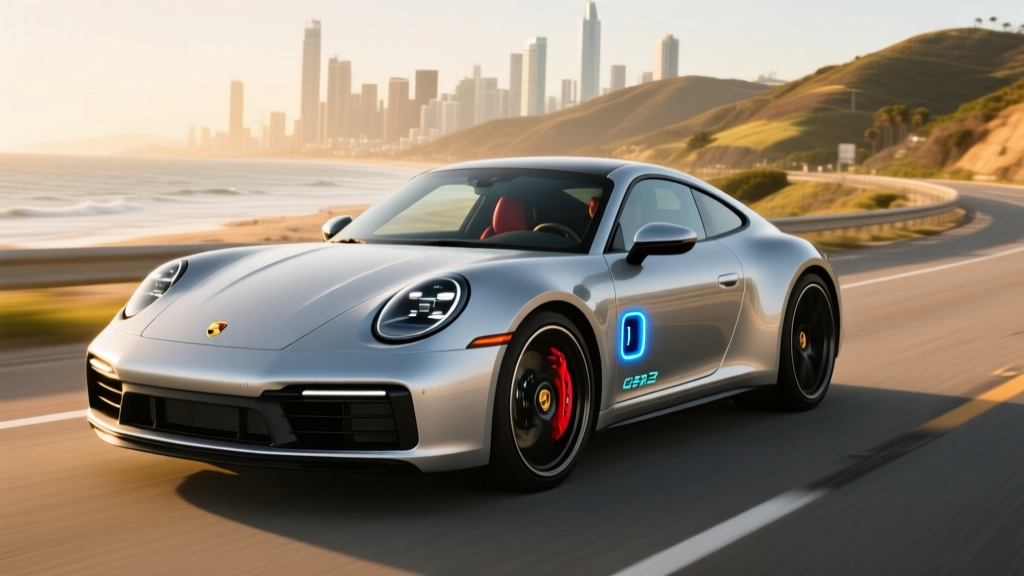
For over six decades, the Porsche 911 has been defined by its rear-mounted flat-six engine. The 2025 911 Carrera GTS T-Hybrid — internally designated the 992.2 generation — marks the first time Porsche has paired electrification with that iconic powertrain in a road-going 911. This is not a plug-in hybrid built for electric-only commuting. It is a performance-oriented conventional hybrid (HEV) engineered to sharpen throttle response, fill turbo lag, and extract more power from every drop of fuel.
If you've been searching for information on the 911 hybrid, you've likely encountered confusion about what it actually is, whether it plugs in, and whether it qualifies for federal tax credits. This guide answers every practical question — from EPA fuel economy and real-world MPG to battery warranty, replacement costs, and how the T-Hybrid compares to both full EVs and traditional gas 911s.
HEV vs PHEV: What Kind of Hybrid Is the 911 T-Hybrid?
The Porsche 911 Carrera GTS T-Hybrid is a conventional hybrid electric vehicle (HEV), not a plug-in hybrid (PHEV). Understanding this distinction is critical before evaluating the car.
HEV vs PHEV — Quick Reference
| Feature | Conventional Hybrid (HEV) | Plug-In Hybrid (PHEV) |
|---|---|---|
| Plugs in? | No — charges via regen and engine | Yes — external charging required for EV range |
| Electric-only range | None (electric motor assists only) | Typically 20–50 miles |
| Battery size | Small (1–2 kWh) | Larger (10–30 kWh) |
| Federal tax credit (§30D) | Not eligible | May qualify (up to $7,500) |
| Primary goal | Efficiency + performance assist | Electric commuting + gas backup |
The 911 T-Hybrid uses a compact 1.9 kWh lithium-ion battery positioned under the rear decklid. This battery cannot be charged from an external source — it recovers energy exclusively through regenerative braking and the gasoline engine. There is no electric-only driving mode and no plug. If you want a 911 you can plug in overnight, this is not it.
Powertrain: The T-Hybrid System Explained
Porsche's T-Hybrid powertrain is a fundamentally different approach from the efficiency-first hybrids found in a Toyota Prius or Honda Accord Hybrid. Here, electrification serves performance.
| Specification | Value |
|---|---|
| Engine | 3.6L twin-turbo flat-six |
| Electric motor | Integrated in 8-speed PDK transmission |
| Combined output | 532 hp / 465 lb-ft torque |
| 0–60 mph | 2.9 seconds (Coupe) |
| Top speed | 196 mph |
| Hybrid battery | 1.9 kWh lithium-ion (high-voltage) |
| System voltage | 400V architecture |
| Transmission | 8-speed PDK dual-clutch automatic |
| Drivetrain | Rear-wheel drive (GTS); AWD available (GTS 4) |
| Curb weight | ~3,490 lbs (Coupe) |
| Base MSRP (Coupe) | $164,900 (before options/destination) |
The electric motor is sandwiched between the engine and the PDK transmission, contributing up to 54 hp and 110 lb-ft of torque on its own. Critically, this motor fills the torque gap during turbo spool-up — the result is near-instant throttle response that a purely turbocharged engine cannot match. An electrically driven turbocharger (e-turbo) further eliminates lag by using a small electric motor to spin the compressor wheel before exhaust gases build pressure.
Porsche also moved the high-voltage battery to the rear, preserving the 911's signature weight distribution and packaging. The total weight gain over the prior non-hybrid GTS is approximately 100 lbs — modest for a hybrid system.
Fuel Economy: EPA MPG and Real-World Expectations
How many MPG does the 911 hybrid get? The EPA has published ratings for the 2025 911 Carrera GTS T-Hybrid, and they represent a meaningful improvement over the outgoing non-hybrid GTS.
| Cycle | EPA Rating | Prior GTS (Non-Hybrid) |
|---|---|---|
| City | 22 MPG | 17 MPG |
| Highway | 28 MPG | 24 MPG |
| Combined | 24 MPG | 19 MPG |
Source: fueleconomy.gov (EPA)
Real-World MPG vs EPA Sticker
Conventional hybrids routinely exceed their EPA city ratings in stop-and-go driving because regenerative braking recovers energy that a gas-only car wastes as heat. Expect the 911 T-Hybrid to deliver 25–28 MPG in mixed city driving and closer to 26–30 MPG on highway cruising at legal speeds. However, aggressive track-style driving, sustained high-speed runs above 80 mph, and cold-weather operation will reduce these numbers. On a spirited canyon run, expect figures closer to 16–18 MPG — the hybrid system prioritizes performance delivery over efficiency under hard acceleration.
For context, a Toyota Prius achieves 57 MPG combined. The 911 T-Hybrid's efficiency gains are significant within the sports car segment — a 26% combined improvement over its predecessor — but this is a 532-hp performance machine, not an economy car.
Electric-Only Range, Charging, and Battery Details
Because the 911 T-Hybrid is a conventional HEV, there is no electric-only driving range. The 1.9 kWh battery does not propel the car on electricity alone for any meaningful distance. Instead, the electric motor provides brief torque-fill bursts during acceleration and enables smoother stop-start operation.
There is no plug, no charging port, and no DC fast-charge capability. The battery maintains its charge through:
- Regenerative braking — kinetic energy recaptured during deceleration
- Engine-driven generation — the flat-six tops up the battery when needed
- Coasting recuperation — mild energy recovery when lifting off the throttle
The 1.9 kWh battery operates on a 400V architecture, which is higher than most conventional hybrids (typically 200–300V). This higher voltage enables the e-turbo and the more powerful integrated electric motor to respond faster. The battery uses lithium-ion chemistry optimized for high power density (rapid charge/discharge cycles) rather than high energy density (long-range storage), which is the correct engineering choice for a performance HEV.
Pricing, Tax Credits, and Ownership Costs
The 2025 Porsche 911 Carrera GTS T-Hybrid starts at $164,900 for the Coupe and $171,000 for the Cabriolet, before the $1,995 destination charge. The all-wheel-drive GTS 4 T-Hybrid commands a further premium. As with all Porsche models, options can add $20,000–$50,000+ to the final price.
Does the 911 Hybrid Qualify for a Federal Tax Credit?
No. The Porsche 911 T-Hybrid does not qualify for the federal §30D Clean Vehicle Credit. This credit applies only to plug-in electric vehicles (BEVs and PHEVs) that meet specific battery-sourcing, critical-mineral, MSRP-cap, and buyer-income requirements as outlined by the IRS. Since the 911 T-Hybrid is a conventional HEV with no plug-in capability, it falls outside the credit's scope entirely.
- ❌ Vehicle type: HEV — not eligible for §30D credit
- ❌ Plug-in capable: No
- ❌ Battery capacity threshold: Does not meet the ≥7 kWh requirement for PHEVs
- ℹ️ State incentives: Some states offer rebates for any electrified vehicle, including HEVs — check your state's energy office or DMV for current programs
Battery Warranty, Reliability, and Replacement Cost
Hybrid battery longevity is consistently a top concern for buyers. Porsche backs the 911 T-Hybrid's high-voltage battery with a robust warranty.
Porsche Hybrid Battery Warranty
Coverage: 8 years / 100,000 miles (whichever comes first)
Capacity retention threshold: Porsche warrants the battery against defects and excessive capacity loss. Under normal use, lithium-ion HEV batteries of this size experience minimal degradation because they operate in a narrow state-of-charge window (typically 40–60% SoC), which dramatically reduces cell stress.
Estimated out-of-warranty replacement cost: $3,000–$6,000 based on comparable Porsche high-voltage battery service pricing, though this figure is preliminary as the 992.2 platform is new. For reference, Porsche Cayenne Hybrid battery replacements have ranged from $4,000–$7,000 at dealerships.
Expected lifespan: Modern lithium-ion HEV batteries routinely last 150,000–200,000+ miles before significant degradation, based on data from Toyota, Lexus, and Porsche's own hybrid SUVs.
The 992.2 generation is new for 2025, so long-term reliability data specific to the T-Hybrid system is not yet available. However, Porsche's PDK transmission and flat-six architecture are proven, and the hybrid components (e-turbo, electric motor, battery) share engineering DNA with the Porsche 919 Hybrid LMP1 race car and the current Cayenne E-Hybrid lineup. The IIHS and NHTSA have not yet published crash-test ratings for the 992.2 911.
911 Hybrid vs Full EV vs Gas 911 — Which Should You Choose?
The decision between the 911 T-Hybrid, a gas-only 911, and a high-performance EV depends on how you drive, where you live, and what you value.
Choose the 911 T-Hybrid If:
- You want 911 performance with sharper throttle response
- You drive a mix of city and highway and value the MPG improvement
- You don't want to change your fueling habits (no plug needed)
- You want the latest 992.2 tech (e-turbo, updated interior)
Stick with a Gas 911 If:
- You want a lower entry price (Carrera starts ~$115,300)
- You prefer the lightest possible curb weight
- You track the car frequently and want maximum simplicity
- You want a manual transmission (available on some non-GTS trims)
Consider a Performance EV If:
- You want instant torque and sub-2-second 0–60 times
- You have home Level 2 charging and want lower fuel costs
- You qualify for the $7,500 federal tax credit
- Daily commuting efficiency matters more than track heritage
Bottom Line Decision Framework
The 911 T-Hybrid is for you if: You're buying a 911 Carrera GTS anyway (which now comes exclusively as a T-Hybrid in the US) and you appreciate that electrification has made it faster, more responsive, and marginally more efficient — without requiring any lifestyle change.
Look elsewhere if: You expected a plug-in 911 with electric-only commuting capability, or you're seeking a hybrid primarily for maximum fuel savings. A Prius, RAV4 Hybrid, or a PHEV like the Toyota RAV4 Prime will save far more fuel for far less money.
The honest take: Porsche didn't hybridize the 911 to save the planet. They did it to make the GTS faster and more responsive. The fuel economy improvement is a welcome bonus, not the mission.
Frequently Asked Questions
How many MPG does the 2025 Porsche 911 hybrid get?
The EPA rates the 911 Carrera GTS T-Hybrid at 22 city / 28 highway / 24 combined MPG. In real-world mixed driving, owners can expect 25–28 MPG, with highway cruising potentially reaching 28–30 MPG at moderate speeds.
Can the 911 hybrid drive on electric power alone?
No. The 911 T-Hybrid is a conventional hybrid (HEV), not a plug-in hybrid. The electric motor assists the gasoline engine during acceleration but cannot propel the car independently for any meaningful distance. There is no EV mode and no charging port.
Does the Porsche 911 hybrid qualify for any tax credit?
The 911 T-Hybrid does not qualify for the federal §30D Clean Vehicle Credit, which is limited to plug-in vehicles (BEVs and PHEVs) meeting battery-sourcing and price-cap requirements. Some state-level programs may offer incentives for hybrid vehicles — check your state's energy or environmental agency for current offerings.
Is the 911 T-Hybrid reliable? What about battery replacement cost?
>Long-term reliability data is still accumulating for the 992.2 platform. However, Porsche's hybrid components draw from proven motorsport and Cayenne E-Hybrid technology. The high-voltage battery is warranted for 8 years / 100,000 miles. Out-of-warranty replacement is estimated at $3,000–$6,000, though the battery is expected to last 150,000+ miles under normal use thanks to its narrow state-of-charge operating window.Is the Carrera GTS the only 911 available with the hybrid system?
For the 2025 model year in the United States, yes. The T-Hybrid powertrain is exclusive to the Carrera GTS and Carrera GTS 4 trims. The base Carrera, Carrera S, and Turbo models continue with conventional gasoline powertrains. Porsche has indicated the hybrid system may expand to additional 911 variants in future model years.
How much does the hybrid system add to the 911's weight?
Approximately 100 lbs compared to the outgoing non-hybrid 992.1 GTS. The 2025 GTS Coupe has a curb weight of roughly 3,490 lbs. Porsche offset some of this weight by making the GTS exclusively PDK (no manual transmission option), which simplified the powertrain integration.
How does the 911 hybrid compare to the Corvette E-Ray?
The Chevrolet Corvette E-Ray is also a performance-oriented conventional hybrid, pairing a 6.2L V8 with a front-axle electric motor for 655 combined hp and standard AWD. The E-Ray starts around $104,900, offers a slightly different hybrid philosophy (electric front axle for AWD traction), and achieves an EPA-estimated 19 combined MPG. The 911 T-Hybrid is more expensive, lighter, and focuses on turbo-lag elimination rather than AWD traction assist.