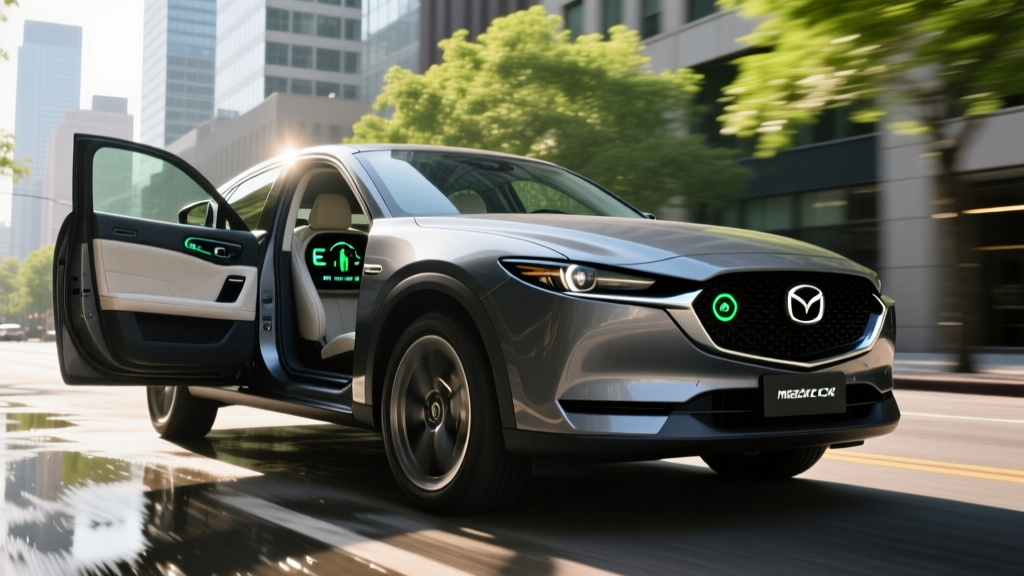
The compact SUV segment doesn't lack for electrified options, but the 2026 CX-50 Hybrid occupies a specific niche: a conventional hybrid (HEV) that prioritizes driving dynamics alongside efficiency, without asking you to plug in. Mazda borrowed Toyota's proven hybrid synergy drive system and tuned it with its own character, creating an SUV that returns excellent city fuel economy while maintaining the brand's handling reputation.
If you're weighing the 2026 Mazda CX-50 Hybrid against plug-in hybrids or full battery-electric vehicles, this guide breaks down every number that matters — from EPA MPG to real-world consumption, powertrain specs, warranty coverage, and tax credit eligibility under current IRS rules.
What the 2026 CX-50 Hybrid Is (and Isn't)
Before examining the specs, it's critical to understand what you're buying. The 2026 CX-50 Hybrid is a conventional hybrid electric vehicle (HEV). It pairs a 2.5-liter four-cylinder engine with an electric motor and a small battery pack that charges through regenerative braking and the engine itself. You never plug it in.
HEV vs. PHEV: Quick Distinction
| Feature | Conventional Hybrid (HEV) | Plug-In Hybrid (PHEV) |
|---|---|---|
| Plug-in charging | No — self-charging via regen + engine | Yes — plug in for electric-only miles |
| Battery size | ~1.1 kWh (small buffer) | 13–20+ kWh (larger pack) |
| Electric-only driving | Brief low-speed EV mode only | 20–40+ miles electric-only |
| Federal tax credit (§30D) | Not eligible | Up to $7,500 if requirements met |
| Best for | No home charging access; want simplicity | Home charging available; short commute |
Mazda does not currently offer a CX-50 PHEV in the US market for 2026. If plug-in capability is a priority, consider the Toyota RAV4 Prime or Hyundai Tucson PHEV as alternatives.
Fuel Economy: EPA Numbers and Real-World MPG
The headline number for any hybrid buyer is fuel efficiency. Here's what the EPA rates the 2026 CX-50 Hybrid at, per fueleconomy.gov:
| Driving Cycle | EPA MPG |
|---|---|
| City | 39 MPG |
| Highway | 37 MPG |
| Combined | 38 MPG |
Real-world expectations: Conventional hybrids frequently exceed their EPA city ratings in stop-and-go traffic because regenerative braking recovers energy that gas-only vehicles waste as heat. In mixed suburban driving with moderate climate control use, owners typically report 36–40 MPG. Sustained highway driving at 75+ MPH in cold weather (below 40°F) may drop efficiency to 32–34 MPG, as the engine runs more frequently for cabin heat and aerodynamic drag increases with air density.
Compared to the gas-only 2026 CX-50 (rated at approximately 27 MPG combined with the turbo engine or 28 MPG with the naturally aspirated 2.5L), the hybrid saves roughly 3–4 gallons per 100 miles — translating to about $450–$600 annually in fuel savings at $3.50/gallon and 12,000 miles driven per year.
Powertrain and Performance Specs
Mazda pairs Toyota's fourth-generation hybrid transaxle with its own 2.5-liter Skyactiv-G engine. The result is a system that feels more responsive than the Toyota RAV4 Hybrid it shares architecture with, thanks to Mazda's throttle mapping and chassis tuning.
| Specification | 2026 Mazda CX-50 Hybrid |
|---|---|
| Engine | 2.5L inline-4 (naturally aspirated) |
| Electric motor | Permanent magnet synchronous (integrated in transaxle) |
| Combined system output | 219 horsepower |
| Transmission | eCVT (planetary gearset, no fixed gears) |
| Drivetrain | AWD standard (electronic rear motor) |
| 0–60 MPH | ~7.2 seconds (est.) |
| Towing capacity | 1,500 lbs |
| Battery type | Nickel-metal hydride (NiMH), ~1.1 kWh |
The 219 combined horsepower figure represents peak system output — the engine and motor don't both hit peak simultaneously. The electric motor provides strong low-end torque fill while the engine builds RPM, which makes the CX-50 Hybrid feel quicker off the line than its 0–60 time alone suggests. The eCVT eliminates shift shock entirely, though drivers accustomed to stepped automatics may notice the sustained-RPM character under hard acceleration.
Who Should Choose the CX-50 Hybrid Over a PHEV or EV?
The Decision Framework
Choose the 2026 CX-50 Hybrid (HEV) if:
- You lack access to home or workplace charging (apartment, street parking)
- You want zero behavior change — no plugging in, no range planning
- Your budget is under $40,000 and you want AWD standard
- You drive a mix of city and highway miles with no single pattern
Consider a PHEV (e.g., RAV4 Prime, Tucson PHEV) if:
- You can install a Level 2 home charger and commute under 35 miles round-trip
- You want electric-only daily driving with gas backup for road trips
- You can leverage the §30D federal tax credit (up to $7,500)
Consider a full EV (e.g., Tesla Model Y, Hyundai Ioniq 5) if:
- You have reliable home charging and drive under 250 miles daily
- You want the lowest per-mile fuel cost and minimal maintenance
- You qualify for federal and state EV incentives
Pricing, Trims, and Tax Credit Eligibility
The 2026 CX-50 Hybrid is offered across three trims, all with AWD as standard equipment:
| Trim | MSRP (incl. destination) |
|---|---|
| Preferred Hybrid | $35,920 |
| Premium Hybrid | $39,320 |
| Premium Plus Hybrid | $42,120 |
Federal tax credit: As a conventional hybrid (HEV), the 2026 CX-50 Hybrid does not qualify for the IRS §30D Clean Vehicle Credit. That credit applies only to plug-in electric vehicles (BEVs and PHEVs) meeting battery sourcing, MSRP caps, and buyer income requirements. There is currently no federal tax credit for conventional hybrids.
Some states and municipalities offer rebates or HOV lane access for hybrids — check your local DMV and Alternative Fuels Data Center for current programs. These vary widely by jurisdiction and change frequently.
Battery Warranty, Reliability, and Replacement Cost
Hybrid battery longevity is the single most common concern for first-time hybrid buyers. Here's what Mazda covers:
2026 CX-50 Hybrid Battery Warranty
| Hybrid battery warranty | 10 years / 150,000 miles (whichever comes first) |
| Hybrid system components | 8 years / 100,000 miles |
| Powertrain warranty | 5 years / 60,000 miles |
| Capacity retention threshold | Below ~60% of original capacity triggers warranty claim |
In states adopting California emissions standards (CARB states), hybrid battery coverage may extend further. Verify with your dealer for state-specific terms.
Real-world reliability: The Toyota hybrid synergy drive system underpinning the CX-50 Hybrid has over two decades of proven service in millions of vehicles (Prius, RAV4 Hybrid, Camry Hybrid). Nickel-metal hydride (NiMH) batteries in this application are exceptionally durable because they operate within a narrow state-of-charge window (roughly 40–80%), avoiding the deep cycles that stress lithium-ion packs. Taxi fleets running Toyota hybrid systems routinely exceed 200,000 miles on the original battery.
Replacement cost if out of warranty: A replacement hybrid battery pack for the CX-50 Hybrid is estimated at $2,500–$4,000 including labor, based on comparable Toyota hybrid battery pricing. Refurbished or reconditioned packs are available from third-party suppliers for $1,500–$2,500. Individual cell replacement (if only a few modules degrade) can reduce costs further to $500–$1,200 at a hybrid specialist shop.
For context, the hybrid system eliminates the traditional starter motor, alternator, and conventional automatic transmission — components that commonly fail on gas-only vehicles and cost $800–$3,000 each to replace. The eCVT planetary gearset has no clutch packs or bands to wear out.
Pros and Cons at a Glance
Pros
- 38 MPG combined — class-leading for a non-plug-in compact SUV with AWD
- Standard AWD with dedicated rear electric motor
- No charging infrastructure required
- 10-year/150,000-mile hybrid battery warranty
- Strong 219 hp system output for confident merging
- Proven Toyota hybrid architecture underneath
Cons
- No plug-in option — cannot drive on electric-only power for meaningful distances
- Not eligible for the $7,500 federal §30D tax credit
- Towing limited to 1,500 lbs (gas turbo CX-50 tows 3,500 lbs)
- eCVT drone under sustained hard acceleration
- Rear cargo space slightly reduced vs. gas model due to battery placement
Frequently Asked Questions
How many MPG does the 2026 CX-50 Hybrid get?
The EPA rates the 2026 CX-50 Hybrid at 39 MPG city, 37 MPG highway, and 38 MPG combined. Real-world results in mixed suburban driving typically fall between 36–40 MPG, with cold weather and sustained highway speeds reducing efficiency to the low-to-mid 30s.
Does the CX-50 Hybrid need to be plugged in?
No. The CX-50 Hybrid is a conventional (self-charging) hybrid. The battery charges through regenerative braking and the gasoline engine. There is no plug, no charging cable, and no electric-only range to manage.
How far can the CX-50 Hybrid drive on electric power alone?
As a conventional HEV, the CX-50 Hybrid can only operate in EV mode at very low speeds (under ~25 MPH) for less than a mile — typically in parking lots or stop-and-go traffic. It is not designed for electric-only commuting. If you want 30+ miles of electric-only range, you need a PHEV, and Mazda does not offer a CX-50 PHEV for 2026.
Is the CX-50 Hybrid reliable?
The hybrid powertrain is based on Toyota's fourth-generation hybrid system, which has been deployed in millions of vehicles globally with a strong reliability record. Mazda's 10-year/150,000-mile hybrid battery warranty provides additional protection. The NiMH battery chemistry is less energy-dense than lithium-ion but significantly more tolerant of the shallow charge cycles used in HEVs.
What does it cost to replace the hybrid battery?
Out-of-warranty replacement is estimated at $2,500–$4,000 for a new OEM battery pack. Refurbished packs run $1,500–$2,500, and individual cell module replacement can cost as little as $500–$1,200. Under normal use, the battery should last the lifetime of the vehicle.
Does the 2026 CX-50 Hybrid qualify for any tax credit?
No. The IRS §30D Clean Vehicle Credit applies only to plug-in electric vehicles (battery-electric and plug-in hybrid). Conventional hybrids like the CX-50 Hybrid are not eligible. Check your state's incentive database for any local hybrid rebates, though these are increasingly rare as programs shift focus to plug-in vehicles.
How does the CX-50 Hybrid compare to the RAV4 Hybrid?
Both share the same Toyota hybrid architecture and 2.5L engine. The RAV4 Hybrid produces 219 hp and is rated at 39–41 MPG combined depending on trim. The CX-50 Hybrid matches the horsepower but rates slightly lower at 38 MPG combined, partly due to its wider tires and more aggressive styling. The trade-off: the CX-50 offers a more premium interior, sportier steering feel, and standard roof rails rated for higher cargo loads.
Final Verdict: Who the 2026 CX-50 Hybrid Is For
The 2026 Mazda CX-50 Hybrid is the right choice if you want a compact AWD SUV that delivers near-40 MPG in daily driving without any lifestyle changes — no charger installation, no range planning, no plug-in routine. Starting at $35,920 with standard AWD and a 10-year battery warranty, it undercuts many PHEVs on price while delivering fuel economy that makes gas-station visits infrequent.
Its limitations are clear: no electric-only commuting range, no federal tax credit, and modest towing capacity. If those matter, a PHEV or BEV is a better fit. But for the majority of compact SUV buyers who simply want to spend less on fuel without thinking about it, the CX-50 Hybrid is one of the most compelling options in the 2026 model year.