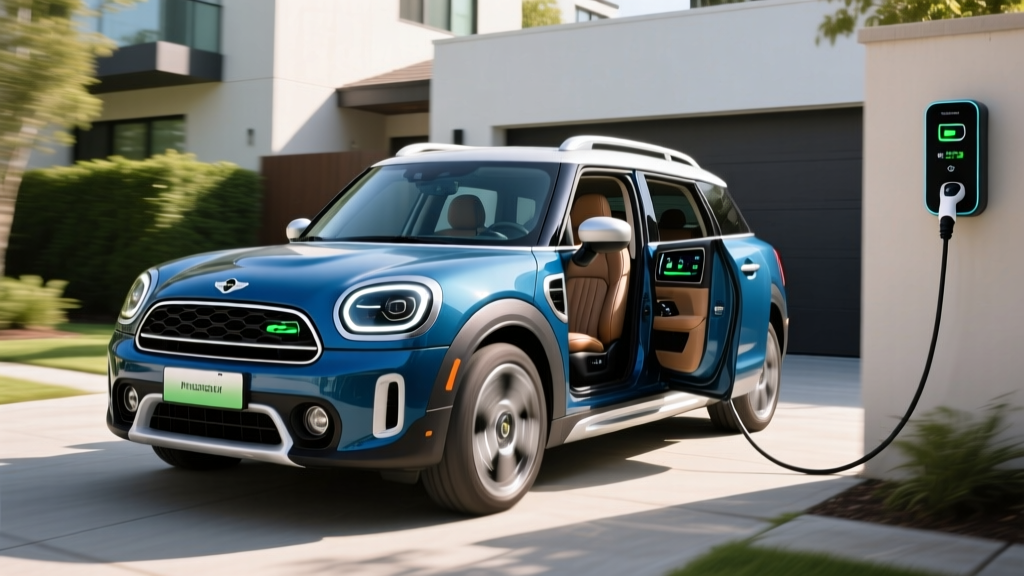
The Mini Countryman Plug-in Hybrid occupies a specific niche: buyers who want compact-crossover practicality, the option to commute on electricity alone, and the freedom to take longer road trips without charging stops. For 2026, the Countryman PHEV (officially the Countryman SE ALL4) pairs a turbocharged three-cylinder engine with an electric motor and an all-wheel-drive system that gives it genuine all-weather capability. Below, we dissect the numbers that matter — from EPA efficiency ratings to real-world electric range, charging logistics, and whether this PHEV qualifies for federal tax incentives.
2026 Mini Countryman PHEV: Key Specifications at a Glance
| Attribute | Value |
|---|---|
| Powertrain | 1.5L turbo 3-cyl + electric motor, ALL4 AWD |
| Combined Horsepower | ~220 hp |
| Battery (usable) | ~16.3 kWh lithium-ion |
| EPA Electric-Only Range | ~30 miles |
| EPA MPGe (combined) | ~80 MPGe |
| EPA MPG (gas-only, combined) | ~29 MPG combined (28 city / 31 hwy) |
| Total Combined Range | ~400 miles |
| Level 2 AC Charging (max) | 7.4 kW |
| DC Fast Charging | Not available |
| Charge Time (0–100%, Level 2) | ~2.5 hours |
| 0–60 mph | ~6.8 seconds |
| Base MSRP | ~$42,900 (before incentives) |
| Battery/Powertrain Warranty | 8 years / 100,000 miles |
Note: Specs reflect 2026 model-year data from Mini USA and fueleconomy.gov. Always verify with your local dealer, as mid-year running changes occur.
HEV vs. PHEV: Where the Countryman Fits
Before evaluating the Countryman PHEV specifically, it's worth clarifying the two hybrid categories, since Mini does not currently sell a conventional hybrid (HEV) version of the Countryman in the U.S. market.
Conventional Hybrid (HEV)
- Battery: small (~1–2 kWh), recharges via regenerative braking and engine
- Plug-in charging: No — you never plug it in
- Electric-only driving: very limited (under 1 mile at low speeds)
- Benefit: improved MPG with zero behavior change
Plug-in Hybrid (PHEV) — Countryman SE ALL4
- Battery: larger (~16.3 kWh usable), rechargeable from a wall outlet or charger
- Plug-in charging: Yes — Level 1 (120V) or Level 2 (240V)
- Electric-only driving: ~30 miles at highway-capable speeds
- Benefit: short commutes on electricity, gas engine for longer trips
If you never plan to plug in, a PHEV still works as a conventional hybrid — the gas engine takes over seamlessly. But you'd be paying for a larger battery and electric motor you're not fully utilizing. The Countryman PHEV rewards owners who charge regularly.
Fuel Economy: EPA Numbers and Real-World MPG
| Mode | City | Highway | Combined |
|---|---|---|---|
| Electric-only (MPGe) | ~85 MPGe | ~76 MPGe | ~80 MPGe |
| Gas-only (MPG) | 28 | 31 | 29 |
What the EPA Numbers Mean in Practice
Electric mode: The ~80 MPGe combined figure translates to roughly 26–28 kWh per 100 miles of electric driving. With the ~16.3 kWh usable battery, expect about 25–30 miles of real-world electric range depending on temperature, terrain, and driving style. In cold weather (below 35°F), plan on a 15–25% reduction, bringing electric-only range down to roughly 20–25 miles.
Gas mode: Once the battery is depleted, the Countryman operates as a conventional hybrid, returning the EPA-estimated 29 MPG combined. In real-world mixed driving, owners report 27–32 MPG depending on highway cruising versus stop-and-go city traffic. City driving tends to yield slightly better results than the EPA sticker suggests, because regenerative braking recovers energy that a gas-only car wastes as heat.
Total range: With a full battery and a full ~13.2-gallon fuel tank, the Countryman PHEV can cover approximately 400 miles before needing both a charge and a refuel — enough for most road trips without range anxiety.
Electric-Only Range and Charging: The Daily-Commute Equation
The ~30-mile electric range is the Countryman PHEV's defining feature. According to EPA data, the average American one-way commute is roughly 16 miles. That means most PHEV owners who charge at home overnight can complete their daily round-trip without burning a drop of gasoline.
Charging Logistics
The Countryman PHEV uses a standard J1772 connector for AC charging. Here's what to expect:
- Level 1 (120V household outlet): ~1.4 kW — a full charge takes roughly 10–12 hours. Sufficient for overnight top-ups if your daily electric use is under 20 miles.
- Level 2 (240V home charger or public station): Up to 7.4 kW — a full 0–100% charge in approximately 2.5 hours. This is the practical sweet spot for daily use.
- DC Fast Charging: Not available. The Countryman PHEV does not support DC fast charging — this is typical for PHEVs, whose smaller batteries don't justify the added cost and weight of DC hardware.
Battery Warranty & Longevity
Mini covers the Countryman PHEV's high-voltage battery for 8 years or 100,000 miles (whichever comes first), with a capacity-retention threshold typically set at 70% of original capacity. If the battery degrades below that threshold within the warranty period, Mini will repair or replace it at no cost.
Out-of-warranty replacement costs for PHEV batteries in this class typically range from $6,000 to $10,000 depending on labor and parts availability. However, modern lithium-ion PHEV batteries are engineered for 15+ years of service with proper care — most owners will never face a replacement.
Powertrain and Performance
The 2026 Countryman SE ALL4 combines a 1.5-liter turbocharged three-cylinder gasoline engine (producing roughly 136 hp on its own) with an electric motor integrated into the rear axle. The combined system output reaches approximately 220 horsepower, routed through Mini's ALL4 all-wheel-drive system.
The result is a 0–60 mph time of roughly 6.8 seconds — genuinely quick for a compact crossover. The electric motor provides instant torque from a standstill, making the Countryman PHEV feel more responsive than its gasoline-only counterpart in city driving. At highway speeds, the transition between electric and gas power is nearly imperceptible under normal acceleration.
One practical note: the rear-mounted electric motor and battery pack reduce cargo capacity slightly compared to the gas-only Countryman. Expect roughly 17–18 cubic feet behind the rear seats, versus about 20 cu ft in the non-hybrid variant.
Pricing, Trims, and Tax Credit Eligibility
The 2026 Mini Countryman SE ALL4 PHEV starts at approximately $42,900 MSRP (including destination). Higher trims and option packages — such as the Signature and Iconic trims — can push the price into the $48,000–$52,000 range.
Federal Tax Credit (§30D)
Under current IRS §30D rules, the Countryman PHEV may qualify for a federal clean vehicle credit of up to $3,750 or $7,500, depending on battery-component and critical-mineral sourcing requirements. Key eligibility factors:
- MSRP cap: SUVs/vans/pickups must have an MSRP at or below $80,000 — the Countryman clears this easily.
- Buyer income cap: Modified adjusted gross income must not exceed $150,000 (single), $225,000 (head of household), or $300,000 (joint filers).
- Battery sourcing: The credit splits into two halves ($3,750 each) — one for battery components manufactured/assembled in North America, one for critical minerals sourced from the U.S. or free-trade-agreement partners. Sourcing rules tighten annually; verify current-year eligibility on irs.gov or with your tax professional.
- Point-of-sale transfer: As of 2024, buyers can transfer the credit to the dealer at purchase, reducing the out-of-pocket price immediately rather than waiting to claim it on their tax return.
Important: Tax credit eligibility changes frequently and depends on your individual tax situation. Consult a qualified tax professional before making purchase decisions based on incentive assumptions.
Countryman PHEV vs. Full EV vs. Gas: Which Should You Choose?
Decision Framework
Choose the Countryman PHEV if:
- Your daily commute is under 30 miles round-trip and you can charge at home
- You take road trips several times a year and don't want to plan around charging infrastructure
- You live in an area with sparse public DC fast-charging networks
- You want to reduce fuel consumption without fully committing to an EV
Choose a full EV (e.g., Mini Countryman Electric) if:
- You have reliable home Level 2 charging
- Your daily driving rarely exceeds 150–200 miles
- You want the lowest per-mile fuel cost and minimal maintenance
- You're ready to plan longer road trips around DC fast-charger locations
Choose a gas-only vehicle if:
- You cannot charge at home or at work
- Your budget is tight and you want the lowest purchase price
- You regularly drive in areas with no charging infrastructure
Pros and Cons
Pros
- ~30 miles of electric-only range covers most commutes
- ALL4 AWD with instant electric torque feels confident in rain and light snow
- No range anxiety — gas engine provides 400+ mile total range
- Level 2 charging in ~2.5 hours is practical for overnight use
- Premium interior with Mini's latest infotainment and driver-assist features
- Eligible for up to $7,500 federal credit (subject to sourcing rules)
Cons
- No DC fast charging — not ideal for frequent long-distance electric driving
- Starting MSRP near $43K is steep for a compact crossover
- Cargo space slightly reduced vs. gas-only Countryman
- Real-world cold-weather electric range drops to ~20–25 miles
- Gas-only MPG (29 combined) is merely average for the segment
- Three-cylinder engine note may not appeal to all drivers
Frequently Asked Questions
How many MPG does the Mini Countryman PHEV get?
The EPA rates the 2026 Countryman SE ALL4 at 28 MPG city, 31 MPG highway, and 29 MPG combined when running on gasoline after the battery is depleted. In electric mode, it achieves approximately 80 MPGe combined. Real-world owners typically see 27–32 MPG in gas mode depending on driving conditions.
How far can the Countryman PHEV go on electric only?
The EPA estimates approximately 30 miles of electric-only range. In real-world conditions — especially in cold weather or at sustained highway speeds — expect 25–28 miles. Below freezing, plan on 20–25 miles.
Does the Mini Countryman PHEV qualify for a tax credit?
It may qualify for up to $7,500 under the federal §30D clean vehicle credit, split into two $3,750 halves based on battery-component and critical-mineral sourcing requirements. Eligibility also depends on buyer income caps and the vehicle's MSRP (which is well under the $80,000 SUV cap). Check current rules on irs.gov and consult a tax professional.
Is the Countryman PHEV reliable, and what does battery replacement cost?
Mini's parent company BMW has extensive experience with PHEV powertrains across its lineup. The high-voltage battery is warranted for 8 years / 100,000 miles at a 70% capacity-retention threshold. Out-of-warranty battery replacement typically costs $6,000–$10,000, but modern PHEV batteries are designed to last 15+ years with normal use. Overall reliability ratings from sources like Consumer Reports place BMW/Mini PHEV systems in the average-to-above-average range.
Can I charge the Countryman PHEV at a DC fast charger?
No. The Countryman PHEV supports only AC charging — Level 1 (120V) and Level 2 (240V, up to 7.4 kW). DC fast charging is not available, which is standard for most PHEVs. For rapid charging capability, you'd need a full battery-electric vehicle.
What's the difference between the Countryman PHEV and the Countryman Electric?
The Countryman Electric (SE ALL4) is a fully battery-electric variant with an EPA range of approximately 230–250 miles and DC fast-charging capability. The PHEV offers ~30 miles of electric range plus a gas engine for unlimited range. If you can charge at home and rarely drive more than 200 miles in a day, the EV variant offers lower running costs. If you need road-trip flexibility, the PHEV is the pragmatic choice.
Do I need to install a home charger for the Countryman PHEV?
You don't strictly need one — a standard 120V outlet will recharge the battery overnight. However, a Level 2 (240V) home charger cuts charge time to about 2.5 hours and makes it far easier to maintain a full battery daily. Home Level 2 installation typically costs $500–$2,000 including equipment and electrician labor, depending on your electrical panel's capacity.