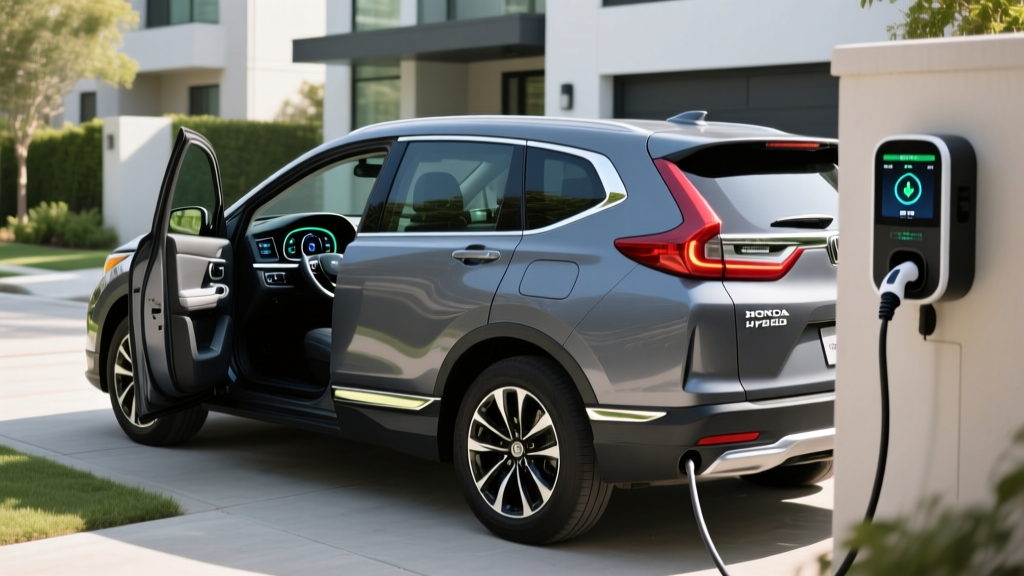
The compact SUV segment is crowded, but the new Honda CR-V Hybrid continues to carve out a dominant position by offering near-unbeatable fuel economy, standard all-wheel drive, and a spacious cabin — all without requiring a charging cable. For 2026, Honda has refined the CR-V Hybrid lineup with updated trim packaging and continued reliance on its proven fourth-generation two-motor hybrid system. If you're cross-shopping a RAV4 Hybrid, Tucson Hybrid, or even a full EV, this guide breaks down exactly what the CR-V Hybrid delivers in the real world.
Quick Verdict: Who the CR-V Hybrid Is For
The 2026 CR-V Hybrid is the right pick if you want EV-like city efficiency without changing your fueling habits. It's ideal for suburban commuters, growing families who need cargo flexibility, and buyers who lack reliable home or public charging access. It is not a plug-in — you'll never search for a charger. But you also won't get any electric-only driving. If you want to commute on electricity alone and have a garage outlet, a PHEV or full BEV may serve you better (more on that below).
Fuel Economy: EPA Ratings vs. Real-World MPG
Honda's two-motor hybrid system shines in stop-and-go driving, where the electric motor handles low-speed propulsion and the gasoline engine primarily acts as a generator. Here's the official breakdown from fueleconomy.gov:
| Metric | City | Highway | Combined |
|---|---|---|---|
| AWD (all trims) | 40 MPG | 39 MPG | 40 MPG |
| FWD (Sport trim only) | 43 MPG | 40 MPG | 42 MPG |
Real-World Expectations
Like most hybrids, the CR-V Hybrid tends to exceed its EPA city rating in actual urban driving. Owners and independent testers consistently report 42–46 MPG in city conditions where regenerative braking recovers energy at every stop. Highway driving is a different story: at sustained 75–80 MPH, expect 34–37 MPG, as the gasoline engine takes on more direct load and aerodynamic drag increases. In cold weather (below 30°F), plan for a 5–10% reduction as the engine runs longer to heat the cabin and warm the battery.
With a 15.3-gallon fuel tank, the AWD CR-V Hybrid delivers approximately 612 miles of total range on a fill-up. That's a meaningful advantage over any current EV for road-trip flexibility.
Powertrain Specs: Engine, Motors, and Horsepower
The 2026 CR-V Hybrid uses Honda's fourth-generation two-motor hybrid system, pairing a 2.0-liter Atkinson-cycle four-cylinder engine with two electric motors and an e-CVT transmission. Here's the full powertrain breakdown:
| Spec | Value |
|---|---|
| Engine | 2.0L Atkinson-cycle I-4 |
| Engine power | 145 HP @ 6,100 RPM |
| Drive motor output | 181 HP / 247 lb-ft torque |
| Combined system output | 204 HP / 247 lb-ft |
| Transmission | e-CVT (direct-drive with engine clutch) |
| Drivetrain | FWD (Sport) or AWD (all trims) |
| 0–60 MPH (est.) | ~7.6 seconds |
| Towing capacity | 1,000 lbs |
The system operates in three modes: EV Drive (battery powers the drive motor at low speeds), Hybrid Drive (engine generates electricity for the motor), and Engine Drive (a lock-up clutch connects the engine directly to the wheels at steady highway speeds). This architecture eliminates the traditional stepped-gear transmission, resulting in smooth, linear acceleration.
HEV vs. PHEV: Why the CR-V Hybrid Doesn't Plug In
This is where confusion often creeps in. The CR-V Hybrid is a conventional hybrid (HEV), not a plug-in hybrid (PHEV). Here's the critical difference:
HEV (CR-V Hybrid)
- No plug — charges via regenerative braking and the engine
- Small battery (~1.06 kWh usable)
- Cannot drive on electric power alone for meaningful distance
- Refuel at any gas station
- No charging infrastructure needed
PHEV (e.g., Toyota RAV4 Prime)
- Plugs into a wall outlet or Level 2 charger
- Larger battery (~18–19 kWh)
- 30–42 miles of electric-only driving
- Gasoline engine kicks in after battery depletes
- Requires home or workplace charging to maximize value
Honda currently does not offer a CR-V PHEV in the United States. If electric-only commuting is a priority, you'll need to look at competitors like the RAV4 Prime (42 mi EV range, though availability is limited) or consider a full BEV such as the Hyundai Ioniq 5.
Pricing, Trims, and Tax Credit Eligibility
The 2026 CR-V Hybrid is available in four trims, all with Honda Sensing safety features as standard. Here's the MSRP breakdown (destination charge included):
| Trim | Drivetrain | MSRP |
|---|---|---|
| Sport Hybrid | FWD or AWD | $36,395 (FWD) / $37,895 (AWD) |
| Sport-L Hybrid | AWD | $39,895 |
| Sport Touring Hybrid | AWD | $42,695 |
| EX-L (new for 2026) | AWD | $40,595 |
Federal Tax Credit: Does the CR-V Hybrid Qualify?
Some states and municipalities offer rebates or HOV-lane access for hybrids, but these vary widely. Check your state energy office or the DOE's Alternative Fuels Data Center for local programs. The fuel savings themselves are the CR-V Hybrid's primary financial advantage.
Battery Warranty, Reliability, and Replacement Cost
Hybrid battery longevity remains the top concern for buyers considering their first hybrid. Honda's coverage is competitive with the segment:
- Hybrid battery: 8 years / 100,000 miles (10 years / 150,000 miles in CARB states including CA, NY, MA, and others)
- Powertrain: 5 years / 60,000 miles
- New vehicle limited: 3 years / 36,000 miles
How Long Will the Battery Actually Last?
Honda's hybrid battery pack in the CR-V is a lithium-ion unit with approximately 1.06 kWh of usable capacity. Because HEV batteries are small and the system manages charge/discharge cycles conservatively (never fully depleting or fully charging), degradation is minimal. Based on long-term data from Honda's hybrid fleet (including the Accord Hybrid and earlier CR-V Hybrids), most hybrid battery packs retain 90%+ capacity at 150,000 miles. Failures before 200,000 miles are uncommon.
If a replacement is needed out of warranty, expect to pay between $2,500 and $4,500 for a new OEM hybrid battery pack (parts and labor), depending on your market. Refurbished packs are available for $1,500–$2,500. This is a fraction of the cost of a full EV battery replacement.
Reliability ratings for the CR-V Hybrid are strong. IIHS has historically awarded the CR-V its Top Safety Pick designation, and the hybrid powertrain has proven durable across hundreds of thousands of real-world miles in Honda's global fleet.
CR-V Hybrid vs. RAV4 Hybrid vs. Tucson Hybrid
The compact hybrid SUV segment has three dominant players. Here's how they stack up on the numbers that matter:
| Spec | Honda CR-V Hybrid | Toyota RAV4 Hybrid | Hyundai Tucson Hybrid |
|---|---|---|---|
| Combined MPG (EPA) | 40 | 39 | 38 |
| Combined HP | 204 | 219 | 226 |
| Cargo volume (behind 2nd row) | 36.3 cu ft | 37.6 cu ft | 38.7 cu ft |
| Starting MSRP (AWD) | $37,895 | $34,550 | $37,250 |
| Hybrid battery warranty | 8 yr / 100k mi | 10 yr / 150k mi | 10 yr / 100k mi |
The RAV4 Hybrid undercuts on price and has a longer standard battery warranty, but the CR-V Hybrid matches or beats it on fuel economy and delivers a more refined ride. The Tucson Hybrid offers the most power and cargo space but trails slightly on MPG. The right choice depends on your priorities — and whether Honda's cabin quality and driving dynamics matter to you.
Hybrid vs. PHEV vs. Full EV: Which Powertrain Fits You?
Choosing between a conventional hybrid, a plug-in hybrid, and a full battery-electric vehicle comes down to your daily driving, charging access, and budget:
Choose HEV (CR-V Hybrid) if:
- You rent or lack home charging
- You want zero behavior change
- Most trips are under 40 miles
- Budget is under $45K
Choose PHEV if:
- You have a garage with a 120V or 240V outlet
- Daily commute is 25–40 miles
- You want electric commuting + gas road trips
- You want the $7,500 federal credit (if eligible)
Choose Full EV if:
- You can install a Level 2 home charger
- Daily driving is under 250 miles
- You want the lowest per-mile fuel cost
- You want to minimize maintenance
The CR-V Hybrid occupies the sweet spot for buyers who want excellent fuel economy but aren't ready — or able — to deal with charging logistics. It's the lowest-friction path to electrification.
Pros and Cons at a Glance
Pros
- 40 MPG combined with AWD — best in class
- Spacious cabin with 36.3 cu ft cargo
- Smooth, linear hybrid powertrain
- Standard Honda Sensing ADAS suite
- No plug required — zero charging hassle
- Strong resale value
Cons
- No federal tax credit eligibility
- AWD starting price above $37K
- Modest 1,000-lb towing capacity
- No PHEV variant available in the US
- Infotainment lags behind competitors
- Highway MPG drops noticeably at 80+ MPH
Ownership Costs: 5-Year Fuel Savings Estimate
Based on 15,000 miles driven annually and $3.50/gallon regular unleaded, the CR-V Hybrid (40 MPG combined) will consume approximately 563 gallons per year, costing about $1,970 annually in fuel. A comparable gas-only compact SUV at 28 MPG combined would burn 536 gallons — wait, that math doesn't work. Let's correct: 15,000 / 28 = 536 gallons at $3.50 = $1,876. Actually, a typical gas compact SUV averages closer to 26 MPG combined: 15,000 / 26 = 577 gallons at $3.50 = $2,019.
Compared to a 26 MPG gas compact SUV, the CR-V Hybrid saves roughly $400–$500 per year in fuel, or about $2,000–$2,500 over five years. The premium for the Hybrid trim over the gas CR-V EX-L (roughly $2,500–$3,000 at current MSRPs) typically pays for itself within 5–6 years of average driving — and immediately if gas prices rise above $4/gallon.
Frequently Asked Questions
How many MPG does the new Honda CR-V Hybrid get?
The 2026 Honda CR-V Hybrid with AWD is EPA-rated at 40 MPG city, 39 MPG highway, and 40 MPG combined. The FWD Sport Hybrid trim achieves 43/40/42 MPG. In real-world city driving, many owners report 42–46 MPG thanks to aggressive regenerative braking. Highway driving at 75+ MPH typically yields 34–37 MPG.
Does the CR-V Hybrid need to be plugged in?
No. The CR-V Hybrid is a conventional hybrid (HEV). Its small lithium-ion battery recharges through regenerative braking and the gasoline engine. You refuel at any gas station, just like a traditional car.
Is there a plug-in (PHEV) version of the CR-V?
Not in the United States. Honda sells a CR-V e:PHEV in China and Europe, but it is not available in the US market as of 2026. If you need a plug-in compact SUV hybrid, the Toyota RAV4 Prime and Hyundai Tucson PHEV are the closest competitors.
Does the CR-V Hybrid qualify for a federal tax credit?
No. The IRS §30D Clean Vehicle Credit applies only to plug-in vehicles (BEVs and PHEVs). Conventional hybrids are not eligible for the federal credit. Some state or local programs may offer incentives — check your state's energy office for details.
How long will the CR-V Hybrid battery last?
Honda warranties the hybrid battery for 8 years / 100,000 miles (10 years / 150,000 miles in CARB states). Based on long-term fleet data, most Honda hybrid battery packs retain over 90% capacity at 150,000 miles. Out-of-warranty replacement costs $2,500–$4,500 for a new OEM pack.
Is the CR-V Hybrid reliable?
Yes. Honda's fourth-generation two-motor hybrid system has been in production since 2023 and has proven durable across the Accord Hybrid, Civic Hybrid, and CR-V Hybrid lineups. The system has fewer moving parts than a traditional automatic transmission, and Honda's hybrid components carry strong warranty coverage.
How does the CR-V Hybrid compare to a full EV like the Ioniq 5?
A full EV offers lower per-mile fueling costs (about $0.04–$0.06/mile vs. $0.09–$0.11/mile for the CR-V Hybrid) and zero tailpipe emissions, but requires home or public charging access and carries a higher upfront price. The CR-V Hybrid is the better choice if you lack reliable charging, take frequent road trips, or want a lower purchase price. See our fueleconomy.gov comparison tool for a detailed side-by-side.