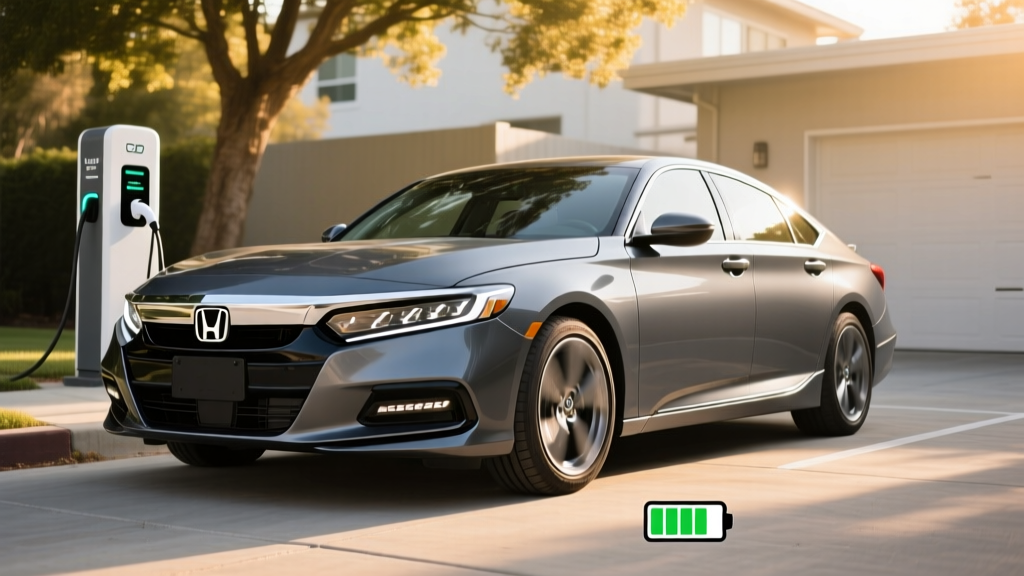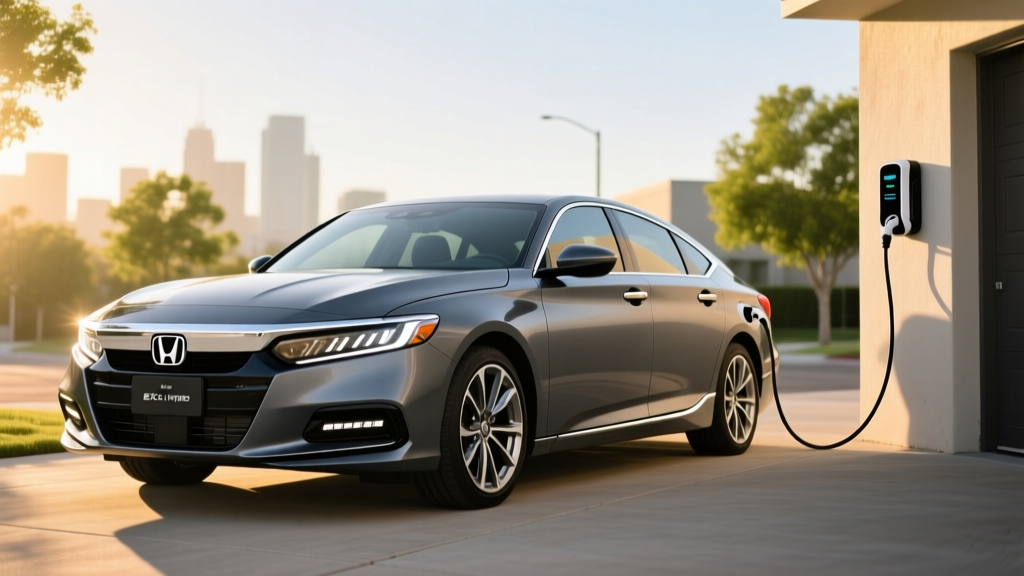
The midsize sedan segment has thinned out, but the Honda Accord remains a benchmark — and the hybrid powertrain is now the volume seller for good reason. The 2026 Honda Accord EX-L Hybrid pairs a proven two-motor system with a premium leather interior, landing in the sweet spot of Honda's lineup. If you're cross-shopping electrified sedans and want real fuel savings without plugging in, this is one of the most rational choices on the market.
Below, we break down the exact EPA fuel economy, real-world MPG expectations, powertrain specs, pricing, battery warranty, and how the Accord EX-L Hybrid stacks up against plug-in hybrids and full EVs.
2026 Honda Accord EX-L Hybrid: Core Specs at a Glance
| Spec | Value |
|---|---|
| Powertrain | 2.0L Atkinson-cycle 4-cyl + two-motor hybrid system |
| Combined Horsepower | 204 hp |
| Combined Torque | 247 lb-ft (electric motor) |
| Transmission | e-CVT (no traditional gears) |
| EPA MPG (City / Hwy / Combined) | 51 / 44 / 48 MPG |
| Fuel Tank | 12.8 gallons |
| Total Range | ~614 miles |
| 0–60 mph | ~7.2 seconds (est.) |
| Drivetrain | Front-wheel drive |
| Hybrid Battery | Lithium-ion, ~1.1 kWh (self-charging HEV) |
| MSRP (EX-L Hybrid) | $35,895 (incl. destination) |
| Federal Tax Credit | Not eligible (§30D requires plug-in capability) |
| Hybrid Battery Warranty | 8 years / 100,000 miles |
Fuel Economy: EPA Numbers vs. Real-World MPG
The EPA rates the 2026 Accord Hybrid at 51 city / 44 highway / 48 combined MPG, according to fueleconomy.gov. These are among the best numbers in the midsize sedan class, rivaling the Toyota Camry Hybrid and significantly outperforming the gas-only Accord (which returns roughly 29/37/32 MPG on the turbo 1.5L).
| Driving Cycle | EPA MPG | Real-World Expectation |
|---|---|---|
| City | 51 MPG | 48–55 MPG (hybrids often beat EPA in stop-and-go) |
| Highway | 44 MPG | 40–44 MPG (sustained 75+ mph reduces regen benefit) |
| Combined | 48 MPG | 45–50 MPG depending on commute mix |
How the Hybrid Powertrain Works
The Accord Hybrid uses Honda's fourth-generation two-motor hybrid system. Here's the architecture:
- 2.0L Atkinson-cycle inline-4: Produces 146 hp and 134 lb-ft on its own, but primarily acts as a generator at lower speeds.
- Propulsion motor: The primary drive motor delivers 181 hp and 247 lb-ft of torque directly to the front wheels, providing the instant throttle response that makes the Accord Hybrid feel quicker than its 0–60 time suggests.
- Generator motor: Converts engine output to electricity, which either feeds the propulsion motor or charges the small lithium-ion battery pack.
At low speeds and in stop-and-go traffic, the Accord Hybrid operates almost entirely on electric power, with the gasoline engine spinning only to generate electricity (not directly driving the wheels). At highway speeds, a lockup clutch engages, connecting the engine directly to the wheels for maximum efficiency — this is why Honda's e-CVT doesn't feel like a traditional "rubber band" CVT.
Combined system output is 204 horsepower, which is adequate for daily driving and highway merging, though not sporty. The 247 lb-ft of electric torque is available from near-zero RPM, giving strong off-the-line acceleration.
HEV vs. PHEV vs. Full EV: Which Is Right for You?
The Accord EX-L Hybrid is a conventional hybrid (HEV) — it does not plug in and has no meaningful electric-only range. This is an important distinction from plug-in hybrids and battery-electric vehicles. Here's how the three electrification levels compare:
Conventional Hybrid (HEV)
Example: Accord Hybrid
Plug in? No
Electric-only range: <1 mile (assist only)
Battery: ~1.1 kWh
Best for: Drivers without home charging access who want lower fuel costs with zero behavior change.
Plug-In Hybrid (PHEV)
Example: Toyota Prius Prime
Plug in? Yes
Electric-only range: 25–44 miles
Battery: 13.6 kWh
Best for: Drivers with home charging who want EV commuting with gas-engine backup for road trips.
Full EV (BEV)
Example: Hyundai Ioniq 6
Plug in? Yes
Electric-only range: 300–360 miles
Battery: 77.4 kWh
Best for: Drivers with reliable home/work charging who want zero tailpipe emissions and lowest per-mile cost.
Choose the Accord HEV Hybrid If:
- You don't have access to Level 2 home charging (apartment, street parking)
- Your commute is 30+ miles and you don't want to think about charging
- You want a proven, low-risk powertrain with no plug-in dependency
- You take frequent road trips and don't want to plan around charging stops
Consider a PHEV Instead If:
- You can install a Level 2 charger at home and your commute is under 40 miles
- You want to drive mostly electric on weekdays but need gas flexibility for weekends
- You want to qualify for the federal §30D tax credit (up to $7,500 — see eligibility rules below)
Consider a Full EV Instead If:
- You have reliable home charging and your daily drive is under 250 miles
- You want the lowest operating cost (~$0.04/mile on home electricity vs. ~$0.08/mile in the Accord Hybrid)
- You're eligible for the full $7,500 federal credit, which can close the price gap
Pricing, Trims, and Tax Credit Eligibility
The 2026 Honda Accord EX-L Hybrid carries an MSRP of approximately $35,895 (including destination). This positions it between the Sport Hybrid (~$34,395) and the top-trim Sport-L/Touring Hybrid models.
The EX-L trim adds leather-trimmed seats, a 12.3-inch touchscreen with wireless Apple CarPlay and Android Auto, heated front seats, a power-adjustable driver's seat, and Honda's full Honda Sensing suite of ADAS features (adaptive cruise, lane-keeping, collision mitigation).
Federal Tax Credit Status
The Accord Hybrid is not eligible for the federal §30D Clean Vehicle Credit. Under current IRS rules, only plug-in electric vehicles (PHEVs and BEVs) with a minimum battery capacity of 7 kWh qualify. The Accord Hybrid's ~1.1 kWh battery is far below this threshold.
If federal incentives are a priority, you'd need to look at a PHEV like the Toyota Prius Prime (eligible for up to $7,500, subject to income caps, MSRP limits, and battery-sourcing requirements) or a BEV. Check the IRS's qualified vehicle list at the time of purchase, as eligibility changes based on supply-chain sourcing rules.
Battery Longevity, Warranty, and Replacement Cost
How Long Will the Battery Last?
The Accord Hybrid's battery pack is small (~1.1 kWh) and is managed conservatively — Honda's battery management system (BMS) never allows a full 100% charge or full discharge, using only a portion of total capacity. This shallow cycling dramatically extends lifespan.
Based on data from previous-generation Accord and Civic Hybrids, most Honda hybrid battery packs last well beyond 150,000 miles with minimal degradation. The battery doesn't "wear out" the way a phone battery does because it operates in a narrow state-of-charge window (roughly 20–80%).
Battery Replacement Cost
If the hybrid battery does fail out of warranty, replacement costs for a Honda Accord Hybrid battery pack typically range from $2,000 to $4,000 including labor at a dealership. Third-party and refurbished options can reduce this to $1,500–$2,500. This is far less than a full EV battery replacement because the pack is small.
For context, the hybrid system's inverter and electric motors are also covered under the 8-year/100,000-mile warranty and have proven highly reliable in Honda's fleet.
Reliability and Ownership Costs
Honda's two-motor hybrid system has been in production since 2014 (Accord Hybrid) and has accumulated billions of real-world miles across the Honda and Acura lineup. It is one of the most proven hybrid architectures on the market, second only to Toyota's Hybrid Synergy Drive in total fleet miles.
Key reliability advantages of the Accord Hybrid over the gas-only model:
- No traditional transmission: The e-CVT has no belts, pulleys, or clutch packs to wear out — it's a fixed-ratio gearset connecting the motors.
- Regenerative braking: Reduces wear on the friction brake pads and rotors. Many Accord Hybrid owners report original brake pads lasting 80,000+ miles.
- Engine runs less: The Atkinson-cycle engine operates only when needed, reducing total engine-hours and associated wear.
The Accord earned a TOP SAFETY PICK+ rating from the IIHS and a 5-star overall rating from NHTSA, making it one of the safest midsize sedans available.
| Cost Category | Accord Hybrid (EX-L) | Accord Gas (EX-L 1.5T) |
|---|---|---|
| Fuel (75,000 mi @ $3.40/gal) | $5,313 (48 MPG) | $7,969 (32 MPG) |
| Maintenance (est.) | $2,800 | $3,200 |
| Insurance (avg.) | $7,500 | $7,200 |
| Depreciation (est.) | $14,000 | $13,500 |
| Total (5-yr est.) | ~$29,613 | ~$31,869 |
The hybrid saves roughly $2,200–$2,600 over five years in fuel alone, with additional savings from reduced brake wear and fewer engine-related service intervals. The higher initial MSRP of the hybrid (typically $1,000–$1,500 over the gas equivalent) is usually recouped within 2–3 years of average driving.
Pros and Cons
Pros
- 48 MPG combined — best-in-class for midsize sedans
- Strong electric torque (247 lb-ft) for confident city driving
- No plug-in required — zero behavior change from a gas car
- Proven hybrid system with 8-yr/100k-mi battery warranty
- Spacious cabin with 16.7 cu-ft trunk (no battery intrusion)
- Top safety ratings (IIHS TSP+, NHTSA 5-star)
Cons
- Not eligible for federal EV tax credit
- FWD only — no AWD option (unlike Toyota Camry Hybrid)
- Highway MPG (44) trails city MPG (51) noticeably
- Engine drone under hard acceleration (e-CVT character)
- 204 hp is adequate but not exciting for a 3,400-lb sedan
- No spare tire — tire-inflator kit only
Frequently Asked Questions
How many MPG does the Honda Accord EX-L Hybrid get?
The EPA rates the 2026 Accord Hybrid at 51 city / 44 highway / 48 combined MPG. In real-world driving, most owners report 45–53 MPG combined depending on their commute profile. City-heavy drivers tend to exceed the EPA sticker, while sustained highway driving at higher speeds returns closer to 40–44 MPG.
Does the Honda Accord Hybrid need to be plugged in?
No. The Accord Hybrid is a conventional hybrid (HEV). It charges its small battery entirely through regenerative braking and the gasoline engine. You fuel it exactly like a regular gas car — just fill up at the pump and drive. There is no plug, no charging cable, and no electric-only driving mode of any meaningful distance.
Is the Accord Hybrid available as a plug-in hybrid (PHEV)?
No. Honda discontinued the Accord Plug-In Hybrid after the 2015 model year. The current Accord is offered only as a conventional hybrid or a turbocharged gas model. If you want a Honda PHEV, the closest option is the CR-V (not available as a PHEV in the US as of 2026) — you'd need to look at competitors like the Toyota Prius Prime or Hyundai Tucson PHEV for plug-in capability.
Does the Accord Hybrid qualify for any tax credit?
The Accord Hybrid does not qualify for the federal §30D Clean Vehicle Credit, which requires plug-in capability and a minimum 7 kWh battery. Some states may offer small hybrid incentives or HOV lane access, but these vary by jurisdiction. Check your state's energy office or DMV for local programs.
Is the hybrid battery reliable and what does replacement cost?
Honda's hybrid battery packs have proven highly reliable, with most lasting well beyond 150,000 miles. The battery is covered by an 8-year/100,000-mile warranty (10 years/150,000 miles in CARB states). Out-of-warranty replacement runs $2,000–$4,000 at a dealer, or $1,500–$2,500 with refurbished or third-party options.
How does the Accord Hybrid compare to the Toyota Camry Hybrid?
The Camry Hybrid (51/49/50 MPG combined) slightly edges out the Accord on highway efficiency and offers an AWD option. The Accord Hybrid counters with a more refined interior, a larger trunk (16.7 vs. 15.1 cu-ft), and a more engaging driving feel. Both are excellent choices — the Camry wins on pure MPG and AWD availability; the Accord wins on interior quality and cargo space.