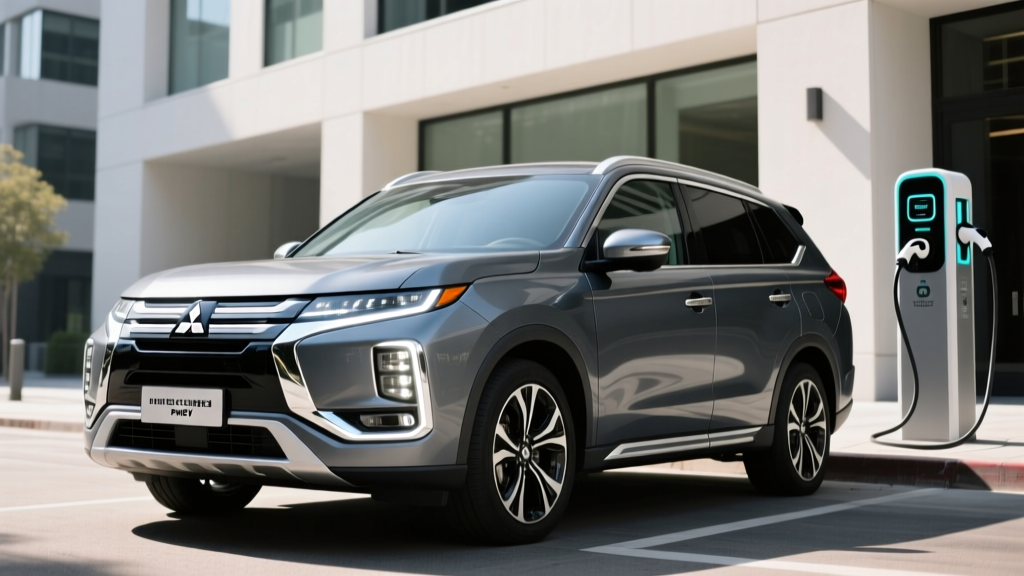
The Mitsubishi Outlander PHEV occupies a specific niche: a three-row plug-in hybrid SUV with standard all-wheel drive and DC fast-charging capability at a price point well below most competitors. For buyers researching the Mitsubishi Outlander PHEV cost of ownership, the numbers tell a more nuanced story than the sticker price alone. This guide breaks down every figure that matters — from MSRP and federal tax credit eligibility to real-world fuel economy and battery warranty coverage — so you can decide whether this PHEV fits your budget and driving pattern.
HEV vs PHEV: What the Outlander Actually Is
Before examining pricing, it is essential to distinguish between a conventional hybrid (HEV) and a plug-in hybrid (PHEV), because the Outlander is sold in both forms and they behave very differently.
| Feature | Outlander HEV (Conventional Hybrid) | Outlander PHEV (Plug-In Hybrid) |
|---|---|---|
| Plug-in charging | No — charges via regenerative braking and engine | Yes — plug in to access electric-only driving |
| Battery size | ~1.5 kWh (small buffer) | 20.0 kWh usable (lithium-ion) |
| Electric-only range | None (motor assists engine at low speeds only) | EPA-estimated 38 miles |
| Fuel economy | EPA ~32 MPG combined | EPA 64 MPGe (electric+gas); 26 MPG gas-only |
| Federal tax credit | Not eligible under §30D | Eligible — up to $3,750 (see details below) |
| DC fast charging | No | Yes — CHAdeMO connector |
The PHEV is the focus of this cost analysis. If you cannot charge at home or at work, the HEV variant may make more financial sense since you would never utilize the PHEV's electric range and would carry extra battery weight for nothing.
Mitsubishi Outlander PHEV Cost by Trim (2026 MSRP)
The 2026 Outlander PHEV is offered in five trims. Prices below include the $1,395 destination charge and reflect manufacturer MSRP before any incentives or dealer adjustments.
| Trim | MSRP (incl. destination) | Key Additions |
|---|---|---|
| ES | $41,845 | Base PHEV; 18" wheels, 8" touchscreen, heated front seats, S-AWC |
| SE | $44,645 | 20" wheels, power liftgate, synthetic leather, roof rails |
| SEL | $47,845 | Genuine leather, panoramic sunroof, head-up display, 12.3" digital cluster |
| SEL Touring | $50,445 | Nappa leather, Bose 13-speaker audio, rear sunshades, ventilated front seats |
| SEL Black Edition | $51,245 | Black exterior accents, unique 20" wheels, dark interior trim |
The entry ES trim is the volume seller and the most cost-effective path into the Outlander PHEV. Moving to the SEL adds roughly $6,000 primarily for interior luxury; the powertrain, battery, and electric range remain identical across all trims.
Fuel Economy and Electric-Only Range
The Outlander PHEV pairs a 2.4-liter four-cylinder engine with twin electric motors (one front, one rear) and a 20.0 kWh battery pack. Mitsubishi's Super All-Wheel Control (S-AWC) system distributes torque between all four wheels. Combined system output is 248 horsepower.
| Metric | EPA Estimate | Real-World Expectation |
|---|---|---|
| Combined MPGe (electric + gas) | 64 MPGe | 58–68 MPGe depending on charge frequency |
| Gas-only combined MPG | 26 MPG | 24–27 MPG (hybrids often match or exceed EPA city) |
| City MPG (gas-only) | 25 MPG | 26–28 MPG (regen braking helps in stop-and-go) |
| Highway MPG (gas-only) | 27 MPG | 23–25 MPG (aerodynamic drag dominates at 70+ mph) |
| Electric-only range | 38 miles | 30–36 miles (highway); 35–40 miles (city, mild weather) |
| Total combined range | ~400 miles | 360–420 miles depending on driving mix |
Real-World Range Note: The EPA's 38-mile electric range assumes moderate temperatures and mixed driving. In winter conditions below 30°F, expect that figure to drop to roughly 28–32 miles due to cabin heating load and reduced battery efficiency. The Outlander PHEV does not include a dedicated heat pump for the cabin — it uses a combination of electric resistance heating and engine waste heat, which means winter electric range takes a meaningful hit. If your commute is 30 miles round-trip, you will likely cover it on electricity most of the year, but plan for the engine to kick in during deep cold snaps.
Charging: Level 1, Level 2, and DC Fast Charging
One of the Outlander PHEV's most distinctive features is its CHAdeMO DC fast-charging port. This is increasingly rare — most competitors use CCS1 or NACS — and it shapes where and how quickly you can charge on the road.
| Charging Level | Power | 0–100% / 0–80% Time | Miles of Range Added per Hour |
|---|---|---|---|
| Level 1 (120V household outlet) | 1.4 kW | ~14 hours (0–100%) | ~3 miles/hr |
| Level 2 (240V, home or public) | 3.6 kW (onboard charger limit) | ~5.5 hours (0–100%) | ~12 miles/hr |
| DC Fast Charge (CHAdeMO) | 22 kW peak | ~38 minutes (0–80%) | N/A — session-based |
A few critical details about Outlander PHEV charging:
- The onboard charger is limited to 3.6 kW. Even if you plug into a 48-amp Level 2 station capable of 11.5 kW, the Outlander will only accept 3.6 kW. This means a full Level 2 charge takes about 5.5 hours regardless of the station's capacity.
- DC fast charging tops out at 22 kW. This is slow by modern BEV standards (where 150–350 kW is common), but it is perfectly adequate for a 20 kWh battery. You will go from 0–80% in roughly 38 minutes.
- CHAdeMO infrastructure is declining. Electrify America has phased out CHAdeMO connectors at most new stations, and Tesla Superchargers (now opening to non-Tesla vehicles) use NACS only. Before relying on DC fast charging for road trips, verify CHAdeMO availability along your route using PlugShare or the Alternative Fuels Data Center.
For daily use, most owners will charge overnight on Level 2 and wake up to a full 38-mile electric range every morning — which is the ideal PHEV ownership pattern.
Federal Tax Credit and Incentive Eligibility
Under the current IRS §30D Clean Vehicle Credit rules, the Mitsubishi Outlander PHEV qualifies for a partial federal tax credit. Here is the breakdown:
- Credit amount: Up to $3,750 (the battery meets the critical minerals requirement but does not fully satisfy the battery component sourcing threshold for the full $7,500).
- MSRP cap: SUVs must have an MSRP at or below $80,000. All Outlander PHEV trims qualify.
- Buyer income cap: Adjusted gross income must not exceed $150,000 (single), $225,000 (head of household), or $300,000 (married filing jointly).
- Point-of-sale transfer: The credit can be transferred to the dealer at purchase, reducing your out-of-pocket cost immediately — you do not have to wait until tax filing.
- Assembly requirement: The vehicle must undergo final assembly in North America. The 2026 Outlander PHEV is assembled in Okazaki, Japan — this may disqualify it from the §30D credit. Verify current assembly status on the fueleconomy.gov tax credit lookup before purchasing.
Important: Tax credit eligibility for the Outlander PHEV has been inconsistent across model years due to assembly-location and battery-sourcing rule changes. Always confirm the specific VIN's eligibility on fueleconomy.gov and consult a tax professional. Some states (California, Colorado, New York, Massachusetts) offer additional PHEV rebates of $1,000–$4,000 that stack with federal incentives. Check your state's energy office for current programs.
Effective cost example: If the Outlander PHEV ES qualifies for the $3,750 federal credit via point-of-sale transfer and you live in a state with a $2,000 rebate, your net cost on the $41,845 ES trim drops to approximately $36,095. Without any incentives, you pay full MSRP.
Battery Warranty, Reliability, and Replacement Cost
Battery longevity is the number-one concern for hybrid and PHEV buyers. Mitsubishi provides robust coverage:
| Warranty Component | Coverage |
|---|---|
| PHEV battery (capacity retention) | 10 years / 100,000 miles (drops below 70% capacity) |
| Powertrain (engine, motors, transaxle) | 10 years / 100,000 miles |
| Basic vehicle (bumper-to-bumper) | 5 years / 60,000 miles |
| Corrosion perforation | 7 years / unlimited miles |
The 10-year/100,000-mile battery warranty is one of the strongest in the segment and matches what Hyundai and Kia offer. Mitsubishi guarantees the battery will retain at least 70% of its original capacity during the warranty period. If it degrades below that threshold, Mitsubishi will repair or replace it at no cost.
Battery replacement cost (out of warranty): A full Outlander PHEV battery pack replacement runs approximately $8,000–$12,000 including parts and labor, based on dealer estimates. However, PHEV batteries experience less stress than full BEV batteries because they operate in a narrower state-of-charge window (the system reserves a buffer at the top and bottom). Real-world degradation data from earlier-generation Outlander PHEV owners (2018–2022 models) suggests roughly 8–12% capacity loss over 5 years / 75,000 miles — well within the 70% warranty threshold.
Reliability: Mitsubishi's 2.4-liter MIVEC engine is a mature, naturally aspirated design with a long service history. The PHEV powertrain has been in production since 2013 globally (the current third-generation platform launched for the 2023 model year). The IIHS has rated the Outlander as a Top Safety Pick+ in recent model years. Long-term reliability data for the current generation is still building, but the predecessor generation showed average-to-above-average reliability in owner surveys.
Outlander PHEV vs Full EV vs Gas SUV: Which Fits You?
The decision between a PHEV, a full battery-electric vehicle (BEV), and a conventional gas SUV depends on your charging access, driving pattern, and budget.
Choose the Outlander PHEV if:
- You can charge at home (Level 1 or Level 2) and your daily driving is under 35 miles
- You need three rows of seating but cannot spend $55,000+ on a BEV SUV
- You take occasional road trips and do not want to plan around charging infrastructure
- You want AWD for snow/rain without the range penalty of a BEV in cold weather
Choose a full EV (e.g., Hyundai Ioniq 5, Tesla Model Y) if:
- You have reliable Level 2 home charging and your daily driving is under 250 miles
- You want the lowest per-mile fuel cost and minimal maintenance
- You qualify for the full $7,500 federal tax credit on a qualifying BEV
Choose a gas-only SUV if:
- You have no access to any charging (no garage, no workplace charger)
- Your budget is under $35,000 and you need three rows
- You drive fewer than 8,000 miles per year, making fuel savings negligible
For the specific buyer profile that charges at home nightly and drives 25–35 miles on weekdays, the Outlander PHEV can operate as an electric car Monday through Friday and a gas SUV on weekend road trips — effectively giving you two vehicles in one without range anxiety.
5-Year Ownership Cost Estimate
Here is a simplified five-year cost comparison assuming 15,000 miles per year (12,000 city / 3,000 highway), electricity at $0.14/kWh, and gasoline at $3.40/gallon. The PHEV scenario assumes 80% of weekday miles are covered on electricity.
| Cost Category | Outlander PHEV (ES) | Gas SUV Baseline (e.g., Honda CR-V AWD) |
|---|---|---|
| Purchase price (MSRP) | $41,845 | $36,000 |
| Federal tax credit | –$3,750 (if eligible) | $0 |
| Fuel/electricity (5 years) | $5,200 | $9,800 |
| Maintenance (5 years) | $2,800 | $3,600 |
| Insurance (5 years, est.) | $8,500 | $7,200 |
| Estimated depreciation | $16,000 | $14,500 |
| 5-Year Total (approx.) | $58,595 | $56,100 |
The PHEV costs roughly $2,500 more over five years in this scenario, primarily due to higher purchase price and insurance premiums. However, if you qualify for the full $3,750 credit plus a $2,000 state rebate, the gap narrows to near parity — and you gain the benefit of significantly lower tailpipe emissions during electric-only commuting. Fuel savings widen further if gas prices rise above $4.00/gallon in your area.
Frequently Asked Questions
How many MPG does the Mitsubishi Outlander PHEV get?
The EPA rates the 2026 Outlander PHEV at 64 MPGe when combining electric and gasoline operation. Once the battery is depleted, it operates as a conventional hybrid at 26 MPG combined (25 city / 27 highway). In real-world driving, owners who charge nightly and drive under 38 miles per day may use almost no gasoline during the work week.
How far can the Outlander PHEV go on electric only?
The EPA-estimated electric-only range is 38 miles. Real-world results vary: expect 30–36 miles at highway speeds, 35–40 miles in city driving during mild weather, and 28–32 miles in sub-freezing temperatures due to cabin heating demands and reduced battery efficiency.
Does the Outlander PHEV qualify for a tax credit?
It may qualify for up to $3,750 under the IRS §30D Clean Vehicle Credit, subject to buyer income limits, MSRP caps (all trims qualify), and battery sourcing requirements. However, the vehicle's assembly location (Japan) may disqualify it under current rules. Always verify the specific VIN on fueleconomy.gov before purchasing. State-level rebates may also apply independently of federal eligibility.
Is the Outlander PHEV reliable, and what does battery replacement cost?
The Outlander PHEV powertrain has been in global production since 2013, and the current-generation platform carries Mitsubishi's 10-year/100,000-mile battery and powertrain warranty. Out-of-warranty battery replacement is estimated at $8,000–$12,000. Real-world degradation data from prior-generation owners shows 8–12% capacity loss over 5 years, well within the 70% warranty threshold.
Can the Outlander PHEV use Tesla Superchargers?
No. The Outlander PHEV uses a CHAdeMO connector for DC fast charging and a J1772 connector for Level 1/Level 2 AC charging. Tesla Superchargers (even those opening to non-Tesla vehicles) use the NACS connector, which is not compatible with the Outlander PHEV without an adapter — and no CHAdeMO-to-NACS adapter currently exists that supports DC fast charging.
Should I buy the Outlander PHEV or the Outlander HEV?
If you have access to Level 1 or Level 2 charging at home and your daily commute is under 35 miles, the PHEV will save you significant fuel costs and provide a quieter, smoother electric-driving experience. If you live in an apartment without charging access, or your daily driving regularly exceeds 50 miles, the conventional Outlander HEV at ~$32,000 MSRP is the more practical and affordable choice — you will never benefit from the PHEV's larger battery without plugging in.
Pros
- 38 miles electric-only covers most daily commutes
- Standard AWD (S-AWC) across all trims
- Three-row seating rare in the PHEV segment
- 10-year / 100,000-mile battery and powertrain warranty
- DC fast charging capable (CHAdeMO)
- Competitive starting MSRP for a PHEV SUV
Cons
- CHAdeMO connector limits public DC charging options
- 3.6 kW onboard charger means slow Level 2 fills
- No heat pump — winter electric range drops noticeably
- Federal tax credit eligibility uncertain due to Japan assembly
- Third row is tight for adults on longer trips
- Gas-only MPG (26 combined) trails some competing HEVs