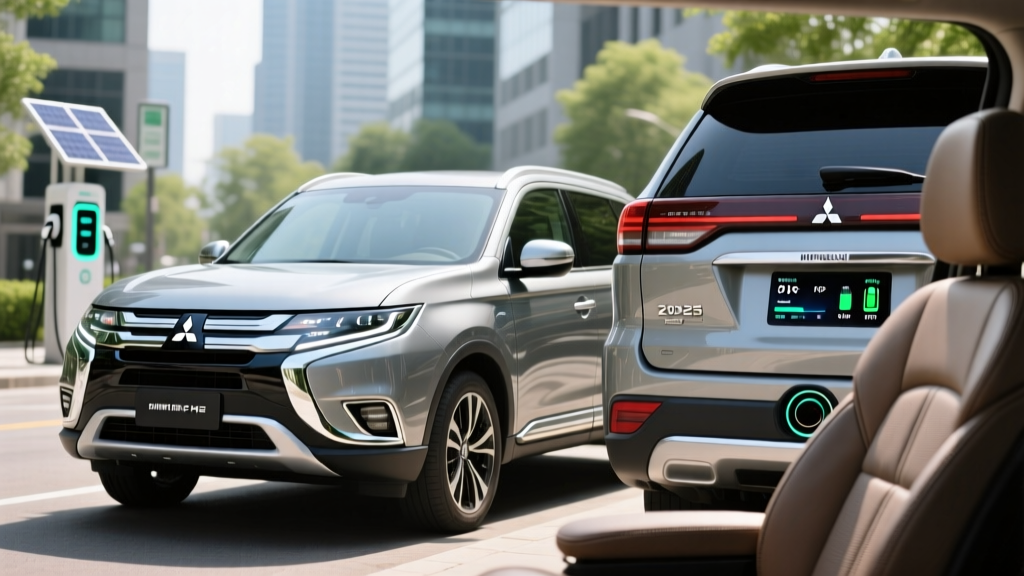
The 2025 Mitsubishi Outlander PHEV occupies a specific niche: a three-row plug-in hybrid SUV that prioritizes practicality and standard all-wheel drive over blistering performance or class-leading electric range. With 38 miles of EPA-rated electric-only driving and a combined 248 horsepower from its twin-motor setup, it targets families who want daily EV commuting without range-anxiety road trips. But in a PHEV segment that now includes the Toyota RAV4 Prime, Hyundai Tucson PHEV, and Kia Sportage PHEV, the Outlander's advantages and compromises deserve a close look.
HEV vs PHEV: What the Outlander Actually Is
Before diving into specs, it's worth clarifying what you're buying. The Outlander is also sold as a conventional hybrid (HEV) in some markets, but the US-spec 2025 model is exclusively a plug-in hybrid (PHEV). Here's the difference:
| Feature | Conventional Hybrid (HEV) | Plug-In Hybrid (PHEV) |
|---|---|---|
| Battery size | ~1–2 kWh | 20.0 kWh (Outlander) |
| Plug-in charging | No — self-charging via regen | Yes — Level 1/Level 2/DC fast |
| Electric-only range | 0–2 miles at low speed | 38 miles (EPA, Outlander) |
| Federal tax credit | No | Potentially, up to $7,500 (§30D) |
| Gas engine | Always available | Always available after battery depletes |
The Outlander PHEV can operate as a pure EV for most daily commutes, then seamlessly switch to hybrid mode for longer trips. If you never plug it in, it functions as a heavy, less-efficient hybrid — you're paying for battery capacity you're not using.
Powertrain Specs: Twin Motors, AWD Standard
| Specification | 2025 Outlander PHEV |
|---|---|
| Engine | 2.4L 4-cylinder Atkinson cycle |
| Engine output | 126 hp / 144 lb-ft |
| Front motor | 85 kW (114 hp) |
| Rear motor | 100 kW (134 hp) |
| Combined system output | 248 hp / 332 lb-ft |
| Drivetrain | Standard AWD (S-AWC, no mechanical link front-to-rear) |
| Transmission | Single-speed reduction gear (no CVT in EV mode) |
| 0–60 mph | ~7.1 seconds (est.) |
| Towing capacity | 1,500 lbs |
| Battery chemistry | Lithium-ion (NMC) |
| Battery capacity (total/usable) | 20.0 kWh / ~17.5 kWh usable |
Mitsubishi's Super All-Wheel Control (S-AWC) system uses independent front and rear electric motors with no mechanical driveshaft connecting them. This allows torque vectoring at each axle and is a genuine advantage in snow and rain. However, the combined 248 hp moves a 4,850-lb curb weight, so acceleration feels adequate rather than quick — a stark contrast to the RAV4 Prime's 302 hp.
Electric-Only Range and Total Range
EPA electric-only range: 38 miles
Real-world expectation: 30–35 miles at highway speeds; 35–40 miles in city driving with regen; 25–30 miles in sub-freezing temperatures with cabin heat.
EPA combined range (EV + gas): 420 miles
Fuel tank: 14.8 gallons
The 38-mile EPA electric range covers the average American commute (approximately 37 miles round-trip per FHWA data). In practice, city driving with frequent regenerative braking opportunities can stretch this to near-EPA figures, while sustained 70+ mph highway driving with climate control running will knock it down to roughly 30 miles.
Cold weather is the PHEV's enemy. At 20°F, expect a 20–30% reduction in electric range due to battery chemistry limitations and cabin heating demands. The Outlander PHEV does offer a heat pump on higher trims, which mitigates this somewhat compared to resistive heating, but the loss is still significant.
Charging: Level 1, Level 2, and DC Fast Charging
| Charging Level | Power (kW) | Connector | 0–100% Time | Miles of EV Range per Hour |
|---|---|---|---|---|
| Level 1 (120V household) | ~1.4 kW | J1772 | ~14 hours | ~5 miles/hr |
| Level 2 (240V home/public) | ~3.6 kW (onboard charger limit) | J1772 | ~5.5 hours | ~13 miles/hr |
| DC Fast Charge | Up to 22 kW (CHAdeMO) | CHAdeMO | 0–80% in ~38 min | ~55 miles/hr (peak) |
A critical detail: the Outlander PHEV's onboard charger is limited to 3.6 kW on Level 2. Even if you plug into a 7.2 kW or 11.5 kW public Level 2 station, the vehicle will only accept 3.6 kW. This means a full charge from empty takes about 5.5 hours regardless of the station's capability.
The Outlander PHEV is one of the few non-Tesla plug-in hybrids that supports DC fast charging — but it uses the CHAdeMO connector, not CCS or NACS. CHAdeMO infrastructure is increasingly scarce in the US as Electrify America and other networks have standardized on CCS, and Tesla's NACS is becoming the dominant standard. Before buying, verify that CHAdeMO chargers exist along your regular routes. In many regions, DC fast charging this vehicle will be impractical.
For most PHEV owners, Level 2 home charging is the primary method. A standard 240V/16A outlet or dedicated EVSE will fully replenish the battery overnight, which is all the 38-mile range requires.
Fuel Economy: EPA Ratings vs Real-World MPG
| Mode | City | Highway | Combined |
|---|---|---|---|
| Charge-depleting (EV + blended) | 64 MPGe (EPA combined, electricity + gas) | ||
| Charge-sustaining (hybrid mode, battery depleted) | 26 MPG | 26 MPG | 26 MPG |
The 64 MPGe figure applies when you're regularly charging and using the electric range. Once the battery depletes and the Outlander operates purely as a hybrid, fuel economy drops to 26 MPG combined — a mediocre figure for a hybrid SUV, largely due to the vehicle's 4,850-lb weight and the Atkinson-cycle engine's modest efficiency when working hard.
For comparison, the Toyota RAV4 Prime achieves 38 MPG combined in charge-sustaining mode, and even the non-plug-in Outlander Hybrid (where available) posts slightly better numbers. If you frequently drive beyond the 38-mile electric range without recharging, the Outlander PHEV's fuel costs will be higher than competitors.
Real-world MPG notes:
- City driving in hybrid mode can yield 27–29 MPG thanks to regenerative braking
- Sustained highway driving at 75+ mph drops to 23–25 MPG
- Cold weather (below 30°F) reduces hybrid-mode economy by 2–4 MPG
- Towing or heavy cargo loading drops figures further
Pricing, Trims, and Tax Credit Eligibility
The 2025 Mitsubishi Outlander PHEV starts at $40,445 MSRP (ES trim, including destination) and ranges up to approximately $50,000 for a fully loaded SEL Platinum Edition.
| Trim | MSRP (incl. destination) | Key Features |
|---|---|---|
| ES | $40,445 | Base AWD, 8-inch display, heated front seats |
| SE | $43,845 | Synthetic leather, power liftgate, 360° camera |
| SEL | $46,845 | Leather, panoramic roof, head-up display |
| SEL Platinum Edition | ~$50,000 | Two-tone paint, premium audio, unique interior |
Federal §30D Tax Credit Eligibility (2025 rules):
- Maximum credit: Up to $7,500, but split into two halves ($3,750 for critical minerals + $3,750 for battery components)
- MSRP cap: Vehicle must be under $80,000 for SUVs — the Outlander PHEV qualifies at all trims
- Buyer income cap: AGI must not exceed $150,000 (single) / $300,000 (joint)
- Battery sourcing: Critical minerals and battery components must meet phased-in domestic/content thresholds — eligibility varies by build date and supply chain; confirm with your dealer and a tax professional before purchase
- Point-of-sale transfer: As of 2024, eligible buyers can transfer the credit to the dealer for an immediate price reduction at purchase
Source: IRS §30D Clean Vehicle Credit. Rules are subject to change; consult a tax professional.
Depending on sourcing compliance, the Outlander PHEV may qualify for $3,750 or the full $7,500. Mitsubishi has not published a blanket eligibility statement, and the critical-minerals and battery-component requirements tighten annually. Always verify current eligibility on fueleconomy.gov before committing to a purchase.
Reliability, Battery Warranty, and Replacement Cost
Hybrid battery warranty: 10 years / 100,000 miles (capacity retention not specified to a fixed percentage, but covers defects and abnormal degradation)
Powertrain warranty: 10 years / 100,000 miles
Bumper-to-bumper: 5 years / 60,000 miles
Mitsubishi's 10-year/100,000-mile powertrain and hybrid battery warranty is among the best in the industry, matching Hyundai and Kia. This is a meaningful confidence-builder for a PHEV, where the high-voltage battery is the most expensive single component.
Battery replacement cost: If out of warranty, a full Outlander PHEV traction battery replacement runs approximately $8,000–$12,000 including parts and labor. However, PHEV batteries are smaller and experience less thermal stress than full BEV batteries, and Mitsubishi's NMC pack has a conservative usable buffer (~17.5 kWh out of 20 kWh total), which reduces cycle-related degradation.
Based on long-term owner reports from the previous-generation Outlander PHEV (2018–2023), capacity loss of 5–10% over 5 years / 60,000 miles is typical. This means the 38-mile range might reduce to approximately 34–36 miles after several years of use — a manageable decline.
Mitsubishi's overall brand reliability, as tracked by Consumer Reports and J.D. Power, ranks mid-pack to below average. Common complaints on the current-generation Outlander involve infotainment responsiveness and minor interior build quality rather than powertrain failures. The PHEV system itself has proven durable in global markets where it has been sold since 2013.
Who Should Choose the Outlander PHEV?
Pros
- Standard AWD with genuine torque vectoring (S-AWC)
- Three-row seating (rare in PHEV segment)
- DC fast charging capability (CHAdeMO)
- 10-year/100,000-mile battery and powertrain warranty
- 38-mile electric range covers most daily commutes
- Competitive starting MSRP under $41,000
Cons
- 26 MPG in hybrid mode — below segment leaders
- CHAdeMO connector is increasingly unsupported at US public chargers
- 3.6 kW onboard charger limits Level 2 speed
- Third row is tight — best for small children only
- Modest 248 hp feels sluggish for the weight
- Towing limited to 1,500 lbs
Choose the Mitsubishi Outlander PHEV if:
- You need three rows and AWD in a PHEV under $50,000
- Your daily commute is under 35 miles and you can charge at home
- You live in a region with mild winters or value Mitsubishi's AWD system
- You plan to own the vehicle 8+ years (leveraging the 10-year warranty)
Look elsewhere if:
- You frequently drive 100+ miles between charges (RAV4 Prime's 42-mi range and 38 MPG hybrid mode are superior)
- You need fast public charging (CHAdeMO availability is limited)
- You prioritize acceleration and driving dynamics (the Tucson PHEV or RAV4 Prime are more engaging)
- You only need two rows of seats (smaller PHEVs offer better efficiency)
Hybrid vs PHEV vs EV: Which Fits You?
| Factor | HEV (Conventional Hybrid) | PHEV (Plug-In Hybrid) | BEV (Full Electric) |
|---|---|---|---|
| Home charging needed | No | Strongly recommended | Essential |
| Daily electric driving | Minimal | 20–45 miles | 200–400 miles |
| Road-trip convenience | Gas stations everywhere | Gas stations everywhere | Requires DC fast-charging planning |
| Federal tax credit | No | Up to $7,500 (varies) | Up to $7,500 (varies) |
| Best for | No home charging, high mileage | Short commute + road trips | Home charging + mostly under 300 mi/day |
| Maintenance cost | Low (less brake wear, no plug-in parts) | Moderate (two powertrains) | Lowest (no engine, no oil changes) |
The Outlander PHEV makes the most sense for households that can charge at home every night and drive less than 40 miles on most days, but still need the flexibility for 400+ mile road trips without charging-infrastructure planning. If you can't charge at home, a conventional hybrid will cost less upfront and deliver comparable real-world fuel economy without the unused battery weight.
Frequently Asked Questions
How many MPG does the 2025 Mitsubishi Outlander PHEV get?
The Outlander PHEV achieves 64 MPGe combined when operating in electric-blended mode with a charged battery. Once the battery is depleted and the vehicle operates as a conventional hybrid, fuel economy drops to 26 MPG combined (26 city / 26 highway). Real-world hybrid-mode driving ranges from 23 MPG on the highway to 29 MPG in stop-and-go city traffic.
How far can the Outlander PHEV go on electric only?
The EPA rates the 2025 Outlander PHEV at 38 miles of electric-only range. In real-world conditions, expect 30–35 miles at highway speeds and 35–40 miles in city driving. Cold weather (below freezing) can reduce this to 25–30 miles due to battery limitations and cabin heating demands.
Does the Mitsubishi Outlander PHEV qualify for a tax credit?
It may qualify for up to $7,500 under the federal §30D Clean Vehicle Credit, depending on battery-component and critical-minerals sourcing requirements that tighten each year. The vehicle's MSRP is well under the $80,000 SUV cap, and buyer income limits apply ($300,000 joint / $150,000 single). Always verify current eligibility on fueleconomy.gov and consult a tax professional before purchase. Some states also offer additional PHEV rebates.
Is the Outlander PHEV reliable, and what does battery replacement cost?
The PHEV powertrain has proven reliable since its global launch in 2013, and Mitsubishi backs it with a 10-year/100,000-mile hybrid battery and powertrain warranty. Out-of-warranty battery replacement costs approximately $8,000–$12,000. Typical degradation is 5–10% over 5 years, reducing the 38-mile range to roughly 34–36 miles. Brand-level reliability ratings from Consumer Reports are mid-pack, with most complaints relating to infotainment rather than the drivetrain.
Can the Outlander PHEV use Tesla Superchargers?
No. The 2025 Outlander PHEV uses a J1772 connector for Level 1/Level 2 AC charging and a CHAdeMO connector for DC fast charging. It cannot use Tesla Superchargers (NACS) or CCS-equipped DC fast chargers without adapters, and no reliable CHAdeMO-to-NACS or CHAdeMO-to-CCS adapter currently exists for passenger vehicles. CHAdeMO infrastructure is declining in the US.
How long does it take to charge the Outlander PHEV at home?
On a standard 120V household outlet (Level 1), a full charge takes approximately 14 hours. On a 240V Level 2 home charger, it takes about 5.5 hours. The onboard charger is limited to 3.6 kW, so upgrading to a higher-amperage Level 2 station will not reduce charge time.
Sources: EPA Fuel Economy — 2025 Mitsubishi Outlander PHEV, Mitsubishi Motors USA — Outlander PHEV Specifications, IRS Clean Vehicle Credit (§30D).