Mercedes-Benz offers two plug-in hybrid SUVs for the 2026 model year, and understanding which one fits your driving pattern — and whether a PHEV makes more sense than a full BEV or a conventional hybrid — requires looking past the marketing gloss at real numbers. This guide breaks down the GLC 350e and GLE 350e powertrains, EPA efficiency data, electric-only range, charging logistics, tax credit eligibility, and long-term battery reliability so you can decide with confidence.
HEV vs PHEV: What Mercedes Actually Sells
Before we get into specs, let's clear up a common confusion. A conventional hybrid (HEV) like the Toyota RAV4 Hybrid uses a small battery recharged only by regenerative braking and the engine — you never plug it in, and electric-only driving is limited to brief low-speed bursts. A plug-in hybrid (PHEV) like the Mercedes GLC 350e carries a much larger battery you charge from a wall outlet or public charger, giving you 30-50 miles of genuine electric-only range before the gas engine kicks in.
As of 2026, Mercedes-Benz does not sell a conventional HEV in the U.S. market. Every electrified SUV in their lineup is a PHEV. If you want a luxury SUV that never needs plugging in, you'll need to look at competitors like the Lexus RX 350h or BMW X5 xDrive50e (mild hybrid). But if you have home charging access and want electric commuting with gas-engine flexibility for road trips, Mercedes PHEVs are purpose-built for that use case.
2026 Mercedes GLC 350e: Compact Luxury PHEV
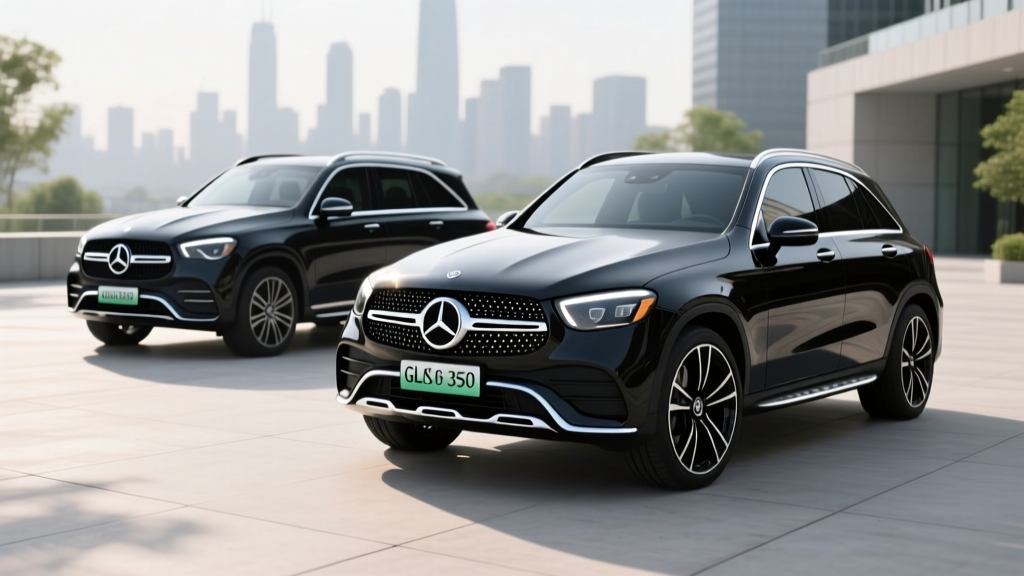
The GLC 350e 4MATIC is the volume player in the Mercedes hybrid SUV lineup. It pairs a 2.0-liter turbocharged inline-four with a permanently excited synchronous electric motor integrated into the 9G-TRONIC automatic transmission.
| Spec | Value |
|---|---|
| Combined Horsepower | 312 hp (215 hp engine + 134 hp motor) |
| Combined Torque | 406 lb-ft |
| Battery Capacity (usable) | 23.3 kWh (NMC lithium-ion) |
| EPA Electric-Only Range | ~54 miles |
| EPA MPGe (electric + gas) | ~79 MPGe combined |
| EPA MPG (gas-only, charge-depleted) | ~28 city / 30 hwy / 29 combined |
| Total Combined Range | ~440 miles |
| AC Charging (Level 2) | 7.4 kW onboard charger, 0-100% in ~3.5 hours |
| DC Fast Charging | Not available |
| 0-60 mph | 6.2 seconds |
| Base MSRP | ~$60,550 |
| Federal Tax Credit (§30D) | Up to $3,750 (see eligibility below) |
| Battery Warranty | 6 years / 62,000 miles (capacity retention ≥70%) |
The GLC 350e's 23.3 kWh battery is large enough to cover most daily commutes on electricity alone. According to fueleconomy.gov, the EPA rates it at approximately 54 miles of electric range — enough for round-trip commutes under 50 miles without burning a drop of gasoline. When the battery depletes, it operates as a conventional hybrid, returning roughly 29 MPG combined.
2026 Mercedes GLE 350e: Midsize Luxury PHEV
For buyers needing three-row capacity (with the optional third-row seat) or more cargo volume, the GLE 350e 4MATIC scales up the same powertrain philosophy into a larger chassis.
| Spec | Value |
|---|---|
| Combined Horsepower | 333 hp (215 hp engine + 134 hp motor) |
| Combined Torque | 479 lb-ft |
| Battery Capacity (usable) | 23.3 kWh (NMC lithium-ion) |
| EPA Electric-Only Range | ~48 miles |
| EPA MPGe (electric + gas) | ~73 MPGe combined |
| EPA MPG (gas-only, charge-depleted) | ~25 city / 27 hwy / 26 combined |
| Total Combined Range | ~420 miles |
| AC Charging (Level 2) | 7.4 kW onboard charger, 0-100% in ~3.5 hours |
| DC Fast Charging | Not available |
| 0-60 mph | 6.5 seconds |
| Base MSRP | ~$72,500 |
| Federal Tax Credit (§30D) | Up to $3,750 (see eligibility below) |
| Battery Warranty | 6 years / 62,000 miles (capacity retention ≥70%) |
The GLE's heavier curb weight (roughly 5,400 lbs vs the GLC's 4,800 lbs) trims electric range to about 48 miles EPA and drops charge-depleted fuel economy to 26 MPG combined. That's still competitive for a midsize luxury SUV — the gas-only GLE 350 returns around 23 MPG combined for comparison.
Charging Logistics: What PHEV Owners Need to Know
Neither the GLC 350e nor the GLE 350e supports DC fast charging. This is a deliberate engineering choice: the 23.3 kWh battery is small enough that a Level 2 home charger refills it in about 3.5 hours, and Mercedes determined the cost and weight of DC fast-charging hardware wasn't justified for a battery this size.
| Charging Level | Power | Time (0-100%) | Cost to Install |
|---|---|---|---|
| Level 1 (120V household) | ~1.4 kW | ~17 hours | $0 (use existing outlet) |
| Level 2 (240V, 32A) | 7.4 kW (max) | ~3.5 hours | $500-$2,000 (electrician + hardware) |
| DC Fast Charge | N/A | N/A | Not supported |
For most PHEV owners, a Level 2 home charger is the practical standard. You plug in overnight, and the battery is full by morning. A 240V/32A circuit delivers the GLC and GLE's maximum 7.4 kW acceptance rate. Level 1 charging from a standard outlet works but takes over 17 hours — impractical unless you drive very few electric miles daily.
Public Level 2 chargers at shopping centers or workplaces will also top off the battery during a typical 2-3 hour stop. The lack of DC fast charging is irrelevant for the PHEV use case: you charge at home or at destinations, and the gas engine covers long highway stretches.
Real-World MPG: EPA Sticker vs What You'll Actually See
| Model | EPA Combined (gas) | Real-World City | Real-World Highway | Real-World Cold Weather |
|---|---|---|---|---|
| GLC 350e | 29 MPG | 30-33 MPG | 27-29 MPG | 25-27 MPG |
| GLE 350e | 26 MPG | 27-29 MPG | 24-26 MPG | 22-24 MPG |
Hybrids and PHEVs in charge-depleted mode tend to exceed EPA city estimates because regenerative braking recaptures energy in stop-and-go traffic that would otherwise be lost as heat. Highway driving is less efficient for any vehicle, and the effect is amplified in heavier SUVs. Cold weather reduces both battery efficiency (shortening electric range) and engine efficiency (cold gasoline engines run richer until warmed up).
If your daily driving stays within the electric-only range and you charge nightly, your actual gasoline consumption could be near zero for months at a time. Many PHEV owners report using less than 10 gallons per month during summer commuting seasons. The gas engine exists as insurance for road trips, not as the primary power source.
Federal Tax Credit & Pricing: What You'll Actually Pay
Under current IRS §30D rules, the Mercedes GLC 350e and GLE 350e may qualify for a partial federal tax credit — but not the full $7,500. Because PHEVs have smaller batteries than full BEVs, and because critical-mineral and battery-component sourcing requirements tighten each year, the credit amount varies. For 2026, expect up to $3,750 if the vehicle meets the critical minerals requirement but not the battery components requirement (or vice versa).
- Vehicle MSRP must not exceed $80,000 for SUVs (both GLC and GLE 350e qualify at base price; loaded GLE trims may exceed the cap)
- Buyer AGI must not exceed $150,000 (single), $225,000 (head of household), or $300,000 (married filing jointly)
- Critical minerals must be sourced from the U.S. or a free-trade-agreement partner (determines half the credit — $3,750)
- Battery components must be manufactured or assembled in North America (determines the other half — $3,750; increasingly difficult for vehicles with Asian-sourced cells)
- Credit can be transferred to the dealer at point of sale as a purchase-price reduction, or claimed on your tax return
- Always verify current eligibility on the IRS clean vehicle credit page before purchasing — sourcing rules change frequently
At base MSRP, the GLC 350e starts around $60,550. With a $3,750 credit, the effective price drops to approximately $56,800 — competitive with a well-equipped gas-only GLC 300 when you factor in fuel savings. The GLE 350e at $72,500 drops to roughly $68,750 after the credit, though options packages can push it past the $80,000 MSRP cap, eliminating credit eligibility entirely.
Battery Reliability, Warranty, and Replacement Cost
This warranty is shorter than what most mainstream brands offer. Toyota, Hyundai, and Kia cover hybrid/PHEV batteries for 10 years or 100,000 miles (and 10 years/150,000 miles in CARB states). Mercedes' 6-year/62,000-mile coverage is adequate for most first owners but provides less protection for second-hand buyers.
Regarding reliability: PHEV powertrains from Mercedes have proven generally robust in the GLC and GLE platforms. The 2.0L M254 engine and electric motor integration have been in production since the early 2020s with iterative improvements. The NMC battery cells are supplied by a major Tier 1 manufacturer with established degradation curves — expect roughly 5-8% capacity loss over 5 years of normal use (daily cycling between 20-100% SoC).
Out-of-warranty battery replacement for a 23.3 kWh PHEV pack typically costs $8,000 to $12,000 including labor at a Mercedes dealer. This is significantly less than a full BEV battery replacement ($15,000-$25,000) because the pack is smaller. However, it's a cost to budget for if you plan to keep the vehicle past 100,000 miles.
Hybrid vs PHEV vs Full EV: Which Should You Choose?
- You have reliable home Level 2 charging and a daily commute under 50 miles
- You take road trips of 200+ miles several times per year and don't want to plan around public chargers
- You want electric commuting without range anxiety in extreme cold weather
- You're not ready to commit to a full BEV but want to reduce gasoline consumption by 60-80%
- You have home charging and rarely drive more than 250 miles in a single day
- You want the lowest per-mile energy cost (electricity is roughly $0.04-$0.06/mile vs $0.12-$0.18/mile for gasoline)
- You want to eliminate oil changes, spark plugs, and exhaust-system maintenance entirely
- You qualify for the full $7,500 federal tax credit on eligible BEV models
- You cannot install a home charger (apartment, street parking, no garage)
- You want better fuel economy than a gas car without changing any habits
- You want the lowest upfront purchase price among electrified options
Pros and Cons at a Glance
Pros
- 48-54 miles of electric-only range covers most commutes without gasoline
- 312-333 combined hp delivers confident acceleration (6.2-6.5 sec 0-60)
- No range anxiety — gas engine covers unlimited distance
- Mercedes MBUX infotainment and driver-assistance suite included
- Partial federal tax credit ($3,750) reduces effective price
- Premium interior materials and ride quality
Cons
- No DC fast charging — limits public charging utility on road trips
- Battery warranty (6 yr / 62k mi) is shorter than most competitors
- MSRP cap ($80,000) can eliminate tax credit on loaded GLE trims
- Charge-depleted MPG (26-29 combined) is modest for the class
- Out-of-warranty battery replacement costs $8,000-$12,000
- Level 1 charging is impractically slow at 17+ hours
Frequently Asked Questions
How many MPG does the Mercedes hybrid SUV get?
The 2026 GLC 350e returns an EPA-rated 29 MPG combined in gas-only (charge-depleted) mode, with real-world city driving often reaching 30-33 MPG. The GLE 350e rates at 26 MPG combined gas-only. When the battery is charged, both vehicles operate primarily on electricity, so your actual gasoline consumption depends on how often you charge and how far you drive.
How far can the Mercedes PHEV go on electric only?
The GLC 350e achieves approximately 54 miles of EPA-rated electric-only range, while the heavier GLE 350e manages about 48 miles. Real-world range drops to 35-48 miles depending on temperature, driving style, and climate-control usage. Both vehicles carry a 23.3 kWh usable battery.
Does the Mercedes hybrid SUV qualify for a tax credit?
Under 2026 IRS §30D rules, both the GLC 350e and GLE 350e may qualify for up to $3,750 in federal tax credit, depending on battery-component and critical-mineral sourcing compliance and your income level. The full $7,500 credit is unlikely due to sourcing requirements. The credit can be applied at point of sale. Always verify eligibility at irs.gov before purchasing, as rules update periodically.
Is the Mercedes PHEV battery reliable and what does replacement cost?
Mercedes PHEV batteries have proven reliable in normal use, with expected degradation of 5-8% over 5 years. The battery is warranted for 6 years or 62,000 miles at a 70% capacity-retention threshold — shorter than Toyota or Hyundai's 10-year coverage. Out-of-warranty replacement costs approximately $8,000 to $12,000 for the 23.3 kWh pack.
Can I charge a Mercedes PHEV at a public DC fast charger?
No. Neither the GLC 350e nor the GLE 350e supports DC fast charging. They accept up to 7.4 kW on Level 2 (240V) AC chargers. This is standard for PHEVs with batteries under 25 kWh — the smaller battery makes DC fast-charging hardware unnecessary for overnight home charging, which fully replenishes the pack in about 3.5 hours.
How does the Mercedes PHEV compare to a full EV like the EQE SUV?
The PHEV gives you 48-54 electric miles plus unlimited gas range — ideal if you road-trip frequently or lack reliable public charging on your routes. The EQE SUV offers 250+ miles of electric range and lower per-mile energy costs but requires DC fast-charging planning for trips beyond its range. If 90% of your driving is under 50 miles and you can charge at home, a full EV saves more money long-term. If you regularly drive 200+ mile routes, the PHEV eliminates charging-station dependency.
Do I need to plug in a Mercedes PHEV every night?
You don't need to, but you should if you want to maximize electric driving and minimize gasoline use. The vehicle operates as a conventional hybrid when the battery is depleted — it won't be damaged by running on gas alone. However, the efficiency and cost benefits of a PHEV come from using electricity for daily miles, which requires regular charging.