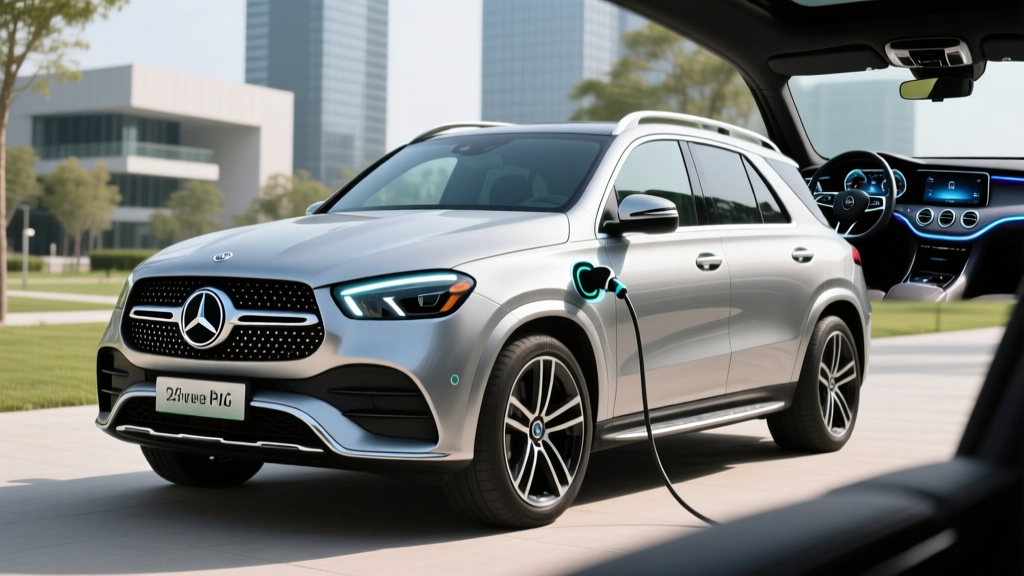
If you're searching for a GLE Mercedes hybrid, the 2026 Mercedes-Benz GLE 450e 4MATIC is the model you'll find in showrooms. Unlike a conventional hybrid that only recovers energy from braking, the GLE 450e is a plug-in hybrid electric vehicle (PHEV) — meaning it carries a large battery you can charge from a wall outlet or public charger, giving it genuine electric-only driving range before the gasoline engine ever starts. For luxury SUV shoppers who want EV-like daily commuting without range anxiety on road trips, this is a compelling proposition.
Below, we break down the real numbers: EPA efficiency, electric range, charging speed, powertrain output, pricing, and whether the GLE 450e qualifies for federal tax incentives under current IRS rules.
GLE 450e Powertrain: Engine Meets Electric Motor
The 2026 GLE 450e pairs a turbocharged 2.0-liter inline-four gasoline engine with a permanently excited synchronous electric motor integrated into the 9G-TRONIC automatic transmission. Here's how the combined output breaks down:
| Component | Specification |
|---|---|
| Gasoline Engine | 2.0L Turbo I4, 258 hp / 295 lb-ft |
| Electric Motor | 100 kW (134 hp) / 325 lb-ft |
| Combined System Output | 375 hp / 479 lb-ft |
| Transmission | 9-speed automatic (9G-TRONIC) |
| Drivetrain | 4MATIC all-wheel drive |
| 0–60 mph | 5.8 seconds (manufacturer est.) |
| Battery (Usable) | 23.3 kWh lithium-ion (NMC chemistry) |
| Onboard Charger (AC) | 7.4 kW |
| DC Fast Charging | Not available |
The combined 375 horsepower is substantial for a midsize luxury SUV, and the instant torque from the electric motor makes acceleration from a stop feel immediate. The key engineering detail here is that the electric motor sits between the engine and transmission, so it can drive the wheels independently at low speeds (pure EV mode) or supplement the engine under hard acceleration.
Fuel Economy: EPA MPG and Real-World Expectations
The GLE 450e carries two efficiency ratings from the EPA — one for electric-only operation (measured in MPGe) and one for gasoline-only operation once the battery is depleted.
| Mode | City | Highway | Combined |
|---|---|---|---|
| Electric (MPGe) | — | — | 51 MPGe |
| Gasoline Only (MPG) | 22 MPG | 27 MPG | 24 MPG |
Real-world MPG vs. EPA: Plug-in hybrids often beat their EPA city rating because stop-and-go traffic maximizes regenerative braking. Expect 25–28 MPG in city driving when the battery is depleted. Highway driving at 75+ mph will trend closer to 22–24 MPG due to aerodynamic drag on this 5,400-pound SUV. If you charge regularly and commute under 48 miles, you may use gasoline only on longer trips — some owners report averaging 80+ MPGe over months of mixed use.
Electric-Only Range: How Far on Battery Alone?
The EPA rates the 2026 GLE 450e at 48 miles of electric-only range. That's enough for most daily commutes, school runs, and errands without burning a drop of gasoline.
Real-world electric range expectations:
- Mild weather, city/suburban driving (35–55 mph): 44–50 miles — you can match or slightly beat the EPA rating
- Highway driving (70–80 mph): 32–38 miles — aerodynamic drag consumes energy faster
- Cold weather (below 35°F): 30–36 miles — battery chemistry is less efficient and cabin heating draws significant power
Mercedes includes an "Electric" drive mode that prioritizes battery use and an "Eco" mode that intelligently blends electric and gas power based on your route. The vehicle's navigation system can pre-plan battery usage across a route — saving electric miles for city segments where they're most efficient.
Charging the GLE 450e: Times, Levels, and Setup
One important distinction: the GLE 450e does not support DC fast charging. This is common among luxury PHEVs — the battery is small enough that overnight AC charging is considered sufficient. Here's what charging looks like at each level:
| Charging Level | Power | 0–100% Time | Notes |
|---|---|---|---|
| Level 1 (120V household) | ~1.4 kW | ~17 hours | Emergency/trickle only |
| Level 2 (240V home/public) | 7.4 kW (max) | ~3.5 hours | Primary charging method |
With a Level 2 home charger (like a ChargePoint Home Flex or Wallbox Pulsar Plus on a 40-amp circuit), a full charge takes roughly 3.5 hours. This means you can easily top up during the workday at a public Level 2 station or fully recharge overnight at home. The 7.4 kW onboard charger is the bottleneck — even if you plug into a 48-amp Level 2 station capable of 11.5 kW, the GLE 450e will only accept 7.4 kW.
Charging connector: The GLE 450e uses the standard J1772 connector for AC charging, which is universal across all non-Tesla EVs and PHEVs in North America. No adapter needed for any public Level 2 station.
HEV vs. PHEV vs. Full EV: Which Is Right for You?
Mercedes-Benz currently offers the GLE exclusively as a PHEV (the 450e) in the U.S. market — there is no conventional hybrid (HEV) GLE variant. This matters because the distinction between these powertrain types determines how you'll use the vehicle daily.
| Factor | GLE 450e PHEV | Conventional Hybrid (HEV) | Full EV (e.g., EQE SUV) |
|---|---|---|---|
| Plugs in? | Yes | No | Yes |
| Electric-only range | 48 miles | 0–2 miles (low speed only) | 250–300+ miles |
| Gasoline engine? | Yes (backup) | Yes (always available) | No |
| Total range | ~590 miles | ~500–600 miles | 250–300+ miles |
| Home charging needed? | Recommended | Never | Essential |
| Tax credit eligible? | Check §30D rules | No | Check §30D rules |
Choose the GLE 450e PHEV if: You have home charging access, your daily commute is under 50 miles, and you want the flexibility to take long road trips without planning charging stops. It's the bridge solution for drivers not yet ready to commit to a full EV.
Choose a full EV (like the Mercedes EQE SUV) if: You have reliable home charging, rarely drive more than 250 miles in a day, and want zero tailpipe emissions with minimal maintenance.
Choose a conventional hybrid (like a Lexus RX 350h) if: You have no home charging access and want better fuel economy without any plug-in routine.
Pricing, Trims, and Tax Credit Eligibility
The 2026 Mercedes-Benz GLE 450e 4MATIC starts at an MSRP of approximately $72,500 (including destination). Well-equipped models with the AMG Line package, MBUX premium tier, and advanced driver-assistance features push the price to $82,000–$88,000.
Federal tax credit (IRS §30D): The GLE 450e's eligibility for the up-to-$7,500 federal plug-in vehicle tax credit depends on several requirements that change periodically:
- MSRP cap: SUVs must be under $80,000 — base GLE 450e qualifies, but heavily optioned models may exceed the cap
- Buyer income limits: Modified AGI must not exceed $150,000 (single) / $300,000 (joint filing)
- Battery sourcing: Critical minerals and battery components must meet phased-in domestic/free-trade-agreement sourcing thresholds per the Inflation Reduction Act
- Point-of-sale transfer: As of 2024+, eligible buyers can transfer the credit to the dealer for an immediate price reduction at purchase
Important caveat: Battery sourcing requirements have tightened significantly. European-assembled vehicles with non-qualifying battery supply chains may see the credit reduced to $3,750 or eliminated entirely. Always verify current eligibility on IRS.gov and consult a tax professional before relying on the credit in your purchase decision.
Battery Warranty, Reliability, and Replacement Cost
Reliability: Mercedes-Benz PHEV powertrains have been in production since 2016 (starting with the S 550e and GLE 500e). The current-generation system in the GLE 450e uses a proven NMC (nickel-manganese-cobalt) lithium-ion chemistry with active liquid thermal management, which significantly slows degradation compared to passively cooled packs.
Battery replacement cost: If out of warranty, a high-voltage battery replacement for the GLE 450e is estimated at $8,000–$12,000 (parts and labor) based on current Mercedes-Benz service pricing. However, PHEV batteries are smaller and less stressed than full-EV batteries, and real-world data suggests most will retain 85%+ capacity after 10 years of typical use.
Conventional maintenance savings: The electric motor handles low-speed driving, reducing engine wear. Brake pad life extends significantly thanks to regenerative braking — many PHEV owners report original brake pads lasting 80,000+ miles.
Pros and Cons of the GLE 450e
Pros
- 48 miles electric-only covers most daily commutes gas-free
- 375 combined hp — quicker than the gas-only GLE 350
- 590+ miles total range eliminates road-trip charging stops
- Silent, smooth EV-mode driving in city traffic
- Premium MBUX interior with PHEV-specific energy flow displays
- Potential federal tax credit up to $7,500 (verify eligibility)
Cons
- No DC fast charging — limited to 7.4 kW AC
- Heavy option packages push MSRP above the $80K SUV tax-credit cap
- Electric range drops to ~30 miles in cold weather
- Cargo volume reduced vs. gas-only GLE (battery under floor)
- Requires home Level 2 charging to maximize value
- Battery warranty (6 yr/62K mi) shorter than some competitors
Frequently Asked Questions
How many MPG does the Mercedes GLE hybrid get?
The 2026 GLE 450e achieves 51 MPGe combined when operating on electric power, and 24 MPG combined (22 city / 27 highway) on gasoline alone after the battery is depleted. In real-world city driving with regenerative braking, expect 25–28 MPG in gas-only mode.
How far can the GLE 450e go on electric only?
The EPA rates it at 48 miles electric-only. Real-world results range from about 30 miles in cold highway driving to 50 miles in mild-weather city conditions. For most commuters, that's enough to cover a full day's driving without using gasoline.
Does the GLE 450e qualify for the $7,500 federal tax credit?
It may, but eligibility depends on your income, the vehicle's MSRP (must be under $80,000 for SUVs), and battery component/critical-mineral sourcing requirements under current IRS §30D rules. Check IRS.gov for the latest qualifying vehicle list before purchasing.
Is the GLE hybrid reliable, and what does battery replacement cost?
Mercedes-Benz PHEV systems have been in production since 2016 and are generally reliable. The high-voltage battery is warranted for 6 years/62,000 miles. Out-of-warranty replacement costs approximately $8,000–$12,000, though most PHEV batteries retain 85%+ capacity after a decade of normal use.
Can the GLE 450e DC fast charge?
No. The GLE 450e supports only AC charging — Level 1 (120V) and Level 2 (240V) up to 7.4 kW. A full charge on Level 2 takes about 3.5 hours. This is typical for PHEVs with batteries under 25 kWh.
Do I need to plug in the GLE 450e, or does it charge itself?
You don't have to plug it in — the gasoline engine and regenerative braking will keep the vehicle running. But if you never plug in, you're paying PHEV pricing for a heavy hybrid that gets only 24 MPG. To capture the value (48 miles of electric driving, lower fuel costs), daily Level 2 charging is strongly recommended.
Should I buy the GLE 450e PHEV or a full EV like the EQE SUV?
Choose the GLE 450e if you need 590+ miles of total range for frequent long trips and want electric commuting during the week. Choose the EQE SUV (300+ mile range) if you have home charging, rarely exceed 250 miles daily, and want zero gasoline dependency with lower long-term maintenance costs.
Sources: EPA fuel economy data via fueleconomy.gov, Mercedes-Benz USA specifications, IRS §30D clean vehicle credit guidelines at irs.gov.