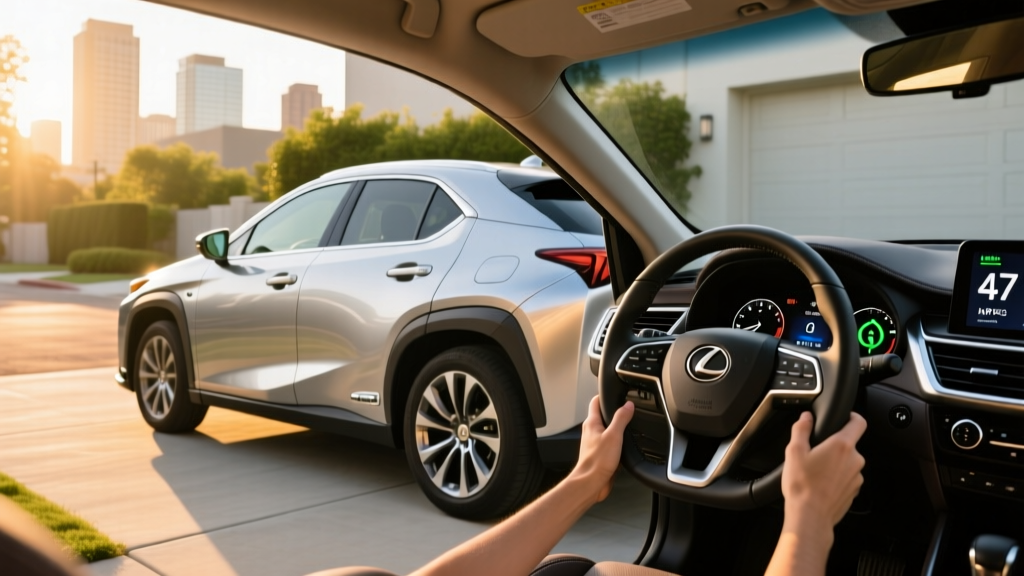
The 2019 Lexus UX 250h arrived as the luxury brand's entry into the subcompact crossover segment, pairing a 2.0-liter four-cylinder engine with Toyota's proven hybrid synergy drive. Now several years into its lifecycle on the used market, the UX 250h remains a compelling option for buyers who want premium badge credibility, exceptional city fuel economy, and the reliability reputation Lexus commands — without committing to a plug-in vehicle. This guide breaks down everything a prospective buyer or current owner needs to know about this conventional hybrid (HEV), from real-world MPG to battery longevity.
HEV vs PHEV vs EV: Where the UX 250h Fits
Before examining the numbers, it's essential to clarify what the 2019 Lexus UX 250h is — and what it is not. The UX 250h is a conventional hybrid (HEV), meaning it generates all its electricity internally through regenerative braking and the gasoline engine. There is no plug, no charging port, and no electric-only driving range to manage. You simply fuel it like any other car and the hybrid system optimizes the blend of gas and electric power automatically.
This is fundamentally different from a plug-in hybrid (PHEV), which carries a larger battery you can charge from a wall outlet for 20–40 miles of electric-only driving before the gas engine kicks in. It's also different from a battery-electric vehicle (BEV), which runs entirely on grid-charged electricity with zero tailpipe emissions.
Quick Powertrain Comparison
| Feature | HEV (UX 250h) | PHEV | BEV |
|---|---|---|---|
| Plug-in charging | No | Yes | Yes |
| Electric-only range | ~1 mi at low speed | 20–45 mi typical | 200–400+ mi |
| Gasoline engine | Yes (primary) | Yes (backup) | None |
| Home charging needed | No | Recommended | Required |
| Tailpipe emissions | Low | Low (electric mode: zero) | Zero |
| Federal tax credit (§30D) | Not eligible | Up to $7,500* | Up to $7,500* |
*Per current IRS §30D rules — subject to MSRP caps, buyer income limits, and battery sourcing requirements. The conventional UX 250h does not qualify.
The UX 250h is ideal for drivers who want hybrid efficiency without changing their fueling habits. If you lack access to home or workplace charging, a conventional HEV eliminates the infrastructure question entirely.
Fuel Economy: EPA Ratings vs Real-World MPG
The 2019 Lexus UX 250h carries an EPA rating of 41 MPG city / 38 MPG highway / 41 MPG combined for the front-wheel-drive configuration, and 41/38/39 MPG for the all-wheel-drive (E-Four) variant. These figures come from the U.S. Department of Energy's fueleconomy.gov database.
| Configuration | City MPG | Highway MPG | Combined MPG |
|---|---|---|---|
| FWD | 41 | 38 | 41 |
| AWD (E-Four) | 41 | 38 | 39 |
Real-World MPG Expectations
Like most Toyota/Lexus hybrids, the UX 250h tends to meet or exceed its EPA city rating in stop-and-go traffic, where regenerative braking recovers energy that would otherwise be lost. Owners frequently report 42–44 MPG in urban driving during mild weather.
Highway driving tells a different story. At sustained 70–80 MPH speeds, expect 35–37 MPG — somewhat below the EPA highway estimate. The compact 1.3 kWh nickel-metal hydride (NiMH) battery provides minimal electric assist at cruising speed, so the gas engine carries most of the load. In cold weather (below 30°F), overall MPG typically drops 3–5 MPG as the engine runs more frequently to maintain cabin heat and battery temperature.
For a subcompact luxury crossover, these numbers remain impressive. Compared to the gas-only UX 200 (rated at 29/37/33 MPG city/highway/combined), the hybrid powertrain delivers roughly 8 MPG more in combined driving — a meaningful savings over years of ownership.
Powertrain and Performance Specifications
The UX 250h pairs a 2.0-liter Atkinson-cycle inline-four engine with one or two electric motor-generators, depending on drivetrain configuration. The FWD model uses a single front motor; the AWD (E-Four) adds a rear-axle motor for all-wheel traction without a mechanical driveshaft.
| Specification | 2019 Lexus UX 250h |
|---|---|
| Engine | 2.0L 4-cyl Atkinson-cycle |
| Engine horsepower | 143 HP |
| Front electric motor | 107 HP (80 kW) |
| Rear electric motor (AWD only) | 40 HP (30 kW) |
| Net combined system output | 181 HP |
| Transmission | eCVT (planetary gearset) |
| Hybrid battery | 1.3 kWh NiMH |
| 0–60 MPH | 8.7 seconds (est.) |
| Drivetrain | FWD or E-Four AWD |
| Fuel tank capacity | 10.6 gallons |
| Total driving range | ~410–435 miles |
The 181 combined horsepower is adequate for daily driving and highway merging, though the UX 250h isn't a performance-oriented vehicle. The eCVT delivers smooth, linear acceleration without the shift shock of a traditional automatic. At 8.7 seconds to 60 MPH, it trails sportier rivals but matches the expectations for a luxury hybrid focused on efficiency.
The eCVT in the UX 250h is not a belt-driven continuously variable transmission — it uses Toyota's planetary gearset design, which has no belts or pulleys to wear out. This contributes significantly to the powertrain's long-term durability.
Battery Warranty, Lifespan, and Replacement Cost
Hybrid battery longevity is consistently the top concern among used-hybrid buyers. The 2019 UX 250h uses a relatively small 1.3 kWh nickel-metal hydride (NiMH) battery pack — far smaller than an EV or PHEV battery, and correspondingly less expensive to replace.
Lexus Hybrid Battery Warranty
- Original warranty: 8 years / 100,000 miles (10 years / 150,000 miles in California and states adopting CARB emissions standards)
- Capacity threshold: Lexus does not publish a specific degradation percentage trigger; coverage applies to defects and failures that prevent normal hybrid operation
- Hybrid system components: Inverter, electric motors, and control modules covered under the same hybrid warranty terms
Real-World Battery Lifespan
Toyota and Lexus NiMH hybrid batteries have an exceptional track record. Data from fleet operators and long-term owners suggests these packs commonly last 150,000–200,000+ miles before significant degradation or failure. The Prius, which shares similar hybrid architecture, has documented cases of original batteries exceeding 250,000 miles.
The UX 250h's small battery operates under less thermal stress than larger EV packs, and Toyota's battery management system is conservative — it never allows the pack to fully charge or fully discharge, keeping it in a longevity-friendly middle range (roughly 40–80% state of charge).
Replacement Cost
If the hybrid battery does fail outside warranty, a new OEM replacement from Lexus typically costs $2,500–$4,000 including labor. Aftermarket and refurbished NiMH packs are available for $1,500–$2,500. Independent hybrid specialists can often perform the swap for less than a dealership. This is dramatically cheaper than EV battery replacements, which can exceed $10,000–$20,000.
Pricing and Tax Credit Eligibility
The 2019 Lexus UX 250h is no longer sold new, so buyers are shopping the used and certified pre-owned (CPO) market. Original MSRP ranged from approximately $34,150 (base FWD) to $42,000+ (fully loaded AWD with Luxury package).
As of 2026, used UX 250h examples typically trade between $18,000 and $28,000 depending on mileage, condition, trim, and drivetrain.
Federal Tax Credit Status
The conventional UX 250h does not qualify for the federal §30D Clean Vehicle Credit. That credit applies only to plug-in electric vehicles (BEVs and PHEVs) with a minimum 7 kWh battery capacity. Since the UX 250h is a self-charging HEV with a 1.3 kWh pack and no plug, it falls outside the program entirely.
Some states offer modest incentives for conventional hybrids, but these are increasingly rare as policy focuses on zero-emission vehicles. Check your state's energy or environmental agency website for current programs.
Reliability and Ownership Experience
Lexus consistently ranks at or near the top of J.D. Power Vehicle Dependability Studies and Consumer Reports reliability surveys. The UX 250h benefits from Toyota's fourth-generation hybrid system, which has been refined over two decades and millions of vehicles. The planetary eCVT eliminates traditional transmission failure modes, and the Atkinson-cycle engine operates under lower thermal stress than conventional engines.
Common owner-reported issues are minor and include:
- Infotainment system responsiveness (the 2019 UX uses a touchpad controller that many find unintuitive — updated in later model years)
- Rear seat space is tight for adults over 6 feet
- Cargo area is compact at 17.1 cu ft (seats up) — smaller than some rivals
- Road noise at highway speeds is noticeable for a luxury-branded vehicle
From a maintenance standpoint, the UX 250h costs less to maintain than a comparable gas-only luxury crossover. Regenerative braking reduces brake pad wear (many owners report 60,000+ miles on original pads), and the hybrid system requires no routine service beyond standard oil changes and fluid checks.
Pros
- Excellent city MPG (41+ real-world)
- Lexus reliability and resale value
- No plug-in charging required
- Smooth, quiet hybrid powertrain
- Available AWD without major MPG penalty
- Low brake wear from regen
Cons
- Modest highway MPG (~35–37 real-world)
- Small cargo area and tight rear seats
- Touchpad infotainment is dated
- Not eligible for federal EV tax credits
- Acceleration is adequate, not quick
- Road noise at highway speed
Who Should Choose the UX 250h Over an EV or Gas Car?
Choose the 2019 Lexus UX 250h if:
- You want premium-badge efficiency without installing a home charger
- Your driving is predominantly city/suburban (where hybrids shine)
- You plan to own the vehicle 5+ years and value long-term reliability
- You live in an apartment or lack reliable charging access
- You want AWD capability in a compact, fuel-efficient package
Consider a PHEV or BEV instead if:
- You have home Level 2 charging and want electric-only daily commuting
- You want to qualify for the federal §30D tax credit (up to $7,500)
- Your commute is under 30 miles round-trip (PHEV covers this on electricity)
- Zero tailpipe emissions is a priority for your driving pattern
- You want the lowest per-mile energy cost (electricity vs. gasoline)
Consider a gas-only vehicle if:
- Your budget is strictly under $15,000 (used hybrid premium may not fit)
- You drive almost exclusively highway miles (hybrid advantage narrows)
- You prioritize cargo space or towing over fuel economy
The UX 250h occupies a specific niche: luxury-badge efficiency for drivers who aren't ready — or able — to adopt plug-in charging. For urban and suburban drivers covering 10,000–15,000 miles per year in mixed driving, the fuel savings versus a gas-only luxury crossover can total $500–$800 annually at 2026 gasoline prices.
Frequently Asked Questions
How many MPG does the 2019 Lexus UX 250h hybrid get?
The EPA rates the FWD UX 250h at 41 city / 38 highway / 41 combined MPG. In real-world driving, expect 42–44 MPG in city conditions and 35–37 MPG on the highway. Cold weather reduces these figures by roughly 3–5 MPG.
Does the 2019 Lexus UX 250h need to be plugged in?
No. The UX 250h is a conventional hybrid (HEV), not a plug-in hybrid. It charges its small battery internally through regenerative braking and the gasoline engine. You never plug it in — just fill the gas tank as you would any car.
Is the 2019 Lexus UX 250h reliable?
Yes. Lexus ranks among the most reliable automotive brands in J.D. Power and Consumer Reports surveys. The fourth-generation Toyota hybrid system in the UX 250h has been proven over millions of vehicles. The planetary eCVT has no belts or friction clutches to wear, and hybrid components carry an 8-year/100,000-mile warranty.
What does a Lexus UX 250h hybrid battery replacement cost?
A new OEM hybrid battery replacement costs approximately $2,500–$4,000 including labor at a Lexus dealer. Aftermarket and refurbished options range from $1,500–$2,500. In practice, Toyota/Lexus NiMH hybrid batteries commonly last 150,000–200,000+ miles before needing replacement.
Does the 2019 Lexus UX 250h qualify for any tax credit?
No. The federal §30D Clean Vehicle Credit applies only to plug-in vehicles (BEVs and PHEVs) meeting battery capacity and sourcing requirements. The UX 250h is a conventional hybrid and does not qualify. Some states may offer minor hybrid incentives — check your state's energy agency for details.
How does the UX 250h compare to a PHEV or full EV?
The UX 250h offers 41 combined MPG with no plug-in requirement — ideal for drivers without home charging. A PHEV would give you 20–40 miles of electric-only range for short commits plus gas-engine backup, while a BEV eliminates gasoline entirely with 200–400 miles of range. The trade-off: PHEVs and BEVs require charging access and cost more upfront, though they may qualify for federal tax credits that narrow the price gap.
Is the 2019 UX 250h a good buy on the used market in 2026?
For buyers seeking a compact luxury crossover with low running costs and proven reliability, the used UX 250h is a strong pick. Prices have settled into the $18,000–$28,000 range, and the hybrid powertrain's durability means lower long-term maintenance costs versus gas-only rivals. The main compromises are a small cargo area, dated infotainment, and modest highway fuel economy.