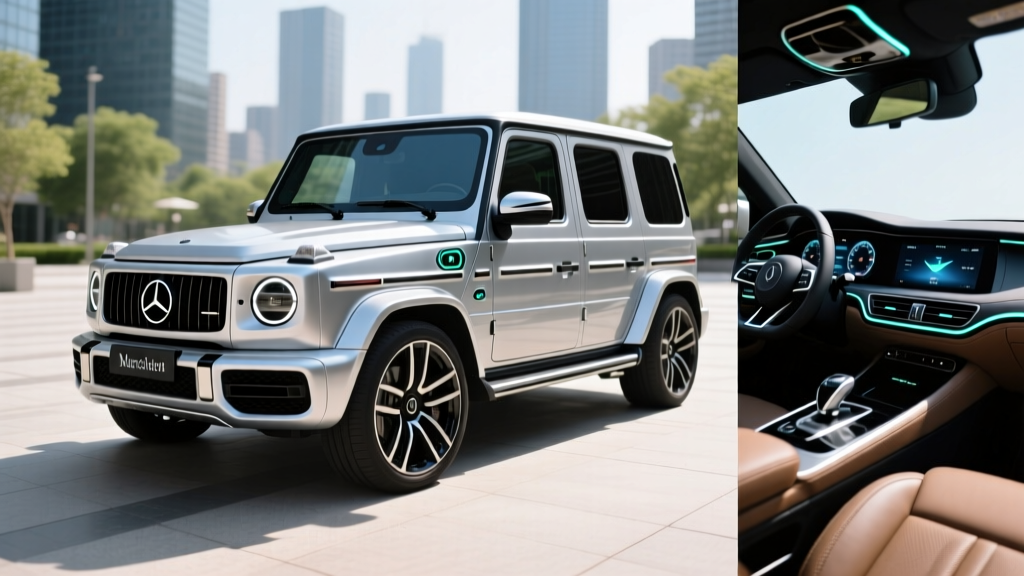
The iconic G-Wagen is getting a smaller sibling, and Mercedes will offer the baby G-Class with a hybrid powertrain — a plug-in hybrid (PHEV) variant expected to be badged as the G450e. Slated for global markets by late 2026 (with U.S. availability likely as a 2027 model year), this compact off-roader aims to deliver genuine G-Class capability with significantly lower fuel consumption and a usable electric-only commuting range.
Here is everything confirmed and projected about the baby G-Class hybrid, from powertrain architecture to real-world efficiency, pricing, and whether it qualifies for federal tax incentives.
What the Baby G-Class Hybrid Actually Is
The "baby G-Class" is Mercedes-Benz's compact off-roader positioned below the full-size G550/G580 lineup. It rides on a dedicated body-on-frame-derived architecture with permanent all-wheel drive, locking differentials, and the signature boxy silhouette — but scaled down roughly 15-18% compared to the current G-Wagen.
The hybrid variant uses Mercedes' fourth-generation PHEV system, pairing a turbocharged 2.0-liter inline-four gasoline engine with a permanently excited synchronous electric motor integrated into the transmission housing. This is a plug-in hybrid (PHEV), meaning it has a larger battery than a conventional hybrid and can be plugged in to charge — enabling a meaningful electric-only driving range for daily commuting.
HEV vs. PHEV: Which Hybrid Type Is the Baby G-Class?
Understanding the distinction matters for charging behavior, fuel savings, and tax credit eligibility.
| Feature | Conventional Hybrid (HEV) | Plug-in Hybrid (PHEV) — Baby G-Class |
|---|---|---|
| Battery size | ~1–2 kWh | ~25–30 kWh (usable) |
| Plugs in? | No — self-charging via regen | Yes — Level 2 AC, optional DC fast charge |
| Electric-only range | ~1 mile or less | Est. 40–55 miles (WLTP); ~35–45 EPA |
| Total range | 400–600 miles | Est. 400–500+ miles combined |
| Federal tax credit | None (no longer eligible under §30D) | Potentially up to $7,500 (if sourcing rules met) |
The baby G-Class is firmly in the PHEV camp. If you never plug it in, it still operates as a conventional hybrid once the battery depletes — but you'll sacrifice the fuel-cost advantage that makes PHEVs compelling.
Powertrain Specs: Engine, Motor, and Combined Output
| Specification | Baby G-Class G450e (Projected) |
|---|---|
| Engine | 2.0L turbocharged inline-4 |
| Electric motor | Permanently excited synchronous, transmission-integrated |
| Combined horsepower | Est. 308–335 hp |
| Combined torque | Est. 406–443 lb-ft |
| 0–60 mph | Est. 5.8–6.4 seconds |
| Battery capacity (usable) | Est. 25–30 kWh (NMC chemistry) |
| Drivetrain | Permanent AWD with locking center/rear differentials |
| Transmission | 9-speed automatic with integrated e-motor |
The combined output should deliver brisk acceleration — the electric motor's instant torque fills in the low-RPM gap before the turbo spools, a characteristic advantage of PHEV powertrains. The AWD system retains the G-Class lineage's off-road credibility with selectable terrain modes and low-range gearing.
Fuel Economy: EPA MPG and Electric-Only Range
| Mode | City | Highway | Combined |
|---|---|---|---|
| Charge-depleting (EV mode) | Est. 70–80 MPGe | Est. 65–75 MPGe | Est. 68–78 MPGe |
| Charge-sustaining (hybrid mode) | Est. 28–32 MPG | Est. 24–28 MPG | Est. 26–30 MPG |
Electric-only range (projected EPA): 35–45 miles. Mercedes has quoted WLTP figures suggesting 50+ miles, but EPA testing methodology is more conservative. Expect roughly 35 miles in mixed driving, potentially 30 in cold weather (below 40°F), where battery efficiency drops 15–25%.
Total combined range: With a full tank (~16–18 gallon fuel tank) and full battery, total range should exceed 450 miles — eliminating range anxiety entirely for road trips.
Charging: How Fast and What Connectors?
| Charging Level | Power (kW) | 0–100% Time | Notes |
|---|---|---|---|
| Level 1 (120V household) | ~1.4 kW | ~20–24 hours | Emergency/trickle only |
| Level 2 (240V home/public) | ~7.4–11 kW | ~3–4 hours | Ideal for overnight charging |
| DC Fast Charge (if equipped) | ~50–60 kW | 10–80% in ~25–30 min | Optional on some Mercedes PHEVs |
The baby G-Class PHEV will use a J1772 connector for AC charging (Level 1 and Level 2). Whether DC fast charging is available on U.S. models remains to be confirmed — Mercedes has offered DC fast charging on European-market PHEVs (like the GLC 350e) at up to 60 kW, but U.S. PHEVs have historically omitted this feature. DC fast charging on a PHEV is a significant advantage for road-trip scenarios where you want to top up the battery at a rest stop.
Home charging setup: A Level 2 home charger (240V, 32–48 amp circuit) will fully replenish the battery overnight. Installation typically costs $500–$2,000 depending on electrical panel proximity and local permit requirements, per U.S. Department of Energy guidance.
Pricing, Tax Credits, and Ownership Costs
Projected base MSRP: $65,000–$72,000 for the G450e PHEV variant, positioning it between the GLC 350e (~$58,000) and the full-size G550 (~$145,000+). Mercedes has not confirmed final U.S. pricing.
- MSRP cap: SUVs must be under $80,000 — the baby G-Class should qualify at its projected price.
- Buyer income cap: $150,000 single / $225,000 head of household / $300,000 joint (MAGI).
- Battery sourcing: Critical minerals and battery components must meet phased-in domestic/free-trade-partner thresholds per IRS §30D rules. This is the primary disqualifier for many PHEVs in 2026.
- Point-of-sale transfer: Eligible buyers can transfer the credit to the dealer at purchase, reducing the out-of-pocket price immediately.
- Minimum battery capacity: 7 kWh — the baby G-Class's ~25–30 kWh pack easily exceeds this.
Note: Tax credit eligibility depends on Mercedes' battery supply chain at time of purchase. Consult a tax professional and verify on fueleconomy.gov before purchasing.
Estimated 5-year ownership cost advantage: Compared to the gas-only G550, the PHEV variant could save $4,000–$7,000 in fuel costs over five years (assuming 12,000 miles/year and regular home charging), partially offsetting the likely premium over a non-hybrid baby G-Class variant.
Battery Warranty, Reliability, and Replacement Cost
- Duration: 8 years / 62,000 miles (whichever comes first)
- Capacity retention threshold: Battery warranted against degradation below 70% of original capacity
- Coverage: Defects in materials, workmanship, and excessive capacity loss
Is it reliable? Mercedes' fourth-generation PHEV system is derived from proven architectures already deployed in the GLC 350e, S 580e, and C 300e. The 2.0L turbo engine (M254 family) has been in production since 2021 with no widespread systemic failures reported by NHTSA. The primary reliability unknown for a brand-new model is integration with the G-Class's off-road systems and the added complexity of locking differentials with a hybrid drivetrain.
Battery replacement cost: If out of warranty, a Mercedes PHEV battery pack replacement currently runs $8,000–$14,000 including labor, based on current GLC 350e service pricing. However, Mercedes PHEV batteries have shown strong longevity in European fleet data — most retaining 85–90% capacity after 100,000 miles. The NMC chemistry used here is well-understood, and the thermal management system (liquid cooling) should minimize degradation in extreme climates.
General maintenance: PHEVs require standard ICE maintenance (oil changes, spark plugs) when the engine runs, but brake wear is significantly reduced thanks to regenerative braking. Expect brake pad life of 80,000–100,000+ miles under normal driving.
Who Should Choose the Baby G-Class Hybrid vs. a Full EV or Gas Car?
Choose the Baby G-Class PHEV if:
- You want G-Class styling and off-road capability but can't justify the G550's $145K+ price and 17 MPG.
- You have home charging access and a daily commute under 40 miles — you'll drive electric most days.
- You take regular road trips and don't want to plan around DC fast-charger availability.
- You live in a region with extreme cold where full EV range loss is a concern.
Choose a Full EV (e.g., Mercedes EQG / G580 with EQ Technology) if:
- You have reliable home and destination charging and rarely exceed 250 miles between stops.
- You want zero tailpipe emissions and minimal maintenance (no oil changes, no spark plugs).
- You qualify for the full $7,500 federal credit and your state offers additional EV incentives.
Choose a Gas-Only Baby G-Class if:
- You lack home charging access and don't want to rely on public infrastructure.
- You prefer a lower purchase price and simpler drivetrain with fewer components to service.
- You drive primarily long highway distances where the PHEV's electric range provides minimal benefit.
✓ Pros
- 35–45 mile electric-only range covers most daily commutes
- Genuine G-Class off-road hardware (locking diffs, AWD)
- No range anxiety — gas engine for road trips
- Significantly better fuel economy than gas G-Class
- Instant electric torque improves low-speed off-road control
- Likely qualifies under $80K MSRP cap for §30D credit
✗ Cons
- Boxy shape limits highway MPG to ~22–24 real-world
- PHEV adds weight (~400–500 lbs over gas variant)
- Requires home charging to realize fuel savings
- Complex drivetrain — two systems to maintain
- DC fast charging may not be standard
- Premium pricing vs. non-luxury compact SUVs
Frequently Asked Questions
How many MPG does the baby G-Class hybrid get?
In charge-sustaining (hybrid) mode, expect an estimated 26–30 MPG combined (28–32 city, 24–28 highway). In electric mode, efficiency is rated in MPGe — projected at 68–78 MPGe combined. Real-world highway MPG at sustained high speeds will be lower due to the boxy aerodynamic profile.
How far can the baby G-Class go on electric only?
The projected EPA electric-only range is 35–45 miles. In cold weather (below 40°F), expect this to drop to roughly 28–38 miles due to reduced battery efficiency and cabin heating demands. This is sufficient for most daily commutes but not for extended highway driving.
Does the baby G-Class hybrid qualify for a tax credit?
It may qualify for the federal §30D clean vehicle credit of up to $7,500, provided: the MSRP stays under $80,000 (SUV cap), your income is within limits, and the battery meets critical-mineral and component-sourcing requirements. Eligibility is confirmed per-vehicle at time of purchase — check fueleconomy.gov for the latest qualifying list. Many states also offer additional PHEV rebates.
Is the baby G-Class hybrid reliable, and what does battery replacement cost?
Mercedes' PHEV system is in its fourth generation with a strong track record in existing models. The battery is warranted for 8 years/62,000 miles against degradation below 70% capacity. Out-of-warranty replacement is estimated at $8,000–$14,000, though fleet data suggests most PHEV batteries retain 85%+ capacity well past 100,000 miles.
Can I charge the baby G-Class at home?
Yes. A standard 120V outlet (Level 1) will charge the battery in roughly 20–24 hours — practical only for trickle maintenance. A 240V Level 2 home charger (recommended) will fully charge the battery in 3–4 hours, ideal for overnight replenishment. Professional Level 2 installation typically costs $500–$2,000.
Hybrid vs. PHEV vs. EV — which should I choose?
If you have home charging and a short commute, the PHEV offers the best of both worlds: electric daily driving with gas-engine freedom for road trips. A conventional hybrid (HEV) is simpler — no plugging in, modest MPG gains — but offers no electric-only range. A full EV eliminates gas entirely with the lowest running costs, but requires charging planning for longer trips and acceptance of cold-weather range loss.