Mazda's Plug-In Hybrid Strategy: Two SUVs, One Powertrain
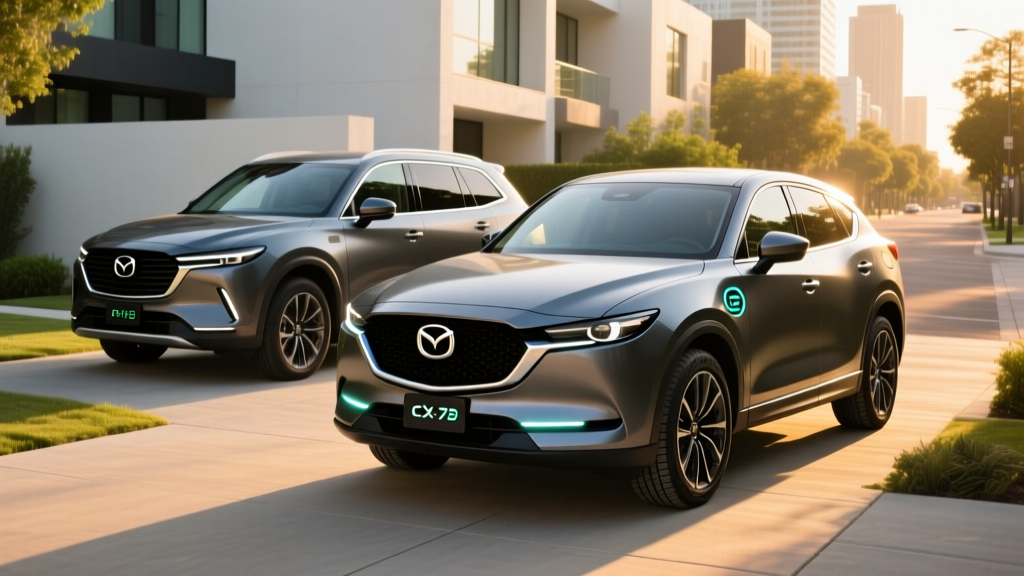
Mazda entered the plug-in hybrid market with a focused approach rather than a sprawling lineup. For 2026, the Mazda PHEV family consists of two three-row-capable SUVs — the midsize CX-70 and the larger CX-90 — both sharing an identical 2.5-liter four-cylinder plug-in hybrid powertrain paired with a 17.8 kWh battery pack. The result is a premium-driving experience with meaningful electric-only commuting capability, without the range anxiety of a full battery-electric vehicle.
Both models target buyers who want electrified efficiency for daily driving but need the flexibility of a gasoline engine for road trips, towing, or rural routes where DC fast chargers remain sparse. Here's everything you need to know about Mazda's PHEV platform, from real-world efficiency to federal tax credit eligibility.
HEV vs PHEV: What's the Difference?
Conventional Hybrid (HEV): Uses a small battery (typically 1–2 kWh) recharged solely by regenerative braking and the engine. No plug. Electric-only driving is limited to low speeds and short distances. Example: Toyota RAV4 Hybrid.
Plug-In Hybrid (PHEV): Carries a much larger battery (Mazda uses 17.8 kWh) that you plug in to recharge — ideally overnight at home on Level 2. Delivers 20–30 miles of pure electric driving before the gas engine engages. Example: Mazda CX-90 PHEV.
Mazda currently does not offer a conventional HEV in the US market for these models — the CX-70 and CX-90 are available as PHEV or with Mazda's mild-hybrid inline-six turbo. If you don't want to plug in, those mild-hybrid variants are the alternative, but they lack meaningful electric-only range.
EPA Range, MPGe, and Fuel Economy Breakdown
The headline number for any Mazda PHEV is electric-only range. Both the CX-70 PHEV and CX-90 PHEV share the same powertrain hardware, but the larger CX-90's weight and aerodynamics reduce its electric range slightly.
| Spec | CX-70 PHEV (2026) | CX-90 PHEV (2026) |
|---|---|---|
| EPA Electric-Only Range | 26 miles | 26 miles |
| EPA Combined MPGe (Electric + Gas) | 56 MPGe | 56 MPGe |
| EPA Combined MPG (Gas Only, Battery Depleted) | 25 MPG | 25 MPG |
| EPA City MPG (Gas Only) | 24 MPG | 24 MPG |
| EPA Highway MPG (Gas Only) | 27 MPG | 27 MPG |
| Total Combined Range (Electric + Gas) | ~430 miles | ~430 miles |
| Fuel Tank Capacity | 15.9 gallons | 15.9 gallons |
Source: fueleconomy.gov
Real-World Range vs. EPA Sticker
EPA says: 26 miles electric-only, 56 MPGe combined.
Expect in practice: In mild weather (60–75°F) with moderate speeds, 26–28 miles of electric range is achievable on flat terrain. In cold weather (below 35°F), expect that to drop to 18–22 miles as the battery's usable capacity shrinks and cabin heating draws additional power. Highway driving at 70+ mph with a depleted battery often yields 23–24 MPG rather than the EPA's 27 MPG highway figure — typical for a heavy three-row SUV. City driving in hybrid mode frequently exceeds the EPA city rating of 24 MPG, reaching 26–28 MPG thanks to frequent regenerative braking opportunities.
Powertrain Specs: 327 Horsepower From a Turbo Four + Electric Motor
Mazda's PHEV powertrain pairs a 2.5-liter inline-four turbocharged engine with a permanent-magnet synchronous electric motor integrated into the transmission housing. Combined output is a robust 327 horsepower and 369 lb-ft of torque — enough to move these heavy SUVs with genuine urgency.
| Specification | Detail |
|---|---|
| Engine | 2.5L turbocharged inline-4 |
| Electric Motor | Permanent-magnet synchronous (integrated in transmission) |
| Combined Output | 327 hp / 369 lb-ft torque |
| Transmission | 8-speed automatic (no torque converter — uses clutch packs) |
| Drivetrain | i-Activ AWD (standard, all trims) |
| 0–60 mph | ~6.3 seconds (CX-70 PHEV) / ~6.5 seconds (CX-90 PHEV) |
| Towing Capacity | 3,500 lbs (CX-70) / 3,500 lbs (CX-90) |
| Battery Pack (Usable) | 17.8 kWh (lithium-ion, NMC chemistry) |
| Onboard Charger (Level 2) | 7.2 kW |
| DC Fast Charging | Not supported |
| Level 2 Charge Time (0–100%) | ~2.5 hours at 7.2 kW |
| Level 1 Charge Time (120V, 1.4 kW) | ~12–14 hours |
The absence of DC fast charging is a deliberate trade-off. Mazda prioritized packaging the battery beneath the floor without compromising cargo space or third-row seating, and a DC fast charge port adds weight, cost, and complexity. For most PHEV owners who charge overnight at home, this is a non-issue. But if your routine involves midday top-ups at public chargers, you'll be limited to Level 2 speeds.
Battery Warranty, Longevity, and Replacement Cost
Mazda PHEV Battery Warranty
- Hybrid Battery Warranty: 8 years / 100,000 miles (whichever comes first)
- Capacity Retention Threshold: Warranty covers defects and abnormal degradation; Mazda does not publish a specific SoH percentage trigger, but industry standard is replacement if capacity falls below 60–70% within the warranty period
- Powertrain Warranty: 5 years / 60,000 miles
- Bumper-to-Bumper: 3 years / 36,000 miles
Mazda's hybrid battery warranty aligns with the federal minimum required for PHEVs under EPA and CARB guidelines. In California Air Resources Board (CARB) states, the hybrid battery warranty extends to 10 years / 150,000 miles.
Battery replacement cost: As of 2026, a full Mazda PHEV battery pack replacement (out of warranty) is estimated at $8,000–$12,000 including parts and labor. However, PHEV battery packs are modular — individual cell modules can sometimes be replaced rather than the entire pack, reducing cost. In practice, modern NMC lithium-ion PHEV batteries are designed for 150,000+ mile lifespans with typical degradation of 10–15% over 10 years. Most owners will never need a full replacement.
Reliability: Mazda's 2.5L turbo engine has been in production since 2018 and is well-proven. The PHEV variant adds complexity (electric motor, power electronics, larger battery), but Mazda's hybrid system is sourced from a well-established architecture. IIHS has rated the CX-90 a Top Safety Pick+, and the powertrain has shown no widespread failure patterns in early model years.
2026 Pricing, Trims, and Federal Tax Credit Eligibility
| Model & Trim | MSRP (2026) |
|---|---|
| CX-70 PHEV Preferred | $55,850 |
| CX-70 PHEV Premium | $59,850 |
| CX-70 PHEV Premium Plus | $63,800 |
| CX-90 PHEV Preferred Plus | $57,450 |
| CX-90 PHEV Premium | $61,450 |
| CX-90 PHEV Premium Plus | $65,950 |
All prices include destination. Pricing reflects 2026 model year MSRPs as published by Mazda North America.
Does the Mazda PHEV Qualify for the Federal Tax Credit?
Under IRS §30D New Clean Vehicle Credit rules for 2026, the Mazda CX-70 PHEV and CX-90 PHEV may qualify for up to $3,750 — but full $7,500 eligibility depends on battery component and critical mineral sourcing requirements that shift annually.
§30D Tax Credit Checklist for Mazda PHEV (2026)
- Battery capacity: 17.8 kWh ✅ (exceeds the 7 kWh minimum for SUVs)
- MSRP cap: SUVs must be under $80,000 ✅ (all trims qualify)
- Buyer income cap: AGI ≤ $150,000 (single) / ≤ $300,000 (joint) ✅ (buyer-dependent)
- Final assembly in North America: Both built in Hofu, Japan ❌ — this disqualifies the Mazda PHEV from the §30D credit
- Point-of-sale transfer: Not applicable if assembly requirement is not met
Critical detail: Mazda's CX-70 and CX-90 are manufactured in Japan, not in North America. Under current §30D rules, final assembly must occur in North America to qualify for the federal new clean vehicle credit. This means neither Mazda PHEV qualifies for the $3,750 or $7,500 federal tax credit as of 2026.
However, some states offer their own incentives for PHEVs regardless of assembly location. Check your state's energy office or AFDC state incentive database for local rebates. California's Clean Fuel Reward, for example, has historically offered rebates for qualifying PHEVs.
Charging at Home: What You Need for a Mazda PHEV
The Mazda PHEV platform uses a standard J1772 connector for Level 1 and Level 2 AC charging. There is no DC fast charge port (CCS or NACS).
| Charging Level | Power | Miles of Range Added per Hour | Full Charge Time (0–100%) |
|---|---|---|---|
| Level 1 (120V household outlet) | ~1.4 kW | ~4–5 miles/hr | ~12–14 hours |
| Level 2 (240V, 32A home charger) | 7.2 kW (vehicle-limited) | ~20–22 miles/hr | ~2.5 hours |
| DC Fast Charge | N/A | N/A | Not supported |
Practical recommendation: A Level 2 home charger is strongly recommended for any Mazda PHEV owner. At 7.2 kW, the battery fully replenishes in about 2.5 hours — meaning you can charge during a work-from-home lunch break or easily top up overnight. Level 1 charging from a standard 120V outlet works for overnight top-ups if your daily electric driving is under 15 miles, but it won't fully recharge a depleted battery in a single night.
Level 2 home charger installation typically costs $600–$1,800 depending on your electrical panel's capacity and the distance from panel to charger. A 240V / 40A circuit with a NEMA 14-50 outlet is the standard recommendation. Have a licensed electrician assess your panel before purchasing equipment.
Who Should Buy a Mazda PHEV — And Who Shouldn't
Choose the Mazda PHEV If:
- Your daily commute is under 25 miles round-trip and you can charge at home — you'll drive almost entirely on electricity on weekdays
- You need a three-row SUV but want lower running costs than a conventional gas CX-90 or competitor
- You take road trips regularly and don't want to plan around DC fast charging infrastructure
- You value Mazda's interior quality and driving dynamics over maximum electric range
- You live in a region with extreme cold where full EV range loss is a concern
Choose a Full EV Instead If:
- You have reliable home charging and your daily driving rarely exceeds 200 miles
- You want near-zero maintenance (no oil changes, no transmission fluid, no spark plugs)
- You qualify for the full $7,500 federal credit on a North American–assembled EV (e.g., Tesla Model Y, Ford Explorer EV, Rivian R1S)
- You want the lowest possible cost per mile — electricity is cheaper than even PHEV hybrid-mode MPG
Choose a Conventional Gas SUV If:
- You cannot install a home charger (apartment, street parking, no garage access)
- You rarely drive under 30 miles per day — the PHEV premium won't pay back through fuel savings
- You want the lowest upfront purchase price and don't care about electric driving
Pros and Cons at a Glance
Pros
- 26 miles of electric-only range covers most daily commutes
- 327 hp delivers strong acceleration for a three-row SUV
- Premium interior materials rival European competitors
- Standard AWD across all PHEV trims
- No range anxiety — gas engine provides 430+ total miles
- Top Safety Pick+ rating (CX-90, IIHS)
- Quiet, refined electric-mode driving around town
Cons
- No DC fast charging capability
- Does not qualify for the $7,500 federal §30D tax credit (Japan assembly)
- Gas-only MPG of 25 combined is average, not class-leading
- Premium pricing — starts near $56K before options
- Third row is tight for adults (especially CX-70)
- Electric range drops noticeably in cold weather
- Infotainment lacks a touchscreen (rotary dial only)
Frequently Asked Questions
How many MPG does the Mazda PHEV get?
When the battery is depleted and the vehicle operates as a conventional hybrid, the Mazda CX-70 PHEV and CX-90 PHEV achieve an EPA-rated 25 MPG combined (24 city / 27 highway). When factoring in electric-only driving, the combined rating is 56 MPGe. In real-world city driving with frequent stops, expect 26–28 MPG in hybrid mode. Highway driving at 75+ mph typically yields 23–24 MPG.
How far can the Mazda PHEV go on electric only?
The EPA rates both the CX-70 PHEV and CX-90 PHEV at 26 miles of electric-only range. In mild weather with gentle driving, 26–28 miles is realistic. In freezing temperatures or at highway speeds, expect 18–22 miles before the gas engine engages.
Does the Mazda PHEV qualify for any tax credit?
As of 2026, the Mazda CX-70 PHEV and CX-90 PHEV do not qualify for the federal §30D New Clean Vehicle Credit because final assembly occurs in Japan, not North America. State-level incentives may still apply — check your local programs. The used-EV credit (§25E) may apply if you purchase a qualifying pre-owned Mazda PHEV from a dealer, subject to price caps ($25,000 max sale price) and income limits.
Is the Mazda PHEV reliable, and what does battery replacement cost?
Mazda's 2.5L turbo engine is well-established, and the PHEV system has shown no widespread reliability issues in early model years. The hybrid battery is warranted for 8 years / 100,000 miles (10 years / 150,000 miles in CARB states). Out-of-warranty battery replacement is estimated at $8,000–$12,000, though modular repair may reduce this. PHEV batteries typically retain 85–90% capacity after 10 years of normal use.
Can I DC fast charge the Mazda PHEV?
No. The Mazda CX-70 PHEV and CX-90 PHEV do not support DC fast charging. The maximum charge rate is 7.2 kW on Level 2 (240V), which fully replenishes the 17.8 kWh battery in approximately 2.5 hours. Level 1 (120V) charging takes 12–14 hours.
Hybrid vs PHEV vs EV — which is right for me?
If you have home charging and a commute under 25 miles, the Mazda PHEV lets you drive on electricity most weekdays while keeping gas-engine flexibility for road trips. If your commute is longer or you lack home charging, a conventional hybrid (like the Toyota Highlander Hybrid at 35 MPG combined) may save more fuel overall without the plug-in requirement. If you have home charging, rarely drive over 250 miles in a day, and want the lowest running costs, a full EV like the Kia EV9 or Tesla Model X eliminates gasoline entirely — but at a higher purchase price and with cold-weather range trade-offs.