Mazda CX-90 PHEV at a Glance
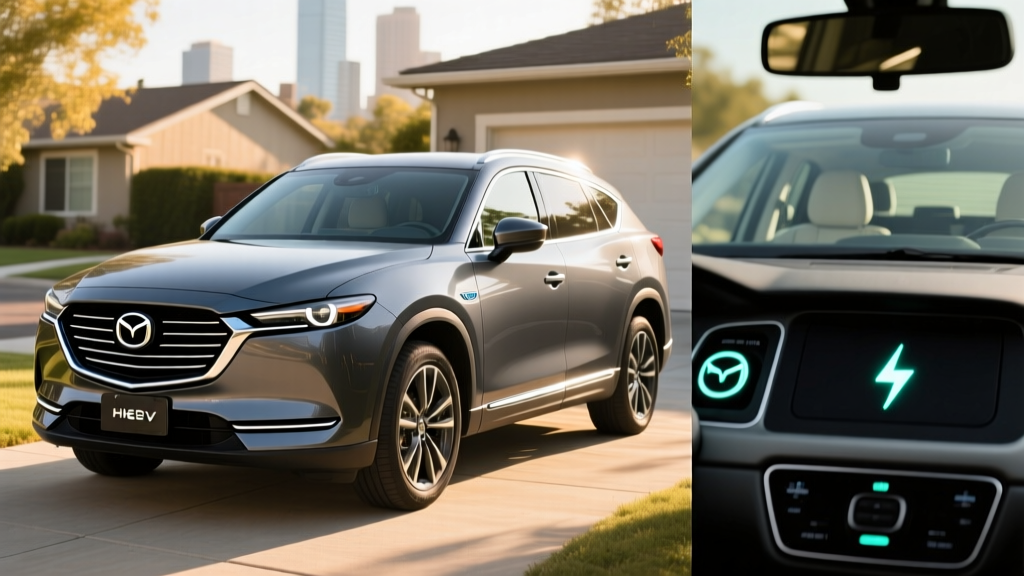
The Mazda CX-90 plug-in hybrid occupies a specific niche: a three-row premium SUV that can handle daily commutes on electricity alone while eliminating range anxiety for longer trips. Unlike a conventional hybrid (HEV), which recharges its small battery through regenerative braking and the engine, the CX-90 PHEV plugs into a wall or charger to fill a much larger battery — giving it genuine electric-only capability before the gasoline engine ever starts.
This distinction matters for buyers cross-shopping the Toyota Grand Highlander Hybrid, Jeep Grand Cherokee 4xe, or even a fully electric Kia EV9. The CX-90 PHEV's inline-six engine paired with its electric motor produces a combined 323 horsepower and 369 lb-ft of torque — figures that place it well above most hybrid competitors in its class.
| Spec | Value |
|---|---|
| Powertrain | 2.5L inline-4 + electric motor (PHEV) |
| Combined Output | 323 hp / 369 lb-ft torque |
| Battery Capacity | 17.8 kWh (lithium-ion) |
| EPA Electric-Only Range | 26 miles |
| EPA Combined MPG (gas) | 25 MPG (city 24 / hwy 25) |
| MPGe (electric + gas) | 56 MPGe |
| Level 2 Charge Time (0-100%) | ~2.5 hours at 7.2 kW |
| DC Fast Charging | Not available |
| 0-60 mph | ~6.5 seconds (est.) |
| Towing Capacity | 3,500 lbs |
| Base MSRP | $50,970 (PHEV Preferred Plus) |
Sources: EPA Fueleconomy.gov, Mazda USA specifications.
HEV vs PHEV: What the CX-90 Actually Offers
Mazda sells the CX-90 with two electrified powertrains, and confusing them is easy if you're skimming spec sheets:
- CX-90 MHEV (Mild Hybrid): The turbocharged 3.3L inline-six features a 48-volt mild-hybrid system. It cannot drive on electric power alone. The system smooths stop-start and provides minor efficiency gains. EPA combined: ~25 MPG. No plug. No electric-only range.
- CX-90 PHEV (Plug-in Hybrid): The 2.5L four-cylinder pairs with a larger electric motor and 17.8 kWh battery. It can travel up to 26 miles on electricity alone and must be plugged in to realize its full efficiency benefit. This is the model most shoppers mean when they search for a "CX-90 hybrid."
Electric-Only Range and Real-World Efficiency
The EPA rates the CX-90 PHEV at 26 miles of electric-only range. In real-world driving, expect between 22 and 28 miles depending on conditions:
- City commuting (below 45 mph): 26-28 miles is achievable. Electric motors are most efficient at low speeds with frequent regenerative braking opportunities.
- Highway driving (65-75 mph): Expect 20-23 miles. Aerodynamic drag and sustained high-speed demand drain the battery faster.
- Cold weather (below 32°F): Range drops to roughly 18-22 miles. The battery's chemical reactions slow in cold temperatures, and cabin heating draws additional energy.
Once the battery depletes, the gasoline engine engages seamlessly, and the SUV operates as a conventional hybrid, returning its EPA-rated 25 MPG combined. On the highway, real-world fuel economy for charge-sustaining mode tends to land between 23-26 MPG — fairly close to the sticker since highway driving doesn't benefit as much from regenerative braking as city driving does.
For owners who plug in nightly and commute under 25 miles round-trip, gasoline consumption can drop to near zero for daily driving, with the engine only firing for weekend trips or longer errands.
Charging: What You Need at Home
The CX-90 PHEV uses a standard J1772 connector for Level 1 and Level 2 AC charging. It does not support DC fast charging — a common limitation among PHEVs, since the 17.8 kWh battery is small enough that Level 2 charging refills it in a practical timeframe.
| Charging Level | Power | Time (0-100%) | Practical Notes |
|---|---|---|---|
| Level 1 (120V household) | ~1.4 kW | ~12-14 hours | Trickle charge; works for overnight if battery isn't fully depleted |
| Level 2 (240V home/public) | Up to 7.2 kW | ~2.5 hours | Full charge in one evening session; recommended for daily use |
| DC Fast Charge | N/A | N/A | Not supported — no CCS or CHAdeMO port |
A Level 2 home charger is strongly recommended. The onboard charger accepts up to 7.2 kW, meaning a 32-amp or 40-amp Level 2 station (such as a ChargePoint Home Flex or Emporia Level 2) will max out the CX-90's charging capability. Installation typically costs $500-$1,500 depending on your electrical panel's proximity to the garage and whether a 240V circuit already exists.
Public Level 2 chargers at shopping centers or workplaces will also replenish the battery, though you'll rarely find a public Level 2 session long enough for a full charge unless you're parked for several hours.
Pricing, Trims, and Tax Credit Eligibility
The CX-90 PHEV starts at approximately $50,970 for the Preferred Plus trim and climbs to roughly $60,000 for the Premium Plus. These prices include destination but exclude options.
Federal tax credit eligibility for the CX-90 PHEV falls under IRS §30D rules. As of 2025-2026, the credit structure requires meeting battery component and critical mineral sourcing thresholds:
- Battery component requirement: A percentage of battery components must be manufactured or assembled in North America.
- Critical minerals requirement: A percentage of critical minerals must be sourced from the US or free-trade-agreement countries.
- MSRP cap: SUVs must be under $80,000 — the CX-90 PHEV clears this easily.
- Income cap: Buyer AGI must be under $150,000 (single) / $300,000 (joint) / $225,000 (head of household).
- Point-of-sale transfer: Eligible buyers can transfer the credit to the dealer at purchase, reducing the purchase price directly rather than waiting for a tax refund.
Reliability, Battery Warranty, and Long-Term Costs
PHEV battery degradation tends to be modest because the system never fully depletes or fully charges the battery — a software buffer protects longevity. Owners who keep the vehicle 8-10 years typically see 5-12% capacity loss, which translates to perhaps 2-3 fewer electric-only miles over the battery's life.
If replacement is needed out of warranty, expect a PHEV battery replacement cost between $6,000 and $9,000 including labor — a figure worth weighing against total ownership length. However, most PHEV batteries outlast their warranty period without requiring replacement, based on data from earlier Mazda and Toyota hybrid systems.
Mazda's overall reliability ratings have been strong in recent years, with the inline-six and hybrid system being relatively conservative in design compared to more complex turbo-hybrid setups from competitors.
CX-90 PHEV vs Competitors: How It Stacks Up
| Vehicle | Type | Electric Range | Combined MPG/MPGe | HP | Base MSRP |
|---|---|---|---|---|---|
| Mazda CX-90 PHEV | PHEV | 26 mi | 25 MPG / 56 MPGe | 323 | ~$50,970 |
| Toyota Grand Highlander Hybrid | HEV | 0 mi (no plug) | 36 MPG combined | 245 | ~$44,405 |
| Jeep Grand Cherokee 4xe | PHEV | 25 mi | 23 MPG / 56 MPGe | 375 | ~$59,495 |
| Kia EV9 (full EV) | BEV | 270-304 mi | 88-89 MPGe | 215-379 | ~$54,900 |
The CX-90 PHEV's advantage is its balance: more electric range than most PHEV SUVs, a premium interior that punches above its price class, and the flexibility of a gasoline engine for long road trips. Its disadvantage is the same 25 MPG charge-sustaining figure you'd get from a simpler, cheaper mild-hybrid SUV — meaning the PHEV premium only pays off if you charge regularly.
Who Should Buy the CX-90 PHEV — and Who Shouldn't
- Your daily commute is under 30 miles round-trip and you can charge at home
- You want a premium three-row SUV without going full electric
- You take road trips where charging infrastructure is sparse
- You value a traditional driving feel with strong straight-line acceleration
- You want to reduce gasoline consumption without range anxiety
- You cannot install a Level 2 charger at home or work (you'll waste the PHEV advantage)
- Your commute exceeds 40 miles daily — a full EV like the EV9 or Rivian R1S offers far lower running costs
- You prioritize maximum MPG above all — the Grand Highlander Hybrid gets 36 MPG combined without plugging in
- Budget is tight — the PHEV premium over a conventional hybrid takes years to recoup
Frequently Asked Questions
How many MPG does the Mazda CX-90 hybrid get?
The CX-90 PHEV is rated at 25 MPG combined (24 city / 25 highway) when operating on gasoline after the battery is depleted. When factoring in electric-only driving, the EPA rates it at 56 MPGe. The mild-hybrid CX-90 (non-plug-in) returns a similar ~25 MPG combined. For comparison, the Toyota Grand Highlander Hybrid achieves 36 MPG combined as a conventional HEV.
How far can the CX-90 PHEV go on electric only?
The EPA rates the CX-90 PHEV at 26 miles of electric-only range. In real-world driving, expect 22-28 miles depending on speed, temperature, and terrain. City driving at moderate temperatures yields the best results; highway driving in cold weather yields the least.
Does the CX-90 PHEV qualify for a federal tax credit?
It may qualify under IRS §30D rules, but the amount depends on current battery-sourcing compliance (critical minerals and component manufacturing). The MSRP and income caps are easily met. Check Fueleconomy.gov for the current credit amount before purchasing, and consult a tax professional. Point-of-sale transfer is available if eligible.
Is the CX-90 PHEV reliable and what does battery replacement cost?
Mazda's hybrid components carry an 8-year/100,000-mile warranty, and PHEV batteries typically degrade only 5-12% over a decade. Out-of-warranty replacement runs $6,000-$9,000, though most batteries outlast their warranty period. Mazda's recent reliability track record is above average for the segment.
Hybrid vs PHEV vs full EV — which is right for me?
Choose a conventional hybrid (HEV) if you want better MPG with zero behavior change — no plugging in needed. Choose a PHEV if you can charge at home and want electric-only commuting plus gas-engine flexibility for long trips. Choose a full EV (BEV) if you have home charging, drive under 250 miles daily, and want the lowest per-mile fuel cost and minimal maintenance. The CX-90 PHEV is the middle path: partial electrification with a safety net.
Does the CX-90 PHEV support DC fast charging?
No. Like most PHEVs, the CX-90 PHEV charges only via AC (Level 1 or Level 2). The 17.8 kWh battery is small enough that a 7.2 kW Level 2 charger refills it in about 2.5 hours, making DC fast charging unnecessary for daily use.