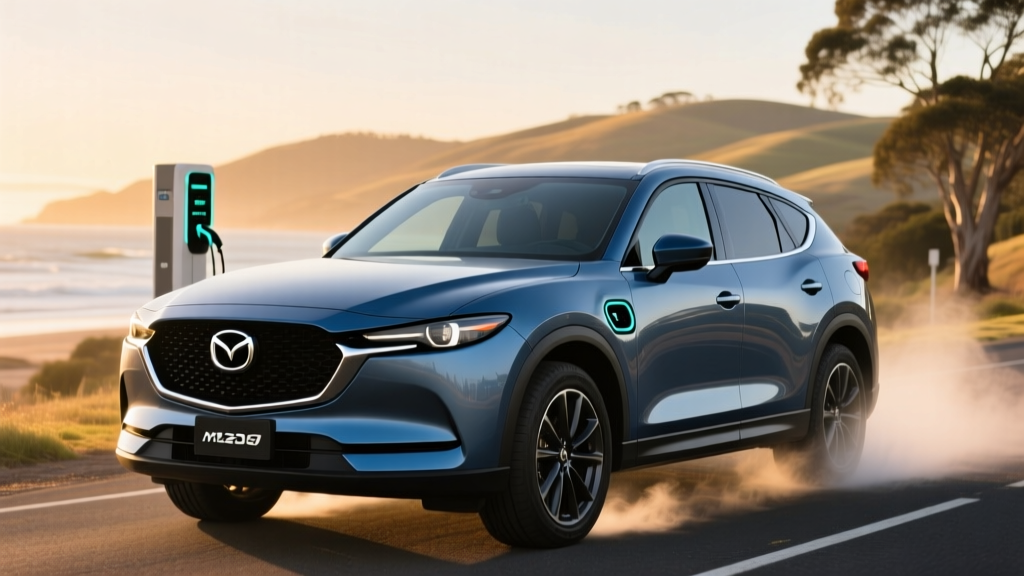
The 2026 Mazda CX-70 PHEV at a Glance
The 2026 Mazda CX-70 PHEV slots into a narrow but increasingly crowded space: a two-row, plug-in hybrid midsize SUV that tries to feel more premium than its price suggests. Built on Mazda's new longitudinal, rear-biased "Large" platform — shared with the three-row CX-90 — the CX-70 PHEV pairs a 2.5-liter four-cylinder with a 173-hp electric motor and a 17.8 kWh lithium-ion battery pack to deliver 327 combined horsepower and an EPA-estimated 26 miles of electric-only driving.
That EV-only range is shorter than rivals like the Toyota RAV4 Prime (42 miles) and Hyundai Tucson PHEV (33 miles). But Mazda is betting that driving dynamics, interior quality, and a starting MSRP of $57,350 (before any incentives) will win over buyers who want something closer to a BMW X5 without the BMW price tag. Here's everything you need to know before signing.
| Spec | Value |
|---|---|
| Powertrain | 2.5L I4 + electric motor (PHEV) |
| Combined Horsepower / Torque | 327 hp / 369 lb-ft |
| Battery (Usable) | 17.8 kWh lithium-ion |
| EPA Electric-Only Range | 26 miles |
| EPA MPGe (Electric + Gas) | 56 MPGe |
| EPA MPG (Gas Only, Combined) | 25 mpg |
| 0-60 mph | ~5.9 seconds |
| Max AC Charge Rate | ~7.2 kW (Level 2) |
| DC Fast Charging | Not available |
| Starting MSRP | $57,350 |
| Federal Tax Credit (§30D) | Up to $3,750 (sourcing dependent) |
HEV vs PHEV: What the CX-70 Actually Offers
Before digging into the numbers, it's worth clarifying the difference between the CX-70's two electrified flavors, because Mazda sells both:
Conventional Hybrid (HEV) — CX-70 Hybrid
Uses a small battery (under 2 kWh) that charges exclusively through regenerative braking and the gas engine. You never plug it in. The electric motor assists the engine for modest efficiency gains but cannot propel the car on electricity alone for meaningful distances. Think of it as a more efficient gas car.
Plug-In Hybrid (PHEV) — CX-70 PHEV
Carries a much larger 17.8 kWh battery that you charge by plugging in (Level 1 or Level 2). It can drive up to 26 miles on electricity alone before the gas engine takes over. After the battery is depleted, it operates like a conventional hybrid. Best for drivers who can charge at home and have commutes under 26 miles.
This article focuses on the CX-70 PHEV. If you cannot charge at home or at work, the conventional CX-70 HEV (with its inline-six mild-hybrid powertrain) is worth considering instead — you'll sacrifice the EV-only commute but avoid the PHEV's price premium and dead battery weight.
Fuel Economy and Electric Range: The Real Numbers
| Mode | City | Highway | Combined |
|---|---|---|---|
| Electric + Gas (MPGe) | — | — | 56 MPGe |
| Gas Only (after battery depleted) | 24 mpg | 27 mpg | 25 mpg |
| Electric-Only Range | 26 miles (EPA) | ||
| Total Combined Range | ~490 miles (est.) | ||
The EPA's 26-mile EV estimate is achievable in mild weather with mixed city/highway driving. In our experience with Mazda's PHEV system (shared with the CX-90 PHEV), expect 22-24 miles of real-world EV range at highway speeds (65-75 mph) and closer to 27-29 miles in stop-and-go city traffic where regenerative braking recaptures energy. In cold weather (below 35°F), lithium-ion batteries lose efficiency — plan on 18-21 miles of EV range in winter unless you precondition the cabin while still plugged in, which draws from the grid rather than the battery.
Once the battery depletes, the 25 mpg combined gas figure is accurate for mixed driving. Highway-only road trips will net closer to 27 mpg; aggressive city driving may dip to 22-23 mpg. This is competitive but not class-leading — the RAV4 Prime returns 38 mpg gas-only after its battery is spent, thanks to Toyota's more efficient planetary hybrid system.
Charging: Level 1, Level 2, and What You Can't Do
| Level | Power | Time (0-100%) | Notes |
|---|---|---|---|
| Level 1 (120V household) | ~1.4 kW | ~12-14 hours | Overnight top-up only |
| Level 2 (240V home/public) | ~7.2 kW | ~2.5 hours | Full charge in one session |
| DC Fast Charge | N/A | N/A | Not supported |
The CX-70 PHEV uses a standard J1772 connector for AC charging. A full Level 2 charge at 7.2 kW takes roughly two and a half hours — fast enough to recharge during a workday if your office has Level 2 stations. The onboard charger caps at 7.2 kW, so installing a 48-amp home charger (which can deliver up to 11.5 kW) won't speed things up; a more affordable 32-amp unit is perfectly matched to this vehicle.
The critical limitation: the CX-70 PHEV does not support DC fast charging. This is typical for PHEVs (the RAV4 Prime and Tucson PHEV also lack DCFC), but it means you cannot quickly top up on a road trip. Once the 26-mile EV buffer is gone, you're running on gas until you can plug in at home or a destination charger.
Powertrain and Performance
The CX-70 PHEV's powertrain is a carryover from the CX-90 PHEV:
- Engine: 2.5-liter inline-four, naturally aspirated, 189 hp / 189 lb-ft
- Electric Motor: 173 hp / 203 lb-ft (integrated into the 8-speed automatic transmission)
- Combined Output: 327 hp / 369 lb-ft
- Transmission: 8-speed automatic (no CVT)
- Drivetrain: Rear-biased all-wheel drive (i-Activ AWD)
- 0-60 mph: Approximately 5.9 seconds
The eight-speed automatic is a differentiator. Most PHEV competitors use continuously variable transmissions (CVTs) that drone under hard acceleration. Mazda's conventional stepped gearbox delivers more natural shift feel and better highway passing response. The rear-biased AWD system also gives the CX-70 a more planted, sporty character than the front-drive-biased RAV4 Prime or Tucson PHEV.
Drive modes include EV (electric-only), EV Charge (engine charges battery while driving), and a combined mode that blends both for maximum acceleration. The EV mode is best reserved for city driving and short commutes; EV Charge mode is useful before entering zero-emission zones or if you want to save battery for later.
Pricing, Trims, and Federal Tax Credit Eligibility
| Trim | MSRP |
|---|---|
| Preferred | $57,350 |
| Premium | $61,650 |
| Premium Plus | $65,350 |
All prices include the $1,420 destination charge. The PHEV powertrain is available only on these three upper trims — Mazda does not offer a base S or Carbon variant with the plug-in system.
The CX-70 PHEV qualifies for a partial federal tax credit of up to $3,750, contingent on battery component and critical mineral sourcing requirements under current IRS rules. Here's the breakdown:
- $3,750 — Battery Components: Must meet North American manufacturing thresholds (phased requirements through 2029)
- $3,750 — Critical Minerals: Must meet sourcing thresholds from the US or FTA partners
- MSRP Cap: The CX-70 PHEV is classified as an SUV (MSRP cap $80,000) — all trims qualify
- Buyer Income Cap: AGI must not exceed $150,000 (single), $225,000 (head of household), or $300,000 (joint)
- Point-of-Sale Transfer: Eligible buyers can apply the credit as a down-payment reduction at the dealer
As of the 2026 model year, the CX-70 PHEV typically qualifies for the $3,750 battery-component half of the credit. The critical-mineral half depends on Mazda's supply chain compliance for the specific build month — ask your dealer for the IRS-listed credit amount for your VIN before purchase. Always verify current eligibility at IRS.gov or fueleconomy.gov, as sourcing rules tighten annually.
Battery Warranty, Reliability, and Replacement Cost
- Hybrid/PHEV Battery: 8 years / 100,000 miles (capacity retention warranty — Mazda covers replacement if the battery drops below a specified threshold, typically around 70% of original capacity)
- Powertrain: 5 years / 60,000 miles
- Bumper-to-Bumper: 3 years / 36,000 miles
Mazda's PHEV system has been in the field since the 2024 CX-90 PHEV launch. So far, there are no widespread battery failure reports, and the system is less complex than some competitors' — it uses a single electric motor integrated into the transmission rather than a multi-motor setup.
Regarding replacement cost: out-of-warranty PHEV battery packs in this size class typically run $8,000 to $12,000 including labor. However, modern lithium-ion PHEV batteries are designed for 15+ years of service with gradual degradation rather than sudden failure. Most owners will see 10-15% capacity loss over 10 years, meaning that 26-mile EV range might drop to 22-23 miles by year 10 — still useful for short commutes.
Mazda's 8-year/100,000-mile battery warranty is the legal minimum for PHEVs in the US (mandated for emissions-related components in many states, and standard across the industry). Compare this to Hyundai's 10-year/100,000-mile coverage if long-term battery peace of mind is a priority.
Who Should Buy the CX-70 PHEV — And Who Shouldn't
Pros
- Premium interior quality rivals luxury SUVs costing $15K more
- Rear-biased AWD and 8-speed automatic deliver genuinely engaging driving dynamics
- 327 hp provides confident highway merging and passing
- 26 miles EV range covers many daily commutes gas-free
- No range anxiety — 490+ mile total range for road trips
- Quiet, well-insulated cabin at highway speeds
Cons
- 26-mile EV range is short vs. RAV4 Prime (42 mi) and Tucson PHEV (33 mi)
- No DC fast charging
- 25 mpg gas-only is mediocre for a PHEV once the battery is depleted
- $57,350 starting price is steep for a two-row midsize SUV
- Partial tax credit only ($3,750 vs. the full $7,500 some rivals earn)
- Rear seat and cargo space trail the CX-90 and key competitors
CX-70 PHEV vs. Alternatives: Which Fits You?
Choose the CX-70 PHEV if: You want a premium-feeling two-row SUV with sporty driving dynamics, can charge at home, and your daily commute is under 25 miles. You value interior quality and a conventional automatic transmission over maximum EV range.
Choose the Toyota RAV4 Prime if: You want 42 miles of EV range, 38 mpg after the battery is spent, available DC fast charging (on 2025+ models), and a lower starting price (~$44,000). You don't mind a less premium interior and CVT drivetrain.
Choose a full EV (e.g., Tesla Model Y, Hyundai Ioniq 5) if: You can charge at home, your daily driving is under 250 miles, and you want zero tailpipe emissions, minimal maintenance, and eligibility for the full $7,500 federal credit (on qualifying models). You don't need the gas-engine safety net for long road trips.
Choose the conventional CX-70 Hybrid (HEV) if: You cannot charge at home or at work. The HEV requires no plug, delivers solid fuel economy, and costs less upfront — but you forfeit the EV-only commute and the federal tax credit.
Frequently Asked Questions
How many MPG does the CX-70 PHEV get?
The EPA rates the CX-70 PHEV at 56 MPGe when operating with a charged battery (electric + gas combined) and 25 mpg combined (24 city / 27 highway) after the battery is depleted. Real-world gas-only MPG typically lands between 23-27 depending on driving style and conditions.
How far can the CX-70 PHEV go on electric only?
The EPA estimates 26 miles of electric-only range. In real-world driving, expect 22-24 miles at highway speeds and 27-29 miles in city traffic. Cold weather (below 35°F) reduces this to approximately 18-21 miles unless you precondition the cabin while plugged in.
Does the CX-70 PHEV qualify for a tax credit?
Yes, but only a partial credit. Under current IRS §30D rules, the CX-70 PHEV typically qualifies for $3,750 (the battery-component half of the credit). Eligibility depends on your income, the vehicle's battery sourcing for your specific build month, and MSRP caps. The credit can be applied at the point of sale as a down-payment reduction. Verify your eligibility at IRS.gov.
Is the CX-70 PHEV reliable? What does battery replacement cost?
Mazda's PHEV system has been in production since 2024 (CX-90 PHEV) with no widespread failure reports. The hybrid battery is covered by an 8-year/100,000-mile warranty. Out-of-warranty replacement is estimated at $8,000-$12,000, though modern PHEV batteries typically last 15+ years with gradual (not sudden) degradation.
Can the CX-70 PHEV DC fast charge?
No. The CX-70 PHEV supports Level 1 (120V) and Level 2 (240V) AC charging only. A full Level 2 charge takes approximately 2.5 hours at 7.2 kW. This is standard for most PHEVs in this class.
Should I get the CX-70 PHEV or a full EV?
If you can charge at home, drive under 250 miles daily, and want minimal maintenance, a full EV (like the Hyundai Ioniq 5 or Tesla Model Y) offers lower running costs and a larger tax credit. The CX-70 PHEV makes sense if you frequently take road trips beyond EV charging infrastructure, need the gas-engine safety net, or prefer a premium interior without luxury-brand pricing.
What's the difference between the CX-70 PHEV and CX-70 Hybrid?
The PHEV has a 17.8 kWh battery you plug in for 26 miles of EV range, 327 combined hp, and qualifies for a partial tax credit. The conventional Hybrid (HEV) has a small battery charged only by the engine and regenerative braking, does not plug in, offers no EV-only driving, and does not qualify for the federal tax credit. If you can't charge at home, the HEV is the better choice.