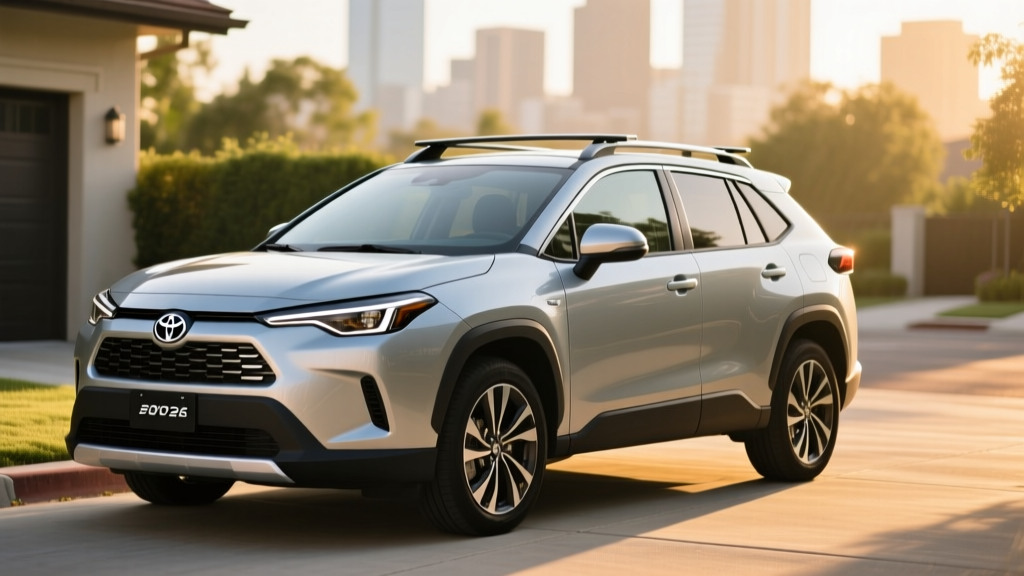
The 2026 Toyota Corolla Cross Hybrid SE occupies a narrow but compelling lane: a compact crossover that delivers genuine hybrid efficiency without the price premium or plug-in complexity of a PHEV. With an EPA-estimated 42 MPG combined and standard all-wheel drive, it targets buyers who want to cut fuel costs without changing their refueling habits. This review breaks down the SE trim specifically — the sportier, more aggressively styled hybrid variant — with exact figures on efficiency, powertrain output, pricing, and long-term battery reliability.
Corolla Cross Hybrid SE: Quick Specs at a Glance
| Spec | Value |
|---|---|
| Powertrain | 2.0L 4-cyl + 2 electric motors (AWD-i) |
| Combined Horsepower | 196 hp |
| EPA MPG (City / Hwy / Combined) | 45 / 38 / 42 |
| Fuel Tank Capacity | 11.4 gallons |
| Total Driving Range | ~478 miles |
| Drivetrain | Electronic AWD (AWD-i) |
| 0–60 mph (est.) | ~7.5 seconds |
| Cargo Volume (rear seats up / down) | 25.5 / 61.8 cu ft |
| Hybrid Battery Warranty | 10 years / 150,000 miles |
| Starting MSRP (SE trim) | ~$32,540 |
HEV vs PHEV: The Corolla Cross Hybrid Is a Conventional Hybrid
Key distinction: The Corolla Cross Hybrid is a conventional hybrid (HEV), not a plug-in hybrid (PHEV). It has no plug, no electric-only driving mode of meaningful distance, and no external charging requirement. The small hybrid battery recharges through regenerative braking and the gasoline engine. If you're looking for a Toyota compact crossover you can plug in, that would be the RAV4 Prime (PHEV) — a larger, more expensive vehicle. The Corolla Cross Hybrid does not have a PHEV variant as of the 2026 model year.
This matters because conventional hybrids like the Corolla Cross Hybrid SE require zero behavioral change. You fuel it like any gas car. The hybrid system simply optimizes when the engine runs, when the electric motors assist, and how much energy is recaptured during braking. The result is dramatically better fuel economy — especially in city driving — without range anxiety or charging logistics.
Fuel Economy: EPA Ratings and Real-World MPG
The EPA rates the 2026 Corolla Cross Hybrid at 45 MPG city, 38 MPG highway, and 42 MPG combined across all hybrid trims including the SE. These figures come from fueleconomy.gov, the official source for EPA efficiency data.
| Driving Cycle | EPA MPG | Real-World Expectation |
|---|---|---|
| City | 45 MPG | 44–48 MPG (hybrids often exceed EPA in stop-and-go) |
| Highway | 38 MPG | 35–38 MPG (aerodynamic drag limits hybrid advantage at speed) |
| Combined | 42 MPG | 39–44 MPG depending on driving mix |
Real-world context: Toyota's hybrid system excels in urban and suburban driving where regenerative braking frequently recaptures energy and the engine can shut off at stops. Owners who do mostly city driving commonly report matching or slightly exceeding the 45 MPG city figure. Highway-heavy commutes at 75+ mph will pull numbers closer to 35–37 MPG, as the electric motors provide less benefit at sustained high speeds and the 2.0L engine carries more of the load. In cold weather (below freezing), expect a 5–10% MPG reduction during warm-up cycles, as the engine runs more frequently to heat the cabin and bring the hybrid battery to operating temperature.
Compared to the non-hybrid Corolla Cross AWD (rated at roughly 29 MPG combined), the hybrid delivers a ~45% improvement in combined fuel economy. Over 15,000 miles per year at $3.40/gallon, that translates to roughly $750–$850 in annual fuel savings.
Powertrain: 196 HP with Electronic AWD
The Corolla Cross Hybrid SE pairs a 2.0-liter Dynamic Force 4-cylinder engine with Toyota's fifth-generation hybrid system. Two electric motor-generators handle the front axle, while a dedicated rear-axle electric motor provides electronic all-wheel drive (AWD-i). Combined system output is 196 horsepower — a meaningful step up from the 169 hp in the non-hybrid Corolla Cross.
The AWD-i system doesn't use a mechanical driveshaft to the rear wheels. Instead, the rear electric motor engages automatically when the system detects front-wheel slip, during hard acceleration, or in low-traction conditions. It's not designed for off-roading, but it handles rain, light snow, and gravel competently.
The SE trim adds sport-tuned suspension tuning and paddle shifters that let you select from six simulated gear ratios. It doesn't change the fundamental powertrain behavior — the e-CVT still manages power delivery — but it gives more engine-braking control on descents and a slightly more engaging feel on back roads.
Hybrid Battery: Warranty, Longevity, and Replacement Cost
Hybrid Battery Warranty: Toyota covers the Corolla Cross Hybrid's battery pack for 10 years or 150,000 miles, whichever comes first. This applies to all 50 states. The warranty guarantees the battery will retain sufficient capacity to operate the hybrid system — it is not a capacity-retention percentage warranty like an EV battery, but rather a functional warranty covering defects and premature failure.
The Corolla Cross Hybrid uses a relatively small nickel-metal hydride (NiMH) or lithium-ion hybrid battery pack (exact kWh capacity is not published by Toyota, as it is not a primary energy storage system — it buffers energy between the engine, regenerative braking, and the electric motors). This pack is far smaller than an EV battery, typically in the 1–2 kWh range, and operates within a narrow state-of-charge window managed by the hybrid control system. This shallow-cycling approach is a major reason Toyota hybrid batteries routinely last 150,000–200,000+ miles.
Replacement cost: If a hybrid battery does fail outside of warranty, replacement at a Toyota dealer typically costs $2,000–$4,000 including parts and labor for Toyota compact hybrid platforms. Independent hybrid specialists often offer refurbished or reconditioned packs for $1,500–$2,500. Given the 10-year/150,000-mile warranty and Toyota's track record with hybrid battery longevity (the Prius has been in production since 1997), out-of-pocket battery replacement is uncommon for first owners.
Pricing, Trims, and Tax Credit Eligibility
The 2026 Corolla Cross Hybrid SE carries a starting MSRP of approximately $32,540 including destination charge. This positions it roughly $3,000–$4,000 above the equivalent non-hybrid SE AWD trim, a premium you'll recoup through fuel savings in approximately 4–5 years at average mileage.
Key SE trim features include:
- Sport-tuned suspension and unique exterior styling
- 18-inch alloy wheels
- Toyota Safety Sense 3.0 (pre-collision, lane departure, adaptive cruise, road sign assist)
- 8-inch touchscreen with wireless Apple CarPlay and Android Auto
- SofTex-trimmed heated front seats
- Smart Key system with push-button start
Federal tax credit: The Corolla Cross Hybrid does not qualify for the federal §30D Clean Vehicle Credit. Per IRS rules, only battery electric vehicles (BEVs) and plug-in hybrid electric vehicles (PHEVs) with a minimum battery capacity of 7 kWh are eligible. Conventional hybrids like the Corolla Cross Hybrid are excluded. Some states and utilities offer rebates for conventional hybrids — check your state energy office or local utility for current programs, but these are typically modest ($250–$500) compared to the federal EV credit.
Corolla Cross Hybrid SE vs Full EV vs Gas: Which Fits You?
Choose the Corolla Cross Hybrid SE if:
- You want 40+ MPG without changing refueling habits
- You lack access to home or workplace EV charging
- You want AWD for inclement weather without a fuel-economy penalty
- You drive 12,000–18,000 miles per year and want measurable fuel savings
- You want Toyota's long-proven hybrid reliability with a 10-year battery warranty
Consider a full EV instead if:
- You can install a Level 2 home charger and want near-zero fuel costs
- You drive mostly in-city (EVs are most efficient in stop-and-go)
- You want to qualify for the $7,500 federal tax credit (subject to income, MSRP, and sourcing rules)
- You want to eliminate oil changes and engine maintenance entirely
- You're ready for 250+ miles of EPA range from vehicles like the Hyundai Ioniq 5 or Tesla Model Y
The Corolla Cross Hybrid SE makes the most sense for buyers who want efficiency gains with zero infrastructure dependency. It's the pragmatic middle path: you'll spend roughly $1,100–$1,300 per year on fuel (at 15,000 miles and $3.40/gallon) versus $1,800–$2,000 for the gas-only Corolla Cross AWD, or $500–$700 for a comparable EV charged mostly at home at national-average electricity rates. The hybrid eliminates range anxiety entirely while still delivering substantial savings.
Frequently Asked Questions
How many MPG does the 2026 Corolla Cross Hybrid SE get?
The EPA rates it at 45 MPG city, 38 MPG highway, and 42 MPG combined. Real-world results typically fall between 39–44 MPG combined depending on your driving mix, with city-heavy routes often achieving 44+ MPG and highway-heavy routes closer to 35–38 MPG.
Can the Corolla Cross Hybrid drive on electric power only?
Only at very low speeds for brief distances (typically under 1 mile at parking-lot speeds). This is a conventional hybrid, not a plug-in. The electric motors assist the engine and enable engine-off coasting and stop-start, but sustained electric-only driving is not a feature. For meaningful electric-only range (40+ miles), you'd need a PHEV like the RAV4 Prime.
Does the Corolla Cross Hybrid qualify for any federal tax credit?
No. The federal §30D Clean Vehicle Credit applies only to plug-in vehicles (BEVs and PHEVs) with at least 7 kWh of battery capacity. The Corolla Cross Hybrid is a conventional HEV and is ineligible. Some state or utility incentives may apply — check your local programs.
Is the Corolla Cross Hybrid reliable, and what will battery replacement cost?
Toyota's hybrid system has an extensive reliability track record spanning over 25 years since the original Prius. The hybrid battery is warrantied for 10 years/150,000 miles. Out-of-warranty replacement typically costs $2,000–$4,000 at a dealer, though failures before 200,000 miles are uncommon based on historical Toyota hybrid data.
Does the SE trim get different MPG than other Corolla Cross Hybrid trims?
No. All 2026 Corolla Cross Hybrid trims (S, SE, XSE) share the same powertrain, battery, and EPA ratings: 45/38/42 MPG. The SE's sport-tuned suspension and 18-inch wheels do not meaningfully affect fuel economy versus other hybrid trims.
How does the Corolla Cross Hybrid compare to the RAV4 Hybrid?
The RAV4 Hybrid is larger, more powerful (219 hp), and offers more cargo space, but it's rated at 39–41 MPG combined and starts around $35,000+. The Corolla Cross Hybrid sacrifices some interior room and power for better fuel economy and a lower entry price. If you need maximum cargo capacity or tow capacity, the RAV4 Hybrid is the better fit. If you prioritize efficiency and a smaller footprint, the Corolla Cross Hybrid wins.