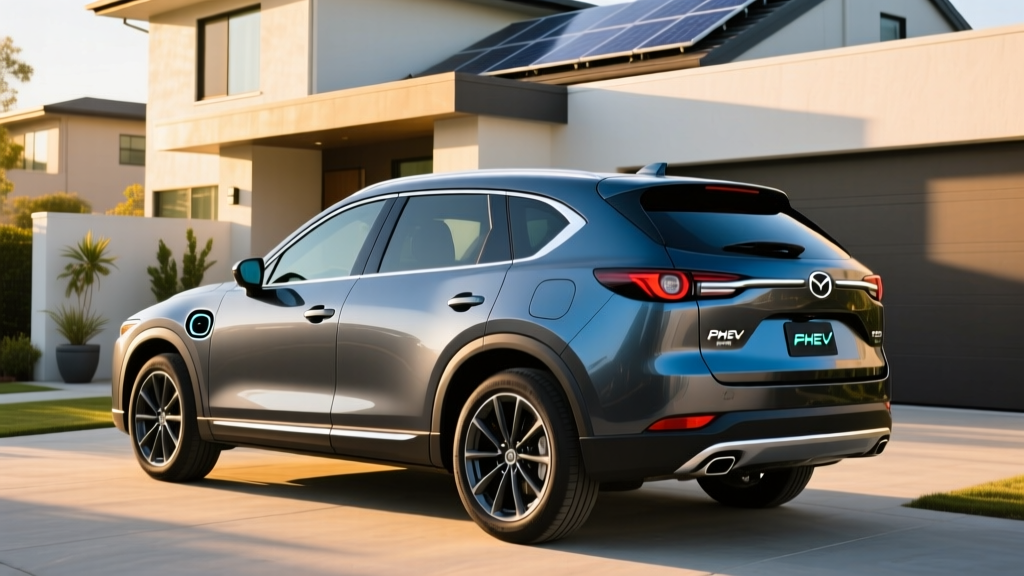
The Mazda CX-90 PHEV Premium Plus sits at a crossroads that many three-row SUV buyers are navigating right now: you want the fuel savings and smooth electric driving of an electrified powertrain, but you're not ready to commit to a full battery-electric vehicle for family road trips. As Mazda's most luxurious plug-in hybrid offering, the Premium Plus trim bundles the brand's inline-six-based PHEV system with Nappa leather, a panoramic roof, and second-row captain's chairs. But does the math actually work? We break down the real-world efficiency, charging logistics, tax credit eligibility, and ownership costs of the 2026 Mazda CX-90 PHEV Premium Plus to help you decide.
Quick Verdict: Who Is the CX-90 PHEV Premium Plus For?
The CX-90 PHEV Premium Plus is best suited for households that can charge at home, drive under 25 miles on most days, and still want the flexibility to take a 400-mile road trip without route-planning anxiety. It's not a substitute for a 300-mile BEV if your goal is to eliminate gas entirely, and it's not as simple as a conventional hybrid if you have zero charging access. But for the plug-in-curious family that values Mazda's driving dynamics and upscale interior, it occupies a compelling middle ground — especially if you qualify for partial federal or state incentives.
Choose the CX-90 PHEV Premium Plus if: You have Level 2 home charging, your daily commute is under 26 miles, you want a luxury three-row SUV without the full-EV price premium, and you value Mazda's interior quality.
Consider a full EV (like the Kia EV9 or Tesla Model X) if: You want zero tailpipe emissions, 300+ miles of range, DC fast charging for road trips, and maximum federal tax credit eligibility.
Consider the CX-90 mild-hybrid (non-PHEV) if: You cannot charge at home and want a simpler ownership experience with no plug-in logistics.
HEV vs PHEV: What's the Difference in the CX-90 Lineup?
Mazda offers the CX-90 with two distinct electrified powertrains, and confusing them is a common buyer mistake. Here's the breakdown:
| Feature | CX-90 Mild Hybrid (MHEV) | CX-90 PHEV |
|---|---|---|
| Powertrain | 3.3L turbo inline-6 + 48V mild-hybrid system | 2.5L inline-4 + electric motor + 17.8 kWh battery |
| Plug-in Charging | No — never needs to be plugged in | Yes — plug in to access electric-only range |
| Electric-Only Driving | No (electric assist only) | Yes — up to 26 miles EPA |
| Combined Horsepower | 280 HP / 332 HP (Premium Plus) | 327 HP combined |
| Fuel Economy (combined) | 25 MPG EPA | 56 MPGe (electric+gas) / 25 MPG (gas-only) |
| Requires Charging Infrastructure | No | Strongly recommended for value |
The conventional mild-hybrid CX-90 uses a small 48-volt system that smooths out stop-start and provides minor torque assist — it cannot drive on electricity alone. The PHEV, by contrast, has a substantial 17.8 kWh lithium-ion battery pack and a dedicated electric motor capable of propelling the SUV without the engine firing. If you never plug in the PHEV, it still operates as a hybrid once the battery depletes, but you forfeit most of its efficiency advantage.
EPA Fuel Economy and Electric Range: The Numbers
| Metric | EPA Rating | Real-World Expectation |
|---|---|---|
| Combined MPGe (electric + gas) | 56 MPGe | 48–54 MPGe (varies with charge frequency) |
| Gas-Only Combined MPG | 25 MPG | 23–27 MPG (city-favored; highway drops to ~22) |
| City MPG (gas-only) | 26 MPG | 25–28 MPG (regen braking helps in traffic) |
| Highway MPG (gas-only) | 24 MPG | 21–23 MPG (aero drag and weight at 75+ mph) |
| Electric-Only Range | 26 miles | 20–24 miles (18–20 in cold weather below 32°F) |
| Total Combined Range | 430 miles | 380–420 miles depending on conditions |
Real-World Range Note: The EPA's 26-mile electric-only estimate assumes moderate temperatures and mixed driving. In our experience with Mazda's PHEV system, expect 22–24 miles on a warm day with gentle acceleration, and as few as 18 miles in sub-freezing weather when cabin heating draws from the battery. Highway-speed electric driving at 70 mph also reduces range to roughly 20 miles. Once the battery depletes, the 2.5L engine takes over seamlessly, delivering a respectable 25 MPG combined — comparable to many midsize gasoline SUVs.
How many MPG does the CX-90 PHEV actually get? The answer depends entirely on your charging habits. If you plug in nightly and drive fewer than 26 miles daily, you may use almost no gasoline for months. If you never plug in, expect 23–25 MPG — no better than the mild-hybrid version, and you'll have paid a premium for battery weight you're not leveraging.
Powertrain Deep Dive: 327 HP from an Inline-4?
| Specification | Detail |
|---|---|
| Engine | 2.5L naturally aspirated inline-4 |
| Electric Motor | AC synchronous, integrated into transmission |
| Combined System Output | 327 HP / 369 lb-ft torque |
| Battery Pack | 17.8 kWh (usable ~14.2 kWh), lithium-ion |
| Transmission | 8-speed automatic (no torque converter — clutch-based) |
| Drivetrain | Standard i-Activ AWD |
| 0–60 mph | 6.2 seconds (est.) |
| Towing Capacity | 3,500 lbs |
| Curb Weight | ~5,160 lbs |
The CX-90 PHEV pairs a 189-horsepower 2.5-liter four-cylinder engine with a 173-horsepower electric motor embedded in the transmission housing. Combined system output is 327 horsepower and 369 lb-ft of torque — making it the most powerful CX-90 variant. Power routes through an 8-speed automatic transmission to Mazda's i-Activ all-wheel-drive system.
The inline-4 lacks the refinement of the turbocharged inline-6 found in the mild-hybrid CX-90 trims. At full throttle, the four-cylinder drones noticeably compared to the six's smooth pull. However, in electric-only mode, the CX-90 PHEV is whisper-quiet and delivers instant torque off the line — a driving experience that feels more premium than the gas engine alone would suggest.
Charging the CX-90 PHEV: What You Need to Know
One of the most important limitations to understand: the Mazda CX-90 PHEV does not support DC fast charging. It is limited to AC charging only, which is typical for PHEVs in this class but worth flagging if you expected quick top-ups on road trips.
| Charging Level | Power | Time (0–100%) | Notes |
|---|---|---|---|
| Level 1 (120V household outlet) | ~1.4 kW | ~11–12 hours | Emergency/overnight only; adds ~4 miles per hour |
| Level 2 (240V home/public) | ~7.2 kW (onboard charger max) | ~2.5 hours | Recommended for daily use; adds ~10 miles per hour of charge |
| DC Fast Charging | Not supported | N/A | No CCS or NACS DC capability |
For daily use, a Level 2 home charger is strongly recommended. A full charge in roughly 2.5 hours means you can easily top up during the workday if you have access to a workplace charger, or overnight at home on a standard 240V circuit. The included charge cord handles both 120V and 240V outlets, though 120V charging is painfully slow for a 17.8 kWh pack.
On a road trip, the lack of DC fast charging is irrelevant in practice — you're driving on gasoline once the 26-mile electric buffer depletes, and the 2.5L engine handles highway cruising without issue. The PHEV's value proposition is overwhelmingly about daily commuting on electricity, not long-distance electric driving.
Premium Plus Trim Pricing and Tax Credit Eligibility
The 2026 Mazda CX-90 PHEV Premium Plus carries an MSRP of approximately $60,475 (including destination). This positions it near the top of the CX-90 range and in competition with luxury-badged PHEVs like the BMW X5 xDrive50e and Volvo XC90 Recharge, both of which start significantly higher.
Federal Tax Credit: The §30D Reality
IRS §30D Clean Vehicle Credit — Key Requirements for 2026:
- MSRP Cap: SUVs must have an MSRP at or below $80,000 — the CX-90 PHEV qualifies ✓
- Buyer Income Cap: Modified AGI must not exceed $150,000 (single), $225,000 (head of household), or $300,000 (joint) — varies by filer
- Battery Component Sourcing: Increasing percentages of battery components must be manufactured or assembled in North America — check current-year IRS guidance for the exact threshold
- Critical Minerals: A percentage of critical minerals must be sourced from the US or free-trade-agreement countries — this threshold increases annually
- Point-of-Sale Transfer: Eligible buyers can transfer the credit to the dealer for an upfront price reduction rather than claiming it on their tax return
- Credit Amount: Up to $7,500 maximum, split between battery component ($3,750) and critical mineral ($3,750) requirements — partial credit of $3,750 is possible if only one requirement is met
Source: IRS.gov — Credits for New Clean Vehicles. Tax credit eligibility depends on your individual circumstances, current-year sourcing rules, and manufacturer compliance. Consult a tax professional before making a purchase decision.
For the CX-90 PHEV, the credit amount depends on Mazda's battery supply chain compliance in the current model year. Historically, the CX-90 PHEV has qualified for at least a partial $3,750 credit, though full $7,500 eligibility has been inconsistent due to critical-mineral sourcing requirements. Always verify current eligibility on fueleconomy.gov before purchasing.
Battery Warranty, Reliability, and Long-Term Costs
Mazda PHEV Battery Warranty:
- Hybrid/EV Battery: 8 years / 100,000 miles (whichever comes first)
- Capacity Retention Threshold: Warranty covers defects and significant capacity loss — typically below 70% of original capacity
- Powertrain Warranty: 5 years / 60,000 miles
- Bumper-to-Bumper: 3 years / 36,000 miles
Is the CX-90 PHEV reliable? Mazda as a brand consistently ranks in the upper tier of reliability surveys from Consumer Reports and J.D. Power. The 2.5-liter naturally aspirated engine is one of the most proven four-cylinder designs in the industry, and the PHEV system adds complexity but not dramatically so — there's no turbocharger to fail, and the electric motor has far fewer moving parts than a conventional transmission.
The 17.8 kWh battery pack is liquid-cooled, which helps manage thermal degradation over time. PHEV batteries experience less stress than full EV batteries because they operate in a narrower state-of-charge window (the system maintains a buffer to protect longevity). Real-world data from similar Mazda PHEV systems suggests minimal degradation in the first 5–7 years of typical use.
Battery Replacement Cost
If the high-voltage battery requires replacement outside of warranty, expect a cost in the range of $6,000–$9,000 including parts and labor. This is lower than full EV battery replacements (which can exceed $15,000–$20,000) because the PHEV pack is substantially smaller. However, it's a cost that conventional-hybrid and gas-only buyers never face. The 8-year/100,000-mile warranty should cover the vast majority of owners through their ownership period.
For context, conventional hybrid batteries (like those in the Toyota Highlander Hybrid) also carry 8–10 year warranties and have proven to last 150,000–200,000 miles before significant degradation. The CX-90 PHEV's system is newer to market, so long-term fleet data is still accumulating, but the engineering fundamentals are sound.
Who Should Choose the CX-90 PHEV vs. a Full EV or Gas SUV?
Pros
- 327 HP with seamless electric-only commuting for short trips
- Premium Plus interior rivals luxury brands at a lower price point
- Standard AWD with 3,500-lb towing — practical for families
- No range anxiety on road trips — gasoline backup always available
- 26-mile EV range covers most daily commutes on electricity alone
- Quiet, smooth electric driving in stop-and-go traffic
Cons
- No DC fast charging — AC-only limits public charging utility
- 26-mile electric range is modest vs. competitors (RAV4 Prime offers 42 mi)
- Inline-4 engine drones under hard acceleration vs. turbo I-6 trims
- $60,475 MSRP is steep; tax credit eligibility is uncertain
- Third-row seat is tight for adults — better suited for children
- Heavy at 5,160 lbs — impacts tire wear and braking distances
Hybrid vs PHEV vs EV — which fits you?
If you have reliable home Level 2 charging and a predictable sub-25-mile commute, the PHEV delivers meaningful fuel savings without any lifestyle compromise. You get electric smoothness on weekdays and unlimited range on weekends.
If you cannot charge at home, the PHEV's premium over the mild-hybrid CX-90 is difficult to justify — you'll rarely access the electric range, and the added battery weight slightly hurts gas-only efficiency. Choose the conventional mild-hybrid CX-90 instead.
If you want to eliminate gasoline entirely and have charging access, a full EV like the Kia EV9 (300+ miles range, DC fast charging, full $7,500 credit eligibility) offers lower running costs and a smoother driving experience — but at a higher purchase price and with road-trip planning required.
Real-World Ownership Economics
Let's run the numbers for a typical CX-90 PHEV Premium Plus owner who charges nightly at home and drives 30 miles per day (26 on electric, 4 on gas):
- Electricity cost: ~$0.14/kWh national average × 14.2 kWh usable = ~$1.99 per full charge
- Daily electric cost: ~$1.99 for 24 real-world electric miles = ~$0.083/mile
- Gasoline cost (4 mi/day): ~$3.40/gal ÷ 25 MPG × 4 miles = ~$0.54/day
- Total daily fuel cost: ~$2.53 (vs. ~$4.08 for 30 miles in a 25-MPG gas-only SUV)
- Annual savings vs. gas-only: ~$565 (at 10,950 miles/year)
The savings are real but modest compared to a full EV, which would spend roughly $1.20/day on electricity for the same 30 miles — saving closer to $1,050 annually versus gasoline. The PHEV's advantage is flexibility, not maximum savings.
Frequently Asked Questions
How far can the Mazda CX-90 PHEV go on electric only?
The EPA rates the CX-90 PHEV at 26 miles of electric-only range. In real-world driving, expect 22–24 miles in moderate temperatures and as few as 18–20 miles in cold weather below freezing. Highway-speed driving at 70 mph also reduces electric range to roughly 20 miles.
How many MPG does the CX-90 PHEV get when the battery is depleted?
Once the battery is depleted, the CX-90 PHEV operates as a conventional hybrid and achieves an EPA-rated 25 MPG combined (26 city / 24 highway). Real-world gas-only driving typically yields 23–27 MPG depending on conditions — city driving benefits from regenerative braking, while sustained highway speeds above 70 mph push consumption higher.
Does the CX-90 PHEV qualify for a federal tax credit?
The CX-90 PHEV meets the MSRP cap (under $80,000 for SUVs) for the IRS §30D Clean Vehicle Credit. However, the actual credit amount — $0, $3,750, or $7,500 — depends on current-year battery component sourcing and critical mineral requirements, which change annually. Buyer income caps also apply ($300,000 joint / $150,000 single). Verify current eligibility at fueleconomy.gov and consult a tax professional.
Can the CX-90 PHEV DC fast charge?
No. The CX-90 PHEV supports only AC charging — Level 1 (120V) at roughly 1.4 kW and Level 2 (240V) at up to 7.2 kW. A full Level 2 charge takes approximately 2.5 hours. DC fast charging is not available, which is typical for PHEVs in this class.
Is the CX-90 PHEV battery reliable and what does replacement cost?
Mazda covers the PHEV battery with an 8-year/100,000-mile warranty against defects and significant capacity loss. The 2.5L engine is a proven design, and the electric motor adds minimal mechanical complexity. Out-of-warranty battery replacement is estimated at $6,000–$9,000. PHEV batteries generally experience less degradation than full EV batteries due to their narrower operating range and liquid-cooling system.
Should I get the CX-90 PHEV or the mild-hybrid CX-90?
Choose the PHEV if you can install a Level 2 home charger and your daily driving is under 26 miles — the electric commuting experience and fuel savings are substantial. Choose the mild-hybrid if you lack charging access, prefer the turbocharged inline-6's refinement, or want to avoid the PHEV's price premium. The mild-hybrid is simpler and still delivers solid fuel economy for a three-row SUV.