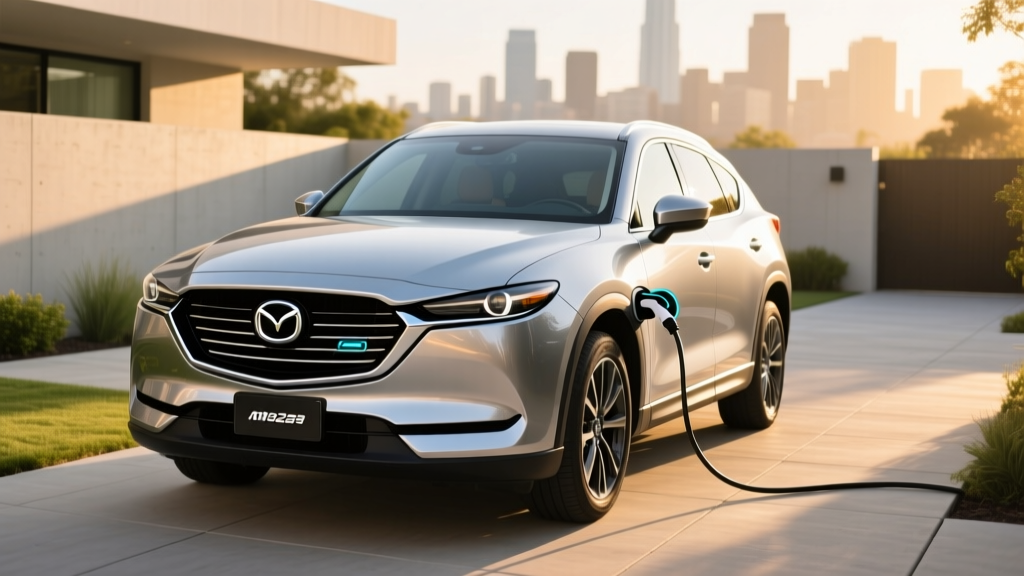
Three-row SUVs that deliver genuine fuel savings without sacrificing driving dynamics are rare. The Mazda CX-90 Hybrid lineup occupies a distinct space: it offers both a conventional mild-hybrid inline-six (the CX-90 Turbo variants) and a full plug-in hybrid (the CX-90 PHEV) under one nameplate. Buyers searching for Mazda CX-90 Hybrid MPG data often land on conflicting numbers because these two powertrains behave very differently at the pump — and at the charger.
This guide separates the mild-hybrid from the plug-in, maps out exact EPA figures, explains real-world expectations, and tells you which version fits your driving life in 2026.
HEV vs PHEV: Two Very Different CX-90 Hybrids
Conventional Hybrid (Mild-Hybrid Turbo)
The CX-90 Turbo S and related trims use a 48-volt mild-hybrid system paired with a 3.3L turbocharged inline-six. This system does not plug in and cannot drive on electric power alone. It recovers energy during braking and assists the engine under acceleration, improving efficiency modestly over a non-hybrid equivalent. Think of it as a more refined gas engine, not an electrified commute solution.
Plug-In Hybrid (CX-90 PHEV)
The CX-90 PHEV pairs a 2.5L four-cylinder engine with a larger electric motor and a 17.8 kWh lithium-ion battery pack. It plugs into a wall or charger, delivers meaningful electric-only range for daily commuting, and switches seamlessly to hybrid mode for longer trips. This is the version that fundamentally changes your fuel consumption — if your routine fits its electric envelope.
Mazda CX-90 Hybrid MPG: EPA Ratings by Powertrain
Here is how both powertrains stack up according to EPA data from fueleconomy.gov:
| Powertrain | City MPG | Highway MPG | Combined MPG | Combined MPGe (PHEV) |
|---|---|---|---|---|
| CX-90 Turbo S (Mild-Hybrid I6) | 24 | 28 | 25 | N/A |
| CX-90 PHEV (Plug-In Hybrid) | 26 (hybrid mode) | 27 (hybrid mode) | 25 (hybrid mode) / 56 MPGe (electric+gas) | 56 MPGe |
A few things jump out. The mild-hybrid's 25 MPG combined is respectable for a 4,800-lb three-row SUV, but it is not dramatically better than competing non-hybrid midsize crossovers. The PHEV's headline 56 MPGe figure only applies when you are regularly charging and driving within its electric range. Once the battery is depleted, you are looking at roughly 25 MPG combined — essentially the same as the mild-hybrid.
MPGe explained: MPGe (miles per gallon equivalent) converts electricity consumption into a gasoline-equivalent figure. It is useful for comparing a PHEV's electric-mode efficiency against gas vehicles, but it only reflects reality if you charge regularly. Drive the PHEV without ever plugging in, and your actual economy will hover around 25 MPG.
PHEV Electric-Only Range and Total Range
The CX-90 PHEV carries a 17.8 kWh battery (gross), with approximately 14.2 kWh usable. The EPA rates it at 26 miles of electric-only range.
EPA Electric Range: 26 miles
Real-World Expectation: 20–24 miles in mixed driving; 17–20 miles in sustained highway or cold-weather (below 40°F) conditions. Regenerative braking in stop-and-go city traffic can push range toward the upper end.
Total Combined Range (Electric + Gas): Approximately 430–460 miles with a full tank and full battery.
For context, 26 miles covers the average American one-way commute (roughly 16 miles according to Census Bureau data), meaning many PHEV owners can complete daily round trips on electricity alone — provided they charge nightly. If your commute exceeds 25 miles one way, you will burn gas on the tail end, which is still more efficient than starting the trip in hybrid mode with a cold engine.
Powertrain Specs and Performance
| Specification | CX-90 Turbo S (Mild-Hybrid) | CX-90 PHEV |
|---|---|---|
| Engine | 3.3L Turbo Inline-6 | 2.5L Inline-4 + Electric Motor |
| Combined Horsepower | 340 hp | 323 hp |
| Combined Torque | 369 lb-ft | 369 lb-ft |
| Transmission | 8-speed automatic | 8-speed automatic (no torque converter) |
| Drivetrain | AWD (i-Activ) | AWD (i-Activ) |
| 0–60 mph | ~6.4 seconds | ~6.9 seconds |
| Towing Capacity | 3,500 lbs | 3,500 lbs |
| Battery | 48V mild-hybrid (small) | 17.8 kWh lithium-ion |
Both powertrains route power through all four wheels via Mazda's i-Activ AWD. The PHEV's electric motor fills in torque at low RPM, giving it a punchy feel around town that belies its slightly slower 0–60 time. The inline-six Turbo S pulls harder at highway speeds and delivers the smoother, more linear power delivery that six-cylinder buyers expect.
Charging the CX-90 PHEV: Times and Limitations
The CX-90 PHEV supports Level 1 (120V) and Level 2 (240V) AC charging. It does not support DC fast charging — a limitation shared with most PHEVs in this class, since the battery is too small to benefit from high-speed DC infrastructure.
| Charging Level | Power | 0–100% Time | Miles of EV Range per Hour |
|---|---|---|---|
| Level 1 (120V household) | ~1.4 kW | ~10–11 hours | ~2–3 miles |
| Level 2 (240V home/public) | ~3.3 kW (onboard charger limit) | ~4.5–5 hours | ~5–6 miles |
The 3.3 kW onboard charger is the bottleneck. Even if you plug into a 7.2 kW or 11.5 kW Level 2 station, the CX-90 PHEV will only accept 3.3 kW. This means a full charge overnight on Level 2 is straightforward — plug in at 10 PM, wake up to a full battery by 5 AM. Level 1 charging from a standard outlet works but requires discipline: a depleted battery needs roughly 10+ hours, which is tight for a full workday turnaround.
Practical tip: The PHEV does not precondition its battery for charging (there is no active thermal management for the traction battery like you would find on a full BEV). In extreme heat or cold, charge times may extend slightly, and electric range will compress.
Pricing and Tax Credit Eligibility
As of the 2026 model year, Mazda prices the CX-90 lineup as follows (destination charges included in approximate figures):
- CX-90 Turbo S Preferred: ~$51,000
- CX-90 Turbo S Premium: ~$56,000
- CX-90 PHEV Preferred: ~$53,500
- CX-90 PHEV Premium Plus: ~$60,500
Federal Tax Credit (§30D)
The CX-90 PHEV has historically qualified for a partial federal tax credit under IRS §30D rules. For 2026, the credit structure requires:
- MSRP cap: SUVs must be priced at or below $80,000 — the CX-90 PHEV clears this easily.
- Buyer income cap: AGI must not exceed $150,000 (single), $225,000 (head of household), or $300,000 (joint).
- Battery sourcing: Critical minerals and battery component requirements phase in more strictly each year. The PHEV's credit amount depends on how many of these requirements the supply chain meets — historically, this has resulted in a $3,750 partial credit rather than the full $7,500.
- Point-of-sale transfer: As of 2024+, you can transfer the credit to the dealer at purchase, reducing your out-of-pocket cost immediately rather than waiting for tax filing.
Important: The mild-hybrid CX-90 Turbo S does not qualify for any federal EV tax credit. It is not a plug-in vehicle, and §30D applies only to BEVs and PHEVs with sufficient battery capacity.
Tax credit eligibility changes frequently due to supply-chain sourcing rules. Always verify current status with your tax professional and the IRS before purchasing.
Real-World MPG: What Owners Actually See
EPA numbers tell part of the story. Real-world results depend heavily on driving style, terrain, climate, and — for the PHEV — charging habits.
Mild-Hybrid Turbo S
Owners who drive predominantly on the highway at 70–80 mph typically report 26–28 MPG, slightly above the EPA highway estimate thanks to the inline-six's relaxed cruising RPM and the mild-hybrid system smoothing out load variations. City driving in dense traffic drops this to 20–22 MPG. Mixed commuting settles around 23–25 MPG.
PHEV
If you charge nightly and your daily driving stays under 26 miles, you may go months between fill-ups, effectively achieving 80–100+ MPGe in practice. Once the battery is depleted, expect 24–26 MPG combined, which is solid for a vehicle of this weight and size. Cold weather (below freezing) compresses electric range by 20–30% and reduces hybrid-mode efficiency by roughly 2–3 MPG due to cabin heating demands and thicker engine oil.
The key insight: the PHEV rewards charging discipline. Owners who plug in every night report annual fuel costs under $800. Owners who treat it as a conventional hybrid (never plugging in) spend roughly $2,200–$2,600 annually on fuel — essentially the same as the Turbo S.
Reliability, Battery Warranty, and Replacement Costs
Mazda Hybrid/PHEV Battery Warranty: 8 years / 100,000 miles (whichever comes first), covering defects and capacity loss below a specified threshold (typically 60–70% of original capacity for PHEV batteries).
Powertrain Warranty: 5 years / 60,000 miles.
Bumper-to-Bumper: 3 years / 36,000 miles.
Mazda's 2.5L four-cylinder (used in the PHEV) is one of the most widely deployed engines in the industry, with a long track record in the CX-5, Mazda3, and Toyota partnership vehicles. The 3.3L inline-six in the Turbo S is newer to the market (introduced for 2023–2024) and has shown no widespread reliability concerns through early model years, though long-term data is still accumulating.
Battery replacement cost: If the PHEV's 17.8 kWh battery requires replacement out of warranty, expect a parts-and-labor cost in the $5,000–$8,000 range based on current PHEV battery pricing in this capacity class. The mild-hybrid's 48V battery is smaller and less expensive to replace — typically $1,500–$2,500.
For reference, PHEV batteries in this size range rarely require full replacement before 150,000–200,000 miles under normal use. Degradation is gradual: expect to lose roughly 10–15% of electric range over the first 8–10 years, meaning your 26-mile EV range may become 22–23 miles by year 10.
Who Should Choose the CX-90 Hybrid — and Which Version?
Choose the CX-90 Turbo S (Mild-Hybrid) If:
- You cannot charge at home or work (no garage, no outlet access).
- You want a smooth inline-six with strong highway passing power.
- Your daily mileage is high and unpredictable — you need consistent fueling without plug-in logistics.
- You want lower upfront cost and do not need electric-only commuting.
Choose the CX-90 PHEV If:
- You have access to a 120V or 240V outlet where you park overnight.
- Your daily round-trip commute is under 25–30 miles.
- You want to minimize fuel costs on weekdays while retaining gas-engine flexibility for road trips.
- You value the partial federal tax credit and lower annual fuel spend.
Consider a Full EV Instead If:
- Your daily driving is consistently under 250 miles and you can install a Level 2 home charger.
- You want zero tailpipe emissions and minimal maintenance (no oil changes, no spark plugs).
- You qualify for the full $7,500 federal credit on a BEV like the Hyundai Ioniq 5, Tesla Model Y, or Kia EV9.
CX-90 PHEV Pros
- 26-mile EV range covers most commutes
- Premium interior with three-row seating
- 323 hp with instant electric torque
- Partial federal tax credit eligibility
- AWD standard on all trims
CX-90 PHEV Cons
- 3.3 kW onboard charger limits Level 2 speed
- No DC fast charging
- EV range drops significantly in cold weather
- Third-row space tight for adults
- Higher starting price than mild-hybrid trims
Frequently Asked Questions
How many MPG does the Mazda CX-90 Hybrid get?
The mild-hybrid CX-90 Turbo S achieves 24 city / 28 highway / 25 combined MPG. The CX-90 PHEV achieves 25 MPG combined in hybrid mode (once the battery is depleted) and 56 MPGe when operating with a charged battery. Real-world results vary: highway drivers in the mild-hybrid often see 26–28 MPG, while PHEV owners who charge daily may use very little gasoline at all.
How far can the CX-90 PHEV go on electric only?
The EPA rates it at 26 miles of electric-only range. In real-world driving, expect 20–24 miles in moderate conditions, dropping to 17–20 miles in cold weather or sustained highway speeds above 65 mph. This is sufficient for most daily commutes but not enough for longer errands without the engine engaging.
Does the Mazda CX-90 Hybrid qualify for a tax credit?
The CX-90 PHEV qualifies for a partial federal tax credit under IRS §30D — historically $3,750, depending on battery sourcing compliance and your income level. The mild-hybrid Turbo S does not qualify for any federal EV credit. State incentives vary; check your local programs.
Is the CX-90 Hybrid reliable, and what does battery replacement cost?
Mazda's hybrid components have shown strong early reliability. The PHEV battery is warranted for 8 years/100,000 miles. Out-of-warranty replacement runs approximately $5,000–$8,000 for the PHEV battery and $1,500–$2,500 for the mild-hybrid 48V battery. Full replacement before 150,000 miles is uncommon.
Do I need to plug in the CX-90 mild-hybrid?
No. The CX-90 Turbo S mild-hybrid charges its small 48V battery through regenerative braking and engine power. There is no plug and no electric-only driving mode. Only the CX-90 PHEV requires (and benefits from) plugging in.
Can the CX-90 PHEV DC fast charge?
No. The CX-90 PHEV supports only Level 1 (120V) and Level 2 (240V) AC charging, capped at 3.3 kW by its onboard charger. A full Level 2 charge takes approximately 4.5–5 hours. DC fast charging is not available, which is typical for PHEVs with sub-20 kWh batteries.