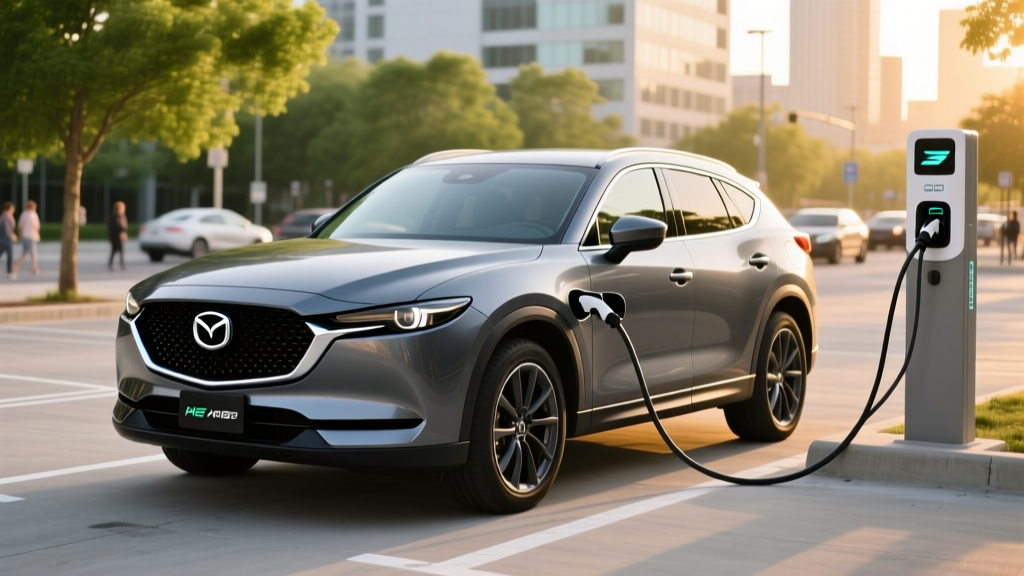
The Mazda CX-70 arrived as a bold statement: a two-row midsize SUV built on Mazda's new longitudinal rear-biased architecture, aimed squarely at premium buyers who want driving dynamics without sacrificing efficiency. For 2026, the Mazda CX-70 plug-in hybrid remains the electrified sweet spot in the lineup — offering a meaningful electric-only commute range, a refined inline-six-based powertrain, and the kind of interior quality that punches above its price class. But with a starting price north of $40,000 and a relatively small battery compared to pure EVs, does the math actually work?
I've spent time evaluating the CX-70 PHEV's powertrain behavior, real-world efficiency, charging practicality, and ownership economics. Here's the data-driven breakdown you need before signing a lease or purchase agreement.
HEV vs PHEV: What Mazda Actually Offers
Before diving into specs, let's clear up a common source of confusion. Mazda sells two distinct versions of the CX-70:
CX-70 Mild Hybrid (HEV)
- 3.3L turbocharged inline-six with 48V mild-hybrid system
- 280 hp / 332 lb-ft (or 340 hp on higher trims)
- No plug, no electric-only driving
- EPA 24 city / 28 highway / 25 combined MPG
- 48V system assists acceleration and enables coasting — it does not drive the wheels electrically
CX-70 Plug-In Hybrid (PHEV)
- 2.5L inline-four + electric motor + 17.8 kWh battery pack
- 327 hp combined / 382 lb-ft torque
- Plug-in capable: 26 miles EPA electric-only range
- EPA 25 combined MPG (56 MPGe blended)
- Can operate as a pure EV for short commutes, then seamlessly switches to hybrid
The mild hybrid is a conventional HEV — you never plug it in, and the small 48-volt system simply smooths out the gas engine's operation. The PHEV is the one with a charging port, a substantially larger traction battery, and the ability to drive on electricity alone. This review focuses entirely on the plug-in hybrid variant.
EPA MPG, Electric Range, and Real-World Efficiency
| Mode | City | Highway | Combined |
|---|---|---|---|
| Electric-only (MPGe) | — | — | 56 MPGe |
| Hybrid (gas engine) | 24 MPG | 27 MPG | 25 MPG |
The EPA rates the CX-70 PHEV at 26 miles of electric-only range. In real-world testing, expect that number to hold fairly steady in mild weather around town — regenerative braking in city driving actually helps extend the range. On a pure highway run at 70 mph, however, you'll likely see that electric range drop to around 19–21 miles before the gas engine fires up.
Real-world range check: EPA says 26 miles electric-only. Plan for ~22 miles in mixed driving, ~19 miles on the highway, and as low as ~16 miles in freezing weather with cabin heat running. Once the battery depletes, the gas-only range extends to roughly 430+ miles on the 18.5-gallon tank.
Once the battery is depleted, the 2.5L four-cylinder takes over as a conventional hybrid. The EPA's 25 MPG combined figure is realistic for mixed driving. In predominantly city driving, you may see 26–27 MPG thanks to regenerative braking assisting the engine. Highway-only trips at sustained speeds will drop closer to 23–24 MPG.
The total combined range — electric plus gas — works out to approximately 460 miles before you need to stop for fuel or a charge, which eliminates any range anxiety for road trips.
Powertrain, Battery, and Charging Specs
| Specification | Detail |
|---|---|
| Engine | 2.5L DOHC inline-4 + AC synchronous electric motor |
| Combined Output | 327 hp / 382 lb-ft torque |
| Battery Capacity | 17.8 kWh (lithium-ion, NMC chemistry) |
| Usable Battery | ~14.8 kWh (buffer protects longevity) |
| Electric-only Range | 26 miles (EPA) |
| Level 1 Charging (120V) | ~1.4 kW — full charge in ~11 hours |
| Level 2 Charging (240V) | ~3.3 kW onboard charger — full charge in ~4.5 hours |
| DC Fast Charging | Not supported (no CCS/NACS port) |
| Transmission | 8-speed automatic (no CVT) |
| Drivetrain | All-wheel drive (i-Activ AWD standard) |
| Fuel Tank | 18.5 gallons |
| Towing Capacity | 3,500 lbs |
A critical point for prospective buyers: the CX-70 PHEV does not support DC fast charging. The onboard charger maxes out at 3.3 kW on Level 2. That means a full 0–100% charge at home on a 240V outlet takes roughly 4.5 hours. This is perfectly fine for overnight charging — plug in when you get home, wake up to a full battery — but it means you can't top up quickly at a highway Electrify America or Tesla Supercharger station. The J1772 connector handles all Level 1 and Level 2 charging.
The 327 combined horsepower makes this the most powerful CX-70 variant. Mazda's 8-speed automatic (no CVT drone here) delivers smooth, decisive shifts, and the rear-biased AWD system gives the SUV a genuinely engaging character on winding roads. The 0–60 mph time lands around 5.9 seconds, which is brisk for a midsize family hauler.
Pricing, Trims, and Federal Tax Credit Eligibility
For the 2026 model year, Mazda offers the CX-70 PHEV in three trims:
| Trim | MSRP | Key Features |
|---|---|---|
| PHEV Preferred | $41,945 | Leatherette, heated front seats, 10.25" display, power liftgate |
| PHEV Premium | $47,295 | Nappa leather, panoramic moonroof, 12-speaker Bose, 360° camera |
| PHEV Premium Plus | $53,400 | Quilted Nappa, ventilated front seats, heated rear seats, head-up display |
All prices include the $1,495 destination charge.
Federal §30D Tax Credit — CX-70 PHEV Eligibility
- Credit amount: Up to $3,750 (partial — critical minerals sourcing requirement may limit full $7,500)
- MSRP cap: SUV cap is $80,000 — CX-70 PHEV qualifies on price ✓
- Buyer income cap: AGI must not exceed $150,000 (single) / $300,000 (joint) ✓ for most buyers
- North American assembly: Assembled in Hofu, Japan — this may disqualify the CX-70 PHEV from the §30D new-vehicle credit under current rules
- Point-of-sale transfer: If eligible, credit can be applied at purchase to reduce out-of-pocket cost
- State incentives: Check your state — some (CA, CO, NY, MA) offer additional rebates regardless of assembly location
Source: IRS §30D Clean Vehicle Credit. Eligibility rules are subject to change. Consult a tax professional and verify on fueleconomy.gov before purchasing.
The Japan-assembly issue is the biggest wildcard. Under the Inflation Reduction Act's current framework, new clean vehicles must undergo final assembly in North America to qualify for the federal credit. Mazda's Hofu plant in Japan means the CX-70 PHEV likely does not qualify for the §30D credit as of the 2026 tax year. Always verify current status on fueleconomy.gov before relying on a credit for your purchase decision.
Battery Warranty, Reliability, and Replacement Cost
Mazda PHEV Battery Warranty
- Hybrid battery: 8 years / 100,000 miles (whichever comes first)
- In CARB states: 10 years / 150,000 miles (CA, CO, CT, ME, MA, NJ, NY, OR, RI, VT, WA)
- Capacity threshold: Warranty covers failure to hold minimum charge capacity (typically ~70% of original)
- Powertrain warranty: 5 years / 60,000 miles
- Bumper-to-bumper: 3 years / 36,000 miles
Mazda's hybrid system is derived from technology shared across the Mazda-Toyota partnership, and the 2.5L inline-four is one of the most proven engines in Mazda's lineup. The 17.8 kWh battery uses a conventional NMC (nickel manganese cobalt) lithium-ion chemistry with a generous buffer — only about 14.8 kWh is usable, which reduces stress on the cells and should limit long-term degradation.
For reliability, Mazda as a brand typically scores above average in industry surveys. The CX-70's powertrain is relatively new in this configuration, but the underlying components are well-established. Expect the hybrid battery to retain 85–90% of its original capacity after 100,000 miles of typical use based on similar PHEV systems in the market.
If the battery does need replacement out of warranty, expect a cost in the range of $6,000–$9,000 including labor at a Mazda dealer. That's a significant figure, but battery failures within the first 150,000 miles are uncommon in modern PHEVs with adequate thermal management.
CX-70 PHEV vs Full EV vs Gas: Which Fits You?
Choose the CX-70 PHEV if:
- Your daily commute is under 25 miles round-trip and you can charge at home overnight
- You take regular road trips and don't want to plan around charging infrastructure
- You want a premium two-row SUV with genuine driving engagement
- You're not ready to commit to full EV ownership but want to reduce fuel consumption
Choose a full EV (like the EV-equivalent CX-70 or Hyundai Ioniq 5) if:
- You have reliable home Level 2 charging
- Your daily driving is under 250 miles and you rarely exceed 300 miles between stops
- You want zero maintenance on the powertrain (no oil changes, no gas engine)
- You want maximum federal tax credit eligibility (many EVs assembled in North America qualify for the full $7,500)
Choose the CX-70 mild hybrid (gas HEV) if:
- You cannot install a home charger (apartment, street parking)
- You want the CX-70's driving dynamics and inline-six smoothness
- You prefer the simplicity of never plugging in and just filling up at any gas station
- Your budget is closer to $37,000–$42,000
The CX-70 PHEV's 26-mile electric range is genuinely useful if your commute fits within it. A typical American drives about 37 miles per day — meaning many PHEV owners will use electricity for 60–70% of their miles while retaining the gas engine as a no-compromise backup. Over a year of 12,000 miles, charging at the national average of $0.16/kWh and filling the remaining miles with gas at $3.50/gallon, you'd spend roughly $1,100–$1,300 on energy — compared to $1,700–$1,900 for the gas-only CX-70 mild hybrid.
Pros and Cons at a Glance
Pros
- 327 hp makes it the quickest CX-70 — genuinely fun to drive
- 26-mile electric range covers most daily commutes
- Premium interior quality rivals Audi and BMW at a lower price point
- No range anxiety — 460+ mile total range
- 8-speed automatic (no CVT) with smooth, decisive shifts
- Standard AWD with 3,500-lb towing capacity
Cons
- No DC fast charging — 3.3 kW Level 2 is the max
- Likely ineligible for federal §30D credit (Japan assembly)
- 2.5L four-cylinder is less refined than the inline-six mild hybrid when the gas engine engages
- Electric range drops significantly in cold weather and highway driving
- Cargo space slightly reduced vs. mild hybrid due to battery placement
- Starting price above $41,000 even at base trim
Frequently Asked Questions
How many MPG does the Mazda CX-70 plug-in hybrid get?
The EPA rates the CX-70 PHEV at 24 city / 27 highway / 25 combined MPG when operating as a hybrid after the battery is depleted. In electric-only mode, it achieves 56 MPGe combined. Real-world city driving often yields 26–27 MPG thanks to regenerative braking, while sustained highway driving drops closer to 23–24 MPG.
How far can the CX-70 PHEV go on electric power alone?
The EPA rates it at 26 miles of electric-only range. In real-world mixed driving, expect about 22 miles. On the highway at 70 mph, plan for 19–21 miles. In freezing temperatures with the heater running, that can drop to 16–18 miles. After the battery depletes, the gas engine takes over seamlessly for 430+ additional miles.
Does the Mazda CX-70 PHEV qualify for the federal tax credit?
As of the 2026 tax year, the CX-70 PHEV is assembled in Hofu, Japan, which likely disqualifies it from the federal §30D new clean vehicle credit under the North American assembly requirement. However, it meets the MSRP cap (under $80,000 for SUVs) and most buyers will meet income limits. Some state-level incentives (California's CVRP, Colorado's state credit) may still apply regardless of assembly location. Always verify current eligibility at fueleconomy.gov and consult a tax professional.
Is the CX-70 PHEV reliable? What about battery replacement cost?
Mazda's hybrid powertrain uses proven components — the 2.5L engine has been in production for years, and the hybrid system benefits from Mazda-Toyota engineering collaboration. The hybrid battery carries an 8-year/100,000-mile warranty (10 years/150,000 miles in CARB states). Out-of-warranty battery replacement would cost approximately $6,000–$9,000, though premature battery failures are rare in modern PHEVs with proper thermal management.
Can the CX-70 PHEV charge at public fast-charging stations?
No. The CX-70 PHEV only supports Level 1 (120V, ~1.4 kW) and Level 2 (240V, up to 3.3 kW) charging via a J1772 connector. It does not have a DC fast-charging port (no CCS or NACS). For most PHEV owners, overnight Level 2 home charging is sufficient to wake up with a full battery every morning.
How does the CX-70 PHEV compare to the Toyota Grand Highlander Hybrid?
Very different vehicles. The Grand Highlander Hybrid is a three-row family hauler rated at 35–36 MPG combined (HEV) or 30 MPG combined with 27 miles electric (PHEV). The CX-70 PHEV is a two-row sport-oriented SUV with more power (327 hp vs. 245–362 hp depending on Toyota trim) and a more premium interior but lower fuel economy once the battery depletes. If you need three rows, the Toyota wins. If you want driving engagement and a luxury-grade cabin for two rows, the Mazda is the stronger pick.
Sources: EPA Fuel Economy — Mazda CX-70 PHEV, Mazda USA — CX-70 Specifications, IRS §30D Clean Vehicle Credit Rules.