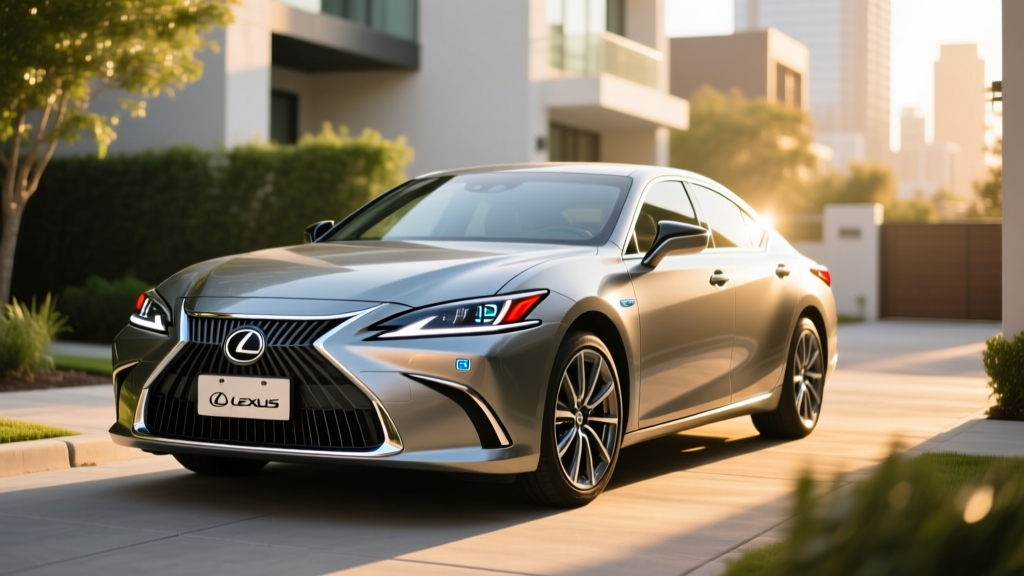
The 2025 Lexus ES 300h hybrid occupies a specific niche: a midsize luxury sedan that sips fuel without requiring you to plug in, change your driving habits, or install home charging infrastructure. With an EPA-estimated 44 MPG combined, it remains one of the most efficient vehicles in the luxury segment — and a compelling alternative to both plug-in hybrids and full battery-electric vehicles for buyers who want premium comfort without range logistics.
This guide covers everything a data-driven buyer needs: exact fuel economy figures, real-world MPG expectations, powertrain specifications, battery longevity data, warranty coverage, pricing across all trims, and a clear decision framework for whether the ES 300h, a PHEV, or a full BEV is the right electrified choice for your situation.
2025 Lexus ES 300h Hybrid Fuel Economy: EPA vs. Real World
The ES 300h pairs a 2.5-liter inline-4 Atkinson-cycle engine with two electric motor-generators through Toyota's fourth-generation hybrid synergy drive system. The result is exceptional efficiency for a 3,600-pound luxury sedan.
| Metric | EPA Estimate | Real-World Expectation |
|---|---|---|
| City MPG | 43 MPG | 44–48 MPG (hybrids excel in stop-and-go) |
| Highway MPG | 44 MPG | 40–43 MPG (less regen benefit at steady speed) |
| Combined MPG | 44 MPG | 42–46 MPG depending on driving mix |
| Fuel Tank Capacity | 13.2 gallons | — |
| Total Range | ~581 miles | ~530–610 miles |
Conventional hybrids like the ES 300h often exceed their EPA city rating in real-world driving because regenerative braking recovers energy that would otherwise be wasted at stoplights and in traffic. Highway driving, where the gasoline engine runs more continuously at steady loads, tends to yield slightly lower numbers than the EPA highway estimate. Owners who do predominantly urban and suburban driving frequently report 46–50 MPG on forums and fuel-tracking apps, while heavy highway commuters should budget for 40–42 MPG.
Cold weather impacts hybrid efficiency less dramatically than full EVs (which can lose 20–30% of range in freezing temperatures), but you can expect a 5–10% fuel economy dip in winter months due to increased engine idling for cabin heat and reduced battery efficiency at low temperatures. Source: fueleconomy.gov — 2025 Lexus ES 300h.
HEV vs. PHEV vs. EV: Where the ES 300h Fits
Understanding the distinction between conventional hybrids, plug-in hybrids, and full battery-electric vehicles is critical before purchasing.
The ES 300h Is a Conventional Hybrid (HEV) — Not a Plug-In
The 2025 Lexus ES 300h is a conventional hybrid electric vehicle (HEV). It cannot be plugged in and has no electric-only driving range beyond very low-speed parking-lot maneuvers (roughly 0.5–1 mile at under 25 mph). The small 1.6 kWh nickel-metal hydride (NiMH) traction battery charges exclusively through regenerative braking and the gasoline engine. You fuel it at any gas station and never need to think about charging infrastructure.
A plug-in hybrid (PHEV), by contrast, carries a larger battery (typically 10–25 kWh), offers 20–50 miles of electric-only range, and can be plugged into a Level 1 or Level 2 charger. Lexus does not currently offer a plug-in variant of the ES. If electric-only commuting is a priority, you'd need to look at PHEVs like the BMW 550e xDrive or a full EV like the BMW i5 or Mercedes EQE.
| Factor | HEV (ES 300h) | PHEV | Full EV (BEV) |
|---|---|---|---|
| Plug in required? | No | Optional but recommended | Yes |
| Electric-only range | ~0.5 mi at low speed | 20–50 mi | 200–400+ mi |
| Home charging needed? | No | Recommended for EV miles | Yes, essential |
| Fuel/energy cost per mile | ~$0.09 | ~$0.04 (EV mode) / $0.10 (gas) | ~$0.04–$0.06 |
| Federal tax credit (§30D) | Not eligible | Eligible if requirements met | Eligible if requirements met |
| Best for | No home charging access, long highway drives | Short commute + road trip flexibility | Home charging + mostly under 300 mi/day |
Powertrain Specs: Engine, Motors, and Horsepower
| Engine | 2.5L inline-4, Atkinson cycle (A25A-FXS) |
| Engine Output | 176 hp / 163 lb-ft torque |
| Electric Motors | Two motor-generators (MG1 + MG2) |
| Electric Motor Output | 134 hp (MG2, drive motor) |
| Net Combined Horsepower | 215 hp |
| Transmission | eCVT (planetary gearset, not belt-driven) |
| Drivetrain | Front-wheel drive |
| Traction Battery | 1.6 kWh NiMH (sealed, under rear seat) |
| 0–60 mph | ~8.1 seconds (manufacturer estimate) |
| Curb Weight | ~3,671 lbs |
The ES 300h's eCVT is not a traditional belt-and-cone CVT — it uses a planetary gearset that seamlessly blends power from the engine and electric motor. This design is proven across millions of Toyota and Lexus hybrids and eliminates the rubber-band acceleration feel associated with older CVTs. Acceleration is adequate for merging and passing but not sporty; this powertrain prioritizes smoothness and efficiency over performance.
Drive modes include Eco, Normal, and Sport. Eco mode aggressively manages throttle response and climate control draw to maximize fuel economy — useful in heavy traffic. Sport mode sharpens throttle mapping and increases steering weight but doesn't transform the car's fundamental comfort-oriented character.
Pricing, Trims, and Tax Credit Eligibility
The 2025 Lexus ES 300h is available in four trims. Pricing below includes the $1,150 destination charge.
| Trim | MSRP (incl. destination) | Key Additions |
|---|---|---|
| Base | $44,630 | 12.3" touchscreen, wireless CarPlay/Android Auto, Lexus Safety System+ 2.5 |
| Luxury | $48,740 | Semi-aniline leather, heated/ventilated front seats, power rear sunshade |
| F SPORT Design | $48,240 | F SPORT exterior/interior styling, NuLuxe trimmed seats |
| F SPORT Handling | $49,390 | Adaptive variable suspension, 19" wheels, sport seats |
| Ultra Luxury | $52,110 | Shimamoku wood trim, rear-seat controls, Mark Levinson audio |
Federal Tax Credit: Not Eligible
The 2025 Lexus ES 300h does not qualify for the federal §30D clean vehicle tax credit (up to $7,500). Under current IRS rules, only plug-in electric vehicles — battery-electric (BEV) and plug-in hybrid (PHEV) models with at least 7 kWh of battery capacity — are eligible. Conventional hybrids like the ES 300h are excluded regardless of price or efficiency. Source: IRS §30D Clean Vehicle Credit guidelines.
Some states offer their own rebates for conventional hybrids, but these are uncommon and vary widely. Check your state's energy office or department of environmental quality for current programs.
Battery Longevity, Warranty, and Replacement Cost
Battery lifespan is the single most common concern among first-time hybrid buyers. The data is reassuring.
Lexus covers the ES 300h's hybrid battery with a 10-year / 150,000-mile warranty (whichever comes first) in all 50 states. This warranty guarantees the battery will retain sufficient capacity for normal hybrid operation. If the battery fails or degrades beyond the threshold within this period, Lexus replaces it at no cost.
| Component | Coverage |
|---|---|
| Basic (bumper-to-bumper) | 4 years / 50,000 miles |
| Powertrain | 6 years / 70,000 miles |
| Hybrid Battery | 10 years / 150,000 miles |
| Hybrid System Components | 8 years / 100,000 miles |
| Corrosion Perforation | 6 years / unlimited miles |
NiMH hybrid batteries in the Toyota/Lexus system have an exceptionally well-documented track record. Data from fleet operators and high-mileage owners shows these batteries routinely last 150,000–200,000+ miles before needing replacement, with many lasting the life of the vehicle. The Prius, which uses a nearly identical system architecture, has documented cases exceeding 300,000 miles on the original hybrid battery.
If replacement is needed out of warranty, a new OEM hybrid battery for the ES 300h costs approximately $3,500–$5,000 including labor at a Lexus dealer. Refurbished and aftermarket options are available for $2,000–$3,000. This is dramatically less than full EV battery replacements, which can range from $8,000 to $20,000+.
Pros
- 44 MPG combined — among the best in luxury midsize sedans
- No plug-in charging required; no range anxiety
- 10-year/150,000-mile hybrid battery warranty
- Proven, reliable Toyota hybrid powertrain architecture
- Quiet, comfortable ride quality with excellent build
- Strong resale value (Lexus consistently tops depreciation rankings)
- Lexus Safety System+ 2.5 standard on all trims
Cons
- No electric-only driving range (HEV, not PHEV)
- Not eligible for the $7,500 federal §30D tax credit
- 8.1-second 0–60 time is leisurely for the price point
- FWD only — no all-wheel-drive option on the hybrid
- Infotainment learning curve (touchpad removed, but interface still lagging rivals)
- NiMH battery (older chemistry vs. lithium-ion in competitors)
Who Should Choose the ES 300h vs. a PHEV or Full EV?
Choose the 2025 Lexus ES 300h If:
- You lack access to home or workplace charging (apartment, street parking)
- Your typical day involves a mix of city and highway driving with no predictable short commute
- You regularly take road trips exceeding 300 miles and don't want to plan charging stops
- You want luxury sedan comfort with minimal fuel cost and zero charging logistics
- You plan to keep the car 8–12 years and value proven long-term reliability
Consider a PHEV Instead If:
- You have home Level 2 charging and a daily commute under 30 miles (a PHEV covers most commutes on electricity alone)
- You want to reduce fuel consumption below the ES 300h's already low levels
- You want eligibility for the federal §30D tax credit (if income/MSRP/sourcing rules are met)
Consider a Full EV Instead If:
- You have reliable home charging and your daily driving stays under 250 miles
- You want the lowest per-mile energy cost (~$0.04/mile vs. ~$0.09/mile for the ES 300h)
- You want instant torque, one-pedal driving, and near-zero routine maintenance
- You qualify for the §30D credit, which can offset a significant portion of an EV's higher MSRP
Real-World Ownership Economics
At 44 MPG combined and a national average regular gasoline price of approximately $3.35/gallon (early 2026), the ES 300h costs roughly $0.076 per mile in fuel. A comparable non-hybrid luxury sedan averaging 26 MPG would cost about $0.129 per mile — a difference of $530 per 10,000 miles driven. Over five years and 75,000 miles, the ES 300h saves approximately $3,975 in fuel compared to a gas-only rival.
However, a full EV charging at the national average residential electricity rate of $0.16/kWh and averaging 3.5 miles/kWh would cost about $0.046 per mile — saving an additional $2,250 over the same period versus the ES 300h. The EV's advantage widens further if you have access to time-of-use electricity rates, workplace charging, or solar.
Insurance premiums for the ES 300h are moderate for the luxury segment. Lexus benefits from strong safety ratings and lower theft rates compared to some German rivals, which helps keep premiums reasonable. Expect annual premiums in the $1,600–$2,200 range depending on your profile and location.
Frequently Asked Questions
How many MPG does the 2025 Lexus ES 300h hybrid get?
The EPA rates the 2025 ES 300h at 43 MPG city, 44 MPG highway, and 44 MPG combined. In real-world driving, urban-heavy commuters often see 46–50 MPG thanks to regenerative braking, while highway-dominant drivers should expect 40–43 MPG.
Can you plug in the Lexus ES 300h?
No. The ES 300h is a conventional hybrid (HEV), not a plug-in hybrid (PHEV). It charges its small 1.6 kWh battery exclusively through regenerative braking and the gasoline engine. There is no charging port and no electric-only driving range beyond low-speed maneuvers.
How far can the ES 300h go on electric power alone?
Effectively zero meaningful distance. The ES 300h can creep at very low speeds (under 25 mph) for roughly half a mile on battery power alone — useful in a parking garage or at a stoplight — but the gasoline engine engages almost immediately for any real driving. If electric-only commuting matters to you, a PHEV or full EV is the correct choice.
Is the Lexus ES 300h hybrid reliable?
Yes. The Toyota/Lexus hybrid synergy drive system is among the most proven electrified powertrains in automotive history, with over 25 years of continuous refinement. The NiMH battery and eCVT transmission have demonstrated lifespans of 150,000–200,000+ miles routinely, and the system has fewer wear components than a conventional automatic transmission (no clutch packs, torque converter, or shifting mechanisms to fail). Lexus consistently ranks at or near the top of J.D. Power and Consumer Reports reliability surveys.
What does a Lexus ES 300h hybrid battery replacement cost?
An OEM replacement hybrid battery costs approximately $3,500–$5,000 at a Lexus dealership including labor. Refurbished units are available for $2,000–$3,000. However, most ES 300h batteries last 150,000+ miles, and the 10-year/150,000-mile warranty covers premature failure. Many owners never need a replacement.
Does the 2025 Lexus ES 300h qualify for any tax credit?
No. The federal §30D clean vehicle tax credit is available only for plug-in vehicles (BEVs and PHEVs) with at least 7 kWh of battery capacity. The ES 300h's 1.6 kWh NiMH battery disqualifies it. Some states may offer minor hybrid incentives, but these are uncommon. Check your state's official energy or environmental agency for current programs.
Does the ES 300h have all-wheel drive?
No. The 2025 ES 300h is front-wheel drive only. If AWD is a priority in the Lexus lineup, the ES 250 (gas-only, 203 hp) offers available all-wheel drive, but it sacrifices fuel economy (25/34 MPG) compared to the hybrid.
Sources: fueleconomy.gov, IRS §30D Clean Vehicle Credit, Lexus USA specifications. Pricing and fuel economy data reflect model-year 2025 as published. Verify current pricing with your local Lexus dealer.