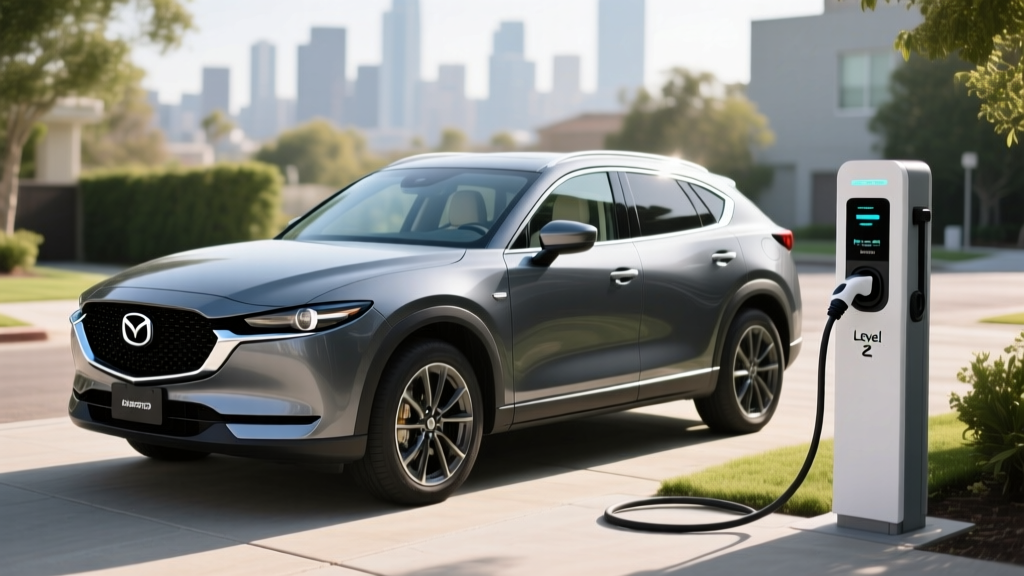
The 2025 Mazda CX-50 Hybrid occupies a specific niche in the compact crossover segment: it pairs Mazda's premium interior and chassis tuning with Toyota's battle-tested hybrid powertrain. If you've been searching for a mazda cx-50 hybrid 2025 model to understand whether this HEV (conventional hybrid) is worth the premium over the turbocharged gas variants, the short answer is yes — provided fuel economy and smoothness matter more to you than outright acceleration.
This is not a plug-in hybrid. The CX-50 Hybrid never needs to be plugged in. It recovers energy through regenerative braking and its gasoline engine to charge a small battery pack, delivering meaningful efficiency gains without any change to your daily routine.
HEV vs PHEV: What the CX-50 Hybrid Actually Is
Before examining the numbers, it's essential to clarify what this vehicle is — and what it isn't. Mazda currently offers the CX-50 Hybrid strictly as a conventional hybrid electric vehicle (HEV). There is no plug-in hybrid (PHEV) variant of the CX-50 as of the 2025 model year, and Mazda has not announced one.
Conventional Hybrid (HEV)
- No plug-in charging required
- Small battery (~1.6 kWh) charged by engine + regen
- Electric motor assists gas engine; short EV-only bursts at low speed
- Typical efficiency: 35-42 MPG combined
- No federal tax credit under §30D
The CX-50 Hybrid is this type.
Plug-In Hybrid (PHEV)
- Must be plugged in to maximize benefit
- Larger battery (12-20+ kWh) with 25-40 miles electric-only range
- Can drive on electricity alone at highway speeds
- Typical efficiency: 30-40 MPG after battery depletes + electric miles
- May qualify for up to $7,500 federal tax credit (income/MSRP/sourcing rules apply)
Examples: Toyota RAV4 Prime, Mazda CX-90 PHEV.
If you want electric-only commuting without range anxiety, a PHEV like the Mazda CX-90 PHEV is the path — but it's a larger, more expensive vehicle. The CX-50 Hybrid delivers efficiency through a simpler, lower-cost system.
Fuel Economy: EPA Ratings and Real-World MPG
The headline number for the 2025 CX-50 Hybrid is its EPA-estimated fuel economy. Because this powertrain uses Toyota's fourth-generation hybrid system (shared with the RAV4 Hybrid), the efficiency figures are well-documented and reliable.
| Metric | CX-50 Hybrid AWD | CX-50 2.5 Turbo AWD (Gas) |
|---|---|---|
| City MPG | 39 | 23 |
| Highway MPG | 37 | 29 |
| Combined MPG | 38 | 25 |
| Annual Fuel Cost (est.) | ~$1,550 | ~$2,350 |
Source: fueleconomy.gov. Annual fuel cost based on 15,000 miles/year, 55% city driving, regular unleaded at $3.50/gallon.
Powertrain: Toyota Hybrid Meets Mazda Tuning
The 2025 CX-50 Hybrid uses a 2.5-liter naturally aspirated four-cylinder engine paired with two electric motor-generators and an electronically controlled continuously variable transmission (eCVT). Total system output is 219 horsepower. All-wheel drive is standard, using a separate rear-mounted electric motor rather than a mechanical driveshaft — a setup Toyota calls "eAWD."
| Specification | Detail |
|---|---|
| Engine | 2.5L inline-4 (Atkinson cycle) |
| Combined System Horsepower | 219 hp |
| Hybrid Battery | ~1.6 kWh nickel-metal hydride (NiMH) |
| Transmission | eCVT (planetary gearset) |
| Drivetrain | AWD (electronic rear motor) |
| 0-60 MPH (est.) | ~7.3 seconds |
| Towing Capacity | 1,500 lbs |
| Fuel Required | Regular unleaded (87 octane) |
The 219-hp figure sits between the non-turbo CX-50 (187 hp) and the turbo variant (up to 256 hp on premium fuel). Acceleration is brisk enough for highway merging and passing, and the eCVT eliminates the shift-hunting feel of conventional automatics. Mazda has retuned the steering, suspension, and throttle mapping to deliver a more connected driving feel than the RAV4 Hybrid, though the underlying hardware is shared.
One trade-off: the hybrid's towing capacity drops to 1,500 pounds, compared to 3,500 pounds for the 2.5 Turbo AWD. If you tow a small trailer or boat regularly, the gas turbo model is the better choice.
Pricing, Trims, and Tax Credit Eligibility
The 2025 CX-50 Hybrid is offered across multiple trims, with pricing starting in the mid-$30,000 range. Mazda includes its i-Activ AWD system standard on all hybrid trims.
| Trim Level | Approx. MSRP |
|---|---|
| Preferred Hybrid | ~$35,395 |
| Premium Hybrid | ~$38,550 |
| Premium Plus Hybrid | ~$41,750 |
| Turbo Premium (Gas, for comparison) | ~$41,550 |
Source: Mazda USA. Prices include destination charge and are subject to change. Verify with your local dealer.
Battery Warranty, Reliability, and Replacement Costs
Hybrid battery longevity is consistently the top concern among first-time hybrid buyers. The CX-50 Hybrid benefits enormously from using Toyota's hybrid system, which has accumulated over two decades of real-world reliability data across millions of vehicles.
The CX-50 Hybrid uses a nickel-metal hydride (NiMH) battery pack rather than the lithium-ion chemistry found in full EVs. NiMH packs in Toyota's hybrid system have demonstrated exceptional longevity: it's common for RAV4 Hybrid and Prius batteries to exceed 150,000-200,000 miles with minimal capacity loss. The battery is small (~1.6 kWh), operates within a conservative state-of-charge window (roughly 40-80%), and never undergoes the deep discharge cycles that stress larger EV batteries.
If a hybrid battery does require replacement outside warranty, expect to pay between $2,000 and $4,000 for a new OEM unit, or $1,000-$2,000 for a refurbished pack from a third-party supplier. However, based on the track record of this exact system in the RAV4 Hybrid (in production since 2016), premature failure is rare.
For overall vehicle reliability, Mazda consistently ranks in the top tier among mainstream brands. The CX-50 earned an IIHS Top Safety Pick designation, and the hybrid variant shares the same structural platform and safety systems.
Who Should Buy the CX-50 Hybrid — and Who Shouldn't
✓ Pros
- 38 MPG combined — saves ~$800/year vs. the turbo gas model
- Smooth, quiet powertrain with no behavior change needed
- Premium Mazda interior and driving dynamics
- Proven Toyota hybrid reliability and strong warranty
- Standard AWD with electronic rear motor
- Runs on regular 87-octane fuel
✗ Cons
- Towing limited to 1,500 lbs (turbo gas model: 3,500 lbs)
- No federal tax credit eligibility
- No electric-only commuting capability (unlike a PHEV)
- eCVT drone under hard acceleration
- Rear cargo space slightly reduced vs. gas model
- Not available with the top-line Turbo Premium Plus trim features
Decision Framework
Choose the CX-50 Hybrid if: You drive 12,000+ miles per year with a mix of city and highway commuting, you want to reduce fuel costs without plugging in, and you don't need to tow more than 1,500 pounds. The hybrid pays for its modest price premium over the non-turbo gas model within 3-4 years through fuel savings alone.
Choose the CX-50 Turbo (gas) if: You tow regularly, you prioritize maximum acceleration (256 hp on premium), or your annual mileage is low enough that fuel savings won't offset the hybrid's higher purchase price.
Choose a PHEV (like the RAV4 Prime or CX-90 PHEV) if: You have home charging access and a commute under 35 miles, you want electric-only daily driving with a gas backup for road trips, and you want to pursue the federal tax credit.
Choose a full EV (like the Hyundai Ioniq 5 or Tesla Model Y) if: You have reliable home charging, your daily driving is under 250 miles, you want zero tailpipe emissions, and you want to minimize long-term maintenance costs.
Hybrid vs PHEV vs EV: Which Electrified CX-50 Fits You?
Mazda's 2025 lineup spans all three electrification approaches across its crossover range. Here's how the CX-50 Hybrid fits into the broader picture:
| Vehicle | Type | Efficiency | Electric Range | Starting Price |
|---|---|---|---|---|
| CX-50 Hybrid | HEV | 38 MPG | N/A | ~$35,395 |
| CX-90 PHEV | PHEV | 25 MPG + 56 MPGe | 26 mi | ~$55,000 |
| MX-30 EV (CA only) | BEV | 92 MPGe | 100 mi | ~$36,000 |
The CX-50 Hybrid is the lowest-friction entry point into electrified driving. No charging infrastructure needed, no behavior changes, no range calculations — just significantly better fuel economy and smoother low-speed driving than a conventional gas car.
Frequently Asked Questions
How many MPG does the 2025 Mazda CX-50 Hybrid get?
The EPA rates the CX-50 Hybrid at 39 MPG city, 37 MPG highway, and 38 MPG combined. In real-world mixed driving, most owners report 36-42 MPG depending on conditions. City-heavy routes tend to yield higher numbers because regenerative braking recaptures more energy at low speeds.
Does the CX-50 Hybrid need to be plugged in?
No. The CX-50 Hybrid is a conventional hybrid (HEV), not a plug-in hybrid (PHEV). Its small battery charges through regenerative braking and the gasoline engine. You fuel it like any other car and never need a charger.
Is the CX-50 Hybrid powertrain reliable?
Yes. The hybrid system is sourced from Toyota and is mechanically identical to the RAV4 Hybrid's powertrain, which has been in production since 2016 with excellent reliability data. The NiMH hybrid battery operates in a conservative charge window and commonly lasts well beyond 150,000 miles.
What does a hybrid battery replacement cost?
Outside of warranty coverage, a replacement hybrid battery for the CX-50 Hybrid is estimated at $2,000-$4,000 for an OEM unit. However, based on the Toyota system's track record, most owners will never need a replacement during typical ownership.
Does the 2025 CX-50 Hybrid qualify for a tax credit?
No. The federal §30D clean vehicle credit applies only to plug-in vehicles (BEVs and PHEVs) with at least 7 kWh of battery capacity. The CX-50 Hybrid's ~1.6 kWh battery does not meet this threshold. Check with your state's energy office for any local hybrid incentives, which vary by jurisdiction.
Can the CX-50 Hybrid tow?
Yes, but with a reduced capacity of 1,500 pounds — adequate for a small utility trailer or lightweight camping gear but not for a boat or larger camper. If you need 3,500-pound towing, the CX-50 2.5 Turbo AWD is the correct choice.
How does the CX-50 Hybrid compare to the RAV4 Hybrid?
The CX-50 Hybrid shares its powertrain, battery, and eCVT with the Toyota RAV4 Hybrid, so efficiency and reliability are nearly identical. The CX-50 differentiates itself with a more premium interior, sharper steering feel, a slightly longer wheelbase for improved ride quality, and Mazda's more upscale design language. The RAV4 Hybrid offers more rear cargo volume and a lower starting price.