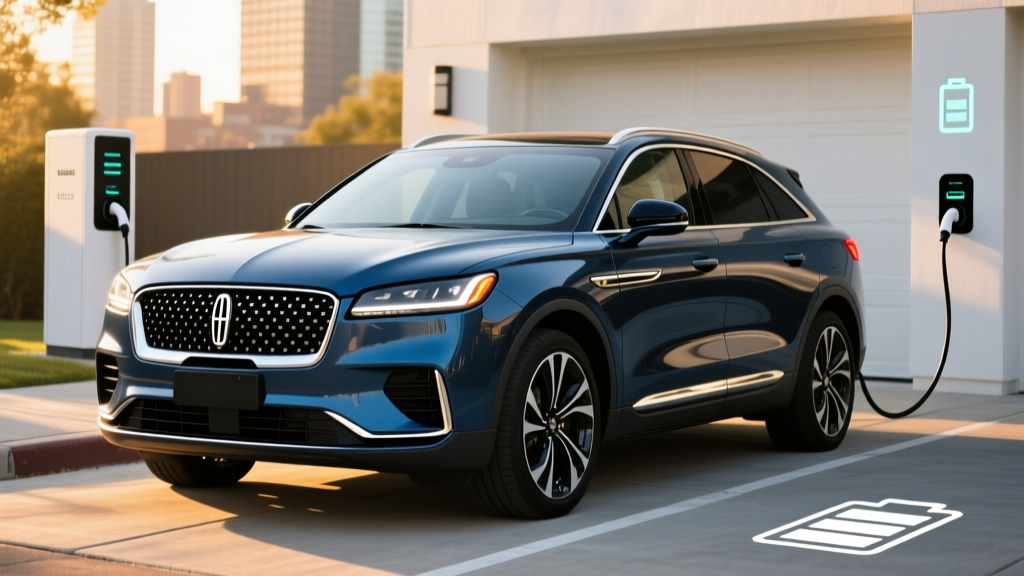
Lincoln's approach to electrification remains pragmatic in 2026: rather than forcing buyers into a full battery-electric vehicle, the automaker offers the Corsair Grand Touring plug-in hybrid as a bridge — one that pairs a turbocharged gasoline engine with a meaningful electric-only driving range. For luxury compact SUV shoppers searching for a hybrid Lincoln that doesn't require a lifestyle overhaul, the Corsair Grand Touring occupies a specific and increasingly popular niche.
This guide covers every number that matters: EPA fuel economy, real-world MPG observations, electric-only range, battery specs, charging logistics, powertrain output, pricing, federal tax credit eligibility, and long-term battery reliability. We'll also clarify where the Corsair PHEV fits against both conventional hybrids and full EVs so you can decide whether it's the right powertrain for your daily routine.
Lincoln's Electrified Lineup: HEV vs. PHEV Explained
Before diving into specs, it's critical to understand what Lincoln actually offers. As of the 2026 model year, Lincoln does not sell a conventional hybrid (HEV) in the United States. The brand's electrified option is the Corsair Grand Touring plug-in hybrid (PHEV). The Aviator previously offered a PHEV variant (the Grand Touring), but Lincoln discontinued it after the 2024 model year, leaving the Corsair as the sole electrified Lincoln.
Conventional Hybrid (HEV) vs. Plug-In Hybrid (PHEV)
| Feature | HEV (Conventional Hybrid) | PHEV (Plug-In Hybrid) |
|---|---|---|
| Plugs in to charge? | No — charges via regenerative braking and engine | Yes — has a larger battery you charge from an outlet or station |
| Electric-only range | Typically under 1 mile at low speed | 20–40+ miles at full highway speed |
| Battery size | ~1–2 kWh | ~12–20+ kWh |
| Federal tax credit | Generally not eligible | May qualify for partial credit (up to $3,750–$7,500 depending on sourcing rules) |
| Best for | Drivers without home charging access | Drivers with home/workplace charging who want EV-like daily commutes plus gas-engine road-trip flexibility |
The Corsair Grand Touring is a PHEV. That means you can plug it in — and to get the most value from it, you should. However, if you never plug it in, it still functions as a conventional hybrid, just with a heavier battery pack reducing efficiency slightly.
2026 Lincoln Corsair Grand Touring: Powertrain and Performance Specs
The Corsair Grand Touring pairs a 2.5-liter naturally aspirated inline-four engine with an electric motor integrated into a continuously variable transmission (CVT). Here are the hard numbers:
| Specification | 2026 Corsair Grand Touring PHEV |
|---|---|
| Combined System Horsepower | 266 hp |
| Engine | 2.5L iVCT Atkinson-cycle I4 |
| Electric Motor | Permanent-magnet synchronous (integrated in eCVT) |
| Transmission | eCVT (electronic continuously variable) |
| Drivetrain | AWD (eAWD with rear electric motor assist) |
| 0–60 mph (est.) | ~7.0 seconds |
| Battery Capacity (total / usable) | 14.4 kWh total / ~11.2 kWh usable |
| Battery Chemistry | Lithium-ion (NMC) |
| Towing Capacity | 2,000 lbs (with Class II tow package) |
| Cargo Volume (behind rear seats) | 27.6 cu ft |
The eAWD system uses a secondary electric motor on the rear axle, eliminating a mechanical driveshaft. This provides all-weather traction without the efficiency penalty of a traditional AWD system. The 266 combined horsepower is adequate for highway merging and confident passing, though the Corsair Grand Touring is tuned for comfort rather than sportiness — the eCVT prioritizes smoothness over the snap of a stepped automatic.
EPA Fuel Economy and Electric-Only Range
The EPA rates the 2026 Corsair Grand Touring with two sets of numbers: one for hybrid operation (charge-sustaining mode, after the battery is depleted) and one that includes electric-only driving (charge-depleting mode, expressed in MPGe).
| Mode | City | Highway | Combined |
|---|---|---|---|
| Hybrid (gas only, battery depleted) | 34 MPG | 32 MPG | 33 MPG |
| Combined (gas + electric, MPGe) | — | — | 78 MPGe |
| Electric-only range | 31 miles (EPA) | ||
| Total combined range (EV + gas) | ~430 miles | ||
Real-World MPG vs. EPA Estimates
According to fueleconomy.gov, the Corsair Grand Touring's EPA hybrid-mode rating is 33 MPG combined. In real-world driving, PHEV owners who charge daily and commute under 30 miles may use very little gasoline at all — effectively achieving 80–100+ MPGe on short trips.
On a 200-mile highway road trip with no charging, expect the hybrid-mode fuel economy to settle around 30–32 MPG at sustained 70–75 mph speeds. In city driving, hybrids typically exceed their EPA city rating because regenerative braking recaptures energy at low speeds — some owners report 35–37 MPG in stop-and-go traffic.
Cold weather (below 30°F) reduces electric-only range by roughly 20–30%, dropping the 31-mile EV range to approximately 22–25 miles. The gasoline engine also runs more frequently in cold weather to provide cabin heat, reducing overall efficiency.
Charging: How Long, What Connector, and Can It DC Fast Charge?
One of the most common questions from PHEV shoppers is about charging logistics. Here's the full picture for the Corsair Grand Touring:
| Charging Level | Power (kW) | 0–100% Time | Connector |
|---|---|---|---|
| Level 1 (120V household outlet) | ~1.4 kW | ~10–11 hours | J1772 |
| Level 2 (240V home/public station) | ~3.3 kW (vehicle-limited) | ~3.5–4 hours | J1772 |
| DC Fast Charging | Not supported — the Corsair PHEV has no DC fast-charge port | ||
The Corsair Grand Touring's onboard charger is limited to 3.3 kW, meaning even if you plug into a 7.2 kW or 11.5 kW Level 2 station, the vehicle will only draw 3.3 kW. This is typical for PHEVs — the smaller battery doesn't require the high-speed charging infrastructure that full BEVs depend on.
For most owners, a standard 120V Level 1 outlet is sufficient for overnight charging. Plug in at 10 PM and by 7 AM you'll have a full or nearly full battery — enough for a 31-mile electric commute. If you want faster top-ups (for example, charging during a workday at a public Level 2 station), the 3.3 kW Level 2 rate adds roughly 8–9 miles of EV range per 30 minutes.
The lack of DC fast charging is a trade-off. On road trips, you won't benefit from a quick 20-minute charge at an Electrify America or Tesla Supercharger station — but on a road trip, you're primarily running on the gasoline engine anyway, which is the whole point of a PHEV.
Pricing, Trims, and Federal Tax Credit Eligibility
The 2026 Lincoln Corsair Grand Touring is offered in a single well-equipped PHEV trim, with optional packages for technology and luxury upgrades.
| Trim / Configuration | MSRP (incl. destination) |
|---|---|
| Corsair Grand Touring PHEV (base) | $52,485 |
| + Technology Package | $55,200 (est.) |
| + Elements Technology Package (loaded) | $58,500+ (est.) |
Does the Corsair Grand Touring Qualify for a Federal Tax Credit?
Under current IRS §30D Clean Vehicle Credit rules, PHEVs are eligible for the federal tax credit — but only if they meet several criteria simultaneously:
- Battery capacity: At least 7 kWh — the Corsair's 14.4 kWh pack qualifies ✓
- MSRP cap: SUVs must be under $80,000 — the Corsair PHEV qualifies ✓
- Buyer income cap: Modified AGI ≤ $150,000 (single) or ≤ $300,000 (joint) — varies by buyer
- Battery component sourcing: Must meet North American assembly and critical-mineral thresholds — this requirement phases in more strictly each year and is the most common disqualifier for PHEVs
- Final assembly: Must occur in North America — the Corsair is assembled in Louisville, Kentucky ✓
The Corsair Grand Touring's battery sourcing has historically qualified it for a partial credit of $3,750 (meeting one of the two sourcing thresholds but not both, depending on model year). Buyers should verify current-year eligibility on fueleconomy.gov's tax credit page before purchasing, as sourcing requirements tighten annually. The credit is non-refundable, meaning you must have sufficient federal tax liability to claim it — though the point-of-sale transfer option now allows eligible buyers to apply the credit as a down payment reduction at the dealer.
Always consult a tax professional for your specific situation. State incentives may also apply — check your state's energy office or the Alternative Fuels Data Center for local rebates.
Battery Reliability, Warranty, and Replacement Cost
Lincoln PHEV Battery Warranty
Hybrid/EV battery component warranty: 8 years / 100,000 miles (whichever comes first)
Capacity retention threshold: Lincoln/Ford covers the battery if it degrades below approximately 70% of original capacity during the warranty period.
Powertrain warranty: 6 years / 70,000 miles
The 8-year/100,000-mile hybrid battery warranty is mandated by federal emissions regulations and is standard across Lincoln, Ford, and most competitors. In practice, PHEV battery packs experience less stress than full EV packs because the usable window is smaller and the pack is less frequently cycled to extremes.
Is the Lincoln Corsair PHEV Reliable?
The Corsair Grand Touring's powertrain is derived from Ford's well-tested hybrid architecture, which underpins hundreds of thousands of Ford Escape PHEVs and Lincoln models on the road. The 2.5L Atkinson-cycle engine is a proven, low-stress design with no turbocharger, reducing complexity. The eCVT has no traditional gear sets or clutch packs — it's one of the most durable transmission designs in the industry.
Common reliability concerns for the Corsair center more on electronics and infotainment (Ford/Lincoln's SYNC system) than on the hybrid powertrain itself. The battery, motor, and eCVT have a strong track record.
What Does a Hybrid Battery Replacement Cost?
If the battery pack fails outside the 8-year/100,000-mile warranty window, replacement costs for a PHEV battery of this size (14.4 kWh) typically range from $4,500 to $7,500 including parts and labor, based on current Ford/Lincoln hybrid service pricing. This is significantly less than a full EV battery replacement (which can exceed $15,000–$20,000 for a 75+ kWh pack).
However, wholesale battery failures are rare. More commonly, individual modules or cells degrade unevenly, and a specialist can sometimes replace individual modules for $1,000–$2,500 rather than the entire pack. As the PHEV fleet ages, third-party refurbishment options are becoming more available.
Corsair Grand Touring vs. Full EV vs. Conventional Gas: Which Fits You?
Choose the Lincoln Corsair Grand Touring PHEV if:
- You have access to Level 1 or Level 2 charging at home or work (even a standard 120V outlet is enough)
- Your daily commute is under 30 miles round-trip — you'll drive on electricity most days
- You take road trips several times a year and don't want to plan around charging stations
- You want a luxury compact SUV with Lincoln's ride quality, cabin quietness, and dealer service network
- You live in a region with extreme cold that significantly reduces full EV range
Choose a full EV (like the Genesis GV60 or Cadillac Lyriq) if:
- You have reliable Level 2 home charging and access to DC fast chargers for road trips
- You want zero tailpipe emissions and minimal maintenance (no oil changes, no engine)
- Your daily driving is predictable and under 200–250 miles
- You want to maximize fuel savings — electricity costs roughly $0.04–$0.06/mile vs. $0.12–$0.16/mile for gasoline
Choose a gas-only compact luxury SUV (like the standard Corsair or BMW X1) if:
- You have no access to any form of charging at home or work
- You want the lowest purchase price (the PHEV premium is ~$8,000–$10,000 over a gas Corsair)
- Your driving is overwhelmingly highway road-trip mileage where the PHEV advantage is minimal
Pros and Cons at a Glance
Pros
- 31 miles of electric-only range covers most daily commutes
- 33 MPG hybrid mode is excellent for a luxury AWD SUV
- No range anxiety — gas engine provides 430+ mile total range
- Quiet, comfortable ride with Lincoln's signature cabin isolation
- AWD standard via rear electric motor
- Eligible for partial federal tax credit ($3,750)
- Proven Ford hybrid powertrain with strong reliability record
- Charges fully overnight on a standard 120V outlet
Cons
- $52,485 starting price is steep for a compact luxury SUV
- No DC fast charging capability
- 3.3 kW onboard charger limits Level 2 speed
- Cargo space slightly reduced vs. gas Corsair (battery packaging)
- eCVT can drone under hard acceleration
- Partial tax credit only — doesn't meet full $7,500 sourcing threshold
- Infotainment system lags behind some European competitors
- Only one PHEV trim available (no lower-priced entry point)
Ownership Costs: 5-Year Total Cost Snapshot
To put the Corsair Grand Touring's economics in context, here's an estimated 5-year / 75,000-mile ownership comparison assuming 60% of driving is within electric range (charging daily at home) and 40% is on gasoline:
| Cost Category | Corsair Grand Touring PHEV | Gas Corsair (2.0T AWD) |
|---|---|---|
| Purchase price (MSRP) | $52,485 | $40,585 |
| Federal tax credit | −$3,750 | $0 |
| Fuel (electricity + gas, 5 yr) | ~$4,800 | ~$9,400 |
| Maintenance (5 yr) | ~$2,800 | ~$3,600 |
| Insurance (5 yr est.) | ~$9,500 | ~$8,800 |
| Estimated 5-yr total | ~$65,835 | ~$62,385 |
The PHEV saves roughly $4,600 in fuel and $800 in maintenance over five years, but the $11,900 higher purchase price (net of the $3,750 credit) means the Corsair Grand Touring doesn't break even on a pure cost basis within five years. The value proposition is about driving experience, daily EV-like commuting, and reduced emissions — not purely financial payback. If you keep the vehicle 8–10 years, the fuel savings narrow the gap further.
Frequently Asked Questions
How many MPG does the Lincoln hybrid get?
The 2026 Lincoln Corsair Grand Touring PHEV achieves an EPA-rated 33 MPG combined (34 city / 32 highway) when operating in hybrid mode after the battery is depleted. When factoring in electric-only driving, the combined rating is 78 MPGe. Real-world city driving often exceeds the EPA city number, with some owners reporting 35–37 MPG in stop-and-go conditions thanks to regenerative braking.
How far can the Lincoln Corsair PHEV go on electric only?
The EPA rates the Corsair Grand Touring at 31 miles of electric-only range. In real-world conditions, expect 28–31 miles in mild weather and 22–25 miles in cold weather (below 30°F). At highway speeds above 70 mph, electric range also decreases due to aerodynamic drag. For commutes under 30 miles round-trip with daily charging, many owners use little to no gasoline on weekdays.
Does the Lincoln Corsair PHEV qualify for a tax credit?
The Corsair Grand Touring currently qualifies for a partial federal tax credit of $3,750 under IRS §30D rules, meeting one of two battery-sourcing thresholds. Full $7,500 eligibility depends on critical-mineral and battery-component sourcing requirements that tighten each year. The vehicle meets the MSRP cap (under $80,000 for SUVs) and North American final assembly requirements. Buyer income limits apply ($150K single / $300K joint MAGI). Verify current eligibility at fueleconomy.gov and consult a tax professional before purchase.
Is the Lincoln hybrid reliable, and what's the battery replacement cost?
The Corsair Grand Touring uses Ford's proven hybrid powertrain architecture, which has been deployed across hundreds of thousands of vehicles. The 2.5L Atkinson-cycle engine and eCVT are low-stress, well-tested components. The hybrid battery is covered by an 8-year/100,000-mile warranty. Out-of-warranty battery replacement costs an estimated $4,500–$7,500, though full pack failures are uncommon. Individual module repair is sometimes possible at lower cost.
Can I charge the Corsair PHEV at a DC fast charger?
No. The Corsair Grand Touring does not have a DC fast-charge port. It charges exclusively via Level 1 (120V) or Level 2 (240V) using a J1772 connector. The onboard charger is limited to 3.3 kW, meaning a full charge takes about 3.5–4 hours on Level 2 or 10–11 hours on a standard household outlet. For PHEV owners who charge overnight at home, this is typically sufficient.
Should I buy the Corsair PHEV or a full electric SUV?
Choose the Corsair PHEV if you need road-trip flexibility without charging planning, have a commute under 30 miles, and want Lincoln luxury with a proven dealer network. Choose a full EV if you have reliable home charging, want zero tailpipe emissions, prioritize lower running costs, and your daily driving is under 200 miles. The PHEV is a bridge; the EV is a destination — which one fits depends on your charging access and driving patterns.