Quick Verdict: The Lexus UX 300h Hybrid at a Glance
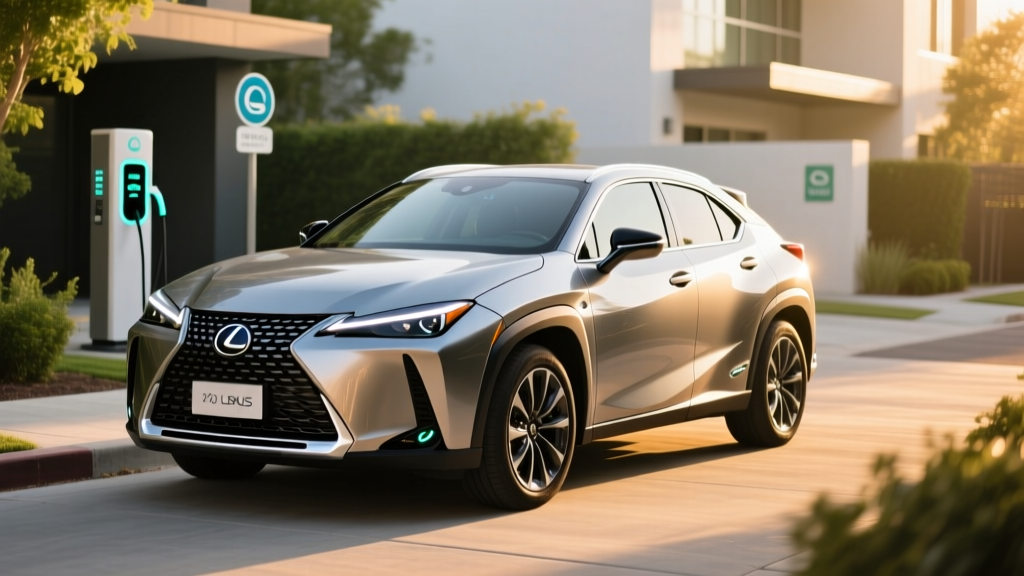
The 2026 Lexus UX 300h hybrid occupies a specific niche: a premium compact crossover that prioritizes fuel efficiency and daily-driver refinement over outright performance or cargo volume. As a conventional hybrid electric vehicle (HEV), it requires no plug-in charging and no change in driving habits — you simply fuel it like any gas car and let Toyota's fifth-generation hybrid system optimize the rest.
With an EPA-rated 43 MPG combined and standard all-wheel drive, the UX 300h undercuts nearly every luxury compact SUV on fuel cost while delivering 200 combined horsepower. The trade-off is interior space — rear seat and cargo room are tight compared to rivals like the BMW X1 or Audi Q3. But if your priority is a premium badge, excellent fuel economy, and Toyota-grade hybrid reliability, the UX 300h makes a compelling case.
| Spec | 2026 Lexus UX 300h |
|---|---|
| Powertrain | 2.0L 4-cyl + 2 electric motors (AWD) |
| Combined Horsepower | 200 hp (net system) |
| Transmission | eCVT (planetary gearset) |
| EPA Fuel Economy | 43 city / 41 highway / 43 combined MPG |
| Fuel Tank | 10.6 gallons |
| Total Range | ~455 miles |
| 0–60 mph | ~7.0 seconds |
| Drivetrain | AWD (E-Four electronic rear motor) |
| Cargo Volume | 17.1 cu ft (rear seats up) |
| Hybrid Battery | ~1.4 kWh lithium-ion (sealed, non-plug-in) |
| Base MSRP | ~$39,500 (Premium trim) |
| Federal Tax Credit (§30D) | Not eligible (HEV, not PHEV/BEV) |
| Hybrid Battery Warranty | 10 years / 150,000 miles |
HEV vs. PHEV: Why the UX 300h Is a Conventional Hybrid
Before evaluating the UX 300h's numbers, it's critical to understand what it is — and what it isn't. The UX 300h is a conventional hybrid (HEV), not a plug-in hybrid (PHEV) or battery electric vehicle (BEV). This distinction shapes everything from how you refuel it to what incentives apply.
| Feature | HEV (UX 300h) | PHEV (e.g., Toyota RAV4 Prime) | BEV (e.g., Tesla Model Y) |
|---|---|---|---|
| Plug-in Charging | No — refuels via gas + regenerative braking | Yes — Level 1/2 AC charging | Yes — Level 1/2/DC charging |
| Electric-Only Range | ~1 mile at low speed | 30–42 miles typical | 250–330+ miles (full battery) |
| Battery Size | ~1–2 kWh | ~15–20 kWh | ~60–100 kWh |
| Fuel Economy (gas mode) | 40–50+ MPG | 35–40 MPG (after battery depleted) | N/A (no gas engine) |
| §30D Federal Tax Credit | Not eligible | Up to $7,500 (if eligible) | Up to $7,500 (if eligible) |
| Behavior Change Required | None | Plug in nightly for max benefit | Plan charging access |
The UX 300h's small lithium-ion battery (~1.4 kWh usable) charges itself through regenerative braking and the gasoline engine. There is no charging port. You cannot plug it in. This is an advantage for apartment dwellers or anyone without reliable home charging access — the hybrid system works transparently without any infrastructure investment.
Lexus previously offered the UX 250h (the UX 300h's predecessor through the 2024 model year) and a short-lived UX 300e all-electric variant in select markets. For 2025–2026, the UX 300h nameplate consolidates the lineup around this fifth-generation hybrid powertrain with more power and slightly improved efficiency over the outgoing UX 250h.
Fuel Economy: EPA Ratings vs. Real-World MPG
The EPA rates the 2026 Lexus UX 300h at 43 MPG city / 41 highway / 43 combined. These figures are impressive for a luxury AWD crossover and place the UX 300h near the top of its class for fuel efficiency.
| Driving Scenario | EPA Rating | Real-World Expectation |
|---|---|---|
| City (stop-and-go) | 43 MPG | 44–48 MPG (hybrids excel here) |
| Highway (65–75 mph) | 41 MPG | 37–40 MPG (aero drag, less regen benefit) |
| Combined (mixed) | 43 MPG | 40–44 MPG |
| Cold Weather (below 30°F) | — | 35–39 MPG (engine runs more for heat) |
Conventional hybrids like the UX 300h typically exceed their EPA city rating in real-world urban driving. The frequent stops maximize regenerative braking, which recaptures kinetic energy back into the small battery. At highway speeds, the gasoline engine carries more of the load and aerodynamic drag increases, so highway MPG dips slightly below the city figure — the inverse of most gas-only vehicles.
In cold weather, expect a 5–8 MPG drop. The engine must run more frequently to provide cabin heat (the UX 300h lacks a heat pump, which is more common in BEVs) and the battery's charge/discharge efficiency decreases at low temperatures. This is normal for all hybrids and far less dramatic than the 20–30% range loss BEVs experience in winter.
With a 10.6-gallon fuel tank and 43 MPG combined, the UX 300h delivers approximately 455 miles of total range between fill-ups. Some careful drivers report exceeding 480 miles on a tank in moderate-weather city driving.
Powertrain: 200 hp With Fifth-Gen Hybrid Efficiency
The UX 300h pairs a 2.0-liter Atkinson-cycle four-cylinder engine with two electric motor-generators through a planetary gearset eCVT. A third electric motor on the rear axle provides electronic all-wheel drive (Lexus calls this E-Four). Combined system output is 200 net horsepower — a meaningful increase over the outgoing UX 250h's 181 hp.
The 0–60 mph time drops to approximately 7.0 seconds, which is adequate for merging and passing, if not sporty. The eCVT delivers seamless acceleration without the shift-shock of a conventional automatic, though some drivers note a characteristic "drone" under hard acceleration as the engine holds at peak RPM — a trait of all planetary-gearset hybrids.
The rear electric motor engages automatically when the system detects front-wheel slip or during hard acceleration from a stop. Unlike mechanical AWD systems, there's no driveshaft — the rear axle is driven purely electrically. This saves weight and reduces drivetrain losses, contributing to the strong MPG figures.
Pricing, Trims, and Tax Credit Eligibility
The 2026 Lexus UX 300h starts at approximately $39,500 MSRP for the Premium trim, rising to around $44,000–$47,000 for F SPORT Handling and Luxury trims with packages. Destination charges add approximately $1,150.
Federal Tax Credit Status: Not Eligible
- IRS §30D credits apply only to plug-in vehicles (PHEVs and BEVs) with battery capacity ≥7 kWh
- The UX 300h's ~1.4 kWh HEV battery does not meet this threshold
- No federal income tax credit or point-of-sale transfer is available
- Some states offer rebates for efficient hybrids — check your state's energy or DMV website
- Check IRS §30D guidelines for current rules on qualifying plug-in vehicles if you're cross-shopping
The lack of a federal tax credit is the trade-off for a vehicle that requires zero charging infrastructure. A PHEV like the Toyota RAV4 Prime (if you can find one) qualifies for up to $7,500 under §30D, subject to MSRP caps, buyer income limits, and battery-sourcing requirements — but requires nightly plug-in charging to realize its benefit.
For buyers who simply want low fuel costs without plugging in, the UX 300h's $39,500 entry price is competitive within the luxury compact SUV segment, especially considering standard AWD and Lexus's strong resale values.
Battery Longevity, Warranty, and Replacement Cost
Hybrid Battery Warranty: 10 years or 150,000 miles (whichever comes first), covering defects and capacity loss below a defined threshold. This applies in all 50 states under current Toyota/Lexus policy.
Expected Lifespan: Toyota's hybrid batteries routinely last 150,000–200,000+ miles in real-world service. Many Prius and Lexus hybrid taxis have exceeded 300,000 miles on the original battery pack.
Replacement Cost (out of warranty): $2,500–$4,000 for a new OEM battery pack; $1,500–$2,500 for a refurbished unit from independent hybrid specialists. Individual module replacement can cost $500–$1,200 if only a few cells have degraded.
Toyota and Lexus have the deepest track record in hybrid battery durability of any automaker, with over 25 years of real-world data since the first Prius. The UX 300h's lithium-ion pack is smaller and less stressed than a PHEV or BEV battery — it never deep-cycles (the system maintains a state-of-charge buffer between roughly 40% and 80%), which dramatically extends cell life.
The 12-volt auxiliary battery (a separate, smaller battery that powers electronics and starts the hybrid system) may need replacement every 4–6 years at a cost of $200–$400, similar to a conventional vehicle. This is a common maintenance item that surprises some hybrid owners unfamiliar with the dual-battery architecture.
Who Should Buy the UX 300h — And Who Shouldn't
Choose the Lexus UX 300h if:
- You want luxury-car refinement with 40+ MPG and no plug-in charging
- You live in an apartment or lack reliable home/workplace charging access
- Your typical trips are under 50 miles round-trip (city/suburban commuting)
- You prioritize low fuel cost and high reliability over cargo space and rear-seat room
- You want AWD for weather confidence without the MPG penalty of a gas AWD SUV
Look elsewhere if:
- You need spacious rear seating or 25+ cu ft of cargo room (consider the Lexus NX 350h instead)
- You want electric-only driving for short trips — a PHEV like the BMW X5 xDrive50e or Toyota RAV4 Prime offers 30–40 miles of EV range
- You want to maximize tax incentives — a qualifying BEV or PHEV can net up to $7,500 federal credit
- You want performance driving dynamics — the UX 300h prioritizes comfort and efficiency over sportiness
Pros
- 43 MPG combined with standard AWD — best-in-class efficiency
- No plug-in charging required — works for any living situation
- Proven Toyota/Lexus hybrid reliability with 10yr/150k battery warranty
- Premium interior materials, quiet cabin, Lexus Safety System+ 3.0 standard
- Strong resale value typical of Lexus nameplates
Cons
- Tight rear seat and only 17.1 cu ft cargo — smallest in the luxury compact segment
- No federal tax credit eligibility (HEV)
- CVT drone under hard acceleration
- No DC fast charging capability (not applicable to HEV, but a limitation vs PHEV)
- Higher starting price than non-luxury hybrid crossovers (Toyota Corolla Cross Hybrid at ~$31,000)
UX 300h vs. Alternatives: Hybrid, PHEV, or Full EV?
The decision between the UX 300h (HEV), a PHEV, and a full BEV depends primarily on your charging access and daily driving pattern:
| Factor | Lexus UX 300h (HEV) | BMW X1 xDrive28e (PHEV) | Tesla Model Y (BEV) |
|---|---|---|---|
| Starting Price | ~$39,500 | ~$45,000 | ~$44,000 |
| Federal Tax Credit | $0 | Up to $7,500* | Up to $7,500* |
| Daily Fuel Cost (30 mi) | ~$2.50 (gas) | ~$0.80 (electric) / $2.50 (gas) | ~$1.00 (electric) |
| Home Charging Needed | No | Recommended for EV-mode benefit | Essential |
| Cargo Volume | 17.1 cu ft | ~25 cu ft | ~30 cu ft (+ frunk) |
| Annual Maintenance | Low (oil changes + standard) | Moderate (engine + EV systems) | Minimal (no engine) |
*Federal tax credit eligibility depends on MSRP caps, buyer income, battery sourcing, and current IRS rules. Verify at irs.gov.
If you can charge at home and your commute is under 30 miles, a PHEV gives you electric-only daily driving with a gas backup. If you have reliable charging and want the lowest operating cost, a BEV eliminates gas entirely. The UX 300h is the right call when charging access is uncertain or you prefer the simplicity of gas-station refueling with hybrid-level efficiency.
Frequently Asked Questions
How many MPG does the Lexus UX 300h hybrid get?
The EPA rates the 2026 UX 300h at 43 MPG city, 41 highway, and 43 combined. In real-world city driving with frequent stops, many owners see 44–48 MPG thanks to regenerative braking. Highway driving at 70+ mph typically yields 37–40 MPG.
Does the Lexus UX 300h need to be plugged in?
No. The UX 300h is a conventional hybrid (HEV), not a plug-in hybrid. It charges its own small battery through regenerative braking and the gasoline engine. There is no charging port. You refuel it at a gas station like any conventional vehicle.
How far can the UX 300h drive on electric only?
Effectively less than 1 mile at very low speeds (under 25 mph in EV mode). The hybrid system uses the electric motor to assist the gas engine and enable engine-off coasting, but it is not designed for meaningful electric-only driving. If you want 30+ miles of EV range, you need a PHEV.
Is the Lexus UX 300h hybrid reliable?
Yes. Toyota/Lexus hybrid systems have over 25 years of proven reliability. The eCVT has no traditional transmission clutches or belts to wear out, and the hybrid battery is warrantied for 10 years / 150,000 miles. Lexus consistently ranks at or near the top of J.D. Power and Consumer Reports reliability surveys.
What does a Lexus hybrid battery replacement cost?
Out of warranty, expect $2,500–$4,000 for a new OEM battery pack or $1,500–$2,500 for a refurbished unit. However, Toyota/Lexus hybrid batteries frequently last 150,000–200,000+ miles. Many owners never need a replacement during the vehicle's life.
Does the Lexus UX 300h qualify for any tax credit?
The UX 300h does not qualify for the federal §30D clean vehicle credit, which is limited to plug-in vehicles (PHEVs and BEVs). Some states or municipalities may offer incentives for high-efficiency hybrids — check your local programs. The fueleconomy.gov tax credit page lists current qualifying vehicles.
How does the UX 300h compare to the Lexus NX 350h?
The NX 350h is one size larger, offering significantly more rear-seat room and cargo space (~28 cu ft) with a similar hybrid powertrain rated at ~39 MPG combined. It starts around $44,000. If cargo and passenger space are priorities, the NX 350h is the better choice. If you want maximum MPG and a lower entry price in a smaller package, the UX 300h wins.
Is the UX 300h good in snow and rain?
The E-Four electronic AWD system provides confident traction in rain and light-to-moderate snow by automatically sending power to the rear wheels when slip is detected. Combined with standard Lexus Safety System+ 3.0 (including pre-collision braking and lane tracing), it's well-suited for inclement weather in regions that don't require dedicated winter tires for deep snow.