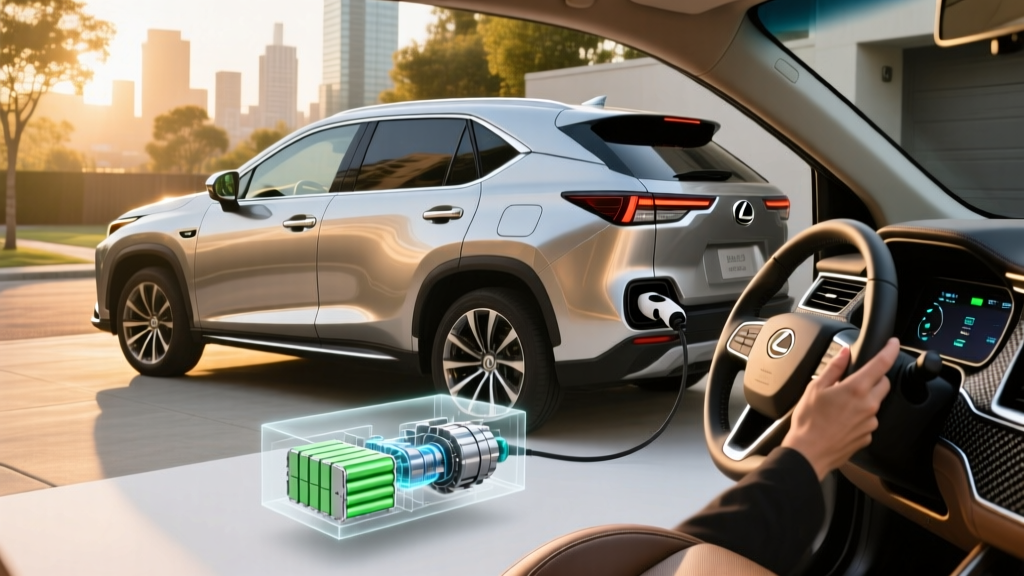
The three-row luxury SUV segment has no shortage of gas-guzzlers, but the Lexus TX plug-in hybrid — badged as the TX 550h+ — takes a distinctly different approach. It pairs a 2.4-liter turbocharged four-cylinder with a pair of electric motors and a sizable 18.1 kWh battery pack, giving you meaningful electric-only commuting range before the gas engine ever fires up. For families who want three rows, Lexus refinement, and a bridge between full electric and conventional hybrid ownership, the TX 550h+ makes a compelling case in 2026.
But does the math actually work? Below, we break down every number that matters — EPA range, real-world MPG, charging speeds, powertrain output, pricing, tax credit eligibility, and long-term battery reliability — so you can decide whether the TX PHEV fits your garage or whether a conventional hybrid or full BEV makes more sense.
Lexus TX 550h+ Core Specs at a Glance
| Spec | Value |
|---|---|
| Powertrain | 2.4L turbo I4 + 2 electric motors (DIRECT4 AWD) |
| Combined Horsepower | 366 hp / 406 lb-ft torque |
| Battery (Usable) | 18.1 kWh lithium-ion |
| EPA Electric-Only Range | 33 miles |
| EPA Combined Range (Electric + Gas) | 427 miles |
| MPGe (Electric + Gas Combined) | 64 MPGe combined |
| MPG (Gas-Only, Charge-Depleted) | 36 city / 34 highway / 35 combined |
| 0–60 mph | 6.2 seconds (est.) |
| Level 2 Charge Time (0–100%) | ~2.5 hours at 6.6 kW |
| DC Fast Charging | Not available |
| Drivetrain | DIRECT4 all-wheel drive (standard) |
| Towing Capacity | 5,000 lbs |
| Base MSRP (TX 550h+ Luxury) | $79,990 |
| Battery/Powertrain Warranty | 10 years / 150,000 miles (hybrid battery) |
HEV vs. PHEV: What the Lexus TX Lineup Actually Offers
Lexus sells the TX in three distinct powertrain flavors, and confusing them is easy if you're only scanning badges. Here's what you need to know before stepping into a dealership:
TX 350 (Gas-Only Turbo)
The TX 350 uses a 2.4L turbo four-cylinder with no electric assist. It gets around 23 MPG combined. No plug, no battery to worry about — just a conventional luxury SUV. It starts around $56,000.
TX 500h (Conventional Hybrid — HEV)
The TX 500h F Sport Performance pairs the 2.4L turbo with a hybrid system for 366 hp and roughly 27 MPG combined. You never plug it in. The battery is small (~1.5 kWh), recharges via regenerative braking and the engine, and simply improves fuel economy over the gas model. This is a traditional self-charging hybrid.
TX 550h+ (Plug-In Hybrid — PHEV)
The TX 550h+ is the plug-in variant. Its 18.1 kWh battery gives you 33 miles of pure electric driving before the gas engine engages. You plug it in at home (Level 2) or at public chargers to replenish the battery. Once the battery is depleted, it operates as a conventional hybrid at 35 MPG combined. This is the model we're reviewing here.
The key distinction: A conventional hybrid (HEV) like the TX 500h never plugs in and has no electric-only range worth mentioning. A plug-in hybrid (PHEV) like the TX 550h+ gives you a meaningful EV-mode buffer for daily commuting, then seamlessly becomes a hybrid for longer trips. If your commute is under 33 miles round-trip and you can charge at home, you may go weeks without burning fuel.
Electric-Only Range and Real-World Efficiency
The EPA rates the TX 550h+ at 33 miles of electric-only range. That number is derived from standardized testing, but your real-world experience will vary based on temperature, terrain, speed, and climate-control usage.
EPA Electric Range: 33 miles
Real-world expectations: In mild weather (60–80°F) with city/suburban driving, expect 30–35 miles. On the highway at 70+ mph, that drops to roughly 24–28 miles. In freezing winter conditions with cabin heat running, plan for 20–25 miles of electric-only range. The TX 550h+ uses a heat pump to mitigate cold-weather battery drain, which helps, but physics still applies.
Once the battery depletes, the TX 550h+ transitions to hybrid mode. The EPA rates it at 36 city / 34 highway / 35 combined MPG in charge-depleted (gas-only) operation.
| Mode | City | Highway | Combined |
|---|---|---|---|
| Electric-only (MPGe) | 64 MPGe combined | ||
| Gas-only (charge-depleted) | 36 MPG | 34 MPG | 35 MPG |
Real-World MPG vs. EPA Sticker
Hybrids — and PHEVs in hybrid mode — tend to outperform their EPA city estimates in stop-and-go traffic, where regenerative braking recaptures the most energy. Owners who drive primarily in urban environments often report 37–39 MPG in charge-depleted mode. Highway-heavy drivers should expect numbers closer to 32–34 MPG, as the turbo engine works harder at sustained speeds and the electric motors contribute less at cruise. These figures align with data published on fueleconomy.gov.
If you charge nightly and commute under 33 miles, your effective fuel consumption could be near zero on most days. The 18.6-gallon fuel tank gives a total combined range of approximately 427 miles, meaning road trips are no different from any gas-powered SUV — just stop at any station and keep going.
Charging: Speeds, Connectors, and Home Setup
The TX 550h+ charges exclusively via AC — there is no DC fast charging capability. This is typical for PHEVs in this class; the battery is small enough that Level 2 replenishment is practical overnight.
| Charging Level | Power (kW) | Time (0–100%) | Notes |
|---|---|---|---|
| Level 1 (120V household outlet) | ~1.4 kW | ~12–14 hours | Emergency/trickle only; not practical for daily use |
| Level 2 (240V home/public) | 6.6 kW | ~2.5 hours | Recommended; overnight top-up easily covers daily needs |
| DC Fast Charge | N/A | N/A | Not supported on TX 550h+ |
The TX 550h+ uses a standard J1772 connector for Level 1 and Level 2 AC charging — the universal plug for non-Tesla EVs and PHEVs in North America. If you have a Tesla Wall Connector at home, you'll need a J1772 adapter (or install a dedicated J1772 Level 2 charger). A 32-amp or 40-amp Level 2 home charger is the ideal setup and costs roughly $500–$1,200 for the unit plus $800–$2,000 for professional installation, depending on your electrical panel's proximity to the garage.
Because the battery is only 18.1 kWh, a full charge costs approximately $2.00–$3.50 depending on your local electricity rate (assuming $0.12–$0.20/kWh). That works out to roughly $0.06–$0.11 per electric mile — dramatically cheaper than the $0.18–$0.22 per mile you'd spend on premium gasoline at $4.00/gallon and 35 MPG.
Powertrain, Performance, and Driving Dynamics
The TX 550h+ powertrain is a direct relative of the TX 500h's hybrid system but with a larger battery and more electric-only capability. The 2.4-liter turbocharged inline-four produces 271 hp on its own, while the electric motor system adds substantial torque for a combined output of 366 horsepower and 406 lb-ft of torque.
Lexus's DIRECT4 all-wheel-drive system uses the rear electric motor to independently drive the rear axle, providing torque-vectoring AWD without a mechanical driveshaft. The result is confident traction in rain and light snow, with a 0–60 mph time estimated at around 6.2 seconds — brisk for a 5,000-pound three-row SUV.
Drive modes include EV (electric-only, up to ~84 mph), HV (hybrid, blending gas and electric), and Auto EV/HV (the car decides). There's also a charge mode that uses the engine to replenish the battery — useful if you want to save electric range for a zero-emission zone or a quiet neighborhood arrival. In practice, the transitions between electric and gas power are nearly imperceptible, a hallmark of Toyota/Lexus hybrid engineering refined over two decades.
Pricing, Trims, and Tax Credit Eligibility
The TX 550h+ is offered in a single well-equipped trim level for 2026:
- TX 550h+ Luxury AWD: Starting at $79,990 (including destination)
Standard equipment includes a 14-inch touchscreen with wireless Apple CarPlay/Android Auto, a 12.3-inch digital gauge cluster, heated and ventilated front seats, a panoramic glass roof, Lexus Safety System+ 3.0 (pre-collision, lane tracing, adaptive cruise, blind-spot monitoring), and a 21-speaker Mark Levinson audio system. Options are limited to premium paint colors and wheel choices, keeping the configurator simple.
Does the Lexus TX 550h+ Qualify for a Federal Tax Credit?
Under the IRS §30D Clean Vehicle Credit, plug-in hybrids with a battery capacity of at least 7 kWh can qualify for up to $7,500 — but several conditions apply that frequently disqualify luxury PHEVs:
- MSRP cap: SUVs must have an MSRP at or below $80,000. The TX 550h+ at $79,990 squeaks under this threshold, but adding dealer-installed accessories could push it over.
- Buyer income limits: AGI must not exceed $150,000 (single), $225,000 (head of household), or $300,000 (joint filers).
- Battery component sourcing: A percentage of battery components must be manufactured or assembled in North America, and critical minerals must meet sourcing thresholds. These requirements tighten annually. Verify current-year compliance on IRS.gov or at fueleconomy.gov.
- Point-of-sale transfer: As of 2024, you can transfer the credit to the dealer for an immediate price reduction at purchase rather than waiting to claim it on your tax return.
Bottom line: The TX 550h+ may qualify for a partial or full $7,500 credit depending on your income, the model year's sourcing compliance, and final transaction price. Consult a tax professional and verify on the IRS portal before committing. State-level incentives (such as California's CVRP or Colorado's innovative motor vehicle credit) may stack on top — check your state's energy office for current programs.
Battery Reliability, Warranty, and Replacement Costs
Hybrid battery longevity is the single most common concern among first-time PHEV buyers. Lexus (and parent company Toyota) has built more hybrids than any other automaker — over 25 million globally — and their track record on battery durability is strong.
Lexus Hybrid Battery Warranty: 10 years or 150,000 miles (whichever comes first), covering defects and capacity loss below a specified threshold. The broader hybrid system (inverter, motors, control modules) is also covered for 8 years / 100,000 miles.
In practice, Toyota/Lexus hybrid batteries routinely last 150,000–200,000+ miles before meaningful degradation appears. The TX 550h+'s battery management system keeps the pack within an optimal state-of-charge window (never truly full, never truly empty), which significantly extends cycle life. Unlike full BEVs that routinely charge to 100%, PHEV batteries operate in a narrower, healthier band.
If replacement is eventually needed out of warranty, expect a cost in the range of $4,000–$7,000 for a new OEM hybrid battery pack for a Lexus PHEV of this size, based on current pricing for comparable Toyota/Lexus PHEV packs (RAV4 Prime, NX 450h+). Third-party refurbished packs may be available for less as the vehicle ages. For context, most TX 550h+ owners will never need a battery replacement within the vehicle's typical ownership lifecycle.
Who Should Buy the Lexus TX Plug-In Hybrid?
Choose the TX 550h+ (PHEV) If:
- Your daily commute is under 33 miles round-trip and you can charge at home
- You want three rows but don't want a full EV for road trips
- You value silent, electric school-run and grocery trips with zero tailpipe emissions
- You live in an area with cold winters where BEV range loss is a concern
- You want Lexus reliability and a strong hybrid battery warranty
Choose the TX 500h (HEV) Instead If:
- You can't install a home charger (apartment, street parking, no garage)
- You want hybrid efficiency without the plug-in complexity or higher price
- Your budget is closer to $65,000–$70,000
Choose a Full BEV (e.g., Tesla Model X, Rivian R1S) Instead If:
- Your commute is longer and you want 250+ miles of electric range
- You want DC fast charging for road trips (20–30 min stops)
- You want to eliminate gasoline entirely and have reliable home charging
Pros and Cons
Pros
- 33 miles of electric-only range covers most daily commutes
- 35 MPG combined as a hybrid after battery depletion — excellent for a 5,000-lb three-row SUV
- DIRECT4 AWD with torque vectoring provides confident all-weather traction
- Near-silent EV mode for neighborhood driving
- Lexus Safety System+ 3.0 standard with comprehensive ADAS suite
- 10-year / 150,000-mile hybrid battery warranty
- No range anxiety — gas engine and 18.6-gal tank for road trips
Cons
- $79,990 starting price — premium even among luxury PHEVs
- No DC fast charging — long road-trip top-ups aren't possible
- 33 miles of EV range may fall short for longer commutes
- Federal tax credit eligibility depends on sourcing rules and buyer income
- Single trim level limits customization
- Heavier than gas TX 350, slightly reducing agility in corners
Frequently Asked Questions
How many MPG does the Lexus TX plug-in hybrid get?
Once the battery is depleted and the TX 550h+ operates as a conventional hybrid, the EPA rates it at 36 MPG city, 34 MPG highway, and 35 MPG combined. In electric-only mode, it achieves 64 MPGe combined. Real-world city driving in hybrid mode often yields 37–39 MPG thanks to regenerative braking.
How far can the Lexus TX 550h+ go on electric only?
The EPA rates the TX 550h+ at 33 miles of electric-only range. In mild conditions with city driving, you can expect 30–35 miles. Highway driving at 70+ mph reduces that to roughly 24–28 miles, and freezing winter temperatures may cut it to 20–25 miles. The heat pump helps, but cold weather always reduces battery efficiency.
Hybrid vs. PHEV vs. EV — which should I choose?
A conventional hybrid (HEV) like the TX 500h is best if you can't charge at home and want better MPG without plugging in. A plug-in hybrid (PHEV) like the TX 550h+ is ideal if you have home charging and a short commute, giving you electric daily driving with gas-engine backup for road trips. A full EV (BEV) makes sense if you want zero gasoline use, have reliable charging access, and want 250+ miles of range. The PHEV is the bridge option — it removes range anxiety while still letting you drive electric most days.
Is the Lexus TX hybrid reliable, and what does battery replacement cost?
Lexus and Toyota have the longest track record of any automaker with hybrid technology, and their hybrid batteries routinely last 150,000–200,000+ miles. The TX 550h+ battery is covered by a 10-year / 150,000-mile warranty. Out-of-warranty replacement for a Lexus PHEV battery pack typically costs $4,000–$7,000 for a new OEM unit, though most owners will never need one. Overall vehicle reliability is expected to be excellent based on Lexus's historical performance and IIHS safety ratings for the TX platform.
Does the Lexus TX 550h+ qualify for a federal tax credit?
It may. Under the IRS §30D Clean Vehicle Credit, the TX 550h+ can qualify for up to $7,500 if: the MSRP stays at or below the $80,000 SUV cap, your adjusted gross income falls within federal limits ($300,000 joint / $150,000 single), and the battery meets current-year critical-mineral and component-sourcing requirements. These sourcing rules tighten annually. Verify eligibility at IRS.gov and consult a tax professional before purchasing. State incentives may provide additional savings.
Can the TX 550h+ DC fast charge?
No. The TX 550h+ supports only Level 1 (120V) and Level 2 (240V) AC charging via a J1772 connector. A full Level 2 charge takes about 2.5 hours at 6.6 kW. This is standard for PHEVs — the battery is small enough that overnight Level 2 charging fully replenishes it, and DC fast charging infrastructure isn't necessary for a 33-mile electric range.
What's the difference between the TX 500h and the TX 550h+?
The TX 500h is a conventional hybrid (HEV) — it never plugs in, has no meaningful electric-only range, and gets about 27 MPG combined. The TX 550h+ is a plug-in hybrid (PHEV) with an 18.1 kWh battery, 33 miles of electric-only range, 64 MPGe, and 35 MPG combined after the battery depletes. The 550h+ costs roughly $14,000 more but offers electric commuting capability and a smoother, quieter driving experience around town.
The Lexus TX plug-in hybrid occupies a specific and practical niche: it's a three-row luxury SUV that lets most families drive on electricity during the week and hit the highway on weekends without a second thought. At nearly $80,000, it's not a budget choice, but for buyers who want Lexus build quality, the security of a gas engine, and genuine daily EV range, the TX 550h+ delivers on all three fronts with the engineering maturity that only two decades of hybrid development can provide.