Quick Verdict: A Three-Row PHEV With Real Electric Commute Range
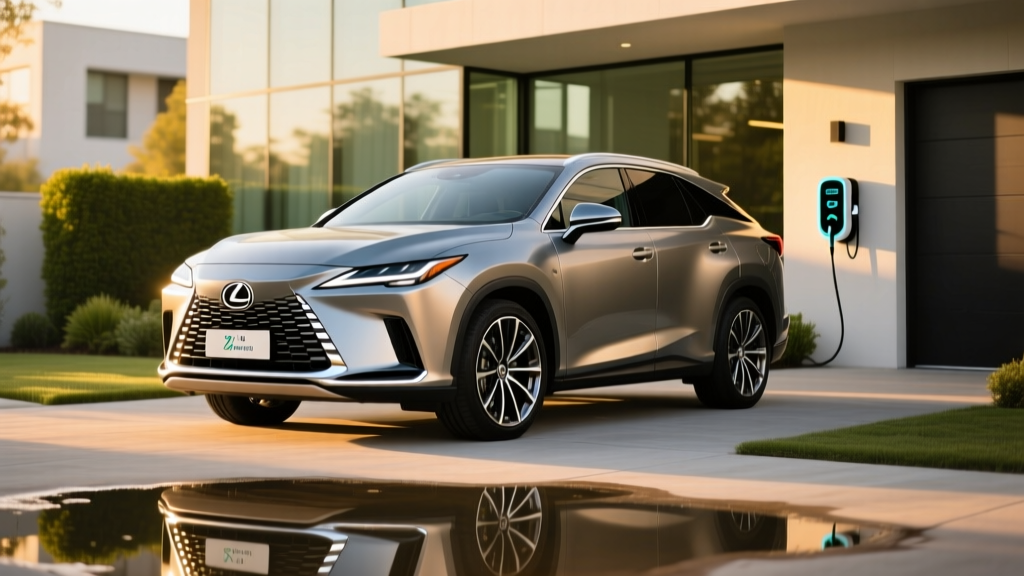
The 2026 Lexus TX 550h+ is one of the only three-row plug-in hybrids on the U.S. market, and it leverages a proven powertrain shared with the Toyota Grand Highlander Hybrid MAX. With an EPA-estimated 33 miles of electric-only range and 35 MPG combined once the battery depletes, the TX PHEV targets families who want daily electric commuting without sacrificing road-trip flexibility. It starts at $72,490 before destination, making it a premium play — but the combination of Lexus reliability, a usable electric buffer, and no range anxiety gives it a distinct niche.
This guide breaks down the TX 550h+ plug-in hybrid specifically. Lexus also sells the TX 500h as a conventional hybrid (HEV) with no plug and a different powertrain. We'll clarify the differences so you can choose the right one.
HEV vs PHEV: Which Lexus TX Is Right for You?
| Attribute | TX 500h (HEV) | TX 550h+ (PHEV) |
|---|---|---|
| Plug-in charging? | No — self-charging | Yes — plug in to access EV range |
| Electric-only range | None (EV assist only) | 33 miles EPA |
| Battery capacity | ~1.4 kWh (small buffer) | 18.1 kWh usable (20.7 kWh gross) |
| Combined horsepower | 366 hp | 406 hp |
| EPA combined MPG | 27 MPG | 35 MPG (hybrid mode) / 76 MPGe (with charge) |
| 0–60 mph | 5.9 seconds | 5.6 seconds |
| Starting MSRP | $63,390 | $72,490 |
| Drivetrain | AWD (DIRECT4) | AWD (DIRECT4, rear electric motor) |
| Federal tax credit | None | Not eligible (§30D battery sourcing) |
The TX 500h is a conventional hybrid: you never plug it in. It uses a small battery and regenerative braking to assist the gas engine, yielding 27 MPG combined. The TX 550h+ is a plug-in hybrid (PHEV): you plug it in to charge a much larger 18.1 kWh (usable) lithium-ion battery, which powers the vehicle on electricity alone for up to 33 miles before the gas engine seamlessly engages.
If your daily commute is under 30 miles round-trip and you can charge at home, the PHEV effectively becomes an EV for weekday driving while retaining a 400+ mile total range for road trips. If you can't charge at home or drive long distances daily, the HEV's simplicity may be the better value.
Range, Efficiency, and Real-World MPG
| Metric | EPA Estimate | Real-World Expectation |
|---|---|---|
| Electric-only range | 33 miles | 28–33 mi (varies with temperature, speed, terrain) |
| Combined MPGe (charge-depleting + sustaining) | 76 MPGe | Depends on how often you charge |
| Gas-only MPG (combined) | 35 MPG | 33–37 MPG (city-biased driving can exceed EPA) |
| Gas-only MPG (city) | 36 MPG | 35–38 MPG (hybrids overperform in stop-and-go) |
| Gas-only MPG (highway) | 34 MPG | 30–33 MPG (aerodynamic drag at 75+ mph reduces efficiency) |
| Total combined range | ~420 miles | 380–440 mi depending on driving mix |
| Fuel tank capacity | 14.5 gallons | — |
Once the battery is depleted, the TX 550h+ operates as a conventional hybrid. The 35 MPG combined rating is strong for a 5,000+ lb three-row SUV. In our experience with Toyota/Lexus hybrid systems, city MPG often exceeds the EPA estimate thanks to aggressive regenerative braking in stop-and-go traffic. Highway cruising at 80 mph, however, will drop you closer to 30–31 MPG — physics demands it from a vehicle this size.
Powertrain and Performance Specs
| Specification | 2026 Lexus TX 550h+ |
|---|---|
| Engine | 3.5L V6 naturally aspirated |
| Front electric motor | Integrated in transaxle |
| Rear electric motor | Dedicated rear axle motor (AWD) |
| Combined system output | 406 hp / 400 lb-ft torque |
| Transmission | e-CVT (electronically controlled) |
| 0–60 mph | 5.6 seconds |
| Drivetrain | DIRECT4 AWD |
| Towing capacity | 5,000 lbs (when properly equipped) |
| Seating capacity | 6 or 7 passengers (config dependent) |
| Cargo volume (behind 3rd row) | 20.2 cu ft |
| Cargo volume (max, all rows folded) | 97.0 cu ft |
The TX 550h+ uses Lexus's DIRECT4 all-wheel-drive system, which pairs the V6 engine with front and rear electric motors. The rear motor is key: it provides true AWD capability without a mechanical driveshaft, and it's what enables the vehicle to operate in pure electric mode with all wheels driven. The 406 combined horsepower is a meaningful bump over the 366 hp in the conventional TX 500h, and the instant electric torque gives the PHEV noticeably stronger off-the-line acceleration.
The e-CVT transmission is characteristic of Toyota/Lexus hybrids — smooth and efficient, though it lacks the stepped gear feel of a conventional automatic. Under hard acceleration, you'll hear the V6 hold a steady RPM (the "drone" familiar to Prius owners), but at cruise speeds the powertrain is whisper-quiet.
Charging: Level 1, Level 2, and DC Fast Charge Reality
| Charging Level | Power (kW) | Time (0–100%) | Notes |
|---|---|---|---|
| Level 1 (120V household outlet) | ~1.4 kW | ~13 hours | Overnight top-up only |
| Level 2 (240V, 16A) | ~3.3 kW | ~5.5 hours | Standard home charging |
| Level 2 (240V, 32A) | ~6.6 kW | ~3 hours | Faster home/public Level 2 |
| DC Fast Charging | Not supported | — | No CCS or CHAdeMO port |
The TX 550h+ charges exclusively via AC power. There is no DC fast charging capability — a deliberate engineering choice common among PHEVs with smaller batteries. With an 18.1 kWh usable pack, a Level 2 charger at 6.6 kW refills the battery in roughly 3 hours, which is practical for overnight home charging or topping up during a workday.
The onboard charger is rated at 6.6 kW maximum. If you plug into a 3.3 kW public Level 2 station (common at older ChargePoint or workplace chargers), expect a full charge to take about 5.5 hours. A standard 120V household outlet (Level 1) works in a pinch but will take over 12 hours — only useful if you drive fewer than 15 electric miles per day and can trickle-charge overnight.
The charge port uses a standard J1772 connector for AC charging, compatible with virtually every public Level 2 station in the U.S. and Canada.
Pricing, Trims, and Tax Credit Eligibility
The 2026 Lexus TX 550h+ is offered in a single Luxury trim with optional packages:
- TX 550h+ Luxury: $72,490 MSRP + $1,350 destination = $73,840
- Mark Levinson Audio Package: +$1,450
- Advanced Package (heads-up display, panoramic roof): +$2,900
- Captain's Chair Package (6-passenger): +$460
A well-equipped TX 550h+ typically stickers between $74,000 and $78,000.
The Lexus TX 550h+ does not qualify for the $7,500 federal EV tax credit under current IRS §30D rules. The primary reason is battery component and critical mineral sourcing — Toyota/Lexus PHEV batteries do not meet the North American assembly and critical mineral thresholds required for 2026 model-year vehicles.
Additionally, the $80,000 MSRP cap for SUVs applies, and a fully loaded TX 550h+ can approach that limit.
Some states offer separate PHEV incentives. California's Clean Vehicle Rebate Project (CVRP) has been restructured and may offer reduced or no rebate for PHEVs depending on current funding. Colorado, for example, has offered PHEV incentives in prior years. Always check your state's current program before purchasing, as these change frequently.
Battery Warranty, Reliability, and Long-Term Ownership
- Hybrid battery coverage: 10 years / 150,000 miles (whichever comes first)
- Hybrid system components: 8 years / 100,000 miles
- Limited vehicle warranty: 4 years / 50,000 miles
- Powertrain warranty: 6 years / 70,000 miles
The TX 550h+ benefits from Lexus's industry-leading 10-year/150,000-mile hybrid battery warranty, which covers capacity loss below a specified threshold and complete failure. This is among the best in the industry and reflects Toyota/Lexus's deep experience with hybrid battery systems spanning over 25 years since the original Prius.
Reliability expectations are high. Lexus consistently ranks at or near the top of J.D. Power Vehicle Dependability Studies, and the hybrid powertrain in the TX 550h+ shares architecture with the Toyota Grand Highlander Hybrid and Sienna — systems with proven track records. The V6 engine is naturally aspirated (no turbocharger complexity), and the e-CVT has no traditional transmission wear components.
If the hybrid battery does need replacement outside warranty — a scenario that is rare within the first 150,000 miles based on Toyota/Lexus historical data — expect a replacement cost in the range of $4,000–$7,000 including labor. This is significantly less than the $15,000–$25,000 cost of replacing a full EV's large traction battery. Third-party hybrid battery refurbishment shops also offer lower-cost options in the $2,000–$3,500 range for older vehicles.
Who Should Buy the TX 550h+ vs a Full EV or Gas SUV?
- Your daily commute is 20–35 miles round-trip and you can charge at home
- You need a three-row SUV for family duty
- You take regular road trips (4+ hours) and don't want to plan around charging stops
- You value Lexus build quality and dealer service experience
- You want electric daily driving without committing to a full EV
- You have reliable home Level 2 charging and your daily driving exceeds 33 miles
- You want to eliminate gasoline entirely and reduce maintenance (no oil changes, fewer moving parts)
- You want access to the $7,500 federal tax credit (model-dependent)
- You live in a region with robust DC fast charging infrastructure
- You cannot charge at home (apartment, street parking, no garage outlet)
- You want the lowest purchase price in the TX lineup
- Your daily driving is long-distance and you rarely drive under 35 miles between fill-ups
- You prefer zero behavior change — just fill up with gas as usual
The TX 550h+ occupies a very specific niche: families who want to drive on electricity most weekdays but need the flexibility of a gas engine for weekend trips, ski weekends, or visits to rural areas with sparse charging. If you can charge at home and your commute fits within the 33-mile electric window, you'll use very little gasoline Monday through Friday. Over a year of mixed driving, a PHEV owner who charges daily might use 40–60% less gasoline than a conventional hybrid owner.
- 33 miles of real, usable electric range covers most commutes
- 406 hp with smooth DIRECT4 AWD — confident in all weather
- 10-year/150,000-mile hybrid battery warranty
- True three-row seating with 97 cu ft max cargo
- 35 MPG combined in hybrid mode — excellent for the class
- No range anxiety on road trips
- No DC fast charging — public charging is slow
- $72,490+ starting price is steep
- Does not qualify for the $7,500 federal tax credit
- 33-mile EV range is modest vs some competitors (e.g., Chrysler Pacifica PHEV at 32 mi but lower price)
- Single Luxury trim limits configurability
- e-CVT drone under hard acceleration
Frequently Asked Questions
How many MPG does the Lexus TX 550h+ plug-in hybrid get?
The EPA rates the 2026 TX 550h+ at 36 MPG city, 34 MPG highway, and 35 MPG combined once the battery is depleted and it operates as a conventional hybrid. When factoring in electric-only driving, the combined rating is 76 MPGe. In real-world driving, expect 33–37 MPG in city-heavy conditions and 30–33 MPG at sustained highway speeds above 75 mph.
How far can the Lexus TX 550h+ go on electric only?
The EPA estimates 33 miles of electric-only range. Real-world results vary: expect 28–33 miles in mild weather with mixed driving, 22–27 miles in cold weather (below 40°F) due to cabin heating and battery resistance, and 25–28 miles at sustained highway speeds. The 18.1 kWh usable battery is the limiting factor.
Does the Lexus TX 550h+ qualify for the federal tax credit?
No. Under current IRS §30D rules, the TX 550h+ does not meet the battery component and critical mineral sourcing requirements for the $7,500 federal clean vehicle credit. Some state-level incentives may apply — check your state's energy office for current programs.
Is the Lexus TX plug-in hybrid reliable?
Lexus and Toyota have the longest track record in hybrid technology of any automaker, and the TX 550h+ uses proven hybrid architecture shared with other Toyota/Lexus models. Lexus ranks consistently at the top of long-term reliability studies. The hybrid battery carries a 10-year/150,000-mile warranty, and out-of-warranty replacement (rare within that period) is estimated at $4,000–$7,000.
Can I charge the TX 550h+ at a DC fast charger?
No. The TX 550h+ only supports AC charging (Level 1 at 120V and Level 2 at 240V via J1772 connector). There is no DC fast charge port. A full charge on a 6.6 kW Level 2 charger takes approximately 3 hours.
How does the TX 550h+ compare to a full electric SUV like the Kia EV9?
The Kia EV9 offers 279 miles of EPA range, DC fast charging up to 236 kW (10–80% in ~18 minutes), and qualifies for the $7,500 federal tax credit (depending on trim and sourcing). However, the EV9 requires access to charging infrastructure for road trips and costs $54,900–$73,900. The TX 550h+ trades electric range for unlimited gas flexibility, making it better suited for buyers who can't reliably charge on long trips or who live in areas with limited public charging.
What's the difference between kW and kWh?
kW (kilowatts) measures power — the rate at which energy flows. Think of it as the "speed" of charging. kWh (kilowatt-hours) measures energy capacity — how much the battery holds. The TX 550h+ has an 18.1 kWh battery (energy) and charges at up to 6.6 kW (power). Confusing the two is the most common EV mistake — they are not interchangeable.
Sources: EPA fuel economy data via fueleconomy.gov; IRS clean vehicle credit rules at irs.gov; manufacturer specifications from Lexus USA. Pricing and tax credit rules reflect 2026 model year and are subject to change. Consult a tax professional for credit eligibility.